Archive: Mar 2015

“Fighting for women’s equality is an arduous but necessary process, ploddingly pursued by dedicated women and men who refuse to accept a lesser role for women in society.” Jean Hardisty (1945-2015)

      March is Women’s History Month, but the history being made in the US is far from uplifting. Women continue to be an easy batting ball for political impasses. We continue to struggle for basics readily available in most other developed nations: e.g. paid family and sick leave, adequate childcarehealth and reproductive rights. As an antidote to setbacks in this country—where we seem to be in the two-steps-back phase of the old ‘three steps forward, two steps back’ adage—I’ve looked at reports released in conjunction with this month’s 59th Session of the UN Commission on the Status of Women (CSW). There are some encouraging signs. But progress is slow, uneven; the struggle for women’s rights and equality is far from over. Nevertheless, celebrating positive accomplishments can provide motivation needed to keep us all plodding ahead, no matter how soggy the road. Jean Hardisty knew better than anyone how critical plodding along is. For all of us around the country—and in various corners of the world— who knew Jean as a beloved colleague, mentor and leader in the battle for human rights and justice, there is no better way to honor her life and her work than to keep on plodding.

So, some good news gleaned from reports on progress for women since the 1995 United Nations Conference on Women in Beijing:

  • The global rate of maternal deaths in childbirth has dropped by over forty percent;
  • Adolescent births have fallen by more than thirty percent;
  • Many countries have made significant gains in girls’ education, particularly at the primary school level;
  • And people everywhere are paying more attention to gender gaps in access and opportunities on everything from health services and education to leadership, employment and earnings.

Sadly, for almost every positive statement one can make, there is a ‘but’. And some ‘buts’ are so overwhelming it seems pointless to mention the positive. For example, awareness of violence against women has grown, but the violence itself has not lessened. One third of the world’s women have experienced physical or sexual violence. It is estimated that the number girls among trafficking victims has increased by more than ten percent in the past seven years.

The Beijing meetings two decades ago were electrifying. A total of 17,000 women and men from 189 countries attended the official Fourth United Nations Conference on Women. Another 30,000 took part in the parallel NGO Forum held outside the capital in Huairou. We returned to our homes around the globe committed to doing whatever we could, both individually and collectively, to implement the Beijing Platform for Action. Many of those unable to attend the meetings in China were eager partners. In country after country, women and men worked together to ensure the ‘full and equal participation of women in political, civil, economic, social and cultural life.’

But the transformative promise of the Beijing Platform for Action has not yet been fulfilled. The Platform was a call for a change in focus from women to gender. A call for recognizing that the structure of society and relationships between women and men must be rethought if women are to be fully empowered as equal partners with men. The Platform affirmed that women’s rights are human rights, that gender equality benefits everyone. In retrospect these called for changes in thinking and action were exceedingly ambitious given the ten-year time frame originally stated. Even after twenty years we have not succeeded. But ambitious goals generate ambitious plans, and ambitious plans are required to sustain commitment, passion, and determined action.

As the Women’s Rights Caucus stated last week in response to the draft declaration from CSW: “At a time when urgent action is needed to fully realize gender equality, the human rights and empowerment of women and girls, we need renewed commitment, a heightened level of ambition, real resources, and accountability.” Some UN member states may not share this perspective. Nations that do must speak loudly. Within a few days over seven hundred and fifty organizations had signed the caucus statement. NGOs representing women from all parts of the world and all strata of society must push, and push hard to ensure that the spirit as well as the letter of the Beijing Platform is carried forward.

None of this work is easy. Much of it is unpopular in certain circles. But we have pushed and plodded our way this far. A forty percent decline in maternal morbidity is a major step forward. The progress in access to primary education for girls is impressive. Many more huge steps await. We have done it before; we can do it again. And again, and again, and again!

 

Girl w/ Pen is excited to present this guest post from Laurel Wider, a psychotherapist with a speciality in gender, relationships and identity.  She’s also a mom and Founder of Wonder Crew, a new line of toys that brings connection and kindness into boys’ play.   

Play is how children learn, which means toys have the power to create change. As I began to pay more attention to toys marketed to boys, it occurred to me that so many of them emphasized muscles and aggression and NONE offered a play experience that encouraged connection or even friendship.  Thrilled by the surge of toys that encourage  STEM and positive body images for girls, I want to help expand the way boys see themselves and the world around them.

I’m a mom, psychotherapist and now founder of Wonder Crew, a line of dolls that bring connection and feelings into boys’ play.  In my therapy practice, I’ve worked with several boys and men who have painfully grappled with impossible stereotypes of masculinity. Boys are raised to prioritize toughness and self-reliance – in my work with clients I’ve seen this lead to isolation, depression and sometimes aggression.

And then about a year ago, my son came home from preschool with the idea that “boys aren’t supposed to cry.”  I was floored that my own son had gotten a hold of this message. These stereotypes impact and harm everyone.  This is how I ended up a toy inventor.

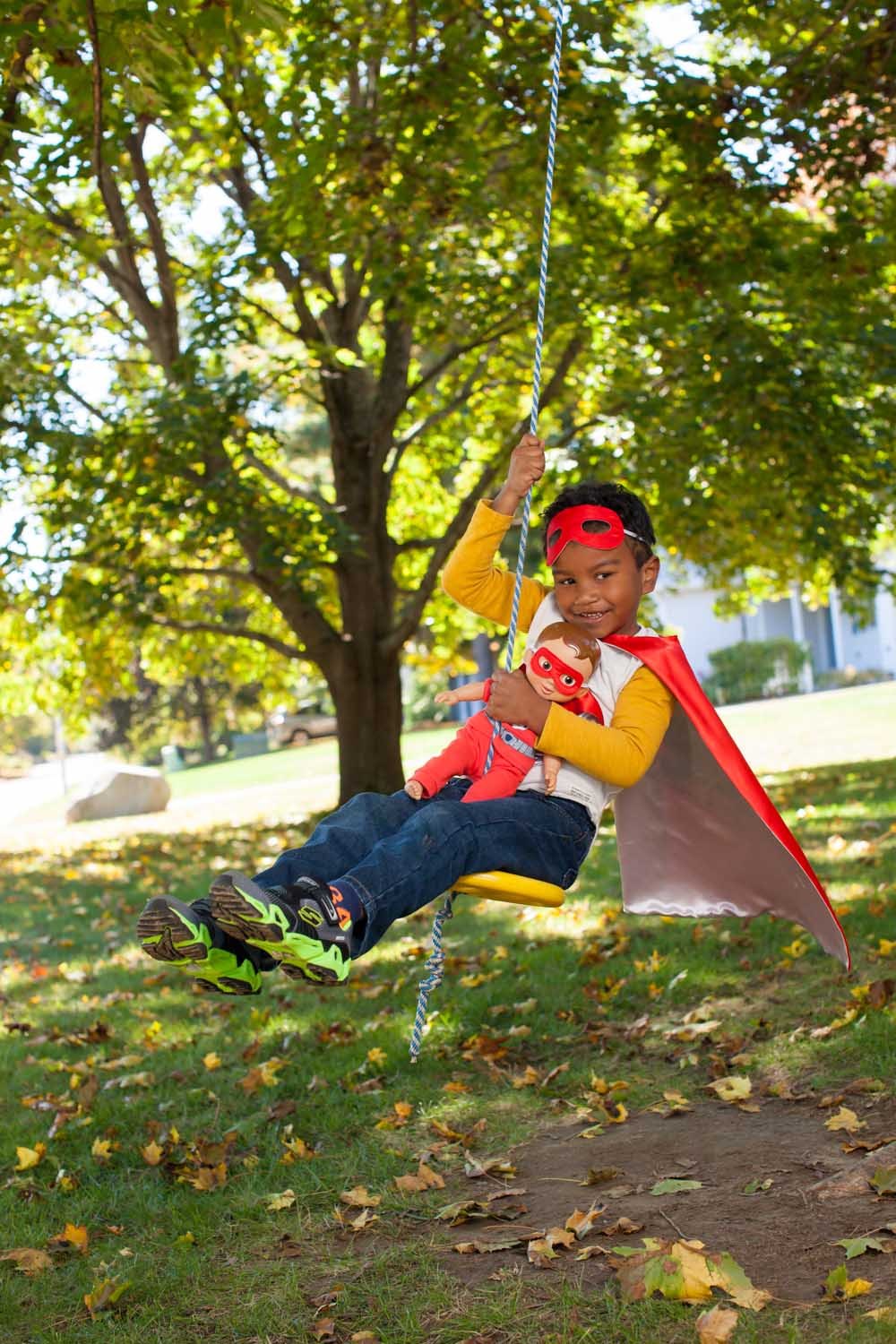
questionphotoChange is generally something that happens gradually. With this in mind, I thought long and hard about how to create a “hybrid” toy, one that still resembled familiar play scenarios for boys, but also offered the opportunity to connect and nurture.  So I came up with action figure meets favorite stuffed animal.  This morphed into Wonder Crew:  a line of Crewmates (aka dolls) that come with a matching piece of adventure gear (dress-up) plus mini open-ended comic book.  The formula:  Child + Crewmate = Wonder Crew.

Right now we have one Crewmate, his name is Will and he comes in three adventures with a fourth in the 4_crewmates (1)pipeline:  Superhero, Rockstar, Builder and Chef.  These adventures were based on interviews with over 150 parents, educators and kids that spoke to me about play that they’ve observed/ kids’ favorite play scenarios.

At first I thought that these adventures were too stereotypical, but I’ve come to realize that it’s important to show that nurturing fits in with all kinds of play, even the kind that’s stereotypically masculine.  And really the big picture idea is that anyone can be a connected, empathetic, nurturing person.

group2bestfavorites_webready-43Wonder Crew is all about friendship and adventure and clearly this is not just a boy thing!  I plan to incorporate a girl Crewmate, while keeping with the same adventures. This would have been my preferred doll growing up.

While inspired by boys, Wonder Crew will be an interest-based brand, not gender based.  And the plan is for Crewmates to represent all kids (race, gender, ability).

Wonder Crew’s Kickstarter launched last week. We’re already over 40% funded, but we’ve got a ways to go. IMG_5037Please check it out and help spread the word!  It’s our goal to not only fund first production, but also to show public interest.  A large toy company told me that dolls for boys will never work; help Wonder Crew enlighten them!

Screen shot 2015-03-10 at 11.59.22 AMTwo new books have recently come onto my radar, both too good not to share.

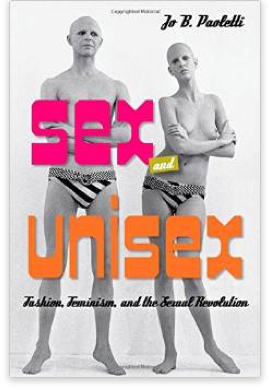
The first is by Jo Paoletti, Associate Professor of American Studies at University of Maryland, and is titled Sex and Unisex: Fashion, Feminism, and the Sexual Revolution. I’ve been a fan of Jo’s since reading (and rereading) her previous and excellent book, Pink and Blue: Telling the Boys from the Girls in America. Here’s more about her new one, published by Indiana University Press, and now available:

Notorious as much for its fashion as for its music, the 1960s and 1970s produced provocative fashion trends that reflected the rising wave of gender politics and the sexual revolution. In an era when gender stereotypes were questioned and dismantled, and when the feminist and gay rights movements were gaining momentum and a voice, the fashion industry responded in kind. Designers from Paris to Hollywood imagined a future of equality and androgyny. The unisex movement affected all ages, with adult fashions trickling down to school-aged children and clothing for infants. Between 1965 and 1975, girls and women began wearing pants to school; boys enjoyed a brief “peacock revolution,” sporting bold colors and patterns; and legal battles were fought over hair style and length. However, with the advent of Diane Von Furstenberg’s wrap dress and the launch of Victoria’s Secret, by the mid-1980s, unisex styles were nearly completely abandoned. Jo B. Paoletti traces the trajectory of unisex fashion against the backdrop of the popular issues of the day—from contraception access to girls’ participation in sports. Combing mass-market catalogs, newspaper and magazine articles, cartoons, and trade publications for signs of the fashion debates, Paoletti provides a multigenerational study of the “white space” between (or beyond) masculine and feminine.

You can read more about Jo’s work on “gender mystique” at her website, www.pinkisforboys.com.

The second is an anthology edited by my pal and former Girl w/Pen blogger Shira Tarrant, Associate Professor of Women’s, Gender, and Sexuality Studies at California State University, Long Beach.  Gender, Sex, and Politics: In the Streets and Between the Sheets in the 21st Century (Routledge July 2015) isn’t available yet, but you can sign up here on Amazon to get notified when it is. Here’s a descript:

Gender, Sex, and Politics: In the Streets and Between the Sheets in the 21st Century includes twenty-seven chapters organized into five sections: Gender, Sexuality and Social Control; Pornography; Sex and Social Media; Dating, Desire, and the Politics of Hooking Up; and Issues in Sexual Pleasure and Safety. This anthology presents these topics using a point-counterpoint-different point framework. Its arguments and perspectives do not pit writers against each other in a binary pro/con debate format. Instead, a variety of views are juxtaposed to encourage critical thinking and robust conversation. This framework enables readers to assess the strengths and shortcomings of conflicting ideas. The chapters are organized in a way that will challenge cherished beliefs and hone both academic and personal insight. Gender, Sex, and Politics is ideal for sparking debates in intro to women’s and gender studies, sexuality, and gender courses.

 Happy reading, Penners!

I invite you to join my Facebook  community, pin with me on Pinterest at Tots in Genderland, follow @girlmeetsvoice, and subscribe to my quarterly newsletter to keep posted on coaching, workshops, writings, and talks.

Not surprisingly, the new interactive chart Gendered Language in Teacher Reviews, drawn from RateMyProfessor.com (produced by Ben Schmidt—a history professor at Northeastern), has been the subject of a lot of conversation among sociologists, especially those of us who study gender. For example, it reminded C.J. of an ongoing conversation she and a former Colorado College colleague repeatedly had about teaching evaluations. Comparing his evaluations to C.J.’s, he noted that students would criticize C.J. for the same teaching practices and behaviors that seemed to earn him praise: being tough, while caring about learning.

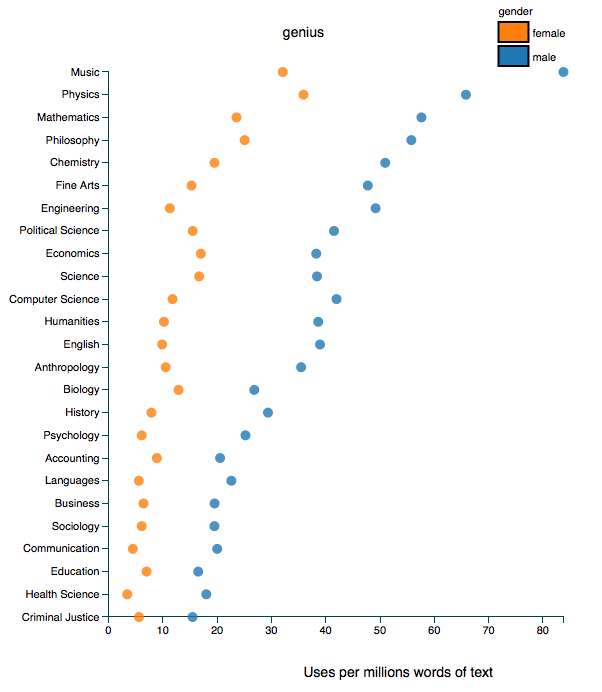
Ratemyprofessor "genius"We’ve long known that student evaluations of teaching are biased. A recent experiment made headlines when Adam Driscoll and Andrea Hunt found that professors teaching online received dramatically different evaluation scores depending upon whether students thought the professor was a man or a woman; students rated male-identified instructors significantly higher than female identified instructors, regardless of the instructor’s actual gender. Schmidt’s interactive chart provides a bit more information about exactly what students are saying when evaluating their professors in gendered ways. Thus far, most commentaries have focused on the fact that men are more likely to be seen as “geniuses,” “brilliant,” and “funny,” while women, as C.J. discovered, are more likely to be seen as “bossy,” “mean,” “pushy.” These discrepancies are important, but in this post, we’ve used the tool to shed light on some forms of gendered workplace inequality that have received less attention: (1) comments concerning physical appearance, (2) comments related to messiness and organization, and (3) comments related to emotional (as opposed to intellectual) work performed by professors.

Physical Appearance

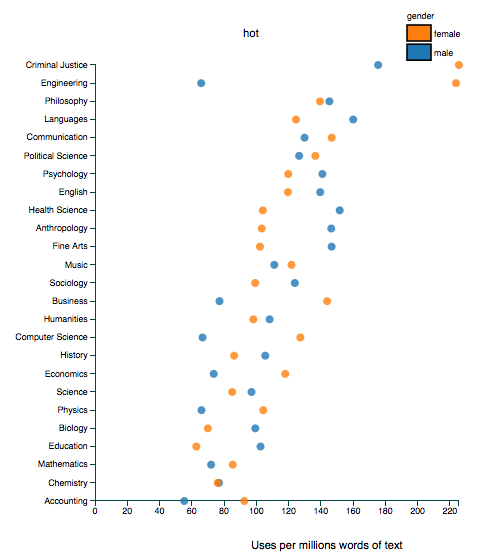
The results from Schmidt’s chart are not universally “bad” or “worse” for women. For instance, the results for students referring to professors as “hot” and “attractive” are actually mixed. Further, in some fields of study, women are more likely to receive “positive” appearance-based evaluations while, in other fields, men are more likely to receive these evaluations. A closer examination, however, reveals an interesting pattern. Here is a list of the fields in which women are more likely to be referred to as “hot” or “attractive”: Criminal Justice, Engineering, Political Science, Business, Computer Science, Physics, Economics, and Accounting. And here is a list of fields in which men are more likely to receive these evaluations: Philosophy, English, Anthropology, Fine Arts, Languages, and Sociology.

Ratemyprofessor "hot"Notice anything suspicious? Men are sexualized when they teach in fields culturally associated with “femininity” and women are sexualized when they teach in fields culturally associated with “masculinity.” Part of this is certainly due to gender segregation in fields of study. There are simply more men in engineering and physics courses. Assuming most students are heterosexual, women teaching in these fields might be more likely to be objectified. Similarly, men teaching in female-dominated fields have a higher likelihood of being evaluated as “hot” because there are more women there to evaluate them. (For more on this, see Philip Cohen’s breakdown of gender segregation in college majors.)

Nonetheless, it is important to note that sexual objectification works differently when it’s aimed at men versus women. Women, but not men, are systematically sexualized in ways that work to symbolically undermine their authority. (This is why “mothers,” “mature,” “boss,” and “teacher” are among men’s top category searches on many online pornography sites.) And, women are more harshly criticized for failing to meet normative appearance expectations. Schmidt’s chart lends support to this interpretation as women professors are also almost universally more likely to be referred to as “ugly,” “hideous,” and “nasty.”

Level of (Dis)Organization

Christin and Kjerstin are beginning a new research project designed to evaluate whether students assess disorganized or “absent-minded” professors (e.g., messy offices, chalk on their clothing, disheveled appearances) differently depending on gender. Schmidt’s interactive chart foreshadows what they might find. Consider the following: women are more likely to be described as “unprepared,” “late,” and “scattered.” These are characteristics we teach little girls to avoid, while urging them to be prepared, organized, and neat. (Case in point: Karin Martin’s research on gender and bodies in preschool shows that boys’ bodies are less disciplined than girls’.) In short, we hold men and women to different organizational and self-presentation standards. Consequently, women, but not men, are held accountable when they are perceived to be unprepared or messy. Emphasizing this greater scrutiny of women’s organization and professionalism is the finding that women are more likely than men to be described as eitherprofessionalorunprofessional,” and eitherorganizedordisorganized.”

Emotional Labor

Finally, emotional (rather than intellectual) terms are used more often in women’s evaluations than men’s. Whether mean, kind, caring or rude, students are more likely to comment on these qualities when women are the ones doing the teaching. When women professors receive praise for being “caring,” “compassionate,” “nice,” and “understanding,” this is also a not-so-subtle way of telling them that they should exhibit these qualities. Thus, men may receive fewer comments related to this type of emotion work because students do not expect them to be doing it in the first place. But this emotional work isn’t just “more” work, it’s impossible work because of the competence/likeability tradeoff women face.

There are all sorts of things that are left out of this quick and dirty analysis (race, class, course topic, type of institution, etc.), but it does suggest we begin to question the ways teaching evaluations may systematically advantage some over others. Moreover, if certain groups—for instance, women and scholars of color (and female scholars of color)—are more likely to be in jobs at which teaching evaluations matter more for tenure and promotion, then unfair and biased evaluations may exacerbate inequality within the academy.