
Archive: Mar 2010

I recently blogged about hooking up at the newly launched Ms. Magazine Blog. I end the piece by saying that when it comes to sex:

Reducing sexual harms like assault, coercion, and slut shaming means maximizing sexual pleasure. Let’s kick forced power disparities and nonconsensual objectification out of our everyday lives in the bed and beyond. That’s when the girls will really go wild. On our own terms.

Writer-artist Karen Henninger wrote me to say she’d love to share some insights, experiences, and history about hooking up. It seems Karen and I don’t quite see eye to eye on the issue of casual sex among consenting adults. So, in keeping with the theme, I thought it would be cool to — yes — hook-up across blogs to keep the conversation lively. With that, I introduce our Girl W/Pen guest blogger who writes the following:

Are you aware that the Women’s Movement at the turn of the 20th century started with the idea of Free Love?

Free Love goes beyond “sex without commitment.” In the late-1800s the issue included marriage, women’s lives, and freedom from government control. Since the 1950s, especially, there has been success moving toward free love rather than forced love. But we won’t even know what is possible until we are given political freedom to live as we choose when it comes to sexuality and love.

I am for Free Love and Free Sexuality but this requires treating people without harm. I watch others go down the same old patriarchal road in their relationships over and over while I scratch my head thinking, Wow, there’s another way that is so much better for everyone.

No only is love free, but it is abundant. Love can’t really exist if it isn’t free. What makes hooking up harmful is the way it is done. The same goes for marriage and everything in between. Harm comes from the abuse of power and control. Love is simply freedom from harm. Yet harm is so entrenched in our everyday lives that we see it as normal. And then activism becomes necessary to experience something different.

Karen Henninger is a visionary visual artist, writer, and independent scholar. She holds a degree in Letters, Arts and Sciences from Penn State University and a Related Arts degree with concentrations in English and Women’s Studies from Kutztown University.

One of my  favorite new websites is www.sweetonbooks.com.  Founded, written, and edited by two book-loving moms who live in my hometown of Larchmont, New York, Sweet On Books offers children’s book recommendations for kids at all literacy levels, from picture books and short chapter readers to novels for middle-schoolers and beyond.  This appealing, user-friendly website is ideal for anyone on the lookout for top-notch children’s lit:  parents and kids obviously, but also teachers, librarians, grandparents, relatives, and friends.

As described by co-founders Melissa Young and Melissa Gaynor, the website guides visitors through an annotated “virtual bookstore” showcasing books that might not be on a reader’s immediate radar or that they might not pick up on their own. The editors write all of the entries themselves, and they add new content every week.  While it’s hardly a comprehensive database, their lively reviews embody the principle of quality over quantity.  Beyond plot summary, each review offers an overall sense of the book’s quality and tone, and points out issues that could potentially arouse fear or anxiety in young readers. On a lighter note, each book is ranked on a “laugh meter” ranging from “not a comedy” to “giggles” to “can’t stop laughing.”

The site is especially remarkable because it refuses to trade in the all-too-prevalent gender stereotypes that dominate children’s book publishing today.  When designing the site, Ms. Young and Ms. Gaynor chose a palette of light blue, chocolate brown, and burnt orange—and selected “gender-neutral” icons and images that would appeal to readers of both sexes. “We definitely wanted to avoid being perceived as a ‘girly site’ or a site that only boys or only girls would want to visit,” explains Ms. Young.  Occasionally, a review might mention a book’s potential appeal to “reluctant boy readers,” but in its basic structure, the site does not presume that readers for particular books will divide neatly along male-female lines.  (Ms. Young’s own kids, perhaps, have encouraged her to disregard conventional marketing wisdom.  In her household, 8-year-old Hannah has devoured all the books in the Diary of a Wimpy Kid series, while 4-year-old Sam can’t get enough of Fancy Nancy.)

In conversations with fellow parents and teachers, they discovered that many elementary-school kids seldom discriminate between “boy books” and “girl books,” and are “equally happy to read from both ends of the spectrum.”  As Ms. Gaynor elaborated, “We try to recommend books that don’t follow typical stereotypes often found in children’s literature:  for example, books that have strong, positive relationships between boys and girls (Melonhead); non-traditional roles for boys and girls (Falling for Rapunzel, Keeping Score); and books with a main character that will appeal to both sexes (Tales of a Fourth Grade Nothing).”

Of course, one website alone can’t change the gendered face of children’s publishing, but for now I’m pleased to report on a cultural space in which sex distinctions aren’t being mined, magnified, and marketed to sell things to kids.  On my own parenting “smile meter,” that scores a big grin indeed.

Here’s what I had to say in today’s Philadelphia Inquirer:

I confess: I dread this time of year. It might sound strange coming from the executive director of the National Women’s Studies Association, but Women’s History Month reminds me of our education system’s failures.

I hope you’ll read the full op-ed, and especially my ideas for solutions, and let me know your hopes for this time next year.

Attention all GwPenners with a book idea: I strongly encourage you to take the She Writes webinar with Christina Baker Kline this Wednesday!

Christina is an experienced book proposal consultant to both nonfiction and fiction writers, and every one of the 22 book proposals she has written or edited has sold to a major publisher. I’ve become a huge fan of her blog, A Writing Life: Notes on Craft and the Creative Process. You can learn more about her consulting services here.  Details about her webinar:

Write a Nonfiction Book Proposal that SELLS Wed, Mar 31, 1-2 p.m. Eastern Daylight Time
Do you have a great idea for a book, but no idea how to pitch it to agents and publishers? Or have you written a book proposal that isn’t selling? In this marketplace, it’s not enough to have a great idea for a book. You must create a flawless book proposal to sell it. But the skills and knowledge it takes to write a great book proposal aren’t always the same ones it takes to write a great book. You must be able to sell you idea, and yourself, assertively and persuasively. You must convince a publisher that not only is your idea a brilliant one, but that you—and only you!—can write this book.

In Christina’s webinar, you’ll gain the tools you need to write a book proposal that sells, including:

• the essential elements of every successful book proposal
• how to craft an attention-getting query letter
• the most effective ways to differentiate yourself from similar projects
• the bells and whistles to avoid
• how to write a persuasive three-to-five page pitch
• the 10 things you can do to make your proposal stand out

Register for the live event or order the download here.

(You can also check out Kamy’s interview with Christina on She Writes Radio right here).

Wishing everyone a year of true freedom, however you define it!

My own little “Exodus” story of going through divorce and infertility and coming out the other side inspired my dear friend the talented filmmaker Ilana Trachtman (of Praying with Lior fame) to make a little movie as part of the Projecting Freedom Project, sponsored by the Skirball Foundation. For this project, different filmmakers were commissioned to do a cinematic interpretation of a specific aspect of the Hagaddah. Here are Ilana’s, below (starring Marco, Anya, and Teo!)

Rachatza:

Nirtza:

Alas, it was snowed out last month… but it has been rescheduled for this Wednesday, March 31 at the CUNY Graduate Center. This time around, I’ll be talking about mothering across borders in a couple of recent films in addition to interviewing writer Amy Sohn. Other participants include Meena Alexander, Leah Souffrant, Stephanie Cleveland and others, in addition to organizers Pamela Stone and Nicole Cooley, who edited the Mother issue of Women’s Studies Quarterly.

Check out the program here.

We’ve got a diversity initiative on campus currently, and so I’ve been thinking a lot about “affirmative action for white guys.” You start to notice it when bits of bad behavior that come from some people are tolerated more than bits of bad behavior that come from others. A colleague has coined the phrase “gentle sexism.” But some of the bad behavior isn’t as gentle as shirking your duties or exerting a kind of “oopsie, look what I did” male privilege. Yet a look at some darker forms of it can put our irritation about lighter forms of it into perspective.

The Milwaukee/Vatican case is the most recent of escalating revelations of what affirmative action for white guys looks like. We learned this week that the Vatican and Joseph Ratzinger (now Pope Benedict XVI) suppressed prosecution of a priest, Lawrence Murphy, in a case where “as many as 200 deaf students had accused him of molesting them, including in the confessional, while he ran” a school for deaf children (as described by the Associated Press). Oi vey.

The news coverage explains how, despite efforts to prosecute Murphy, the Vatican office in charge of this mess–headed at the time by Ratzinger–“axed” it. By the time the investigation finally came around, the Vatican was convinced, Murphy was old, ailing, and only wanted to live out the rest of his life in the “dignity of the priesthood.” Christian compassion prevailed—by which I mean compassion for Murphy.

Though the actions of the “victimizers” in the church cases are heinous, and appear with the accumulation of evidence to be endemic (see the documentary Holy Watergate [2005] for one of many accounts; and see Andrew Sullivan on the distinction between “sin” and “crime”), I wonder what makes the tolerance of this possible?

But here’s the deal: I don’t think it is exceptional. I think tolerance of these outrageous sex abuse cases is on a continuum of a practice of affirmative action for white guys. The Vatican’s forgiveness in case after case, in the interest of “human dignity,” doesn’t extend to a whole host of people, like women or gays or people who are pro-choice or whatever. Church leaders find that it feels okay, passes muster within their community of other white guys, to engage in affirmative action for white guys. It feels comfortable. It makes sense.

There are lots more examples, small and large. The Vatican’s actions remind me of the wild tolerance we have had for the current financial meltdown, really our financial “scandal.” It feels okay to give the boys on Wall Street a pass (there are girls on Wall Street too! I know!)–they are “elite for a reason”—and other elites understand this. Even though they got it wrong, they have something special, and they couldn’t be dishonest because they are one of us.

So the thing that unites the sex abuse scandal in the Catholic Church and the financial scandal in Wall Street is the way that bad behavior from some is tolerated. There is continuity between the logic of the “dignity” that Joseph Ratzinger wanted to grant Murphy, and the logic used by Tim Geithner when he made decisions and promoted policies as if bankers would never be “too greedy” or unlawful. Here’s the thing that blows my mind: the hallmark of affirmative action for white guys isn’t just giving extra consideration for a protected class for the same behavior as others. It is about giving them the benefit of the doubt and assuming the best even with clear and convincing evidence of the worst.

Lighter forms of this–every day gentle sexism, for example–are worth being more wary of than we typically are. That irritation is for good cause.

-Virginia Rutter

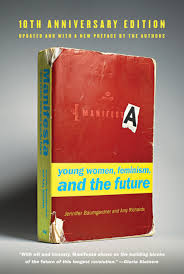
Jennifer Baumgardner and Amy Richards’ ManifestA turns 10, and an anniversary edition has just been released from Farrar, Straus, and Giroux.  For a great retrospective, see Courtney Martin’s piece this week at The American Prospect, “A Manifesta Revisited.” And Happy 10th, Amy and Jen!

A dear friend and colleague is currently seeking an intern for a project that is very up Girl w/Pen’s alley.   The position would be great for a young woman (a student or recent grad) with amazing research, writing and tech skills who is looking for some cool work experience.  The person should be NY based and the job starts asap.  Here are the deets, with a contact email at the end.  Thanks for passing it on!

The Silverleaf Foundation

The Silverleaf Foundation (the “Foundation”) is a private grantmaker focused on women’s issues, education, local communities in New York and Connecticut, and health issues.

Research Associate Position

Location: New York, NY

This position with the Silverleaf Foundation is a full-time paid Research Associate role. Work will involve developing a “map” of the women’s movement by tracking the issues, organizations, and money targeted to women and girls. In addition, the Research Associate will research information associated with building a “business case for women”. The Research Associate will regularly accompany the President and other associated members of the Foundation to various meetings and participate in conference calls with researchers and leaders of the women’s movement to discuss the work and articulate findings. After each meeting, the Research Associate will be responsible for incorporating changes into the main document and addressing any necessary follow-up items and research. Compensation will be negotiated based on the Research Associate’s experience and the length of the engagement.

Required Skills

Strong fluency in Microsoft Office (Word, Excel, PowerPoint essential)

Strong Internet research and organizational skills and willingness to independently follow leads an

explore issues in greater depth

Excellent attention to detail

Interpersonal skills

Superior writing skills

General knowledge of and interest in the women’s movement

Reliable and organized

Strong work ethic and ability to initiate/self-starter

Application

Research Associates are selected on a rolling basis.

Applicants should email a resume to WomensFundingMovement@gmail.com, and thereafter an interview will be scheduled.

Three cheers for health care reform. It isn’t enough, but it is more than we’ve had. And in case you were wondering just how bad we’ve had it lately, I submit to you this graphic reminder. The Center for Economic and Policy Research’s Hye-Jin Rho and John Schmitt analyzed national data for Health Insurance Coverage Rates for US Workers, 1979-2008.

Their report shows that US workers’ rate of health insurance coverage declined by 10 percent over the past 30 years (ahem, just as women’s share of the workforce has been increasing) and low wage workers (with higher concentrations of women workers) have been losing more than anyone else: The rate of low wage workers with no health insurance has more than doubled to 37 percent in 2008.

And that’s a pretty graphic reminder.

Virginia Rutter