Archive: Jul 2009

Check out the National Council for Research on Women’s latest forum. Writes Linda Basch in the introductory post:

Last Sunday marked the 15th annual observance of National Parents’ Day, a holiday established to “uplift ideal parental role models.” Originally introduced into Congress by Senator Trent Lott, in 1994, then-President Bill Clinton formally established the fourth Sunday of July as National Parents’ Day. Generally, this holiday is used to promote the image of two-parent, “traditional” families.

We at the Council, however, find this model to be limited and out-of-touch with reality and we want to reclaim National Parents’ Day by celebrating the diversity of families we have today in the United States and recognizing the urgency of building stronger safety nets for all families.

Contributions include:
Rebecca Spicuglia (of recent TODAY SHOW fame!) on non-custodial parents
Amanda Harris on LGBTQ families
Julie Zellinger (of the FBomb) on lessons from a Jewish feminist family
Amy Sueyoshi on receognizing caregivers
The Alternatives to Marriage Project on traditional families as a myth

And, yes, also moi, on my seemingly favorite topic these days, pregnant in a recession.

A new book has caught my eye, covering some of my favorite themes: Gender Equality: Transforming Family Divisions of Labor (The Real Utopias Project), by Janet Gornick and Marcia Meyers et al.

In a nutshell, the book proposes a set of policies-paid family leave provisions, working time regulations, and early childhood education and care-designed to foster more egalitarian family divisions of labor by strengthening men’s ties at home and women’s attachment to paid work. Its policy proposal is followed by a series of commentaries–both critical and supportive–from a group of distinguished scholars, and a concluding essay in which Gornick and Meyers respond to the debate over how best to promote egalitarian policies.

Contributors include heavy hitters like Barbara Bergmann, Johanna Brenner, Harry Brighouse & Erik Olin Wright, Scott Coltrane, Rosemary Crompton, Myra Marx Ferree, Nancy Folbre, Heidi Hartmann & Vicky Lovell, Shireen Hassim, Lane Kenworthy, Cameron Macdonald, Peter McDonald, Ruth Milkman, Kimberly Morgan, Ann Orloff, Michael Shalev, and Kathrin Zippel.

(Thanks to CCF for the heads up!)

The answers (or at least, the beginnings), right here.

SHE WRITES is offering our first webinar — on this very subject — on August 13, 1-2pm ET, which will also be available as a download after the live event. Details on how to register posted over there soon!

After six decades Jimmy Carter has left the Southern Baptist Convention in protest of the leadership’s continued insistence on the subservience of women. Carter explains his decision:

It was, however, an unavoidable decision when the convention’s leaders, quoting a few carefully selected Bible verses and claiming that Eve was created second to Adam and was responsible for original sin, ordained that women must be “subservient” to their husbands and prohibited from serving as deacons, pastors or chaplains in the military service.

Read his article. This good man of deep faith denotes that such discrimination also appears in many other faiths, and has consequences for women’s leadership opportunities, but also for women’s control over our own bodies.

He goes on, blessedly (!), to link (some people’s) Bible-culture of discrimination to the secular culture of discrimination:

The same discriminatory thinking lies behind the continuing gender gap in pay and why there are still so few women in office in the West. The root of this prejudice lies deep in our histories, but its impact is felt every day. It is not women and girls alone who suffer. It damages all of us. The evidence shows that investing in women and girls delivers major benefits for society. An educated woman has healthier children. She is more likely to send them to school. She earns more and invests what she earns in her family.

Amen. (And thanks Ann Austin!)

(For another principled examination of the role of religion in a different form of discrimination, make sure you check out For the Bible Tells Me So,  a documentary about gays, lesbians and Christianity; it includes the story of another southern gentleman, Episcopal Bishop V. Gene Robinson, and his faithful work for equality.)

-Virginia Rutter

Hello again, Girl w/Pen readers! I’ve been in hibernation finishing up my book Girls’ Studies, which will be published by Seal Press this fall. It’s been a long, intense project, and I look forward to being in more regular rotation here.

It’s not exactly an uplifting way to come back to the blog, but since I’ve spent so much time thinking about girls, I’ve been particularly haunted by this story that I read in the LA Times this past Friday. An 8-year-old girl in Phoenix, Arizona was lured into an empty shed by four boys and brutally raped. Her screams prompted someone to call the police, and all the boys were caught, with the oldest, 14, charged as an adult. The other three (ages 9, 10, and 13) will be charged with sexual assault, with the 10 and 13-year-old additionally charged with kidnapping. Sadly, my research this past year has confirmed how common sexual assault for girls still is, and I wish her case seemed the exception.

What caused this report to turn into international news, however, is the girl’s father’s reaction: the decision to shun his daughter and tell authorities that she was no longer welcome home. According to the LA Times, “The father told the case worker and an officer in her presence that he didn’t want her back,” Phoenix Police Sgt. Andy Hill said. “He said, ‘Take her, I don’t want her.’ ” All five children are cited as being “refugees from the West African nation of Liberia,” and further commentary in the article links the father’s reaction to cultural rejection of a girl or woman who has been raped or dishonored. Tony Weedor, a Liberian refugee from Littleton, Colo., and co-founder of the CenterPoint International Foundation, (which helps Liberians resettle in the U.S.) is cited as saying, “It’s a shame-based culture, so the crime is not as important as protecting the family name and the name of the community.”

The story is heartbreaking not only for the ordeal this girl endured but her position as a victim now blamed. Her path to recovery, at the age of 8, seems long. The story caused me to recall Eve Ensler’s incredible work with rape survivers in the Congo and how often the women she interviewed expressed amazement that their plight was worthy of attention, their bodies and souls deserving of aid. Ensler has spoken out about how often rape is a military assault implemented through the bodies of women and the devastation of women who are then considered devalued within their society.

While not the same, the idea that the family’s patriarch could cast this girl out is shocking – against the backdrop of America where girls and women clearly have rights, even if they aren’t always rigorously enforced. This girl seems caught at an interstice between two cultures – there has been an American outcry against her father’s comments, and yet murmurs in web reaction that pulling a young girl, recently emigrated, from her nuclear family and into the foster care system, could also be hazardous to her well being and recovery. As well, there has been outcry about the depiction of the Liberian family and the boys as crude or savage and in need of paternalistic American protection. There have also been subsequent reports in which the girl’s father has been portrayed as “confused” by American authority or his English simply not good enough to fully comprehend the situation. In this piece he is cited as recanting, although the girl’s sister reinforces the idea that the girl shouldn’t have followed the boys, and is stirring up trouble when they are all of the same nationality.

Liberian president Ellen Johnson Sirleaf has responded urging the girl’s family to help her as well as suggesting the alleged attackers are also offered counseling by the US authorities. She acknowledges, “Let me say very clearly that rape is a problem in Liberia also. There is a strong law regarding that.” Tony Weedor is again cited as noting that “rape was not against the law in Liberia until 2006. Pamela Scully, a professor of women’s studies and African studies at Emory University in Atlanta is quoted in this report as saying, “When you’re dealing with children this young, they’re mimicking actions they’ve seen, they’ve heard about, they’ve grown up with.”

In my research this past year I’ve been heartened to see how many international organizations are working hard to turn around the perception, often in third-world countries, that girls are of lesser value than boys and to reinforce their often unrecognized centrality to family and village systems. But there is a long distance to go, often fraught with tensions between respecting tradition and upending injustice. This girl’s plight, caught in a crossroad of cultural concerns, highlights the multiple ways in which sexual assault for girls is still construed. I wish I could write that there aren’t also American families that would counsel keeping quiet about a girl’s rape for fear of bringing shame on their families as well, or advertising the “ruin” of a girl’s reputation. Despite however else this cultural clash plays out, sympathy for the girl seems widespread with, at the very least, recognition of the brutality of what she has been through, with the hope that she will receive help, however differently defined.

Oh how I wish I could have been there!

A report, for those of you who, like me, weren’t: “What Do Women Want: What I Learned at BlogHer”, at HuffPo. Some video and other links right here. I’m sure lots more coverage will ensue. Seen anything you want to share? Please post any links in comments!

I hear it’s going to be in NYC next year – whohoo

(Thanks, Rebekah and WMC, as always)

Last month I went to the Susan G. Komen Race for the Cure at the National Mall in DC: friends, including one who had had breast cancer, were running. As I walked down to the Mall, I saw many many many shirts, signs, bags, and banners honoring the survivors. I was proud just to be going to watch my friends engage in the Race for the Cure and to honor these cancer survivors. I felt gratitude for the day, for this life, for all the lives. The mass of families was beautiful, moving, charming, and pink.

I secretly had another feeling, though. All the stuff of survivors made me think about two loved ones of my own who were not survivors. My friend Peggy died in April of lung cancer. And my husband Neil had died 10 years before–not of cancer, but anyway, on that walk I was taking it personally that he was not a “survivor.” I kind of felt like, f*#& you (world) with all your glorification of survivors. But that wasn’t what I really felt, because I was so joyful, too, for the survivors.

Writer–and cancer survivor–Deborah Lewis helped me out with these conflicting feelings with her remarkable column in the LA Times. She starts:

Somewhere along the way in our News You Can Use culture, good health has taken on the patina of virtue. Like good grades and job promotion, health is seen as bestowed upon those who work for it. There’s no excuse for not doing everything you can, not with all the lists of necessary practices in popular magazines, not with all the attention to disease prevention. The flip side of this is the judgment passed on those who get sick.

As I reflected beyond my survivor “issue,” she made me think of the many friends of mine who are facing, or have faced, fertility problems. As with judgments passed on those who get sick, those who struggle with fertility often have the two-problem problem: first, they have the problem getting pregnant or sustaining it. But second, they have the problem of feeling guilty, regretful, a whole host of internalized fears, often related to entrenched beliefs about how fertility is a such a necessary part of being a “good woman” (or a “good man”–I wrote about this a while back here) as well as with notion Deborah offered that health=virtue.

So, I wanted to share Deborah’s column with as many people as I could. One line in particular gripped me: “I do not believe we earn our illnesses, even the illnesses that are directly the result of personal habits.” Read it. It is good for what ails you.

-Virginia Rutter


When I was a kid, a familiar black and yellow flower-power poster hung above my mother’s dresser. It said: “War is Not Healthy for Children and Other Living Things.”

Despite this simple message, we’re still fighting. U.S. troops are stationed in Iraq, Afghanistan, and elsewhere around the globe. By September, total war-related federal spending since 2001 will come to an astounding $915.1 billion.

But what happens after war? More to the point, what happens when women put down their guns and come home? Shawna Kenney reviews the gripping new book, The Girls Come Marching Home — a chronicle of women’s lives after war, penned by author Kirsten Holmstedt.
The Girls Come Marching Home

The very idea of women serving in military combat is controversial. Critics fear a “feminized” and “civilianized” U.S. military. But while pundits debate, the reality is that female American soldiers serve in infantry and support positions in Afghanistan and Iraq every day. Author Kirsten Holmstedt captured some of these women’s voices from the battlefield in her first book, Band of Sisters. Holmstedt returns this year with round two: The Girls Come Marching Home: Stories of Women Warriors Returning from the War in Iraq (Stackpole Books).

The 18 soldiers profiled represent all branches of the armed forces, themselves a multicultural sampling of courage and humanity. Without being overly “rah-rah” or “hooah” for war, Holmstedt details the triumphs and struggles of military women returning from combat as they reclaim roles as mothers, daughters, sisters, service members and civilians while struggling with physical wounds, post-traumatic stress disorder, survivor’s guilt, and sexual assault.

All opinions about today’s wars aside, The Girls Come Marching Home is a must-read for anyone concerned about women or war. Gunfire, IEDs, child soldiers, racism, sexism and death are shown as part of wartime routine, with people in the armed forces making split-second decisions no human should ever have to make or imagine.

The most disturbing stories here depict an inept Veteran’s Administration, failing our military (men and women) left and right. Most touching was the author’s postscript, where she reveals the secondary trauma she experienced while researching the book. Flying in the face of military training, Holmstedt urges vets to believe that “it takes courage to be vulnerable” and that “counseling isn’t for the weak.” Holmstedt encourages all who need help to seek it.

The Girls Come Marching Home boldly continues the women-in-combat conversation. Here’s hoping that Holmstedt’s personal sacrifice for such a detailed account of women’s post-war stories will serve many for years to come.

Shawna Kenney is the author of Imposters (Mark Batty Publisher) and the award-winning memoir I Was a Teenage Dominatrix (Last Gasp). Her work has appeared in the Florida Review, Juxtapoz, Swindle Magazine, Veg News and Transworld Skateboarding, among others. She teaches online creative writing workshops for UCLA Extension and lifesabitchbooks.com and serves as Language Editor for Crossing Borders.

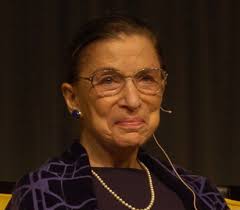
I loved reading Emily Bazelon’s interview with Supreme Court Justice Ruth Bader Ginsburg in Sunday’s New York Times Magazine.

I loved that she gave this interview so strategically, with its publication on the eve of the Sonia Sotomayor confirmation hearings.  The interview both anticipates and undermines the predictable sexism and racism (see, for example, all of the ink spilled about the “wise Latina woman” quote, and Ginsburg’s spin on that tempest in a teapot) that have informed both the hearings and the media coverage surrounding the Sotomayor nomination.

I loved that it was feminist.  From talking about why women matter on the court and in public life to arguing that “[t]ime is on the side of change,” with regard to abortion rights, Ginsburg’s responses are unabashedly feminist.  How wonderful to see this on display—at length—in a mainstream media publication.

But most of all I loved the way it represented women supporting one another.  Maybe this is what our feminist foremothers had in mind when they used the phrase, “sisterhood is powerful.”  I have to say that I’ve never had much use for the idea of “sisterhood” in my definition of feminism, since the term seemed to rely on artificially flattening differences among women.  It seems to assume that gender struggles are the most important ones, something that has been most often true for white women.  (As many GWP readers already know, GWPenner-in-Chief Deborah Siegel has a terrific analysis of the conflicts and controversies at work in feminist ideas of “sisterhood” in Sisterhood, Interrupted).

So with all of that history in mind, that show of support is what I especially loved about Ginsburg’s interview.  Positioning herself as white, Jewish woman from Brooklyn, she was standing up for her Latina. . .colleague (sister??) in a very public, political way.  Speaking as a white woman myself, we need to this more often, and not just when it comes to gender struggles.

I’ve also been thinking about this public, political, feminist show of support in the context of girls’ relationships.  My daughter has recently been grappling with what is probably the beginning of many girl friend conflicts that center around attention, inclusion and exclusion, and degrees of “best friend-ness.”  (For example, “I have no one to play with on the playground.  Sally and Susie are spending all of their time together and they don’t include me.”)

I’m saddened that these conflicts are arising already, in second grade.  But I’m also thinking from a feminist perspective about how my daughter can learn to value her female relationships, and about how I can model female friendship myself.

I return to thinking about the Ginsburg interview.  It’s clear from the Q&A that Ginsburg and Sotomayer don’t know one another well.  Certainly they would not call one another friends.  But no doubt they share a passion for their work, a commitment to advancing social justice, intellectual curiosity, and much more perhaps.

Friends are important in life, no doubt.  But so are feminists.  I hope my daughter finds plenty of both as her relationships unfold.

Do check out Lynn Harris’ commentary on the outburst(!) of edgy teen feminist blogs, like Julie Zellwiger’s TheFBomb. I’m quoted! And feeling old 🙂