childfree

This piece originally appeared on the Ms. Magazine Blog.

Susan, a 53 year old camp director, babysat from the time she was 12 years old. She always assumed she’d have kids one day—but during college, she worked in a department store where watching impatient parents with their children inspired her to radically change the path she’d planned for herself.

Vladimir Pustovit / Creative Commons

“They’d yank them by the arm, pull them around, yell at them, and make them sit down. It just wasn’t right.” Susan took the experience to heart and began to think more deeply about how she could make a positive difference in children’s lives. “I had a lot of experience at being with children at various stages. And I enjoyed it, I loved it, but I said to myself, ‘There are way too many kids out there that don’t have someone to look after them and don’t have someone to be an advocate for them.’ I felt that I could be that person.” She became a teacher and then a camp director and hasn’t looked back since.

Making a difference in children’s lives is what Susan felt destined to do. In addition to working with children in her career, Susan says she’s extremely close to her nieces and nephews. They enjoy weekend visits at her home and she has the financial security to help their parents with expenses. Susan loves giving to them. As she put it, “When they visit me, I take excellent care of them, I lavish them, we have fun, and they have everything they want.”

We know from our interviews with hundreds of childfree women, some of whom appear in Maxine’s forthcoming film, TO KID OR NOT TO KID, that Susan isn’t alone. For these women, being a parent isn’t required for making a positive difference in a child’s life. Non-mothers’ roles as advocates, mentors, and friends to children are well documented. A survey of 1,000 non-mothers inspired by Savvy Auntie Melanie Notkin found that children play an active role in the lives of 80 percent of women who don’t have children of their own. Another study found that it’s common for aunts to spend money on the children in their lives and assist kids’ parents financially. In fact, in 2012 aunts spent an estimated $387 on each child in their lives. Three-quarters of them spent more than $500 per child. Despite aunties’ significant investments in children, and the New York Times’ feature last year on this segment of the market, advertisers have been slow to catch on.

Maxine is trying to rectify this. As a commercial director and filmmaker, she’s made the first Aunty commercial, released on April 17. The advert features Aunties who serve as “other mothers” to their nieces and nephews and celebrates the role of aunts in our community.

We hear proclamations all the time that it takes a village to raise a child and we know from childfree people’s own accounts that they are an important part of that village. As feminist writer Jessica Valenti notes, “ we need to start thinking about raising our children as a community exercise.” Non-parent figures are an essential part of that exercise. Research conducted for Big Brothers Big Sisters of America shows that having caring adults who are not their parents involved in their lives improves kids’ confidence, grades and social skills. Non-parents also provide needed support for parents.

Today, 15 percent of women in the U.S. will reach their 40th birthdays without ever having given birth. While these women may not have given birth, they have given to the children in their lives in significant ways, both emotionally and financially. Childfree Aunties’ contributions should no longer go ignored.
Maxine Trump has directed documentaries for TV networks from Discovery to Sundance and is author of the forthcoming book “Diving Into Documentaries” (Focal Press, 2018). Her previous feature film Musicwood was a New York Times Critics’ Pick. Maxine is in full production on TO KID OR NOT TO KID and is seeking a brand to sponsor her new Aunty commercial.

Amy Blackstone is a co-founder and guest author at Feminist Reflections and a sociology professor at the University of Maine where she studies childlessness and the childfree choice. Her work can be found in academic outlets, in media such as Ms., Broadly, CNN and TIME, and on the blog she co-writes with her husband Lance, we’re {not} having a baby!.
 

I am an abortion provider. I provide abortions because I understand that a woman’s ability to control her life trajectory is intimately tied to her ability to control her fertility. Having worked in rural Africa, I have witnessed firsthand the medical and social consequences of limited access to safe and legal abortion. It is my mission to maintain access to safe and legal abortion in the United States. In the U.S. almost half of all pregnancies are unplanned and about half of unplanned pregnancies will end in abortion. This makes surgical abortion one of the most common procedures performed in the U.S. Do I wish there were fewer unplanned pregnancies and abortions? Of course. But there will always be a need for abortion because contraception fails, pregnancy complications arise, and rape doesn’t just “shut that whole thing down.”

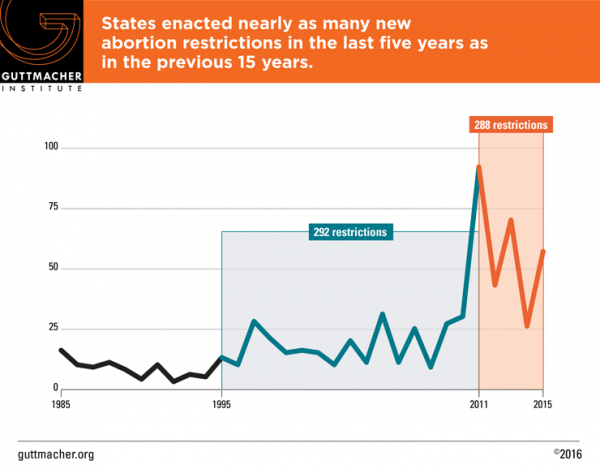
While Roe v. Wade guarantees women’s legal right to abortion, states have the legal authority to restrict and regulate abortion. “TRAP” (Target Regulation of Abortion Providers) laws are state laws that single-out abortion providers and apply burdensome regulations that make it difficult or impossible to provide abortions. TRAP laws have addressed building regulations, staffing requirements, the informed consent process, mandatory waiting periods, whether public funds (such as Medicare or Medicaid) can be used to pay for abortions, and even the surgical technique physicians are allowed to use to perform abortions (see here for a summary of state-by-state laws). Immediately following Roe v. Wade in 1973, states began to regulate abortion provision. But in the last five years the number of restrictions has skyrocketed. From 2011 to 2015, 288 new TRAP laws were enacted.

On the surface, these laws sound great. Who doesn’t want abortion to be safe? However, abortion is already extremely safe and these laws do nothing to protect women. There is no evidence to support the claim that TRAP laws improve the safety of abortion. Multiple legislators have been pleased to admit that passage of TRAP laws would be a means to the end of abortion in their states; revealing their true motives. What proponents of TRAP laws don’t understand (or maybe they do?) is that TRAP laws actually hurt women and their families.

Clinics close because they can’t afford to adapt to ever-changing facility regulations. Physicians are afraid to provide abortion care because of the stigma and violence associated with doing so. Many states require multiple clinic visits to obtain an abortion. Women have to travel increasing distances to find an abortion provider. All of this burdens women and their families in the form of increased procedure cost, transportation, lost wages, and childcare expenses, to name a few. It also leads to increased gestational age at the time of abortion. First trimester abortion is incredibly safe—much safer than pregnancy and childbirth. The risks associated with abortion, though, increase with increasing gestational age.

Recent data from Texas provides evidence of the harmful effects of TRAP laws. Texas House Bill 2 (H.B.2), required hospital admitting privileges for physicians performing abortions, set strict facility guidelines, required specific surgical practices for medical abortions, and banned most abortions after 20-weeks of gestation. When abortion clinics closed as a result of H.B.2, the number of self-induced and late abortions increased (see here and here). Other women were unable to obtain abortions, forcing them to carry unwanted pregnancies to term. Late abortion, illegal abortion, self-induced abortion, and unwanted childbearing are associated with women’s increased morbidity and mortality when compared to early, accessible, and legal abortion. TRAP laws are a form of state-imposed gender-based structural violence.

rate of abortion laws

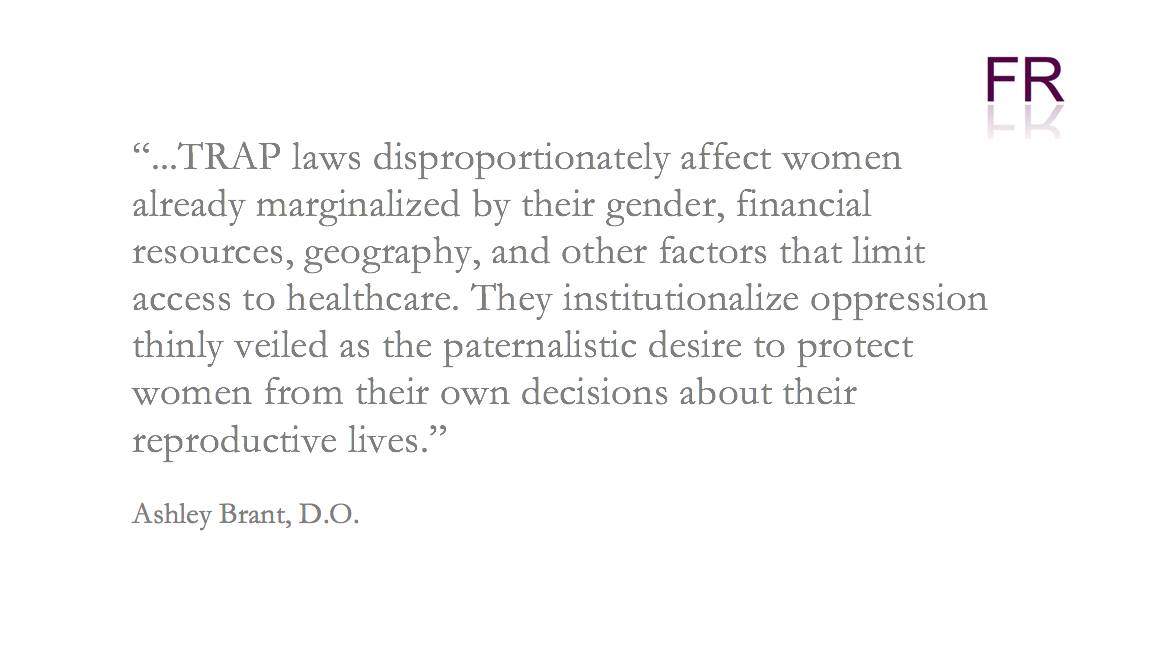
In the Supreme Court case Whole Woman’s Health v. Hellerstedt, the physician admitting privilege and surgical facility requirements of H.B.2 were challenged. The petitioners, a group of Texas abortion providers, argued that H.B.2 created an undue burden on the right of women to obtain abortion. The defendants argued that the bill was necessary to protect women’s health. Justice Ginsberg got to the heart of the issue when she said “Don’t we know…that the focus must be on the ones who are burdened?” She pointed to the fact that TRAP laws disproportionately affect women already marginalized by their gender, financial resources, geography, and other factors that limit access to healthcare. They institutionalize oppression thinly veiled as the paternalistic desire to protect women from their own decisions about their reproductive lives.

brant quoteWith a 5-3 vote, SCOTUS ruled that H.B.2 created an undue burden for the women of Texas. And the female justices played a major role in shaping the course of the oral arguments on the case. Justice Bryer wrote the majority opinion, stating that the requirements of H.B.2 “vastly increase the obstacles confronting women seeking abortions in Texas without providing any benefit to women’s health.” TRAP laws in other states are likely to be challenged as a result of the SCOTUS decision, with defendants having to demonstrate they benefit rather than create burdens on women’s health. TRAP laws, which have been one of the most successful methods of regulating women’s reproductive choices in the last decade, may be on unstable ground. This is a momentous victory for reproductive rights.

______________________________

Brant_headshotAshley Brant, DO, MPH is an obstetrician-gynecologist and abortion provider. She completed her residency at Baystate Medical Center in western Massachusetts. Her research focuses on contraceptive access and medical education. She currently practices in Washington, DC.

 

Please enjoy this re-post of we’re {not} having a baby!‘s interview with sociologist Gillian Ayers on her research on childfree women.

“I could be a father, but I could never be a mother”: Research on Childfree Women in Canada

We here at w{n}hab! love us some research. Especially when it’s sociological (have we mentioned Amy is a sociologist?). So when we came upon an article last summer describing findings from Gillian Ayers’ research on childfree women, we knew we wanted to know more.

Sociologist Gillian Ayers

Gillian Ayers is a Sessional Lecturer at the University of Lethbridge. Her Master’s thesis is entitled “I could be a father, but I could never be a mother”: Values and Meanings of Women’s Voluntary Childlessness in Southern Alberta. Here we chat with Gillian about why she chose to study women in particular and her most surprising research findings.

Q&A

w{n}hab! – How did you get interested in the topic of childfree women?

G.A. – I became interested in the topic of voluntary childlessness during my undergraduate studies in sociology. The courses I took on sociology of the body, gender, deviance, and feminist theory all challenged my world-view and made sense to me on a personal level as I started to figure out what direction my life would take. I eventually started to question the imperative to mother in my own life, and when I applied to graduate school I decided to explore the topic further through a formal research project. During my research I spoke with 21 women in Southern Alberta who identified as childless by choice.

w{n}hab! – Why study women in particular?

G.A. – Social expectations for women and men are very different. I knew fairly early on in my research project that I would only be speaking with women, as women face particular scrutiny when it comes to domestic life and childbearing decision-making. However, it’s important to note that my study takes for granted the belief that men and fathers are viewed as less involved in childbearing decision-making and childrearing more generally, and the social pressures for them are less. Consequently, women are often the ones who are held responsible for the decision to remain childless, regardless of whether or not the decision was made with a partner. As a result, I was most interested in speaking with women about their experiences of voluntary childlessness.

w{n}hab! – Which of your findings most surprised you? Why?

G.A. – I was most shocked by the “ick” factor explained by many of the women I spoke with regarding pregnancy, childbirth, and breastfeeding. This was not an idea I had really thought much about before this research and it truly surprised me because I think many people consider pregnancy, childbirth, and breastfeeding to be beautiful, wonderful, and joyous experiences. In contrast, several women I spoke with were repulsed by these prospects and spoke about wanting to avoid the pain of childbirth, the weight gain, and the feelings of being “hijacked” by a foreign entity during pregnancy. In sum, it was not just the notion of childrearing that women rejected, but also the physical aspects of childbearing.

w{n}hab! – You’ve said that the concept of intensive motherhood was relevant to your research. How so?

G.A. – Sharon Hays (1996) developed the concept of intensive motherhood, which includes methods that should be “child-centered, expert-guided, emotionally absorbing, labor-intensive, and financially expensive.” I found that the voluntarily childless women I spoke with often took up the tenets of intensive motherhood and held motherhood in high esteem. For many of the women, if they couldn’t mother the “right” way, they weren’t going to do it at all. This belief became apparent to me when, for example, 20 of the 21 women I spoke with cited financial reasons for remaining voluntarily childless. Many women viewed intensive motherhood ideologies as an impossible standard, and instead chose to reject motherhood altogether.

w{n}hab! – What’s next for you in this research? What questions remain?

G.A. – Future research could more fully examine the experiences of voluntarily childless First Nations, Métis, or Inuit women, as well as women who are visible minorities. Both these groups have higher than average birth rates in Canada, and they may have different expectations regarding childbearing. Of course, future research could also include speaking to voluntarily childless men about their experiences.

The childfree version of Baby New Year? Image via Flckr CC
The childfree version of Baby New Year?
Image via Flckr CC

It’s that time of year. Babies in top hats don sashes and people everywhere resolve to begin anew, to start fresh, to do things differently or more wisely or somehow better.

I rang in the New Year in much the same way many do – a little too much drinking, some singing, and of course the obligatory New Year’s kiss. But I’ve always been averse to New Year’s resolutions. Why wait til the New Year to do something you should be doing now?

I’ve got a resolution this year, though. This year I resolve to walk the childfree, feminist talk I’ve been peddling for the last couple of years. You see, my partner Lance and I launched our blog about the childfree choice, we’re {not} having a baby!, in early 2013.

Our goals were simple: to celebrate our choice, celebrate that we live in a time and a place where we have a choice, and challenge the many unfounded myths of those of us who choose not to have kids.

These goals are reflected in our w{n}hab! manifesto.

w{n}hab Manifesto Image-Sidebar

You can see from our conclusion that celebrating is indeed a top priority.

Beyond celebrating, we wanted to challenge myths. And while I think we’ve done that through a variety of posts including some on challenging the idea that we’ll change our minds and others on the mistaken belief that we must hate kids, I’m not sure that I’ve challenged myths in my day-to-day life to the extent that I’d like.

So, this year I resolve to:

  1. Apologize less

I admit that I do what I have criticized others for doing: I sometimes apologize for my choice not to have kids. Not directly but implicitly. No more. I made the choice that’s right for me. I don’t need to apologize for that choice.

  1. Balance more

Over the last few months I’ve put in an average of about 75 hours of work/week. That’s nearly double what I’d like to be putting in but when push comes to shove and someone has to do it, I tend to fall on my sword and pick up slack that I might not if I had kids waiting for me at home. But I have a life and a partner at home, both of whom I adore, so I resolve to stop putting work before life. I resolve to take the advice I give to others and just say no when work creeps into the life side of the work/life equation. I didn’t choose a childfree life so that I could work more. I chose a childfree life because I value solitude, quiet, my partnership, and a zillion activities that I’ve given up in favor of work. No more.

This year, more than ever before, I will celebrate my choice. I will celebrate by actually living my life, the life I chose and the life I want to live. I will continue to advocate for work/life balance for all – parents and the childfree alike. And I will celebrate that I have a choice. I will celebrate that I have a choice by not apologizing for my choice. And I will do what I can to support efforts that ensure that all people have a choice. Now that will be walking my childfree, feminist talk!

I’ll drink to that!

Another version of this post was published at we’re {not} having a baby!.

Both Apple and Facebook recently announced that they will cover egg freezing for their employees. The policies at both companies provoked a series of smart analyses of why they are simultaneously something to celebrate and challenge. For instance, Joya Misra writes, “In an environment in which many women face motherhood and pregnancy discrimination, policies that encourage women to freeze their eggs supposedly to delay parenthood, may actually discourage women from becoming mothers altogether. Access to paid leave and high quality, subsidized childcare would better support women’s decisions about having children” (here). Dr. Misra and others are absolutely correct that egg-freezing policies fail to do anything about the family-friendliness of workplaces and organizations.1 The existing data on people who take advantage of the specific technology Apple and Facebook are offering to cover for female employees, however, suggests that the lack of family-friendly policies is only one issue worth considering here. Among these issues are: cost of infertility treatment, same-sex families, and explorations of the other reasons reproductively healthy heterosexual women might pursue these options.

There are four obvious groups of women who might pursue this technology. The first are queer or lesbian women (see here, here, and here). The second are women with known or anticipated fertility issues (such as cancer treatment). The third group (and those who have received most media attention surrounding this issue) are professional heterosexual women who may be in a relationship, but don’t want to have children until they’ve reached a place in their career where they feel it will be least professionally damaging. The fourth group are single heterosexual women who might pursue freezing their eggs in the hopes of eventually meeting someone. The data suggest that the majority of heterosexual women pursuing this technology are single. As one maternal fetal medicine specialist and Assistant Professor of Obstetrics and Gynecology—Dr. Chavi Eve Karkowsky—writes,

“[I]f these women were partnered, but still wanted to delay child-bearing, they would probably pursue IVF with their eggs and their partner’s sperm, and freeze the resulting embryos. IVF and embryo cryopreservation is an older, more refined, and arguably more successful technology… What they want is a baby, yes, but with a willing partner for child rearing and a present father for their child” (here).

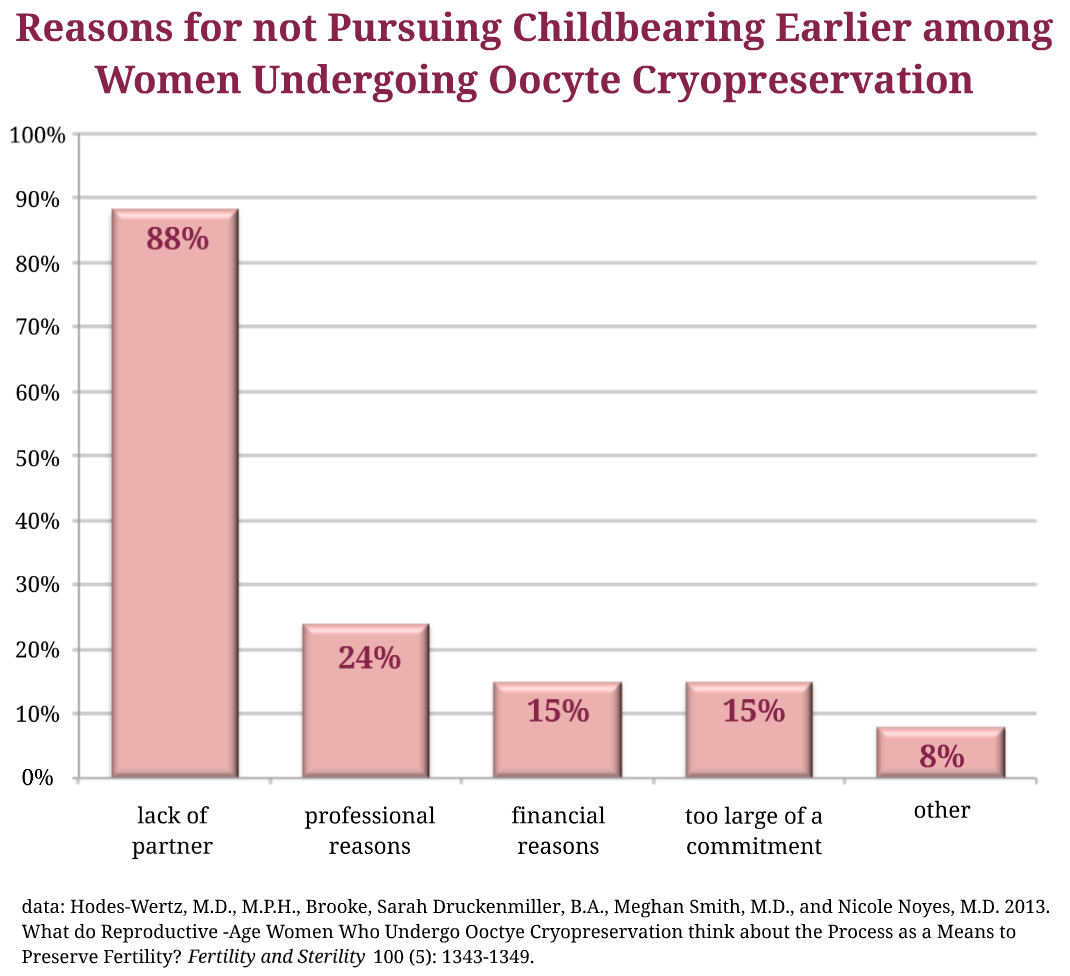
What Dr. Karkowsky suggests is that women’s decisions to freeze their eggs might have more to do with not feeling like they’ve found a “Mr. Right” (if they’re even looking for Mr.’s in the first place) than with a desire to focus on their careers. In one study of the reasons women pursue egg freezing as an option, women were asked to select any and all reasons to account for why they had not pursued childbearing earlier in their lives. Graph of Why Women Pursue CryopreservationWhile they were allowed to select all of the possible reasons that might apply, only about a quarter of the sample cited “professional reasons” for not having children earlier. The overwhelming majority of women (88%) claimed that “lack of partner” was the primary reason (see our adapted graph).2
This is related to an issue sociologists refer to as the “marriageability” of men. In the context of rising joblessness in low-income urban communities, William Julius Wilson suggested one consequence of shifts in our economy was that poor, non-white, urban men were disproportionately affected by the shift to a service economy. They’re not out of work because they don’t want jobs; Wilson found that they are out of work because the jobs simply don’t exist. And this has reverberations throughout their communities. One consequence was shrinking “pools of marriageable men” for poor black women (here). “Marriageability” has, thus far, largely been discussed as an issue of economic stability (having a job). And, as Kathryn Edin and Maria Kefalas more recently documented in Promises I Can Keep, poor women remain hesitant to bet their futures on men on whom they may not be able to count to provide economically for their families over the long haul.

More recently, Philip Cohen updated the outcome, considering the ratios of employed, unmarried men per unmarried women for black and white women. Cohen’s analysis suggests that poor women still have smaller pools of “marriageable” men, but also that black women face greater shortages of “marriageable” men than white women in most major metropolitan areas. Here too, Cohen relies on Wilson’s formula for marriageability: “marriageable” = employed.

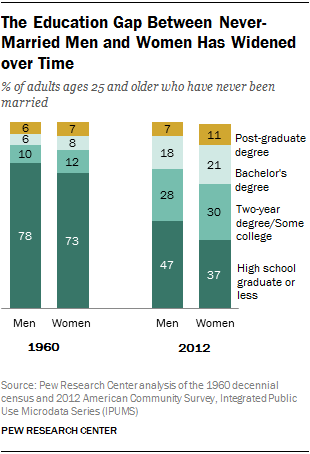
Yet, when middle and upper-class women (the groups most likely to pursue cryopreservation fertility options) are asked why they are pursuing egg freezing, “lack of partner” is highest on the list. But many of these women must live in “partner rich” areas with favorable “pools of marriageable men” as traditionally defined. Surely some of this is the result of women finding men who might qualify as “marriageable” by Wilson’s standard, unmarriageable by their own.  As Stephanie Coontz has shown, women and men are asking a lot more out of their marriages today than their parents and grandparents might have.  As such, it might not be all that surprising that a more diverse group are delaying and forgoing marriage.  Pew Graph - EducationIndeed, as a recent Pew Report investigating the rise in unmarried Americans attests, the population of young adults who have not entered marriage is both growing and changing. For instance, the education gap between never married men and women has widened (see graph). Never married women and men are more educated today than previous generations. More than 53% of never married men today have more than a high school education; 25% have at least a bachelor’s degree. And while it’s a tough economy, Cohen’s analysis suggests that many of these men are finding jobs (often in larger numbers than women in many cities).

We suggest that middle- and upper-class women are delaying and foregoing marriage for many reasons, among them that the employed men they encounter are “unmarriageable” for other reasons.

We are currently working on an article collecting research across the class divide dealing with the “marriageability of men” hypothesis.  Research shows that the “lack of marriageable men” trend is best analyzed as twin trends occurring among different groups for different reasons. For instance, Wilson suggested that “marriageability” primarily had to do with obtaining a job—a task more difficult from some groups of men than others. But, middle- and upper-class women, by this standard, should be marrying in droves—employed men are not always the issue. Men who might be capable of financially providing are not necessarily all women want out of a relationship today.

For instance, in The Unfinished Revolution, Kathleen Gerson found that men and women across a range of class backgrounds said that they desired gender egalitarian relationships. Men were just as likely as women to say that having a partner able to find personally fulfilling work and to co-provide financially was an important part of what they hoped to achieve in current and future relationships.   Things get more complicated, however, when women and men are asked about their backup plans. What happens when those plans for dual-earning, emotionally fulfilling, egalitarian partnerships don’t work out? Women state that they are willing to confront a range of options in terms of fulfilling their family and career goals. Men, on the other hand, are most likely to say that their fallback option does not include the possibility of staying home themselves. Rather, men’s “plan B” appears to put women right back at “plan A” 50 years ago (see Lisa Wade’s analysis here). Indeed, in her interviews with women about their heterosexual experiences in Hard to Get, Leslie Bell finds profound dissatisfaction among 20-something women with their romantic and sexual relationships with men.

While only a small number of women currently choose to pursue oocyte cryopreservation, this issue represents a larger concern with which many women are dealing more generally. Freezing their eggs is one of many strategies heterosexual women might pursue as men are navigating new meanings of what it means to qualify as “marriageable” today.

________________________________

Thanks to D’Lane Compton and C.J. Pascoe for advanced reading and comments on this post.

1 Whether or not assisted reproductive technologies (ART) are covered by insurance also varies by state in the U.S.  Some states mandate IVF coverage, for instance, while other states do not. In states that do not mandate coverage, it is a more expensive for employers to include coverage in their employee health benefits packages. So, this is not only an issue of “good” and “bad” companies, but one of state legislation that influences organizational policies as well. See here for state-specific policies.

2 It’s important to note that some social desirability bias is likely to rear its head here. For instance, some respondents may have felt that claiming “professional reasons” for not pursuing childbearing earlier may be perceived unfavorably by others.

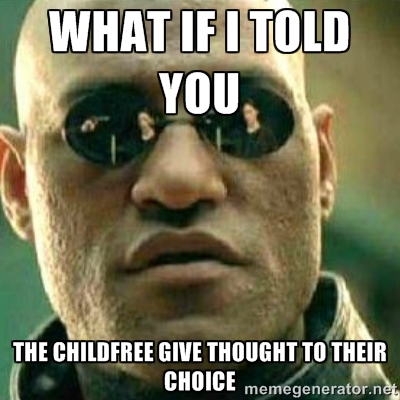
meme_thoughtful choiceA few months ago, the research finding that many couples who don’t want kids reach the decision “after just one conversation” caught the attention of reporters. Many expressed shock and dismay, calling the decision a “snap choice” and referring to couples’ limited discussion about the matter “strange.”

Most reports poo-pooed the childfree who participated in the research, noting that the decision not to have kids deserves “further contemplation than whether to have pizza or Indian for dinner.”

Oddly, all of these reports seemed to overlook a crucial point: that the decision not to have kids is one often made by people who think deeply about their choice and then, hopefully, find mates who feel similarly. In my own study of childfree adults, I’ve examined how it is that people come to decide not to have kids. more...

“I don’t know why women need to have children to be seen as complete human beings.” —Marisa Tomei

lichtenstein
image from chasingthegerberdragon.blogspot.com

In sixteen short words, Marisa Tomei sums up pretty much everything I think about having kids. It’s not for me but I understand it’s a choice that has meaning for lots of people. Whatever any woman’s choice, Tomei is right: it has nothing to do to with our completeness as human beings.

Tomei isn’t the only celebrity who’s been asked to account for her status as a non-mom. Last month, Cameron Diaz made headlines by sharing her thoughts about (not) having kids. Diaz explained,

“It’s so much more work to have children. To have lives besides your own that you are responsible for — I didn’t take that on. That did make things easier for me.”

more...