bodies

I am an abortion provider. I provide abortions because I understand that a woman’s ability to control her life trajectory is intimately tied to her ability to control her fertility. Having worked in rural Africa, I have witnessed firsthand the medical and social consequences of limited access to safe and legal abortion. It is my mission to maintain access to safe and legal abortion in the United States. In the U.S. almost half of all pregnancies are unplanned and about half of unplanned pregnancies will end in abortion. This makes surgical abortion one of the most common procedures performed in the U.S. Do I wish there were fewer unplanned pregnancies and abortions? Of course. But there will always be a need for abortion because contraception fails, pregnancy complications arise, and rape doesn’t just “shut that whole thing down.”

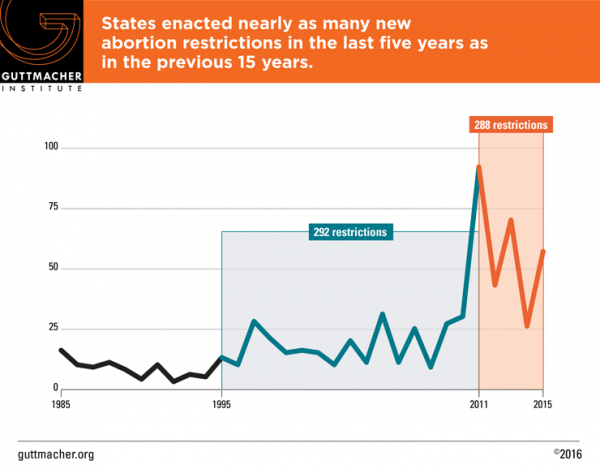
While Roe v. Wade guarantees women’s legal right to abortion, states have the legal authority to restrict and regulate abortion. “TRAP” (Target Regulation of Abortion Providers) laws are state laws that single-out abortion providers and apply burdensome regulations that make it difficult or impossible to provide abortions. TRAP laws have addressed building regulations, staffing requirements, the informed consent process, mandatory waiting periods, whether public funds (such as Medicare or Medicaid) can be used to pay for abortions, and even the surgical technique physicians are allowed to use to perform abortions (see here for a summary of state-by-state laws). Immediately following Roe v. Wade in 1973, states began to regulate abortion provision. But in the last five years the number of restrictions has skyrocketed. From 2011 to 2015, 288 new TRAP laws were enacted.

On the surface, these laws sound great. Who doesn’t want abortion to be safe? However, abortion is already extremely safe and these laws do nothing to protect women. There is no evidence to support the claim that TRAP laws improve the safety of abortion. Multiple legislators have been pleased to admit that passage of TRAP laws would be a means to the end of abortion in their states; revealing their true motives. What proponents of TRAP laws don’t understand (or maybe they do?) is that TRAP laws actually hurt women and their families.

Clinics close because they can’t afford to adapt to ever-changing facility regulations. Physicians are afraid to provide abortion care because of the stigma and violence associated with doing so. Many states require multiple clinic visits to obtain an abortion. Women have to travel increasing distances to find an abortion provider. All of this burdens women and their families in the form of increased procedure cost, transportation, lost wages, and childcare expenses, to name a few. It also leads to increased gestational age at the time of abortion. First trimester abortion is incredibly safe—much safer than pregnancy and childbirth. The risks associated with abortion, though, increase with increasing gestational age.

Recent data from Texas provides evidence of the harmful effects of TRAP laws. Texas House Bill 2 (H.B.2), required hospital admitting privileges for physicians performing abortions, set strict facility guidelines, required specific surgical practices for medical abortions, and banned most abortions after 20-weeks of gestation. When abortion clinics closed as a result of H.B.2, the number of self-induced and late abortions increased (see here and here). Other women were unable to obtain abortions, forcing them to carry unwanted pregnancies to term. Late abortion, illegal abortion, self-induced abortion, and unwanted childbearing are associated with women’s increased morbidity and mortality when compared to early, accessible, and legal abortion. TRAP laws are a form of state-imposed gender-based structural violence.
rate of abortion laws

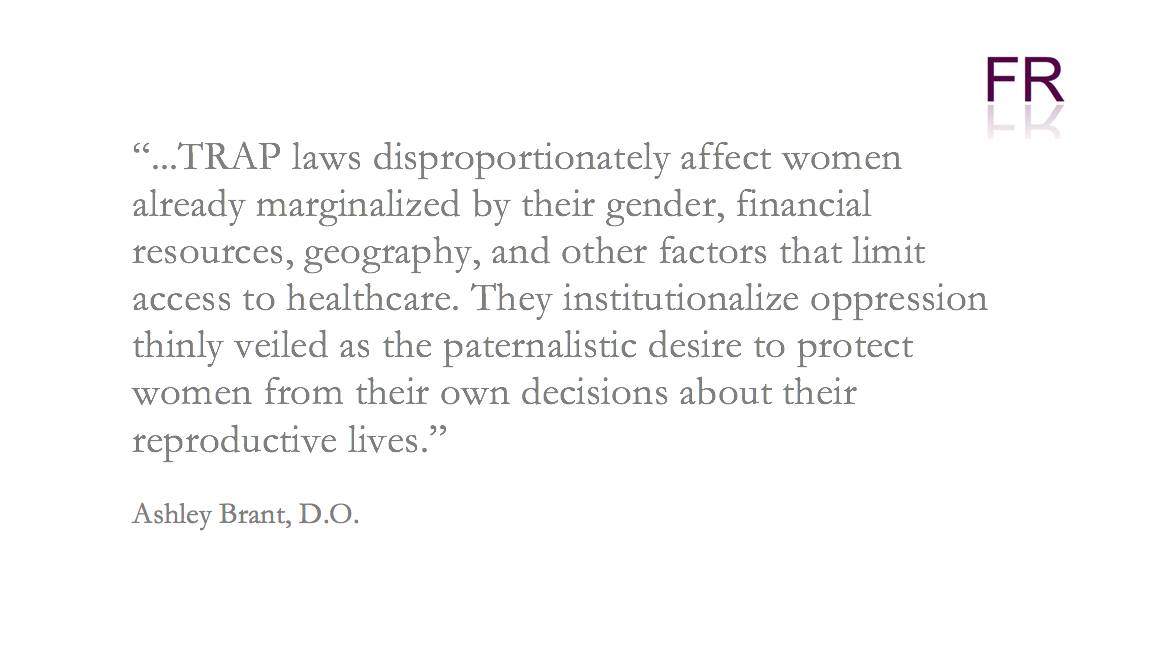
In the Supreme Court case Whole Woman’s Health v. Hellerstedt, the physician admitting privilege and surgical facility requirements of H.B.2 were challenged. The petitioners, a group of Texas abortion providers, argued that H.B.2 created an undue burden on the right of women to obtain abortion. The defendants argued that the bill was necessary to protect women’s health. Justice Ginsberg got to the heart of the issue when she said “Don’t we know…that the focus must be on the ones who are burdened?” She pointed to the fact that TRAP laws disproportionately affect women already marginalized by their gender, financial resources, geography, and other factors that limit access to healthcare. They institutionalize oppression thinly veiled as the paternalistic desire to protect women from their own decisions about their reproductive lives.
brant quoteWith a 5-3 vote, SCOTUS ruled that H.B.2 created an undue burden for the women of Texas. And the female justices played a major role in shaping the course of the oral arguments on the case. Justice Bryer wrote the majority opinion, stating that the requirements of H.B.2 “vastly increase the obstacles confronting women seeking abortions in Texas without providing any benefit to women’s health.” TRAP laws in other states are likely to be challenged as a result of the SCOTUS decision, with defendants having to demonstrate they benefit rather than create burdens on women’s health. TRAP laws, which have been one of the most successful methods of regulating women’s reproductive choices in the last decade, may be on unstable ground. This is a momentous victory for reproductive rights.

______________________________

Brant_headshotAshley Brant, DO, MPH is an obstetrician-gynecologist and abortion provider. She completed her residency at Baystate Medical Center in western Massachusetts. Her research focuses on contraceptive access and medical education. She currently practices in Washington, DC.

 

My friend’s daughter, Zoe, came home from school one day and told her dad about something that happened in school. She was in 8th grade at the time, and a trainer had just come to her class to conduct a session on sex ed. She and a boy were asked by the trainer to stand in the front of the room and hold two sides of a plastic heart together. One side was blue; the other pink. You can guess which side Zoe was asked to hold. The trainer then told them to pull the heart apart. When the two pieces of plastic were separated, the trainer told the class, “This is what happens when you have sex before marriage. Your heart is broken”.

When Zoe got home that day, she told her dad about it and said that it was “kind of ridiculous…stupid”. But she also felt weird about it. And so did her dad. He reached out to other parents he knew at the school, and what ensued – once the word got out – was a year-long campaign to identify who ran the program, how they got into the school in the first place, and ultimately, how to get rid of them. We discovered that the program was run by a non-profit organization called Healthy Futures, which claims it is “dedicated to empowering adolescents to avoid the health, social, and psychological consequences of risky decisions by equipping students with the tools and educated support system they need to make healthy choices”.  Their services included – and continue to include – classroom-based education, peer education through after-school and summer programs, parent education workshops, school and community connections, and web-based resources.  But when we dug deeper, we discovered that Healthy Futures was an abstinence-only-until-marriage (AOUM) program that was part of a larger entity in Massachusetts called A Woman’s Concern. Healthy Futures is considered “the intervention side” of this larger entity. Neither the website for Healthy Futures or A Woman’s Concern indicate a connection between these two groups. That can be found on a Christian website, listing them as a volunteer opportunity. The mission statement for A Woman’s Concern’s mission is as follows:

woman concern 2A Woman’s Concern is a Christian mission to women and couples in pregnancy distress, especially those considering abortion due to lack of information and support, and dedicated to providing life-saving help in a life-changing way. To this end we provide competent and caring services that include free pregnancy tests, sonograms, peer counseling and intervention, on-going support and referrals, parenting preparation classes, post-abortion healing and opportunities to learn about healthy sexual values, mature relationships and how to establish a vital relationship with Jesus Christ and His Church.   

I was in shock. What was a fundamentalist Christian program doing in a public school? And for the next year, I was obsessed with understanding more about this organization and its values, as well as learning about the different approaches to sexuality education. I wanted to understand where Healthy Futures – sponsored in stealth-like fashion by A Woman’s Concern and brought into my daughter’s school – fit along the spectrum of sexuality education curriculum.

The Case against abstinence-only-until-marriage programs

According to the 35-year-old national program, Advocates for Youth, there are a number of reasons abstinence-only-until-marriage (AOUM) programs don’t work. Of the eleven states that have evaluated the impact of AOUM programs, none have demonstrated a reduction in teen sexual activity. One strategy of these programs is have teens make a “virginity pledge”, promising to remain virgins until marriage. Researchers found that despite their promise, some “pledgers” engage in risky oral or anal sex, and if they do end up having vaginal intercourse, they don’t use condoms. According to researchers, Hannah Brückner and Peter Bearman, even if virginity pledges help some young people delay sexual activity for up to 18 months, once they break their pledge, they are less likely to use contraception or condoms, which puts them at risk for unintended pregnancy and HIV or other STDs.

AOUM programs often contain lies and inaccurate information. A 2004 report about AOUM programs says that over 80% of federally-funded AOUM programs contain false information about the effectiveness of contraceptives, claiming that condoms aren’t effective in preventing sexually transmitted diseases and pregnancy. AOUM programs also contain false information about the risks of abortion, with one curriculum claiming that 5% to 10% of women who have legal abortions will become sterile, will be more at risk for giving birth later on to a child with mental retardation, and that tubal and cervical pregnancies are increased following abortions. AOUM curricula blurs religion and science, presenting “as scientific fact the religious view that life begins at conception”. One curriculum calls a 43-day-old fetus a “thinking person”. And AOUM curricula “treat stereotypes about girls and boys as scientific fact”. The report concludes that these programs are a colossal waste of federal taxpayers’ dollars.

The major clearinghouse on sexuality education in the US – The Sexuality Information and Education Council of the United States (SIECUS), says AOUM programs are “based on fear and shame, inaccurate and misleading information, and biased views of marriage, sexual orientation and family structure.”

The case for comprehensive sexuality education

According to SIECUS, comprehensive sex education provides students with “medically accurate information about the health benefits and side effects of all contraceptives, including condoms, as a means to prevent pregnancy and reduce the risk of contracting STIs, including HIV/AIDS”. It teaches young people “the skills to make responsible decisions about sexuality, including how to avoid unwanted verbal, physical, and sexual advances”, as well as how “alcohol and drug use can effect responsible decision making”. Students are provided with the tools to make informed decisions. While these programs stress the value of abstinence, they also prepare students for when they become sexually active.

A series of studies show that the lessons learned in comprehensive sex education programs are critical for healthy decision making during the teen years and beyond. When teens are educated about condoms and have access to them, they’re more likely to use them. When teens practice contraception in their first sexual relationship, they’re more likely to keep doing so, compared to those who used either no method or used a method inconsistently. In fact, a 86% decline in teen pregnancy from 1995 to 2002 is attributed by Columbia University researchers to dramatic improvements in contraceptive use. Only 14% of the decline in teen pregnancy rates was attributed to a decrease in sexual activity.

Researchers Starkman and Rajani found that one-half of HIV infections in the US and two-thirds of all sexually transmitted diseases (STD) occur among young people under the age of 25. By the end of high school, nearly two thirds of American youth are sexually active, and one in five has had four or more sexual partners. Nonetheless, they say, “Despite these alarming statistics, less than half of all public schools in the United States offer information on how to obtain contraceptives and most schools increasingly teach abstinence-only-until-marriage (or ‘abstinence-only’) education”.

A Short history of Abstinence-only–until marriage programs

Over the past few decades, the federal government has poured millions of tax-payer dollars into AOUM programming. The two main federal funding streams for AOUM programs were the Community-Based Abstinence Education grant program and the AOUM portion of the Adolescent Family Life Act. Funding for these unproven programs expanded from 1996 until 2006, particularly during the Bush Administration. Between 1996 and federal Fiscal Year 2010, Congress allocated over $1.5 billion tax-payer dollars into AOUM programs and a significant amount of funding CONTINUES today!

Interestingly, President Bill Clinton’s “welfare reform” bill, signed into law in 1996, included a provision for AOUM programs. This funding, created via Title V, Section 510(b) of the Social Security Act, represented a shift from promoting pregnancy prevention programs to promoting abstinence from sexual activity outside of marriage, at any age. Sex was to be “confined to married couples”, and abstinence from sexual activity outside of marriage became the “expected standard for all school-age children”; with the “exclusive purpose (of) teaching the social, psychological, and health gains to be realized by abstaining from sexual activity”. In other words, these programs could not – still cannot – discuss, much less advocate for the use of contraceptives, except to focus on their failure rates. AOUM programs are meant teach that sexual activity outside of the context of marriage is likely to have “harmful psychological and physical effects”, and that it’s important for people to “attain self-sufficiency before engaging in sexual activity.”

After decades of federal support for a number of these programs, the Obama Administration and Congress eliminated the two main funding streams for AOUM programs. Congress allowed the third funding source, the Title V AOUM program, to expire on June 30, 2009. But this program was unfortunately revived as part of the health care reform package, which continues to provide $50 million a year in mandatory funding to this very day!

Power of the parents…

After discovering the AOUM program at our school, a core of parents initially gathered together and we drew up a petition, calling for the school to remove Healthy Futures and demanding comprehensive sexuality education. The support for the petition was phenomenal. Hundreds of parents signed it! Our main concern was our children’s health. We felt that it was inappropriate for a fundamentalist Christian organization, such as A Woman’s Concern, to be brought into our school. And we didn’t like the sneaky way the school had chosen to bring this program into the school. We also wanted to know how Healthy Futures had come to our school in the first place. To our surprise, we discovered that the school’s Vice Principal had brought them. He claimed that a parent referred him and that he had no knowledge of the group’s affiliation.

We presented a statement to the school administration, accompanied by a list of over 140 organizations that support comprehensive sexuality education in public schools, stating the following:

We are concerned that the Healthy Futures curriculum is driven by a very narrow viewpoint and provides inaccurate information regarding the viability of condoms as protection against STDs and unwanted pregnancies. The (school system) has a comprehensive sexuality education curriculum that has served the system well for many years…We believe that it is in the interests of the community served by the (school system) to be given full access to the comprehensive sexuality education curriculum established by the (XX) Public Schools.

We went to dozens of meetings  – with parents and administrators – where we presented data on AOUM and comprehensive sexuality education, and we demanded that the Assistant Principal be held accountable. Under duress, he promised to review other options for the following year. We also demanded that parents and students be included in any assessment of alternative options. A number of the parent teacher meetings were very tense, because parents – particularly those who were fundamentalist Christian and anti-abortion – felt personally offended that we were organizing to get rid of this program. We let them know that we respected their points of view, but that a religiously-affiliated program didn’t belong in a public school.

In the end we won!  After all our wrangling with the school administration, we realized that we needed to take it one level up, to the School Committee, who shared our shock that a religiously affiliated program had snuck into the school. We also presented our case to the Superintendent of the school district, and as it turned out, his wife was on the Board of Planned Parenthood. Within weeks, the program was eliminated from the district!

With this victory, parents continued to be active in a number of other school-based activities. So, not only were we successful in removing AOUM programming; we also invigorated parent engagement in the school, which spilled over to other efforts to improve the school. I was asked to be on a Sexuality Education Curriculum Committee for the school system, and spent the next year reviewing curriculum which would be brought into the schools. We ended up selecting Planned Parenthood’s excellent comprehensive sexuality education curriculum.

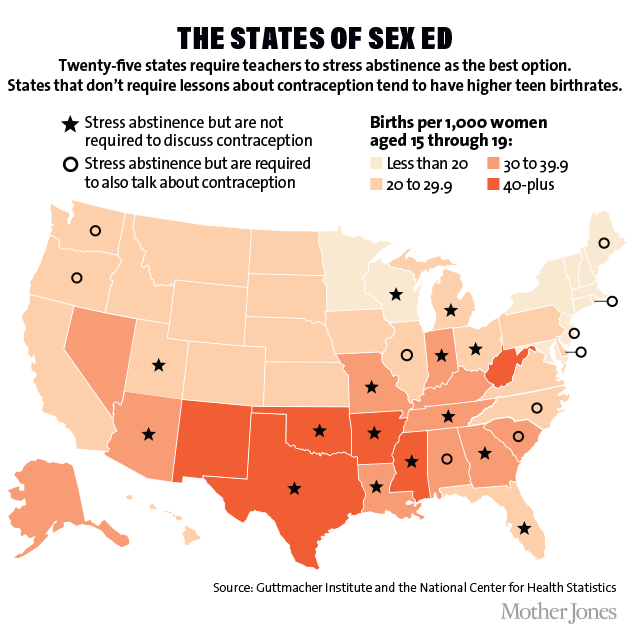
To date, 23 states have rejected Title V abstinence-only federal funding, including:  Alaska, Arizona, California, Colorado, Connecticut, Delaware, District of Columbia, Idaho, Iowa, Kansas, Maine, Massachusetts, Minnesota, Montana, New Jersey, New Mexico, New York, Ohio, Rhode Island, Vermont, Virginia, Wisconsin, and Wyoming. This is progress, but the fight isn’t over for other states and school districts. There’s still work to do…

states sex ed

maiden madonna maiden

My childhood friend, Gail, is six months younger than me. As adults, that age differential is totally meaningless, but as “pre-teens”, it apparently meant a lot. She reminds me that when my mother took me to the local department store to buy me a “training” bra, she followed suit.  “I had to get a bra because you had one”. We both bought Peter Pan “AA”s, ironically from a company named after a boy who never wants to grow up, played in film and play versions by petite adult women.

Underneath the story of the bra (literally) is the story of the breast, that contested body part – shall we say, the ONLY body part – on women that is multiply-functioned to feed, and to receive and give sexual pleasure; a body part which is also the site of deadly disease for growing numbers of women.

Purchasing a first bra is a rite of passage into womanhood, sort of like a secular Bat Mitzvah for young girls*. And how apt that this first bra is called a “training” bar, signifying a broader issue of how girls are “in training” to be women.

While many women – particularly those with larger breasts – may need or want a bra for comfort, the reality is that bras are not anatomically necessary to support breasts. In fact, the history of “the bra” suggests that they are literally shaped by cultural norms, which are historically situated, including the economic climate, the role of technology and available materials within a particular time period. My own drawer of bras – and yes, because I’m terrible at throwing things out, I have kept bras for at least a decade – is a veritable history of the changing notion of women’s beauty, as seen through the lens of the shaping of the breast. I might even go so far as to say that the bra is an element of physical and even social control that tells one chapter of the gendered history of women.

Short history of the bra

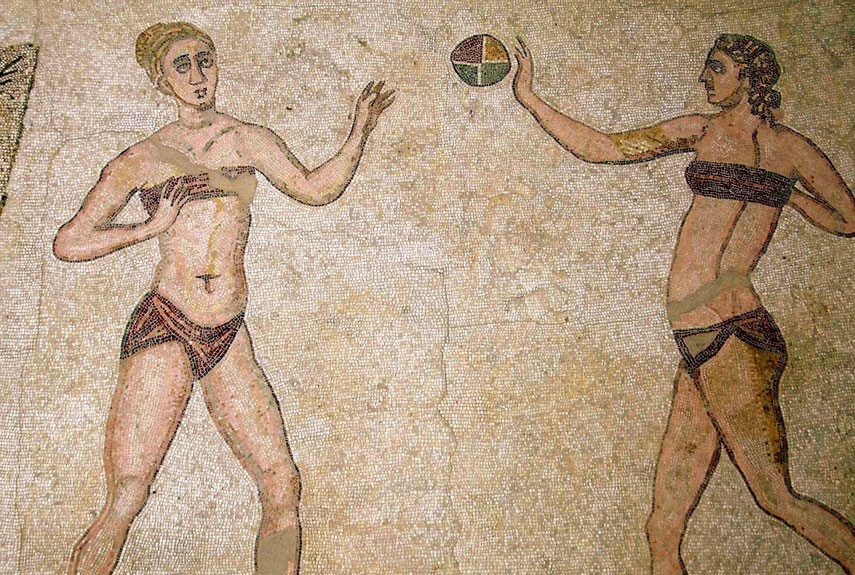
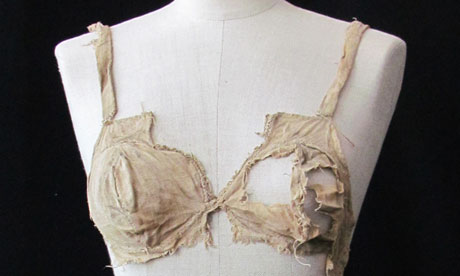
There is evidence that Greek and Roman women athletes in the 14th century wore simple bands of cloth covering their breasts while playing sports.bra ancient1

And apparently, medieval bras were called “breast bags”, which had distinct cut cups, in contrast to antique Greek or Roman breast bands. In the 16th century, women in France wore corsets which flattened the breast and pushed it up and nearly out of women’s dresses. The containing and shaping of women’s bodies continued well into the 19th century, as women were corseted from breast to hip. In the Victorian era, women’s waists were tight-laced in order to emphasize the breasts and hips.

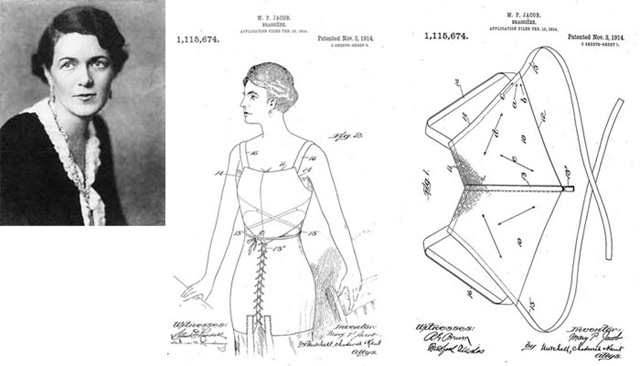
An American named Mary Phelps-Jacob is credited with inventing “the modern bra” in 1914. It was made out of silk handkerchiefs and ribbons, and she patented her design under the name of Caresse Crosby. Phelps-Jacob came from a well-to-do family, and she decided to create a bra that was more comfortable for dancing (presumably at fancy balls!).

Mary Phelps-Jacob and her bra design

She worked with her French maid, creating a design by tying two silk handkerchiefs together, sewing on baby ribbons as straps and a seam in the center front of the item. She later wrote: “I can’t say the brassiere will ever take as great a place in history as the steamboat, but I did invent it.”

By 1932, the bra company, Warner, introduced the notion of “cup sizes” correlated with letters – A, B, C and D – and added adjustable bands and eye hooks. This is the first time that breasts were no longer treated as one object; rather, they were viewed as two body parts to be enclosed separately.  Bras now used latex – as chemists had figured out how to transform rubber into textile fabric that could be woven and was washable.

bra ancient2
World War II era utility bra

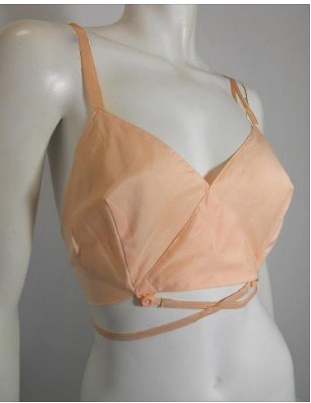
During World War II, material shortages affected the design of the bra. Some were made out of minimal fabric, called “utility bras”, and they were comprised of cotton-backed satin or “drill”, often in a peachy pink color. Women also sewed their own bras from patterns or magazine instructions, using parachute silk or nylon or old satin wedding dresses.

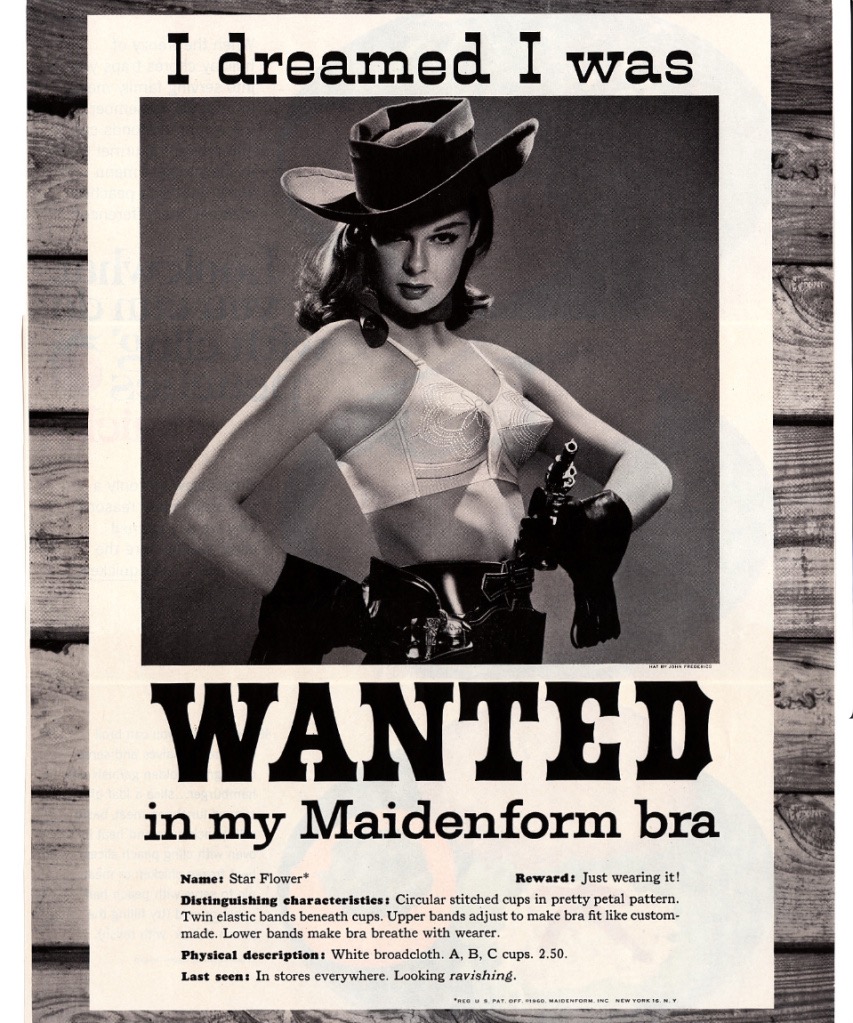
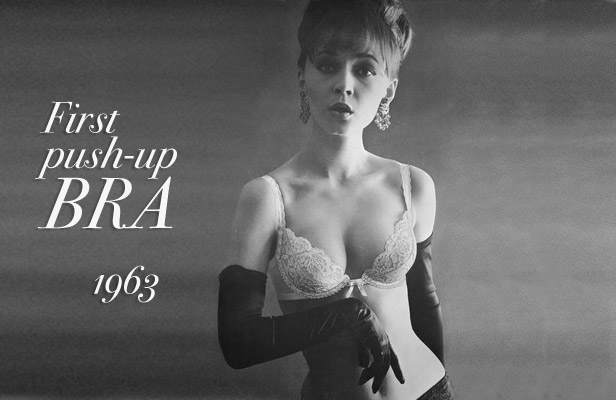
Some women began wearing “torpedo” bras, which claimed to protect women in war factory jobs. In the 1950s, after the war, women were wearing pointy bras, called the sweater or bullet bra, which drew upon war imagery. The 60s brought the push-up bra.

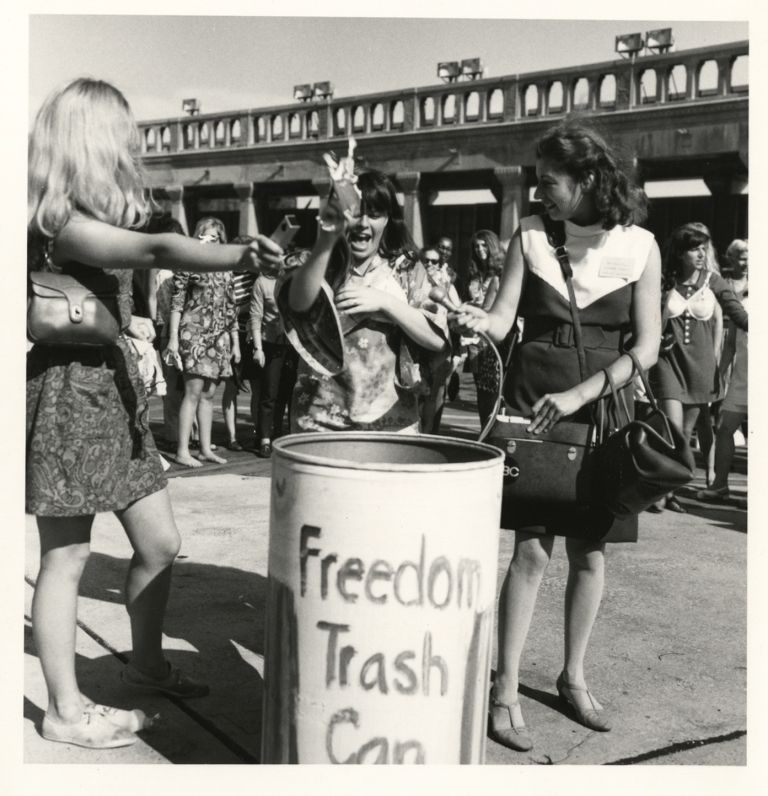
In 1968, a small group of feminists staged a dramatic demonstration at the Miss America Pageant in Atlanta, to protest the oppression of women. They picketed the event with signs saying, “Let’s Judge Ourselves as People.” And they also dumped symbols of female oppression – girdles, cosmetics, high-heeled shoes, and bras – into a “freedom trash can”.

Feminist dumping bras and make-up into freedom trash can at 1968 Miss America Pageant

It’s unclear as to whether there was any real fire at this event, much less women baring their breasts publicly. But the image of bras going into a trash can was captured in a photo, and journalists tagged these women as “bra-burning feminists”, a phrase that was meant to brand them as crazy radicals, but only contributed to the overall protest movement, which catalyzed women for action.

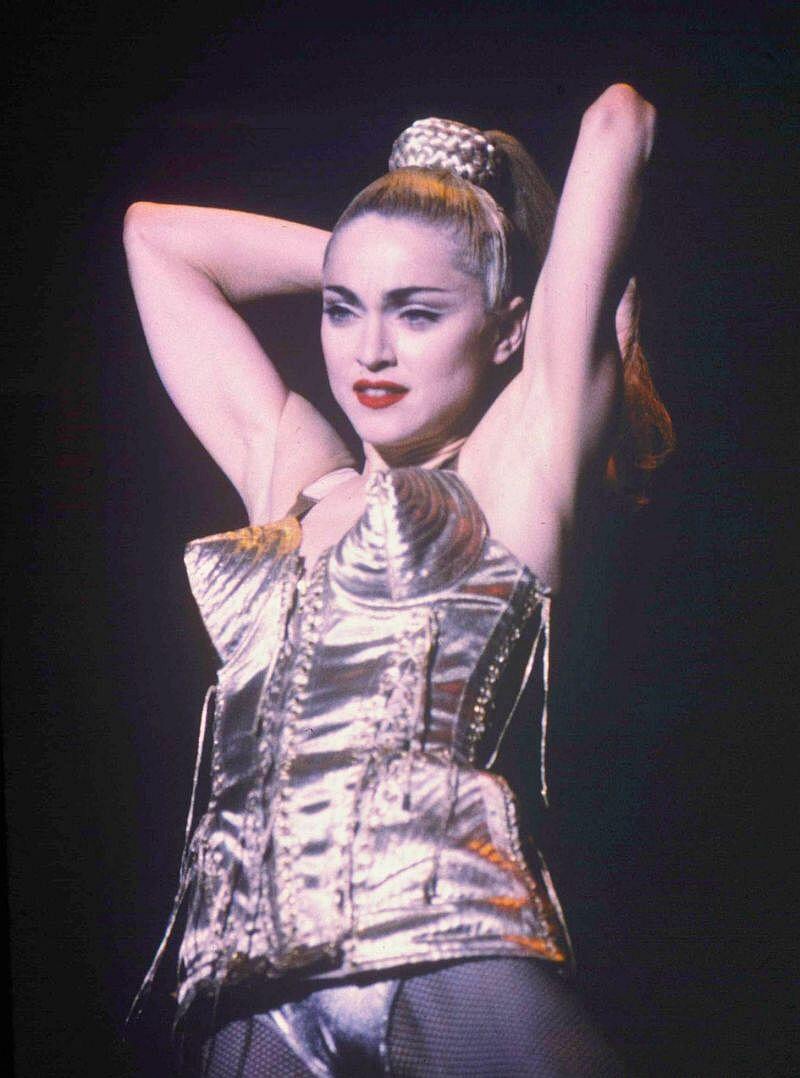
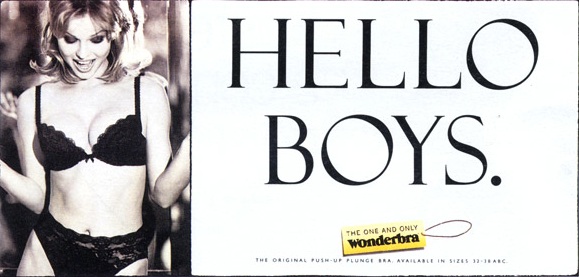
In 1977, the first “sports bra” was created, made out of stretchy rubberized material that held in women’s breasts for comfort so they could do more active sports. That same year, Victoria’s Secret opened its first store, accentuating women’s breasts as objects of sexuality aimed at the male gaze. These two bra types reflected the complex notion of women’s roles in society. In the 1990s, if it wasn’t clear what the bra was intended to do, this “Hello Boys” ad came out for Wonder Bra!hello boys

While I know many women who would like to NOT wear a bra, these images are very compelling. Our choice to wear a bra – and particularly our choice about which bra style to wear – is consciously and unconsciously impacted by notions of the so-called ideal body shape, including the socially constructed notion of what it means to be “attractive” or “desirable”, and these notions have changed over time.

So how about today?

In the 2000s, technology has allowed the creation of the “bioform” bra – which provides a consistent shape of the breast that doesn’t rely on what’s underneath it. Pauline Weston Thomas says that this bra “uplifts and contours the breasts so well that it immediately takes ten years off a sideways sagging bust.  If you are past 40 with a full cup size you may realize that you have not seen your breasts in this position for twenty years, as it centers and uplifts the breasts.”

This new bra – made possible by synthetic materials and technology-driven design – promises to literally freeze, or even turn back, time! As we age, women’s breasts change in shape and form. They may sag, but the Bioform bra maintains a youthful veneer, or what we perceive as the young breast. The bra defines the shape of the breast, including the tilt and the amount of cleavage (think, push up bras). This bra claims to literally shave years off our age, without any invasive surgery. It’s tantamount to an anti-aging tool, and considered safe. We’re not injecting any foreign substance into our bodies when we wear this type of bra, so ostensibly, it’s not harmful. But is it necessary?

Research on bras…

Based on a study conducted by French researcher, Professor Jean-Denis Rouillon from the University of Besançon in eastern France, “bras are a false necessity”. Rouillon argues that “medically, physiologically, anatomically – breasts gain no benefit from being denied gravity.” On the contrary, he says, “they get saggier with a bra”. Rouillon spent many years measuring changes in the orientation of breasts on hundreds of women, ages 18-35, and found that women who did not wear bras had less sag. “There was no dis-improvement in the orientation of their breasts, and in fact, there was widespread improvement”. A 28-year-old woman who participated in his study and stopped wearing a bra for 2 years says, “There are multiple benefits: I breathe more easily, I carry myself better, and I have less back pain”.

So is there anything wrong with wearing a bra?  NO, of course not. And if women need a bra for comfort, want a bra because they’re modest, or want to attract men or other women with their breasts – however they want to accentuate them through the use of the bra – it’s all good!  Who am I to judge? Nonetheless, some women find “the bra” constricting and would welcome more comfort.

Here’s a great piece about a woman who experiments with not wearing a bra for a week, and discovers that she initially feels naked, discovers her breasts are lop-sided, learns that it’s not as painful as she thought it would be and eventually realizes it’s more comfortable without. She also goes out clubbing and realizes that no one notices!

And here’s another great video with a few women who try it for one week!


* A Bat Mitzvah is a coming-of-age ritual for Jewish girls signifying that they are now full-fledged members of the Jewish community with associated responsibilities.


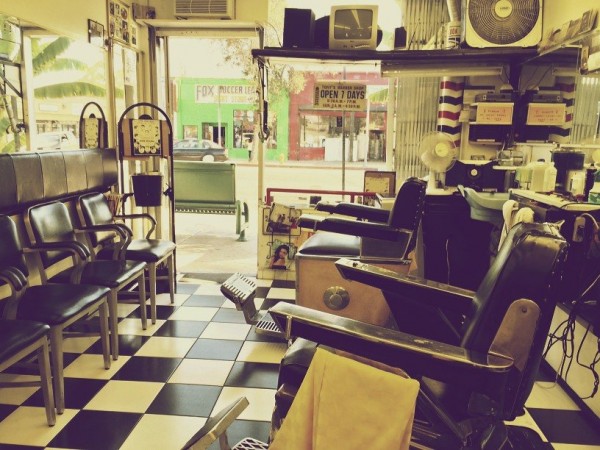
The barbershop holds a special place in American culture. With its red, white, and blue striped poles, dark naugahyde chairs, and straight razor shaves, the barbershop has been a place where men congregate to shore-up their stubble and get a handle on their hair. From a sociological perspective, the barbershop is an interesting place because of its historically homosocial character, where men spend time with other men. In the absence of women, men create close relationships with each other. Some might come daily to talk with their barbers, discuss the news, or play chess. Men create community in these places, and community is important to people’s health and well-being.

But is the barbershop disappearing? If so, is anything taking its place?

In my study of high-service men’s salons—dedicated to the primping and preening of an all male clientele—hair stylists described the “old school” barbershop as a vanishing place. They explained that men are seeking out a pampered grooming experience that the bare-bones barbershop with its corner dusty tube television doesn’t offer. The licensed barbers I interviewed saw these newer men’s salons as a “resurgence” of “a men-only place” that provides more “care” to clients than the “dirty little barbershop.” And those barbershops that are sticking around, said Roxy, one barber, are “trying to be a little more upscale.” She encourages barbers to “repaint and add flat-screen TVs.”

Tony's Barber Shop. Yelp.com.
Tony’s Barber Shop. Yelp.com.

When I asked clients of one men’s salon, The Executive, if they ever had their hair cut at a barbershop, they explained that they did not fit the demographic. Barbershops, they said, are for old men with little hair to worry about or young boys who don’t have anyone to impress. As professional white-collar men, they see themselves as having outgrown the barbershop. A salon, with its focus on detailed haircuts and various services, including manicures, pedicures, hair coloring, and body waxing, help these mostly white men to obtain what they consider to be a “professional” appearance. “Professional men… they know that if they look successful, that will create connotations to their clients or customers or others that they work with—that they are smart, that they know what they’re doing,” said Gill, a client of the salon and vice-president in software, who reasoned why men go to the salon.

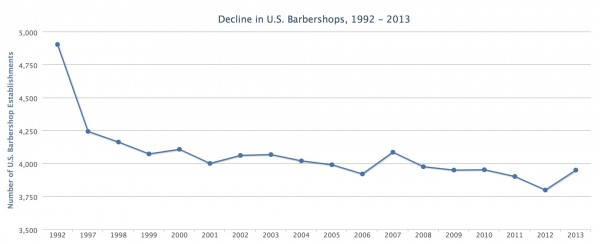
Indeed the numbers support the claim that barbershops are dwindling, and it may indeed be due to white well-to-do men’s shifting attitudes about what a barbershop is, what it can offer, and who goes there. (In my earlier research on a small women’s salon [see here], one male client told me the barbershop is a place for the mechanic, or “grease-monkey,” who doesn’t care how he looks, and for “machismo” men who prefer a pile of Playboy magazines rather than the finery of a salon). According to Census data, there is a fairly steady decline in the number of barbershops over twenty years. From 1992-2012, we saw a 22.5% decrease in barbershops in the United Stated, with a slight uptick in 2013.

U.S. Census Bureau, Statistics of U.S. Businesses, www.census.gov.

But these attitudes about the barbershop as a place of ol’, as a fading institution that provides outdated fades, is both a classed and raced attitude. With all the nostalgia for the barbershop in American culture, there is surprisingly little academic writing about it. It is telling, though, that research considering the importance of the barbershop in men’s lives focuses on black barbershops. The corner barbershop is alive and well in black communities and it serves an important role in the lives of black men. In her book, Barbershops, Bibles, and BET, Political Scientist and TV host, Melissa Harris-Perry, wrote about everyday barbershop talk as important for understanding collective efforts to frame black political thought. Scholars also find the black barbershop remains an important site for building communities and economies in black neighborhoods and for socializing young black boys (see here, here, and here).

And so asking if the barbershop is vanishing is the wrong question. Rather, we should be asking: Where and for whom is the barbershop vanishing? And where barbershops continue as staples of a community, what purpose do they serve? Where they are disappearing, what is replacing them and what are the social relations underpinning the emergence of these new places?

In some white hipster neighborhoods, the barbershop is actually making a comeback. In his article, What the Barbershop Renaissance Says about Men, journalist and popular masculinities commentator, Thomas Page McBee, writes that these places provide sensory pleasures whereby men can channel a masculinity that existed unfettered in the “good old days.” The smell of talcum powder and the presence of shaving mugs help men to grapple with what it means to be a man at a time when masculinity is up for debate. But in a barbershop that charges $45 for a haircut, some men are left out. And so, in a place that engages tensions between ideas of nostalgic masculinity and a new sort of progressive man, we may very well see opportunities for real change fall by the wayside. The hipster phenomenon, after all, is a largely white one that appropriates symbols of white working-class masculinity: think white tank tops with tattoos or the plaid shirts of lumbersexuals. (See Tristan Bridges’ posts on hipster masculinity and the borrowing of working-class masculine aesthetics, and his post with D’Lane Compton on the lumbersexual).

When we return to neighborhoods where barbershops are indeed disappearing, and being replaced with high-service men’s salons like those in my forthcoming book, Styling Masculinityit is important to put these shifts into context. They are not signs of a disintegrating by-gone culture of manhood. Rather, they are part of a transformation of white, well-to-do masculinity that reflects an enduring investment in distinguishing men along the lines of race and class according to where they have their hair cut. And these men are still creating intimate relationships; but instead of immersing themselves in communities of men, they are often building confidential relationships with women hair stylists.


*Thank you to Trisha Crashaw, graduate student at Southern Illinois University, Carbondale, for her work on the included graph.

The term “grooming,” hairstylists told me, is important in recoding beauty for men. During my research at high-service men’s salons, which focus on creating a pampered, “elevated experience” for their clients, I explored what it takes to make beauty masculinizing for some men. Veronica, the owner of one men’s salon, refers to her business as a “grooming lounge” so that clients invest in the space, services, and products as distinctly masculine. Beauty has been linked to women and femininity; to sell men on the commercial beauty industry, so the thinking goes, it has to be repackaged. This repackaging of beauty as “grooming” has been effective for Veronica, as well as for large cosmetic companies.

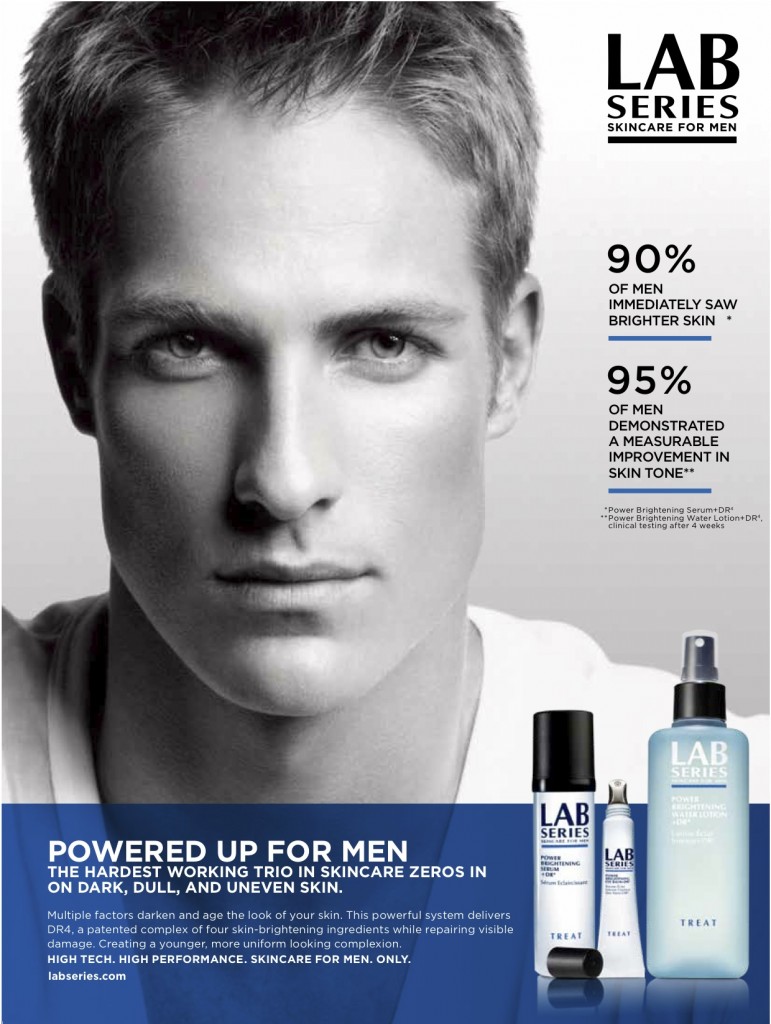
Men’s grooming is a growing subsector of the beauty industry, with already established and emerging product lines like Nivea Men, The Lab Series, Dove Men+Care, Jack Black, and Lauder for Men. And salons dedicated solely to shoring-up men’s hair, eyebrows, and nails are popping up across the country. Market research companies announce varying revenue numbers, but they all agree men’s grooming sales are in the billions and growing exponentially. This is cause for intrigue among social scientists like myself as well as journalists like Sabri Ben-Achor, who recently reported for NPR’s Marketplace on “How it became OK for guys to take care of themselves.”

Image from: www.hisstylediary.com

We are thrilled here at Feminist Reflections that two of our contributing editors were interviewed as academic experts for Ben-Achor’s piece, including Tristan Bridges and myself. Lisa Wade, of our sister blog Sociological Images, is also featured. The article focuses on “why now?” What is it about the current cultural climate in the United States that makes the production, marketing, and sale of men’s grooming so successful, and why didn’t this happen sooner?

Listen to the NPR Marketplace report, here:


*I use pseudonyms to refer to my field sites and research participants, and this data come from my forthcoming book, Styling Masculinity: Gender, Class, and Inequality in the Men’s Grooming Industry.

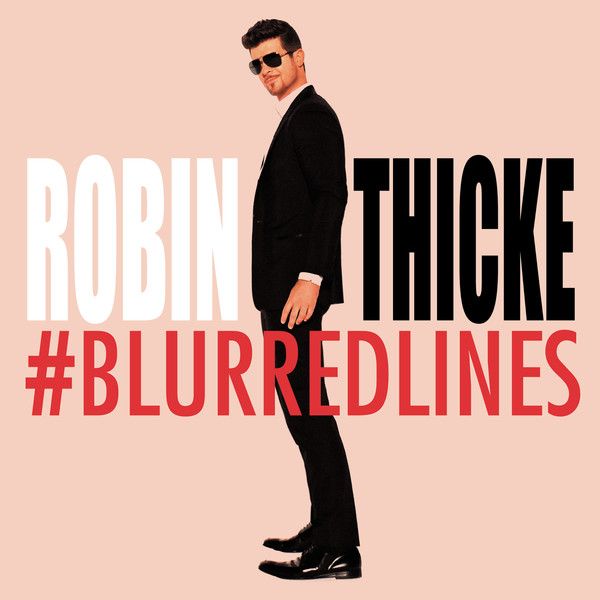
Robin-Thicke-Blurred-LinesRobin Thicke’s song, “Blurred Lines,” achieved international recognition in 2013. But the lyrics were also heavily criticized as promoting sexual violence by celebrating “blurred lines” around sexual consent. Indeed, the song and video prompted an online photo essay in which women and men are depicted holding up signs with words they heard from their own rapists—some of which were almost direct quotes from Thicke’s song. The song received a great deal of negative and positive press all at the same time. The media attention seemed to prove the media adage that any coverage is good coverage if Thicke’s continued celebrity is any measure.

It’s not a new argument to suggest that many elements of what feminist scholars refer to as “rape culture” are embedded in seemingly pleasurable elements of pop culture, like songs, movies, television shows etc. And Robin Thicke’s song served as an example to many of how we not only tolerate rape culture—but how we celebrate it and render it “sexy.” Recently, Rebecca Traister discussed just how much rape culture even informs what we think of as “good sex” in her piece “The Game is Rigged: Why Consensual Sex Can Still be Bad.” In it, Traister challenges the notion that all consensual sex is good and shows just how messy the debate about what qualifies as “consensual” really is. In many ways, our national discussion around sexual assault and consent is taking up themes raised by feminists in the 1980s about what actually qualifies as consent in a society in which violence against women is considered sexy.

Compared with “Blurred Lines,” Justin Bieber’s newly released hit single, “What Do You Mean?” has been subject to less critique. The notion that women do not actually know what they want and that they are notoriously bad and communicating their desires (sexual and otherwise) is pervasive. In the song, Bieber asks the woman with whom he’s interacting, “What do you mean? / Ohh ohh ohh/ When you nod your head yes / But you wanna say no / What do you mean?” The lack of clear consent isn’t just present in the song; it is what provides the sexual tension. It’s part of what is intended to make the song “sexy.”

Sexualizing women’s sexual indecision is an important part of the way rape culture works. It is one way that conversations about consent often over-simplify a process that is and should be much more complex. The song itself presents Bieber nagging the woman to whom he’s singing to make a decision about their relationship. But there are many elements suggesting that the decision she’s being asked to make is more immediate as well—not only about the larger relationship, but about a sexual interaction in the near future. Throughout the song, the click of a stopwatch can be heard as a beat against which Bieber presses the woman to make a decision while berating her for the mixed signals she has been sending him.

Bloomingdales-Spike-Drink-Ad-jpg
Image from Bloomingdale’s 2015 holiday catalog.

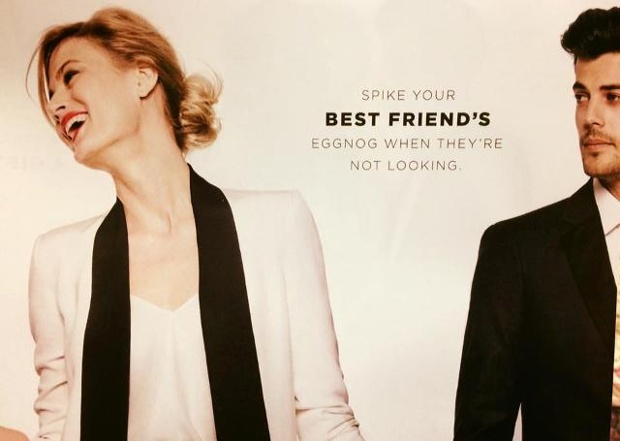
Bieber is presented as the “good guy” throughout the song by attempting to really decipher what the woman actually means. Indeed, this is another element of rape culture: the way in which we are encouraged to see average, everyday guys as “not-rapists,” because rapists are the bad guys who attack women from bushes (at worst) or simply get them drunk at a party (at best).*  The controversy over the ad in Bloomingdale’s recent 2015 holiday catalog urging readers to “spike your best friend’s eggnog when they’re not looking” shows that this kind of rape culture is also casually promoted in popular culture as well.  But, the larger discourse that Bieber’s song plays a role in promoting is the notion that women do not know what they mean or want. Bieber plays the role of someone simultaneously pressuring her for sexual advance (“Said we’re running out of time”), helping her work through her feelings (“What do you mean?”), and demanding results (“Better make up your mind”). And, like the Bloomingdale’s advertisement, this is not sexy.

Indeed, the music video (above) takes this a step further. Bieber is shown at the beginning paying John Leguizamo on a street corner and asking him to make sure “she doesn’t get hurt.” We later find out that John was paid to orchestrate a kidnapping of both Justin and the woman whom he meets in a hotel room. Both are taken by men in masks, driven to a warehouse in the trunk of a car, and tied up. Justin is able to free them, but they are still in a room with their kidnappers. They back up to a door that leads outside the building and see that they are one of the top floors. Justin turns to the woman, holds out his hand and asks, “Do you trust me?” She takes his hand and they both jump out of the building. They jump and fall to the ground, landing on a parachute pillow only to discover that the whole thing was a trick. The kidnapping was actually orchestrated ruse to bring her to a party that they entered by leaping from the building away from the men who’d taken them. The men in masks all reveal themselves to be smiling beneath. She smiles at Justin, recognizing that it was all a trick, grabs his face, kisses him and they dance the night away in the underground club.

Even though the song is about feeling like a woman really can’t make up her mind about Justin, their relationship, and sexual intimacy, the woman in the video is not depicted this way at all. She appears sexually interested in Justin from the moment the two meet in the video and not bothered by his questions and demands at all. Though it is worth mentioning that he is terrorizing her in the name of romance, indeed the terror itself is a sign of how much he loves her—also a part of rape culture. This visual display alongside the lyrics works in ways that obscure the content of the lyrics, content that works against much of what we are shown visually.

justin-bieber-what-do-you-mean-cover-413x413Part of what makes rape culture so insidious is that violence against women is rendered pleasurable and even desirable. Thicke and Bieber’s songs are catchy, fun, and beg to be danced to. The women in Thicke’s video also appear to be having fun strutting around nude while the men sing. The woman in Bieber’s video is being kidnapped and terrified for sport, sure, but it’s because he wants to show his love for her. She’s shown realizing and appreciating this at the conclusion of the video. Rape culture hides the ways that sexual violence is enacted upon women’s bodies every day. It obscures the ways that men work to minimize women’s control over their own bodies. It conceals the ways that sexual violence stems not just from dangerous, deviant others, but the normal everydayness of heterosexual interactions. And all of this works to make sexualized power arrangements more challenging to identify as problematic, which is precisely what makes confronting rape culture so challenging.

___________________________

*See C.J. Pascoe and Jocelyn Hollander’s forthcoming work in Gender & Society“Good Guys Don’t Rape: Gender, Domination, and Mobilizing Rape”—for more on what this discourse looks like and how it works.

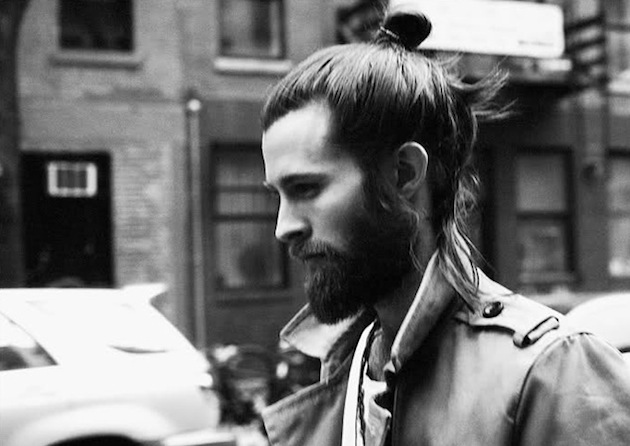
Singer-songwriter Hozier played “guess the man buns” on VH1, and Buzzfeed facetiously claimed they had “Scientific Proof That All Celebrity Men are Hotter with Man Buns.” Brad Pitt, Chris Hemsworth, and David Beckham have all sported the man bun. And no, I’m not talking about their glutes. Men are pulling their hair back behind their ears or on top on their heads and securing it into a well manicured or, more often, fashionably disheveled knot. This hairstyle is everywhere now: in magazines and on designer runways and the red carpet. Even my neighborhood Barista is sporting a fledgling bun, and The Huffington Post recently reported on the popular Man Buns of Disneyland Instagram account that documents how “man buns are taking over the planet.”

David Beckham, Orlando Bloom, and Jared Leto all sporting man buns/elle.com

At first glance, the man bun seems a marker of progressive manhood. The bun, after all, is often associated with women—portrayed in the popular imagination via the stern librarian and graceful ballerina. In my forthcoming book, Styling Masculinity: Gender, Class, and Inequality in the Men’s Grooming Industry, however, I discuss how linguistic modifiers such as manlights (blonde highlights for men’s hair) reveal the gendered norm of a word. Buns are still implicitly feminine; it’s the man bun that is masculine. But in addition to reminding us that men, like women, are embodied subjects invested in the careful cultivation of their appearances, the man bun also reflects the process of cultural appropriation. To better understand this process, we have to consider: Who can pull off the man bun and under what circumstances?

I spotted my first man bun in college. And it was not a blonde haired, blue eyed, all American guy rocking the look in an effort to appear effortlessly cool. This bun belonged to a young Sikh man who, on a largely white U.S. campus, received lingering stares for his hair, patka, and sometimes turban. His hair marked him as an ethnic and religious other. Sikhs often practice Kesh by letting their hair grow uncut in a tribute to the sacredness of God’s creation. He was marginalized on campus and his appearance seen by fellow classmates as the antithesis of sexy. In one particularly alarming 2007 case, a teenage boy in Queens was charged with a hate crime when he tore off the turban of a young Sikh boy to forcefully shave his head.

Stylehunter.com encourages men to "Think more Indian Sikh than Kardashian at the gym" when creating their man buns.
Stylehunter.com encourages men to “Think more Indian Sikh than Kardashian at the gym” when creating their man buns.

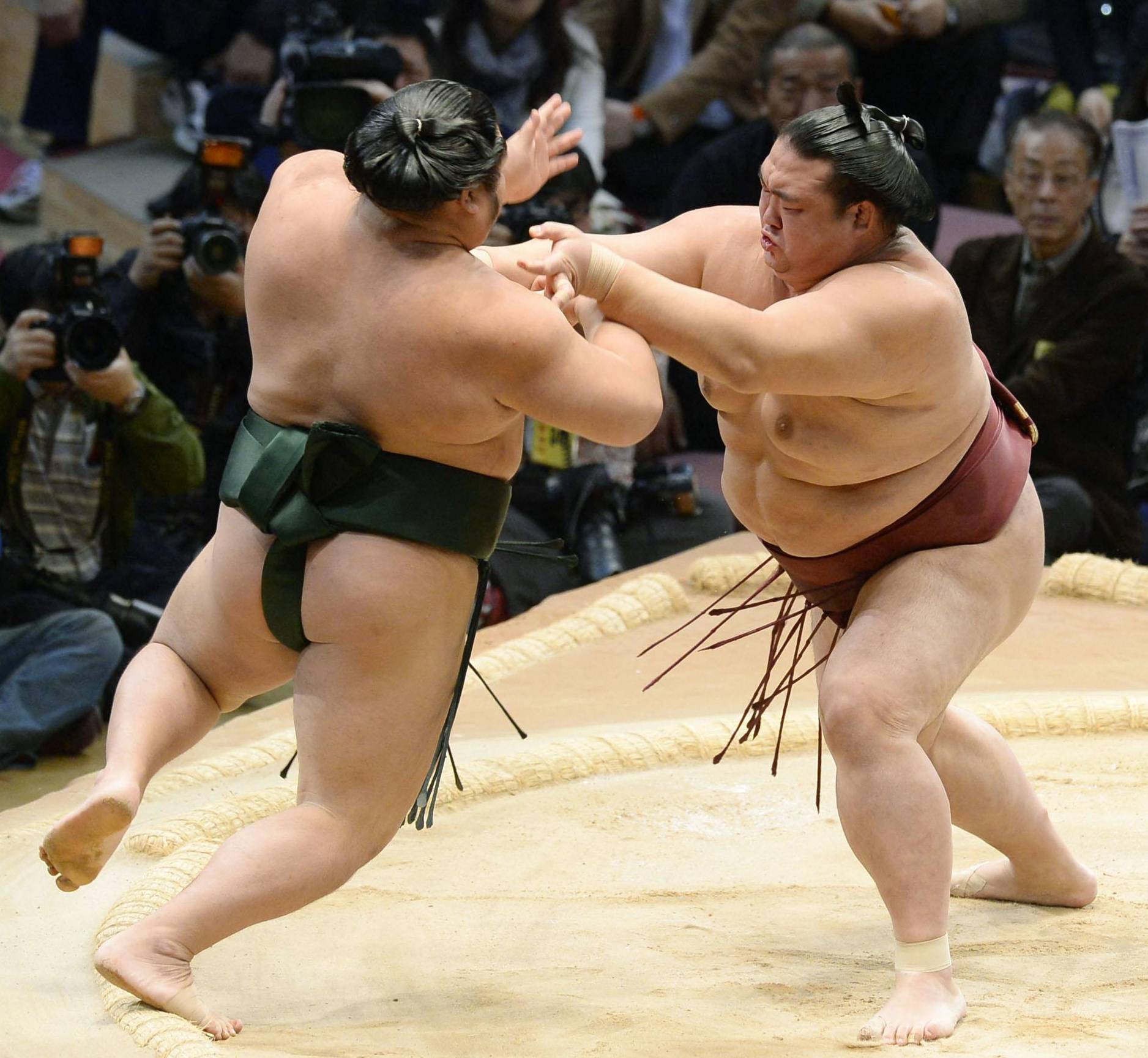
A journalist for The New York Times claims that Brooklyn bartenders and Jared Leto “initially popularized” the man bun. It’s “stylish” and keeps men’s hair out of their faces when they are “changing Marconi light bulbs,” he says. In other words, it’s artsy and sported by hipsters. This proclamation ignores the fact that Japanese samurai have long worn the topknot or chonmage, which are still sported by sumo wrestlers. Nobody is slapping sumo wrestlers on the cover of GQ magazine, though, and praising them for challenging gender stereotypes. And anyway, we know from research on men in hair salons and straight men who adopt “gay” aesthetic that men’s careful coiffing does not necessarily undercut the gender binary. Rather, differences along the lines of class, race, ethnicity, and sexuality continue to distinguish the meaning of men’s practices, even if those practices appear to be the same. When a dominant group takes on the cultural elements of marginalized people and claims them as their own—making the man bun exalting for some and stigmatizing for others, for example—who exactly has power and the harmful effects of cultural appropriation become clear.

Actor Toshiro Mifune in the movie, Samurai I: Musashi Miyamoto/whitecitycinema.com
Sumo Wrestlers with the traditional chonmage/japanesetimes.co.jp

Yes, the man bun can be fun to wear and even utilitarian, with men pulling their hair out of their faces to see better. And like long-haired hippies in the 1960s and 1970s, the man bun has the potential to resist conservative values around what bodies should look like. But it is also important to consider that white western men’s interest in the man bun comes from somewhere, and weaving a narrative about its novelty overlooks its long history among Asian men, its religious significance, and ultimately its ability to make high-status white men appear worldly and exotic. In the west, the man bun trend fetishizes the ethnic other at the same time it can be used to further marginalize and objectify them. And so cultural privilege is involved in experiencing it as a symbol of cutting-edge masculinity.

It’s different for women to collect tattoos than men. Back in the 1970s when tattooing was just starting to become an interesting, edgy way for people to express themselves, tattoo shops even had a special section of art dubbed, “for the ladies.” Little hearts and cute animals were something for women to hide away on a breast, hip, or shoulder.

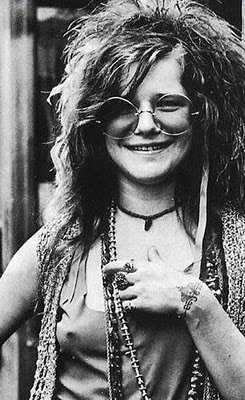
Image Source: http://www.pcs.org/blog/item/janis-joplin-tattoo-trailblazer/
Image Source: PCS Blog,  http://www.pcs.org/blog/item/janis-joplin-tattoo-trailblazer/

Janis Joplin popularized the small tattoo style for women after she got a  delicate Florentine bracelet tattoo on her wrist from famed tattoo artist, Lyle Tuttle at his shop in San Francisco. He went on to put the Joplin bracelet on hundreds of women. After awhile, having one or two “small, cute and hidden” tattoos became “gender appropriate,” and if the tattoos were visible, like the Joplin bracelet, small and mild was still the norm for years.

Over the last few decades, women’s ink started to creep out from under their shirts to cover their bodies in earnest, with images that are not so meek or mild. In fact, for the first time in recent U.S. history, women are beginning to outnumber men as tattoo collectors, and they are also becoming “heavily tattooed.” But if women are supposed to strive for beauty, then collecting large, visible, and not-so-cute imagery such as snakes or skulls crosses a socially appropriate gender line. It is not uncommon for heavily tattooed women to be sexually harassed with public comments, like: “You’re such a pretty girl, why would you do something like that to yourself?” In other words, why would you “make yourself ugly?” Women should be objects of beauty.

Kristen Wall
Kristen Wall, a student in Texas.

Embodied gender transgression is the topic of my recently published book, Covered in Ink: Tattoos, Women, and the Politics of the Body (NYU Press, 2015). While other tattoo ethnographies study people with one or more tattoos, Covered in Ink exclusively focuses on “heavily tattooed” women or those who violated that traditional mandate to keep their ink small, cute, and hidden.

I started this research as a heavily tattooed woman who herself wondered if her experience was representative of other women who chose to cover their bodies in ink. Did other women hide their tattoos from their fathers, or carry around a sweater in their car for last minute tattoo hiding, as they went about their day? Did strangers approach them and to touch their skin without permission? Was it common for them to worry about losing their jobs, in the chance that a tattoo might pop out from under their sleeve?

tampaTattooFest_contest
Tampa Tattoo Fest 2007 hosted a tattooed women beauty contest.

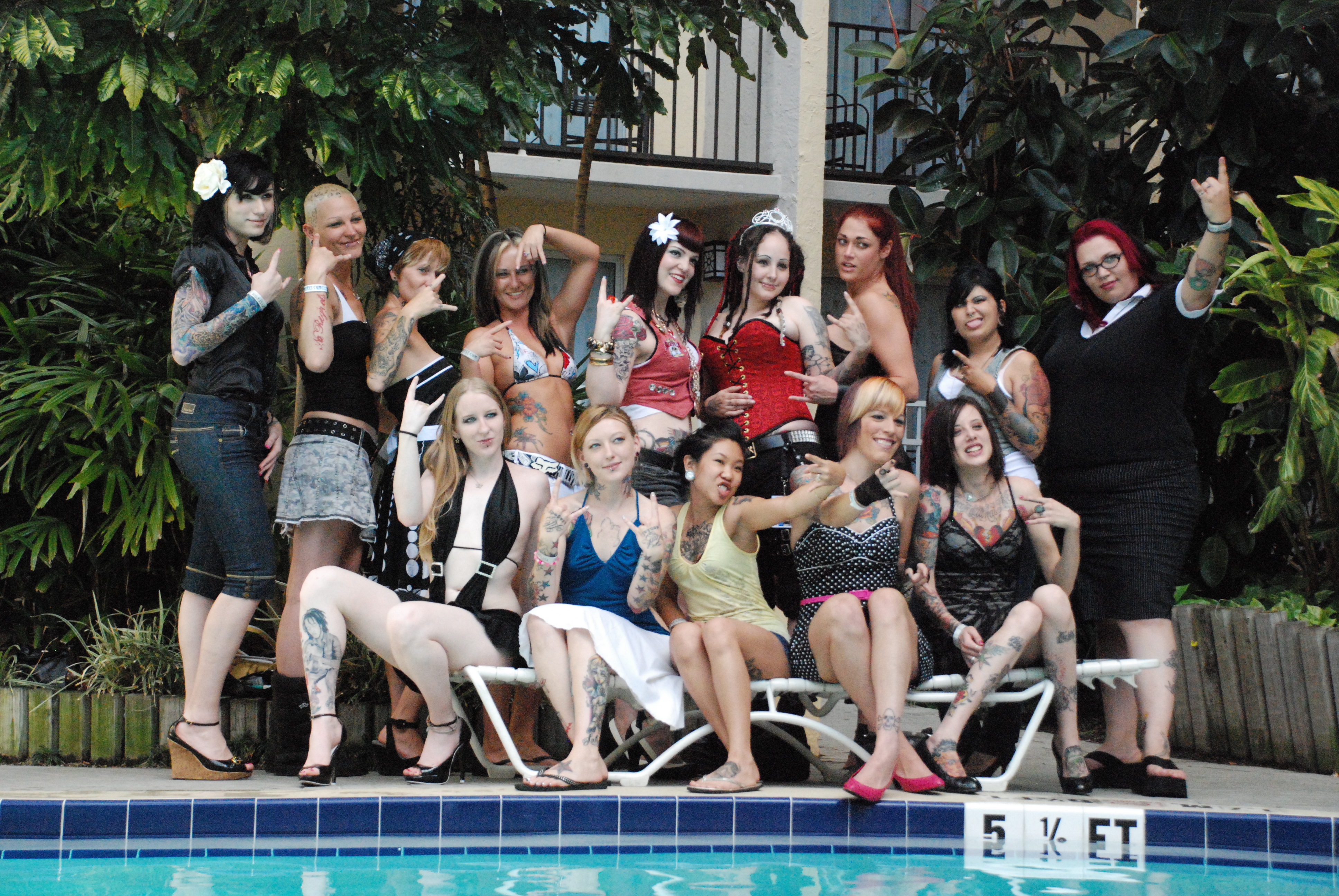
From 2007 when I attended my first Marked for Life all-female tattoo convention held annually in Orlando in January until 2010, I traveled to tattoo studios, conventions, and the homes of seventy women tattoo artists and collectors.

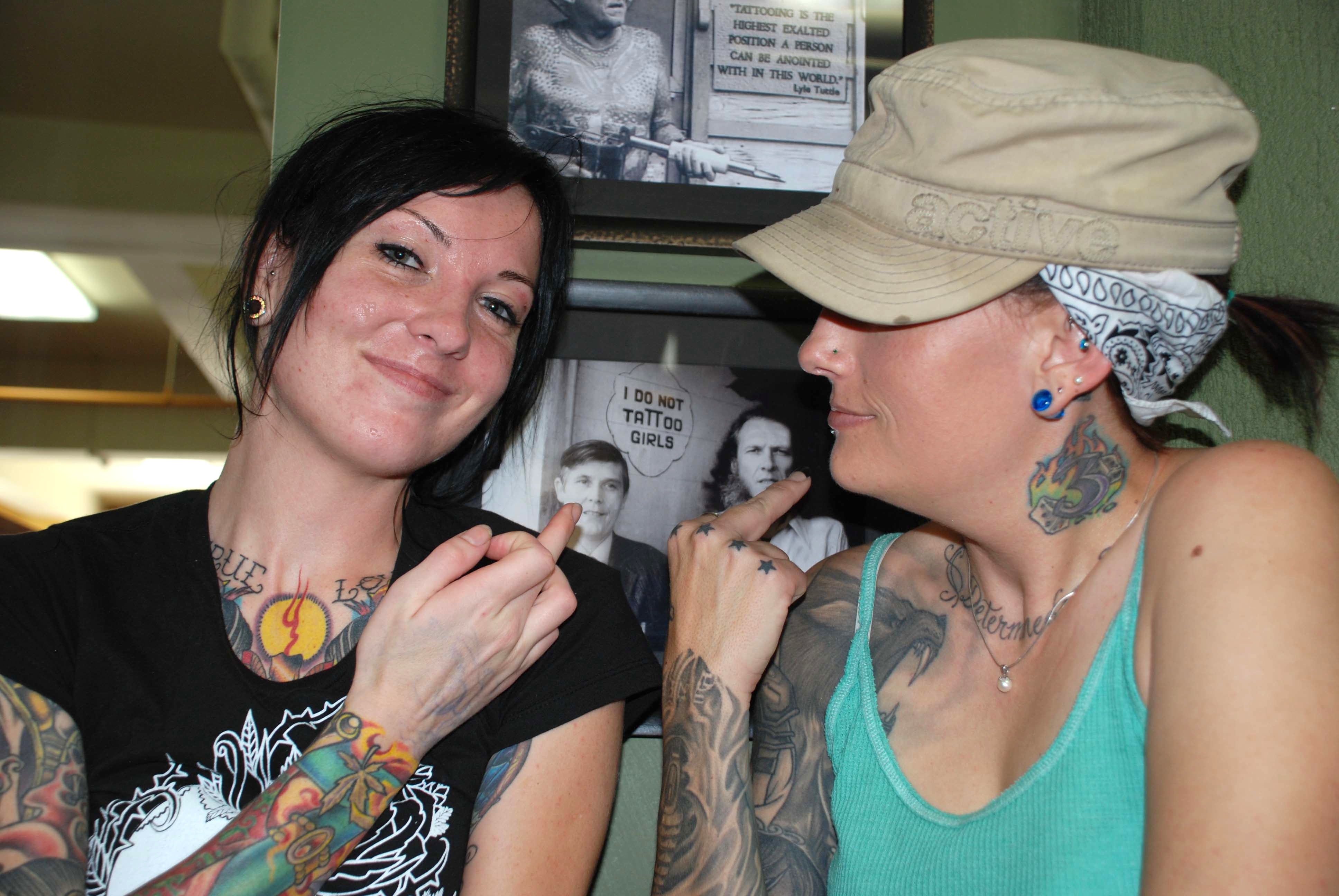
Shorty and Kody Kushman are tattoo artists at Outer Limits Tattoo in California
Shorty and Kody Kushman are tattoo artists at Outer Limits Tattoo in California. They are sitting in font of a picture of Lyle Tuttle and Burt Grimm, famous tattoo artists who spoke out against women working in the profession in the early days. The women are giving the middle finger to these old timers views on women.

These beautifully tattooed women were an inspiration to me, and their stories did overlap with my own in many ways. I share their experiences in this book and also a documentary film, Covered. [https://vimeo.com/94019352]

Each chapter of the book opens with a personal story of my own before sharing the similarities and differences across women’s experiences in the varied contexts of their lives — the family, the workplace, and the larger societal beauty culture within which women define themselves. It wasn’t surprising for me to learn for example that for other women, too, there is a world of difference between having a small, safe tattoo and sporting something like a large skull on your forearm, especially in terms of the negative social sanctions we receive.

“What does that say on your arm?” A man asked me as I sat in a coffee shop, deeply immersed in a textbook, studying for an exam, when I was eighteen years old.

“Feminist.” I replied, looking up at him, cringing as I awaited his response.

“Oh? Does that mean you hate men?” He asked with a frown, shaking his head.

“Something like that,” I replied.

The lettering this man was so interested in evaluating was my second tattoo, a stylistic, cursive script that stood alone on my arm until I collected more tattoos around it, making it harder to discern. It always leads to questions. And whenever I clarify that it says “feminist,” well, you might imagine the interactions that follow, with men attempting to define the word and me offering up sassy answers, growing more insolent depending on how bold I feel at the moment. The chapter “Tattoos Are Not for Touching” shares this story and the voices of other women who have been reprimanded for their tattoo collection, including the stares, comments, and touches that sociologist Erving Goffman demonstrated in his research on public self presentation.

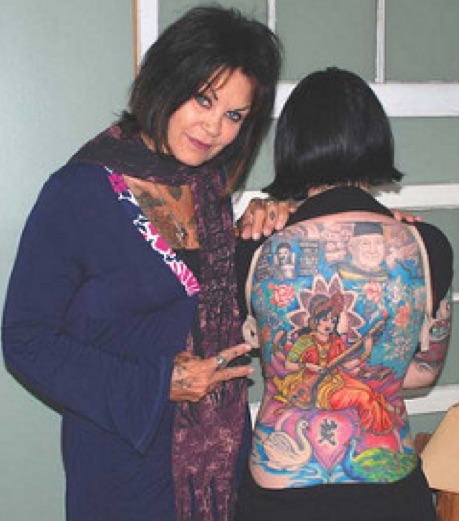
Beverly Back ArtDuring my fieldwork I found an amazing artist who spent five years giving me a back piece tattoo, in her own beautiful style, that represented my academic journey.

Since Covered in Ink has been published I’ve been hearing more women’s stories of their artwork and the social struggles, both positive and negative, that accompany them.

What’s yours?
________________________

Listen to Beverly Yuen Thompson’s interview on KERA’s Think with host Krys Boyd.


Beverly with her book Covered in Ink

Beverly Yuen Thompson is an Associate Professor and Chair of Sociology at Siena College, Loudonville, New York. She earned a PhD and MA in Sociology from the New School for Social Research in New York, a Master’s Degree in Women’s Studies from San Diego State University, and a Bachelor’s Degree in Political Science from Eastern Washington University. Her first book, Covered in Ink: Women, Tattoos, and the Politics of the Body, was published by NYU Press in 2015. Her research interests include subcultures, visual culture, and gender.

I traveled to Winthrop University five months after my baby was born to talk to faculty and students about women’s unique needs during disaster. I was flying with my electric breast pump, which would both save me from the horrifying pain of engorgement and allow me to avoid dumping what women’s health practitioners call “liquid gold.” I am not a “breast is best” advocate; I’m a “whatever-the-mother-wants-to-do” advocate. Women, after all, already experience a lot of pressure around what it means to be a good mother, and research shows that the discrepancies between their expectations (like breastfeeding) and their experiences (finding breastfeeding difficult, impossible, painful, frustrating, and just plain not wanting to do it) causes stress, unhappiness, feelings of failure, and affects their overall experiences of motherhood.

Look how easy it is/Blogs.babycenter.com

Older women have oohed and ahhed over my pump, wishing they had something so efficient when their children were babies. Indeed, I came home from the hospital with a manual pump that was completely useless (the only pump my insurance covered), and I wondered how the generation before me didn’t chuck them in the fire just to watch them burn (yes, they are that bad). To these women, I was a “good” mother—a mother so dedicated to breastfeeding my child that I was able to bridge my work and my motherly duties. If I was going to insist on working outside of the home, they suggested, at least I was still putting my baby first. There is no short supply of family and friends who applaud mothers of infants for toting their pumps to work, and who tsk-tsk women for forgoing breastfeeding (or, ironically, for breastfeeding “too long”).

The portable electric breast pump symbolizes the supposed freedom of contemporary mothers and conjures up the image of the Supermom who juggles it all seamlessly: work, family, husband. Supermom’s repertoire notably does not include self-care, which reflects the cultural conflation of motherhood with martyrdom and ignores women’s experiences of postpartum depression, anxiety, and OCD. (see also, Trina’s post on maternal mental health). What these women didn’t see, though, was me anxiously looking for space to pump while I traveled. Considering that we as a society are so quick to demand women breastfeed, the lack of such space is both curious and telling.

In the United States, we promote conflicting and constraining ideas about women’s bodies as heterosexually titillating or maternal—and which never really belong to them. We show breasts when they are represented as for men, but mothers should hide their breasts by investing in shawls or nursing in dirty public restrooms. On the verge of tears, I stood in a dark humid bathroom stall of the Atlanta airport. My pump hung from a small hook on the stall door, drooped open while I stood there pumping into the toilet. There was no way I could get a clean catch in the bacteria filled lavatory. I snapped a blurry selfie with my iPhone and sent the photo along with an expletive filled text to my husband, expressing my frustration with living in an androcentric society built “by men, for men.” The absence of spaces dedicated to traveling families and nursing mothers does not make the airport gender neutral. On the contrary, by not accommodating nursing and pumping mothers, we push them into the recesses of public spaces and contain their bodies in the home. We imply that public spaces are not meant for them and consequently normalize and privilege adult male bodies. At the same time, demanding that women breastfeed marginalizes their physical, emotional, and psychological struggles with motherhood. It also ignores the multifaceted character of women’s lives, which creates pressure to succeed at both home and work.

Supermom/Christopher Boswell/PhotoSpin

During my layover returning home, I walked swiftly around the American Airline terminal, desperately looking for a place to pump. I would have just plugged into the nearest cellphone charge station but was sure that the site of me pumping, even if not showing my breasts, would offend someone. When I passed a room dedicated to smokers—with comfy couches and a flat screen cable television—I was tempted to incite protest. An airline representative looked surprised when I asked her, “Where do nursing mothers go?” She finally pointed me to a small family restroom, where I could lock the door. It was dirty and there was no place to sit or set up my pump, but at least it was private—that is until people started knocking at the door to get in and jiggling the handle to hurry me up. I hung my head as a woman yelled through the door, “Other people need to get in!”

Lactation Room Sign Breastfeedchicaho.wordpress.com

Should airports have lactation rooms? Absolutely. So should universities, workplaces, and other public and private spaces. Sometimes all it takes is a clean room, a cozy chair, an electrical outlet, and a mini-fridge. Of course this requires shifting ideologies around women’s bodies and who has a right to be comfortable in social spaces. Lactation rooms don’t make Supermom an attainable ideal and do not excuse people who pressure women about breastfeeding. But they do signal to women and their families that this world is built for them, too. Of course, what might also help is conceptualizing women’s bodies beyond a binary in which they are either exposed heterosexual objects or hidden maternal nurturers. But that’s for another post.

As sociologists and feminists we are quick to critique, which does have merit. We tend to look structurally and think individuals are for the psychologists. While we can offer needed critiques on society, it seems our limitation is in proposing solutions that look at both structure and agency, including an understanding of the daily lives of people, especially those who are marginalized in society and have less agency.

I started thinking of this post this the summer when numerous articles posted on the internet reported how a teen with Down Syndrome started modeling. While the articles were positive, I happened to see a comment on Facebook on a feminist group about this young woman modeling. Again, while most of the comments were positive, one person stated how this teen with Down Syndrome should not be modeling or aspiring to be a model because in so many words it reinforced gender subordination. It made me stop and think.

MODELING INDUSTRYYes, the modeling industry is not always an ideal industry. Airbrushed images have pushed women (and men) into eating disorders and unrealistic expectations of body image. Yet, do we critique the industry or the teen? A teen who has lived her life with Down Syndrome in a society that is not always friendly to different abilities? Can we change our lens to see this as someone changing the face or nature of the industry? The comment in ways could be read as critiquing the person, not the industry. How can we critique structures while also remembering how people may have limited options or want to feel included or normal. Can we think of how agency can change the structure? disability inclusion

While we study social problems and issues from a structural view and advocate what we think changes should be, we cannot forget the people who we as a society have not given agency to, such as those with differing abilities. Can we have a focus of inclusion, which sees these individuals as having agency as something that does change the structure for the better?

The first model with Down Syndrome

We can say “embrace your differences” all day long or “normal is boring”, yet it seems part of human nature to want to be included and to feel normal. Or at the least, not just treated with only sympathy and woe, but seen as a person who has something to contribute to society. This does not mean that structural change does not need to happen.

For the teen with Down Syndrome who is modeling, I say go for it! In alignment with a New York Post piece on these issues, http://nypost.com/2015/07/16/this-model-with-down-syndrome-is-changing-the-face-of-fashion/, you are changing the industry, how we view (dis)abilities, and are a role model to others!  Here are some fabulous pictures of this inspiring teen!