Scientific experts widely agree that our climate is changing at an unprecedented rate, and that human activity is (at least partially) to blame. Among the general public, the consensus is not quite as high, although across the globe worry about climate impacts is on the rise. A majority of Americans, for example, believe in anthropogenic, or human-caused, climate change, but beliefs are politically polarized and tied up with identity. All of this has important implications for how we communicate about the climate.
A recent study conducted by researchers from The University of Queensland sought to understand how trust functions in climate communications. Using survey data from over 6,000 participants across 13 countries, they examined who respondents trusted regarding climate change, what features made them trustworthy, and most strikingly, how these differed between climate believers and skeptics.
Participants were asked to indicate how much they would trust certain groups of people to tell them the truth about climate change and what should be done about it. The charts below demonstrate that while “scientists/climate experts” were highly trusted among believers, skeptics rated “someone like me” and “friends/family” significantly more trustworthy than scientists. Among both groups, however, scientists/climate experts were trusted significantly more than government leaders, social media influencers, and religious figures, as well as journalists, activists, and environmental authorities.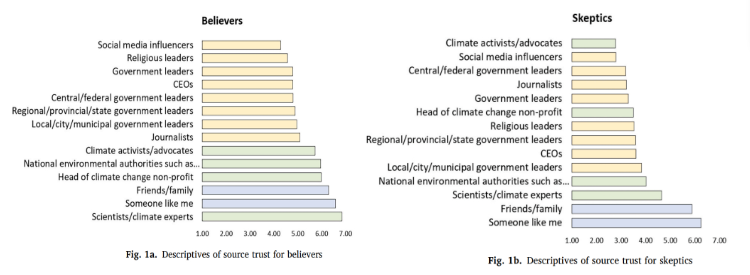
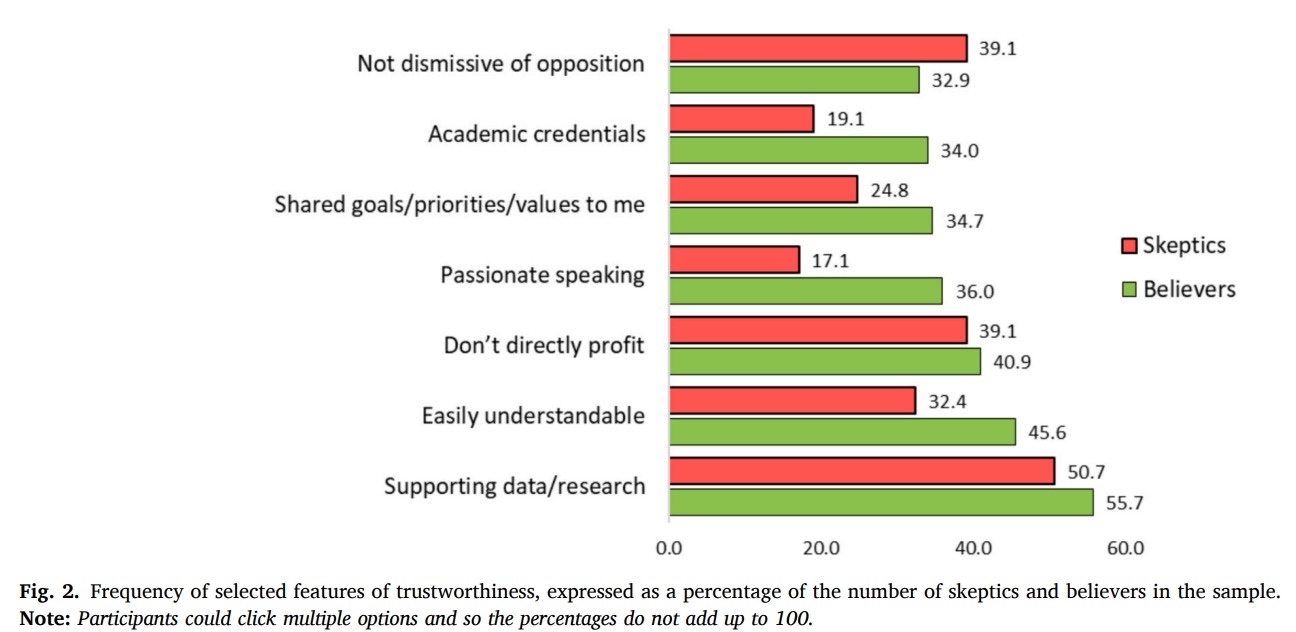
The survey also asked about which features made messengers seem trustworthy. Believers placed the greatest value on having supporting data and communicating in easily understandable ways. In contrast, skeptics were more likely than believers to select “not dismissive of opposition” as a marker of trustworthiness. “Academic credentials” were also less compelling to skeptics, who selected them at 19% compared to the believers’ 34%.
Ultimately, the study signals that trust is not inherent to a particular message or messenger, but that it emerges from an interaction between audience and communicator. With “friends and family” and “people like me” among the most trusted sources overall – especially among climate skeptics – the researchers suggest that policymakers might leverage trusted lay networks, like peers and community leaders, for climate communication. So if you feel strongly about climate change, maybe try talking to your neighbor.
————–
Nicole Bekesz is a first-year PhD student in the Geography, Environment & Society department. She is interested in critical Climate and Environmental Justice, particularly in urban contexts.
Comments