
Archive: Jan 2021

Image: a White man’s hands in handcuffs behind his back. Image courtesy of pixabay and Pixabay License.

In 2019, nearly 72,000 Americans died from a drug overdose — more than car accidents or gun violence. Over 50,000 of those deaths involved opioids. Drug overdose deaths have been on the rise for the past twenty years, with deaths increasing fourfold

Katherine Beckett and Marc Brydolf-Horwitz wanted to know whether states had altered drug policies in response to the opioid crisis. The researchers reviewed US state sentencing statutes between 2010-2016, as well as drug arrest and imprisonment records in a similar time frame. With the rise of the opioid crisis, the authors hypothesized that the drug war is de-escalating and that White drug users would see the greatest decline in punishment. The War on Drugs that began in the 1970s overwhelmingly targeted Black communities, contributing to the rise of police brutality and mass incarceration. What they found surprised them. 

Contrary to their prediction that White drug users would disproportionately benefit from policy changes, drug arrests decreased more sharply for Black people in the last decade. While Black people remain considerably overrepresented in drug arrests, 31 percent fewer Black people were arrested for drugs in 2018 than in 2007. Further, the number of Black people incarcerated in state prisons due to a drug conviction fell by 53% between 2012 and 2017.

Beckett and Brydolf-Horwitz think geography could explain this decline. Drug arrest and imprisonment rates decreased in urban areas but increased in suburban and rural areas. Since urban areas are typically more racially diverse, this geographic trend could explain why Black people were arrested and imprisoned at lower rates. This trend could also explain why drug arrest and imprisonment rates did not fall for White people, because many suburban and rural areas remain predominantly White. 

While further research is needed to understand these shifting patterns in drug arrests, the most recent War on Drugs appears to be slowing down. And this decline is significantly narrowing the racial disparities between Black and White drug arrests. The racial injustices of previous drug scares and the tragedies of the opioid crisis cannot be undone, but these trends demonstrate that meaningful changes are underway in state drug policies.


Image: A Group of White Hands Toasting Alcoholic Drinks. Image via pixabay, Pixabay License.

Since the beginning of the pandemic, internet memes have made light of people’s use of alcohol to cope with the stress and isolation of social distancing and virtual work and schooling. The corresponding rise in alcohol sales and consumption has raised questions about how isolation and loneliness contribute to drinking. New research by Eric Vogelsang and Joseph Lariscy, however, concludes that increased social participation may actually increase drinking, particularly for older adults.

Using the Wisconsin Longitudinal Sample, a long-term survey of a random sample of Wisconsinites who graduated high school in 1957, Vogelsang and Lariscy ask how participants’ families and social networks influenced their alcohol consumption in their sixties and seventies. 

The authors found that greater social participation was associated with more drinking days per month. Respondents who met with friends regularly, participated in group exercise, or attended arts or cultural events had more drinking days per month compared to respondents who did not engage in these social activities. One measure, meeting with friends regularly, was also associated with greater chances of participating in “at risk” drinking, or having more than three drinks at any one occasion.

The long duration of social distancing means that many Americans are missing their friends and family members, and some have begun drinking more. However, this research suggests that decreased social interaction may curb alcohol consumption among older adults, a population that is vulnerable to the health risks of alcohol abuse and facing increasing rates of substance abuse. Such findings remind us of the  potential “dark side” of social support, which may encourage negative health behaviors through peer pressure, relaxed norms, or providing more opportunities for substance use.

This image has an empty alt attribute; its file name is writing-1149962_1920-600x400.jpg
Image: a man fills in paperwork with a pen. Image courtesy of pixabay, CC0.

Originally published November 19, 2020.

From 1900 to 1978, between 25 to 35% of American Indian children were forcibly removed from their homes. Federal officials used this practice to colonize indigenous lands and undermine tribal sovereignty. In 1978, Congress passed the Indian Child Welfare Act (ICWA) which created new legal protections for Native children in child welfare cases. At the time, this legislation was considered “the most far-ranging [Indian rights] legislation ever enacted.” Despite this legislative success, American Indians continue to be disproportionately represented in foster care, continuing the legacy of child removal.

Under the ICWA, state officials must determine whether or not a child is American Indian In order to apply these new legal protections.How do state agencies and officials decide if a child is American Indian? Hana Brown examines how state child welfare agencies, state courts, and federal courts implemented the Indian Child Welfare Act between 1978 and 2018. Analyzing state archival data, she explores how these agencies identify Native children and the consequences of those everyday decisions.

Brown explains that American Indians are classified as both citizens of sovereign tribal nations and as racialized minorities. Although the ICWA applies to citizens of tribal nations, caseworkers and public officials often applied the law based on race, not citizenship. For example, a caseworker may think a child “does not look Native” and marks them as non-Native. By assuming who “looks Native,” the caseworker treats citizenship status as something that is visible. In doing so, they racialize American Indians. When state workers misclassify Native children, they deny the sovereign legal rights of both individual children and tribes. In short, this misclassification strips away the tribe’s agency in child welfare cases of their own citizens, halting the progress of the Indian Child Welfare Act.

Native children have a unique set of legal protections due to tribal sovereignty. While the ICWA combats the legacy of child removal in American Indian communities, the application of the law does not always enable these added protections. This research shows how legislation advancing racial justice or tribal sovereignty is often just a first step toward equality. The force of such laws is determined by the small, everyday moments in which the rules are applied. Without this analysis, we overlook how state actors may reproduce inequality and undermine sovereignty, even when they attempt to rectify it.

This image has an empty alt attribute; its file name is church-pews-600x240.png
Image: low camera angle photo of church pews facing the front of a sanctuary. Image courtesy of pixabay/marcino.

Originally published April 22, 2020.

The Rev. Dr. Martin Luther King Jr. famously proclaimed that Sunday mornings contain the most segregated hour in America. MLK was talking about churches in 1960. Today, a small but growing reality is a move toward multiracial churches. These churches create a unique situation in which Black pastors have a seat at the table in predominantly white institutional settings. But, as recent research demonstrates, white pastors benefit more from leading a multiracial church. 

 Christopher Munn conducted a qualitative analysis using a national, stratified sample of 121 religious leaders to understand how race shapes inequality in multiracial churches. He looked at multiple social contexts (i.e. mentorship, leadership positions) and material resources (i.e. grant funding) that each leader described, weighing each social relationship by its potential benefit and perceived durability. Munn found clear racial differences in social capital, or the resources that come from social relationships.

First, white pastors hoard capital. They trap resources by sharing primarily with other white network members. This looks benign on the surface, as it commonly takes the shape of things like peer mentor programs, sharing social ties, and informal exchanges of resources in general. But access to these embedded resources is mostly limited to white men, and to a lesser extent white women. 

Second, Black pastors found a more symbolic seat at the table, in which their contributions were devalued and their access was restricted. For example, they could be paid a small sum for leading a diversity workshop for other church leaders, but were unlikely to find the more sustainable funds that white pastors were more able to access. 

In a telling example, a white male pastor serving on the board for a local healthcare system befriended the hospital’s CEO, and now his church’s nonprofit housing initiative receives $100K/year from that hospital. Racial inequality in wealth and access continues to matter, even in the leadership of religious organizations. 

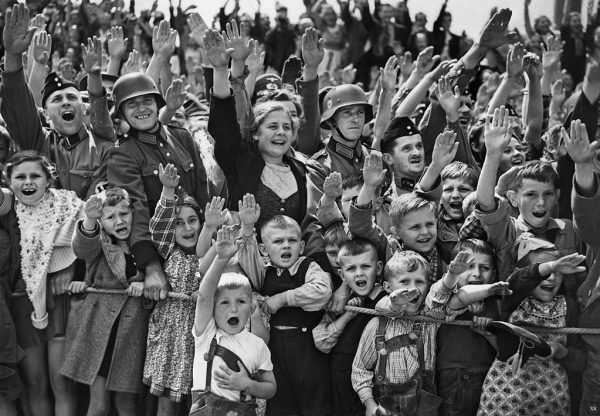
Image: Children, soldiers, and women engage in the Nazi salute. Image via James Vaughan, CC BY-NC-SA 2.0. The legacy of Nazi perpetrators echoes through generations.

When learning about the role that their community members and/or loved ones played during the Holocaust, descendants of Nazi perpetrators can experience a wide range of emotions: shame, anger, sadness. These emotions stem from the trauma and stigma that many Germans experience as a result of grappling with the ongoing, historic aftermath of the Nazi holocaust.  In a recent article, Joachim Savelsberg explores the relationships between cultural trauma and stigma to better understand how Germans manage these emotions.

Savelsberg analyzes family histories written by the descendants of Nazi perpetrators and one victim. He asks: How do the children and grandchildren of Nazi perpetrators make sense of their family’s history and their own existence? For example, he explores how family members grapple with learning that their family members was a Nazi perpetrator and having to consider their role in the Holocaust. Within the pages of these family histories, Savelsberg identifies three ways in which the descendants of genocide perpetrators manage the stigmatized knowledge that their loved ones took part in the Holocaust.

Many authors attempted to silence the past. For example, one author describes a curtain used to cover the lower shelves of his grandfather’s library. It was only after the grandfather’s death that the curtain was pulled back to reveal Nazi propaganda. Denial was also a second typical response. Perpetrator’s family members struggled to search for and acknowledge their family histories while also preserving their family member’s integrity. Interestingly, even after revealing the shelves of Nazi propaganda, such family members sometimes felt the need to express the belief that their grandfather was a good man. Lastly, Savelsberg discusses acknowledgment and confessions, as the authors and family members of perpetrators confessed their own guilt about not asking about their elder’s troubling past.

Through these stigma management strategies, the family members of perpetrators try to reconcile the painful reality that their family members were involved in perpetrating genocide. These findings show that even decades after mass violence, cultural trauma is prevalent among the descendants of perpetrators. The children and grandchildren of Nazi perpetrators struggle to manage the stigma of being related to a genocide perpetrator while also trying to maintain family loyalty and emotional ties. These findings point to the importance of understanding that those who commit mass violence are not monsters, but rather, they are someone’s loved one.