myspace

In the social sciences, we often hear about, talk about, and preach about the relationship between theory and methods. Here, I present a poignant example their interconnectedness.
In a recent post, I argued that the accomplishment of authenticity in a cyborg era is particularly difficult. Drawing on Goffman, Turkle, and others, I argued that we live in a time of constant documentation, exposing the identity work that is supposed to remain hidden in the so-called “back stage.” I purported that our online and offline selves are not only mutually influential, but that we also engage in preemptive behavior in order to accurately present our ideal selves through multiple mediums.

Overall my theoretical point is this: As social actors we expect authenticity in others, and in ourselves. In a time of constant documentation, our online personas become our reflections, and they must not only be ideal, but also truthful. As such, we do not document falsehoods, but preemptively create documentable situations in an effort to present a self that is simultaneously ideal and authentic.

Here is the methodological conundrum: If the constructed nature of selves and identities must remain hidden not only from others, but also from ourselves, then how can we get people to talk about the labor involved in the identity construction process? In other words, how do we support the theoretical assertion? more...
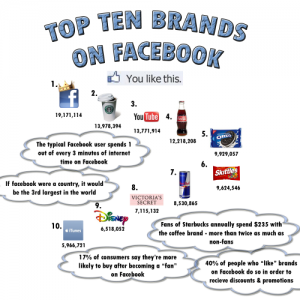
Advertising on social media is more than those segregated paid-for-spaces that display ads paid for by companies (e.g., on the far-right of your Facebook screen). This sort of paid-advertising has been shown to be so highly ineffective that some have predicted it will be the downfall of the social web. However, these predictions do not understand that the fundamental point of the social web (2.0) is that users are prosumers; they are simultaneously both consumers and producers of content. And advertising is no different. Advertisements that we simply consume worked in a consumer medium, like television. However, social media is a prosumer medium, and today we are the ones doing the advertising work of integrating corporate logos and branding into our profiles and news feeds.

Facebook’s ubiquitous “like” button reflects our modern task of self-presentation (and distinction) based on our taste in just about anything and everything, documented and compared to the various “likes” of any other visitor to your profile (and remember: what someone “likes” may not be what they actually like but what they want others to see that they like). In modern consumer culture, this collection of displayed “likes” will include corporate brands that one identifies with. This might mean clicking “like” on the Starbucks or Victoria’s Secret pages, which then becomes a part of your profile. more...

Because I am usually trapped in the Sociology Department’s data dungeon on Wednesdays, I have decided to establish a recurring series of posts that discuss new trends or data.

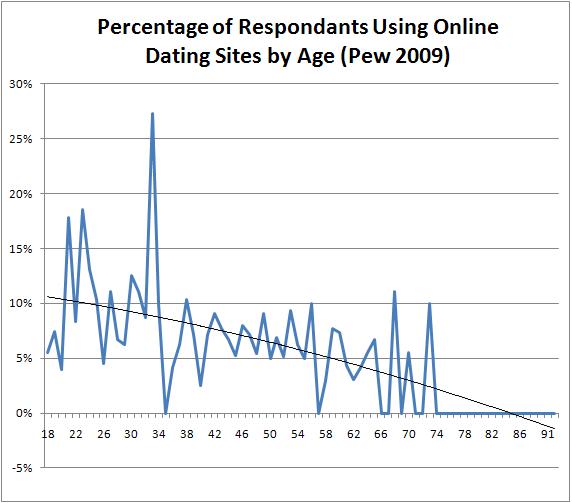
Last week, I compiled some data from a 2005 Pew study to explore whether college students are using Online dating.  I’ve now replicated that chart for Pew’s 2009 data.What’s most striking about these data is their sizable departure from the 2005 data.  Particularly, because the movement is opposite of the expected direction (i.e., upward).  more...

The cyborg is a technologically-enhanced human. While we recognize and even play off of the campy sci-fi/cyberpunk vision of a half-robot that is conjured up by the term “cyborg,” our vision of the cyborgour topic of study for this new blogis at once more sophisticated and more mundane. We believe that the cyborg concept is epitomized by the ordinary person living in the 21st Century, whose everyday activities are seldom, if ever, independent of technology, whether they be for communication (e.g., cell phones and other electronic communication devices), bodily enhancement (e.g., medicine and specialized articles of clothing), or self-presentation (e.g., fashion or the social media profile).

Our fundamental thesis is that technology (exemplified by social media) alters who we are, how we interact, even how we define reality. And, in turn, we continuously alter and define these technologies. All of reality, including ourselves, has been augmented by technology of some sort, and all technology has been augmented by our sociality. As such, we are all cyborgs. And the study of this blurring of technology and social reality is cyborgology.

Facebook has become the homepage of today’s cyborg. For its many users, the Facebook profile becomes intimately entangled with existence itself. We document our thoughts and opinions in status updates and our bodies in photographs. Our likes, dislikes, friends, and activities come to form a granular picturean image never wholly complete or accuratebut always an artifact that wraps the message of who we are up with the technological medium of the digital profile. more...