
Council on Contemporary Families

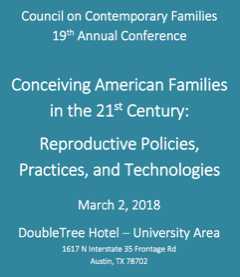
Picture featured in the Conference Program

If you couldn’t come to CCF’s 19th conference, Conceiving American Families in the 21st Century: Reproductive Policies, Practices, and Technologies, you don’t know what you were missing. So I’m here to tell you. Held on March 2nd in our new single-day format, it was a great success and the theme could not have been more timely. Individual rights, freedoms and immunities are being fiercely debated globally and locally, and if, how and to whom babies are born are part of that debate. Throughout the day, issues of positive and negative rights related to reproduction were a recurring theme in lively presentations and discussions.

The theme of individual rights influenced the conference even before it began this year. Traditionally, we convene at our organizational home, which has been UT Austin since 2015. However, Texas has recently implemented a campus carry law, which gives individuals the right to carry licensed concealed handguns in public university conference rooms. Some states have since denied travel funding to presenters invited to speak at these institutions. Considering safety and funding concerns, our diligent co-chairs, Adina Nack and Josh Coleman, changed locations to the DoubleTree hotel nearby, where firearms are prohibited.

Our flexible co-chairs continued to work around hurdles shortly before the conference began. Illness prevented keynoter, Mary Mason, from coming at the last minute so her Babies of Technology co-author and son, Tom Eckman, took the podium alone. We heard startling stats on the $100 billion worldwide assisted reproduction market, and examples of how the rights of the child can get lost in the for-profit designer baby marketplace. We learned about new technologies such as CRISPR-Cas9 gene editing techniques that can snip defective disease causing genes and keep them from being passed on to offspring. When or if this technology is ready for prime time, who will have the right to decide what genetic defects will be permanently removed from family lineage? What will be the unintended consequences of permanently altered DNA?

Our second keynoter, Carole Jaffe, gave us stunning examples of coercive reproductive policies, and how denial of access to adequate family planning services disproportionately affect poor, black, and brown women. She noted that maternal mortality is three times higher for black women than white women, and fifty-five percent of births today are to mothers receiving Medicaid. These women are trapped in a system with insufficient birth control choices, lack of access to termination of unwanted pregnancies, and inadequate healthcare after birth. In her talk, Amanda Stevenson also pointed out the coercive state policies that result in disproportionate distribution of IUDs and implants to Medicaid recipients in Texas.

Lisa Ikemoto and Sharmila Rudrappa eloquently illustrated how laws banning commercial surrogacy, which are intended to protect working-class women’s rights to fair compensation and treatment, can backfire. In some countries, women end up even more vulnerable as they move across borders to places where state immunity decreases their control over compensation and care. We learned how regulation rather than outright banning can protect women’s rights and give women more control over their surrogacy.

Teresa Morris raised questions about who is protected and who is vulnerable during prenatal care and delivery. For example, although 99.8% of the problems detected via continuous fetal monitoring are false positives and expose the mother to additional radiation, continuous monitoring persists to lower malpractice risk. Since the C-section is the “gold standard of care” in malpractice court cases, a dramatic rise in U.S. C-sections may also be attributed to provider liability concerns that trump maternal health considerations.

I could go on. All our presenters brought something new, enlightening, counter-intuitive, or clarifying to the table.

A hallmark of all CCF conferences is the generous time devoted to Q & A. Negative and positive reproductive rights dominated these lively discussions as well. Some hot topics were: How will legal and ethical codes regulate the eugenics of commercial surrogacy, when cryobanks broker higher prices for “fair complexion” “Ivy League”, and “celebrity look-alike”? How are babies being treated like commodities rather than a public good? What complex immunities and injustices will the new Conscience and Religious Freedom rule usher in? For example, under this rule, what happens to frozen embryos when the private hospital that stored them is taken over by a Catholic hospital?

As you know, CCF’s mission is to disseminate robust family research and best practice findings from diverse disciplines to a broad audience. This year we expanded our reach by including two non-academic speakers who founded community organizations that educate the public about family issues. Mo Cortez is an intersexed, trans, Latino man who co-founded the Houston Intersexed Society for this purpose. His personal stories about reproductive injustices and denied rights in the intersexed and transsexual communities hit home viscerally. Marsha Jones, co-founder and executive director of the Afiya Center, shared stories of black women who are not supported for fertility control, pregnancy termination, healthy pregnancy or healthy baby. Both speakers contributed such rich additions to the human rights and justice conversation that we will hopefully be adding more community educators to our rosters in the future.

Several features that make CCF conferences special were brought back by popular demand. Flash Sessions, which allow budding researchers to present their work in five minute summaries, were thought-provoking and left us wanting more. We were also left wanting more at our fabulous Media Workshop. Stephanie Coontz, CCF Director of Research and Public Education, gave us cutting edge tools for producing op-eds that stand out. Board member Philip Cohen, who founded the SocArXiv.org open archive for social sciences, and the popular FamilyInequality blog, brought us up to speed on social media and blogging do’s and don’ts. Board member and UMass economics professor, Lee Badgett, shared her insights from her latest book, The Public Professor.

The CCF Media Award went to noted ProPublica and NPR reporter, Nina Martin, for her outstanding reporting on abortion, pregnancy, and maternal health. Two 2017 pieces, Nothing Protects Black Women From Dying in Pregnancy and Childbirth, (NPR audio here) and The Last Person You’d Expect to Die in Childbirth are brilliant examples of her recent work.

Hat tips to all who made the 2018 CCF conference possible – our phenomenal organizers Josh Coleman and Adina Nack, CCF Executive Director Jennifer Glass, her above-and-beyond grad assistant Rachel Donnelly, and all of our UT co-sponsors. And special thanks to Pam Smock, for her generous donation that allowed CCF to fund an early career student scholar travel award. This year’s award went to Elizabeth Nalepa, of Case Western Reserve with honorable mention to Maurice Anywie, of Bowling Green State.

This report is a conference tasting menu. For more on this year’s content, go to this link. If you missed this year, another theme is already in the works for 2020. Manage your FOMO (fear of missing out), stay tuned and hope to see you next time!


Virginia in Shaw, DC. credit: Dean Manis

Virginia Rutter was the founding editor of the Council on Contemporary Families Blog—CCF @ The Society Pages — which was launched in 2014. CCF@TSP is a venue for reporting on new research, policy reports, and current events. A particularly valuable feature of the blog has been the inclusion of undergraduate students, who have had the chance to engage with the substance of family sociology and the opportunity to address broader audiences. Virginia steps down in April, and I will be taking over. Here are some questions I had for Virginia before she leaves us:

AK:  What were some of your favorite blog posts that you edited in your tenure as editor of the Council on Contemporary Families blog?

VR: I’m still delighted with the title for Braxton Jones’s October 2016 post, As American as Divorce, which was a round-up of interviews done about research and commentary on divorce. But, Secular Listening at a Brainstorming and Prayer Meeting on 11/9/16 by Sarah Diefendorf, about the reaction by Evangelicals to the election of President Trump, was a wonderful, generous, quick turnaround piece of writing dealing with just a shocking, shocking day. I felt like Sarah had gone off to do the best kind of meditation for a sociologist to do on WTF had just happened the day before: She studied it. Respectfully, thoughtfully, effectively. And she told us a bit of what she heard, and so told us also about her own process in that strange time. The post went up two weeks after that 2016 election day. At that time it was hard to talk about the election, about people, about factions, and yet so hard not to do so. She did it, and it was a great post.

AK:  What is your advice for a blog writer who wants to write a successful blog post? What are some common missteps?

VR: The great thing about blogging is whenever you’ve said something you want to put out into the world, that’s success. But at CCF@TSP a few things work well: Make it short. Make one point. Don’t be cutesy or corny or cliché. You aren’t writing a scholarly paper, but you do have to support or substantiate what you have to say.

So, to make it short: Edit yourself, just take the time to streamline it sentence by sentence. To make one point, try reading your post backwards, paragraph by paragraph. You might see that you have more points than you need. You can always keep the multiple directions—there’s really no limit on space!—but make that decision consciously. Remember, that stray point could be the start of a separate post.

A few other rules: Try to make your title short, too. Provide the editor with open source artwork to go with your post, and embed good links to key references. Here or anywhere, know the website you are writing for; read other people’s posts there. That will teach you what to do and what not to do better than anything else.

AK:  What are you looking forward to doing with all your free time now that you will no longer be managing this blog?

VR: Yes, like other professors at underfunded state universities fighting for our contract, I am mostly, but for the occasional blogging, a lady of leisure. Just kidding. I have a project right now that focuses on connecting students from underrepresented groups to people just like them in professions they want to pursue. And at this very moment, I am completing a report about a family diversity and change teach-in we held last fall at Framingham State. It involved a digital photography installation, SHOWING (workxfamily), and about six weeks of campus events including about 65 classes that incorporated the exhibition into their subjects—from physics to English to (of course) sociology.

Virginia Rutter is Professor of Sociology at Framingham State University. Follow her on twitter at @virginiarutter. Arielle Kuperberg is an Associate Professor of Sociology at the University of North Carolina at Greensboro. Follow her on twitter at @ATKuperberg.

In preparation for the Council on Contemporary Families’ March 2 Annual Conference, Conceiving Families in the 21st Century, the Council asked speakers and CCF Senior Scholars to submit recent research related to the facts and dilemmas of the legal, medical, and social creation of families. The result: Unconventional Wisdom, vol. 7 (out today!) is a highly readable, non-technical survey with fifteen research updates, edited by Joshua Coleman and Stephanie Coontz. Psychologist Coleman and historian Coontz edited the first edition of Unconventional Wisdom in 2007. Eleven years later, the CCF’s new report concludes with a focused, annotated resource list of recent trends and useful facts related to reproductive health and policy.

Coleman, who with Adina Nack (California Lutheran University) is co-organizer of CCF’s upcoming conference, notes that, “Technology, medical advances, health policies, and social change have shaped the new frontier of reproductive health care. Those who receive and provide services face new possibilities and uncharted risks.” As Unconventional Wisdom highlights, the concepts and realities of sex, gender, sexuality, parenthood, and family in the U.S. reflect increasingly complex and inclusive definitions.

For example:

·      As reported by Mary Ann Mason (University of California-Berkeley), a 2013 international study determined that five million babies had been born from assisted reproductive technology. Hard figures, not to mention outcomes for surrogates and infants, are hard to track, with dire consequences for all, including the children who are created. Professor of Law Lisa C. Ikemoto, notes that global businesses evade restrictions enacted by governments to move ova, sperm and embryos, infertility specialists, egg donors and surrogate mothers across national boundaries.

·      Research shared by Caroline Sten Hartnett (University of South Carolina) shows that categories of “intended” versus “unintended” pregnancy don’t capture how women think of their births.

·      A less-considered way of making families includes those who are not having children: Amy Blackstone (University of Maine) advances information about how well those families are doing.

·      Not all can rely on families to advance for well-being. Rutgers (Camden) sociologist Joan Maya Mazelis’s brief highlights community organizations aimed at helping impoverished people with no family to help out.

·      What does college debt have to do with making families? Arielle Kuperberg (The University of North Carolina-Greensboro) reports on how debt influences how and when women (but not men) have children.

Background data to support fresh stories

This year, Unconventional Wisdom also features an annotated list of sources with research highlights from each study, produced by CCF intern Selena Walsh Smith (The Evergreen State College). Topics covered in this section include: studies that show how difficult life is for mothers and children when the pregnancy is experienced as unintended; the benefits of contraception; racial disparities in infertility and maternal mortality; how the U.S. has the highest infant mortality rate among 19 of the world’s richest countries; and other facts about the gains, losses, and gaps in reproductive and child health.

Below is the full table of contents for this easy-to-use report.

Reproductive Tourism: Opportunities and Cost….2

New Babies of Technology: Where is the Voice of the Child?…. 2

Banning Surrogacy Can Be Harmful to Women and Children…. 3

Women in Affairs: Cheating to Save the Marriage…. 3

10 Common Questions of Intended Parents through Egg or Sperm Donation…. 4

Adoption: Are Genes More Powerful Than Parents?…. 4

Women’s Experiences of Intended and Unintended Births…. 5

Reproductive Health Services in the U.S.: Too Much or too Little?…. 5

Where the Millennials Will Take Us: Gender Policies among Young Adults…. 6

LGBTQ Grief over Miscarriage and Failed Adoptions Increased by Discrimination…. 6

More People than ever are not having Babies and They’re Doing Just Fine…. 7

The Opposite of a Shotgun Wedding – Getting Pregnant and Moving Out…. 7

Not Everyone can Rely on their Families when they are Desperate, and for Poor People, it Matters…. 8

Student Loans are Changing our Families in Surprising Ways…. 8

If You’re Infertile, Why Use Condoms?…. 9

U.S. Reproductive Health and Policy Facts…. 10-14

Intended and Unintended Pregnancy – 10

Benefits of Contraception; Consequences of Unintended and Unwanted Births – 10

Infertility and Miscarriages – 11

                 Maternal Mortality – 12Infant and Child Mortality Rates -13

Gains, Losses, and Gaps in Reproductive and Child Health 13-14

Greetings from the Council on Contemporary Families, and welcome to our new blog!CCF Logo hi res

We’re delighted to join this community at The Society Pages as we create more online opportunities for scholars and clinicians to share grounded, individual reflections on research, open dialogue for questions and debates, as well as to share ideas for instruction and for clinical practice.

The new CCF blog, Families as They Really Are (like our CCF-edited book of the same name) presents a range of views from researchers who aim to provide the most current and best information about American families. The blog features posts on teaching family topics, as well as op-ed style essays about key issues that arise.

Our blog adds to CCF’s outreach of well-established brief reports, fact sheets, and symposia—the ones people often see covered in the press. For the past 18 years, CCF has taken the lead in sharing carefully vetted research in our brief reports which we send out to news media. Now, we will also post new briefs at The Society Pages.

At CCF, we are united by a passion to give the press, public, and students access to solid research and data-based answers about how and why families today are changing, what needs and challenges they face, and how these needs can best be met.

For more CCF updates between blog posts, like us on Facebook and follow us on Twitter.