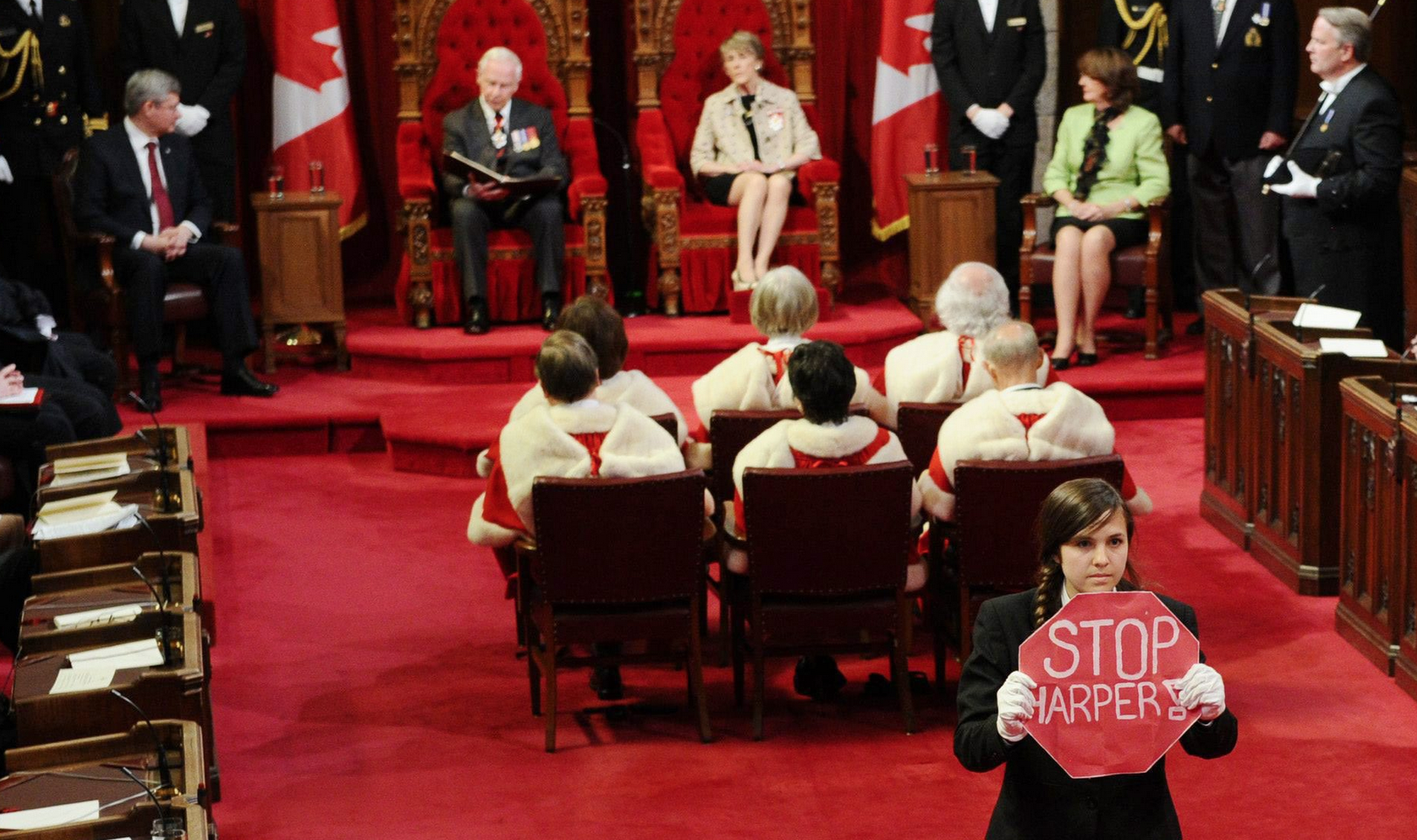
Some say the Throne Speech’s reading in the Senate was not the place, tut tut. The easy group think response rears its head right from the get go. It allows you to give a nod to the sentiment of protest but just say, well, maybe it should have been somewhere else. Essentially agreeing with the protest then, which is the most important aspect. But if it had been somewhere else, it wouldn’t have achieved a fraction of the impact.
Canada is in the midst of a federal election and you can read posts covering it by myself on r h i z o m i c o n and Impolitical on our respective blogs. Lorne Gunter in the National Post is mad as hell and he’s not taking it anymore. His beef? All of this social media in politics hoopla::
“Oh, please, spare me. Social media – services such as Twitter and Facebook – are not going to swing the current federal election away from the Tories and in favour of the Liberals, NDP or Green party, no matter how much anti-Harper activists and reporters wish they could.”
While he acknowledges that social media is a useful tool, he’s also making sweeping generalizations about their effects::
“But they don’t win or lose elections on their own (or pull off Middle Eastern revolutions), no matter how much social media devotees in newsrooms and elsewhere claim they do.”
“The Vancouver Sun story claims 2 million web surfers quickly hit on the www.shitharperdid.ca site. Great, so they went to a site run by like-minded lefties and had their prejudices confirmed. Whoopee.”
He drifts into a Malcolm Gladwell argument that social media promotes just “one click activism” and doesn’t really engender any real persuasion. Here on ThickCulture, we have discussed Malcolm Gladwell’s downplaying and concerns about social media in the social activism arena, here, here, and here.
Lorne argues that social media campaigns are largely ineffectual, citing anti-prorogation and strategic voting efforts. Then, he loses it and goes off on Harper Derangement Syndrome as the latest manifestation of a leftist affliction along the lines of Bush Derangement Syndrome. Well, the left has no monopoly on demonizing the other side.
The problem with Lorne’s analysis is his narrow definition of success and assumption that social media merely preaches to the converted. There are three things wrong with what he’s saying:
It assumes a narrow definition of efficacy
It ignores the “mere exposure” effect
It ignores the marketing concept of “segmentation”
Efficacy
Gunter suggests that social media doesn’t win elections on their own, but nobody is really advocating that they are. Naheed Nenshi, the Calgary mayor whose campaign last fall was attributed to the use of social media notes that his campaign was based on ideas. Social media helped to personalize his campaign to make it salient to voters. I don’t think Gunter would quibble with this, but I think he underestimates the effects of content that “preaches to the converted” and the persuasive effects of content that goes viral.
When the March 2007 anti-Hillary Clinton Vote Different video went viral {posted by a designer who worked for the firm that designed Obama’s website}, Obama’s polling numbers didn’t budge. Guess what? That month, his contributions did, quite considerably. My point being is that the effects of social media may not be straightforward and political strategy needs to take account of this. The preaching to the base aspect of social media that Gunter views as a waste of time can help a campaign motivate its loyals and turn them into activists. Social media can also increase the exposure and salience of a party, which segues into the next issue.
The “Mere Exposure” Effect
Decades ago, social psychologist Robert Zajonc found that people can be persuaded to have positive inferences about an object {or brand, party, or candidate} through increased exposure. So, controlling for aesthetics and other source material and content characteristics, Zajonc found that increasing exposure leads to higher favourable attitudes. In effect, a “familiarity breeds contentment” route to persuasion that doesn’t require any real substance to the content. This explains how the ubiquity of Starbucks builds the brand with relatively little advertising. Social media can have the same effect. Anti-Harper sites can persuade by just going viral and entering into voter consciousness. The challenge is cutting through the clutter to get that exposure, i.e., coming up with something that resonates and goes viral.
Segmentation: It’s the Young Voters, Stupid
A big topic this election is the youth vote. The 2008 turnout for those 18-24 was 37%, compared to 58% overall, a historic low. Interestingly, some view this as likely to worsen, as prevailing attitudes deem voting as a choice rather than a duty [Also, see StatCan 2005 pdf youth voting/civic engagement report]. The youth vote is a prime target of sites like shitharperdid.ca and the youth…have more of a tendency to not vote Conservative. Getting the youth mobilized, along the lines of the Rock the Vote campaign in 1992, is tricky business that cannot be easily replicated. Nevertheless, sites targeting the youth aren’t necessarily “one-click activism” that has no effect.
It’s About Engagement
At the end of the day, engagement matters. I think it’s the height of arrogance for Gunter to state that social media cannot swing the federal election. I’m curious what Gunther’s thoughts are on the Conservative Party’s efforts to use the web and social media to scare voters about how there “might” be an iPod tax with false claims that IP expert Michael Geist has debunked.
The A Channel news in Victoria gets it, as does NDP Leader Jack Layton who used the Twitter term “#fail” {hashtag fail} in the English debates last week::
The idea that social media can increase youth engagement of “square” politics through sites young people use and help to make politics less intimidating are part of the democratizing potential of the web.
The talking points were deployed to downplay the attack, as if little of consequence had happened. Prime Minister Harper and Toews spoke on Thursday about the matter, Harper in what seem to be newly perfected dulcet tones that characterize his manner in recent months:
But he said at a press conference in Toronto that he recognized cybersecurity was “a growing issue of importance, not just in this country, but across the world.”
He added that in anticipating potential cyberattacks, “we have a strategy in place to try and evolve our systems as those who would attack them become more sophisticated.”
Public Safety Minister Vic Toews said he could not speak about details pertaining to security-related incidents, but he said the government takes such threats seriously and has “measures in place” to address them.
Lulling Canadians to sleep, as they so expertly do. It’s as if nothing, really, bothers these guys. Cyberattacks are everywhere, not just in Canada. What’s more, they explained, a government strategy is in place, the October launched strategy. The Harper government strategy is so successful, in fact, that the computers of Treasury Board, Finance and National Defence have been attacked over the past few weeks and the hackers “also cracked into the computer system of the House of Commons.” The severity of the breach is canvassed in the video report from CBC below, which reports the hackers “trolled government networks for weeks without a trace” for example. See also this expert: “…even in just a few seconds, if it was properly targeted — and it sounds like it was targeted — information of immense value could have been exchanged.” It’s a heck of a strategy that’s in place.
Canadians have been told there will be no effect on the upcoming budget, presently thought to be forthcoming on March 22 or March 29, a budget which will be a confidence vote and could see the defeat of the government, provoking a spring election. How the government is able to assure us, however, that no information pertinent to the budget has been lost is unclear. A security expert cited in the New York Times reporting on the breach was not convinced. We can imagine the fallout if the day after the budget were to be released any suspicious market moves were to occur. That’s a matter of speculation at the moment, given the uncertainty surrounding the hacking and the inability to get definitive information, but it’s something for rational observers to consider. How the government acts now in respect of the budget is something to watch. Indeed, on Friday, the Prime Minister engaged in sudden budget consultations with the leader of the fourth largest party in Parliament, the New Democratic Party. Whether this attack has factored into that consultation to any extent is anyone’s guess, given that there are other major controversies facing the Conservative government at the moment that may just as likely motivate them to stave off an election (they need only the support of one of the three opposition parties in order to survive a confidence vote).
Other points of interest surrounding Canada’s efforts on cybersecurity and this recent attack…
It’s worth wondering what’s been done prior to and since Toews’ hastily arranged Sunday October news conference. Inquiring minds would like to know. Much of anything? It certainly served a useful purpose this week for the government and media to point to the event as an indication of the existence of a government cyberstrategy.
Canada’s Conservative government likes to characterize itself as tough on crime. They budget lots of money to build brick and mortar jails, billions in fact. But the above referenced cyberattack that has come to light fully in the past week, as they say in the online community, looks to be a big fail.
I was taking a break from a stack of work and watched a bit of the Australian Open on TSN here in Montréal. I saw the above attack ad by the Conservative Party of Canada, targeting Liberal Party of Canada leader Michael Ignatieff, and I was wondering if it was recycled, since the rhetoric was rather familiar. After some research, I saw that impolitical, who is always on top of these things, already blogged about the new campaign. In a phrase, “forced and desperate”. This ad is one of several attack ads on the CPC YouTube channel. I could analyze these ads but this overview in the National Post pretty much says what I wanted to say {also has the ads embedded in the post}.
I think strategically this crop of ads is phoning it in. Maybe PM Stephen Harper is believing the hype that he can eradicate the Liberals. This “stay the course ad” doesn’t inspire and only makes sense if the Conservatives wanted to hold onto a comfortable majority in Parliament, not get one::
The rest of the ads represent, in my opinion, muddled thinking and a lack of strategic prowess. The attacks on Ignatieff are saying nothing new and border on making Stephen Harper and the Conservatives look like bullies. Attacking the NDP’s Jack Layton definitely makes Stephen Harper and the Conservatives look like bullies. Plus, here in Québec, the ads are targeting the Bloc’s Gilles Duceppe {in French, but you can get the drift with the on-screen text}::
Layton is a relatively popular leader of a relatively unpopular party. Attacking Layton, rather than the NDP, is an interesting way to go. I tend to agree with the conventional wisdom that a strong NDP erodes Liberal support by splitting the vote on the left, so attacking the NDP only makes sense if the objective is to get converts. If the strategy is to shift support from the NDP to the Conservatives, that’s an uphill battle. In 2010, those polled by EKOS who support the NDP are more likely to support {as a second choice} the Liberals, no other party, or the Greens, in that order, rather than the Conservatives. Attacking Duceppe on his home turf, as opposed to showing the positives of the Conservative Party for Québec, seems downright reckless. Bloc Québécois supporters’ second choice is no other party, the NDP, the Greens, and then the Liberals and Conservatives, in that order.
Over the holidays, I heard a pundit on CBC radio saying that it might be the end of the road for all of the party leaders including Harper. He hasn’t obtained a majority and if this is part of his bid to do so, I think it’s a risky strategy. The negativity runs the risk of coalescing ABC, anything but Conservative, sentiments and fostering strategic voting. While in the US there’s a call to tone down the negative rhetoric, the CPC is turning the heat up.
It’s always better to be lucky than good and I’ve always wondered when Harper’s luck would run out. With this advertising strategy, I wonder if his time is up.
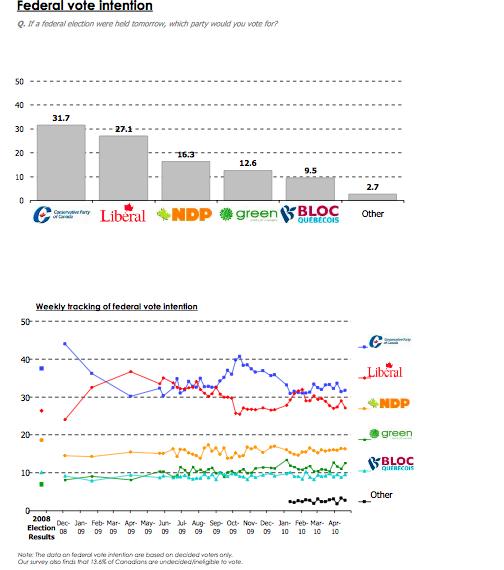
EKOS Federal Voting Intent Poll-Decided Voters, 22 April 2010
Notes from North of 49ºN
In the wake of the bizarre Helena Guergis scandal centred around Conservative Prime Minister Stephen Harper and a MP from Ontario who he kicked out of caucus, the Conservatives held their ground and the Liberals lost a few points. Additionally, EKOS reported that this was the 16th. consecutive poll where no party received more than 33%. The direction of the government poll has 46.6% saying the government is going in the wrong direction and 41.4% saying the government is going in the right direction, with 12% saying don’t know/no response.
The gap in favour of the Liberals in bellwether Ontario is well within the margin of error with the Conservatives polling at 33.1% and the Liberals at 34.6% +/- 4%.
Disillusionment anyone?
One possibly interesting pattern is the stability of support for the minor parties {NDP, Greens, and Bloc} since last October.
Twitterversion:: Post-Guergismania EKOS poll shows Liberals slipping. NDP, Greens, & Bloc with fairly steady %s since Oct’09 #ThickCulture @Prof_K
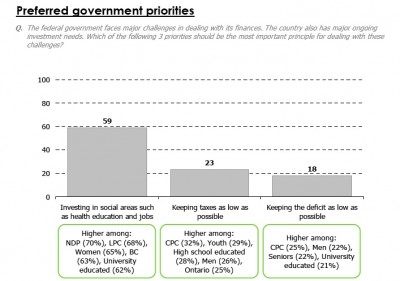
Lower taxes? Controlling the deficit? Nope. Social investment, in areas like health, education, and jobs.
Over a month ago, I analyzed the Canadian federal voting landscape and came to the conclusion that a huge risk for Harper and the Conservative Party is poor performance in Ontario. What Ontarians want is pretty much on par with the nationwide numbers above and the Conservatives have closed the gap in the polling numbers in the province at 34.9%, compared to the Liberals at 38.0% and the New Democrats at 14.3%.
Harper also ended a study to change the Canadian anthem, “Oh Canada” to a more gender neutral version reflecting the 1908 poem that it is based on. The current line, “True patriot love in all thy sons command,” while the poem has the line ,“True patriot love thou dost in us command.” According to an Ipsos Canwest poll, the Conservatives and Liberals were statistically tied in their support by women.
The Conservatives are in the drivers seat but on thin ice. The policy emphases in the budget are risky, in my opinion, particularly given Ontario’s higher than the national average unemployment rate of 9.2% last month. The anger over proroguing has melted like so much Whistler slush. The Liberals have an unpopular leader in Ignatieff and the Dippers have a relatively popular leader of a relatively unpopular party.
Twitterversion:: What Canadians want: investment in social areas. Harper & Conservatives in driver’s seat but on thin ice. #ThickCulture @Prof_K
The above video from YouTube does a decent job of explaining what the big issue in Canada is at the moment, Prime Minister Stephen Harper’s proroguing of Parliament. Proroguing? It may seem like a Sarah Palinism, as in “pro-rogue”, but it’s a suspension of Parliament without dissolving it. Harper, a Conservative, prorogued Parliament last year when the other parties were threatening to form a coalition of New Democrats, Liberals, and the Bloc Québécois. This time around, Harper was being asked tough questions by Parliamentary committees about what his government knew about the torture of Afghan detainees after they were turned over to Canadian Forces. On 30 December, the Governor General, upon Harper’s request, prorogued Parliament until 3 March 2010, killing all bills and suspending all committees. The official reason given was the economy, but nobody bought it.
There were two major results::
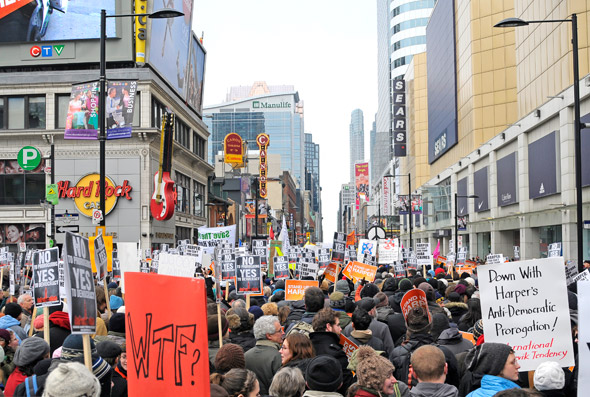
A grassroots effort using social media mobilized sizeable protests across Canada
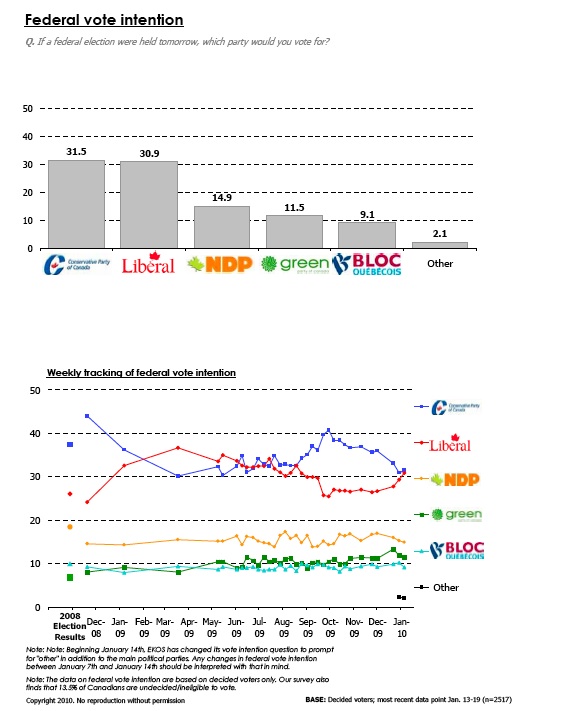
The Conservatives have lost ground in the public opinion polls and are in a statistical dead heat with the Liberals
CAPP Protest 23 January, Yonge St. looking south of Dundas at Eaton Centre
The prorogation of Parliament is viewed by many as anti-democratic {See Rick Mercer’s opinion piece in the Globe & Mail}, although Harper has supporters of his decision. For the time being, anti-Conservative momentum has picked up the pace and support for the Liberals has increased—at the expense of the NDP, Greens, and Bloc.
EKOS Federal Opinion Poll Results:: 4oth. General Election—Mid-January 2010
It’s over a month until Parliament reconvenes. It will be interesting to see if the anti-Conservative sentiments will weather the Winter Olympics in Vancouver and any possible coherent response by Harper. Upon Parliament reconvening, I’m not sure if an election will be triggered. A weakened Harper that’s ready to deal may do more long-term damage to the Conservatives. I’ll be blogging on Rhizomicon within a few days on my detailed analysis of the EKOS poll data, which should make the Liberals a bit cautious about another {expensive} election in the near future.
Up here in Canada, Remembrance Day is coming up on the 11th, so plenty of red poppies have cropped up, which is a Commonwealth tradition. Until Afghanistan, it’s been a while since Canada has been in a “war” and the specifics of getting out of Afghanistan has entered into the news up here. The Conservatives and the Liberal parties in Canada already agreed in 2008 to withdraw from Afghanistan::
“Canada’s top soldier, Chief of Defence Staff Walter Natynczyk, has given the order for Canadian Forces logistics whizzes to begin mapping out the move, expected to be finished by the end of 2011. That’s in keeping with a 2008 deal between the Harper government and Opposition Liberals that extended the combat mission until July, 2011, with a pullout taking until Dec. 31.”
On a sidenote, shortly after Harper’s announcement, news of the pricetag was released. It was reported that by 2011 the military mission in could cost up to $1.8B CAN, or $1,500 per household. While the decision was made last year, the logistics and details of the estimated skeleton crew of 500-600 soldiers to stay behind to protect redevelopment efforts and train local police has remained an open question. In the interim, the war has become increasingly unpopular and according to Allen Sens, a University of British Columbia political scientist::
“Canada’s government and public is suffering from Afghanistan fatigue…There’s been a lack of progress, and I think the public has a sense that it’s time for other countries to step up and move into the south, where the fighting has been the toughest.”
The Obama Factor
The Liberals in Canada are quick to point out the failure of humanitarian efforts. Canada had the objective of building 50 schools by 2011 but because of the instability, only five have been built. So, why should Prime Minister Harper {Conservative} drag his feet on the “drawdown” planning?
“the Prime Minister acknowledged that not every single soldier will return with the combat pullout, and is expected lingering pressure from the Obama administration to help out may lead to a contingent remaining.”
Will Canada cave to possible pressure from the Obama administration to stay? Politically, the opposition Liberals would be wise to shift as much decision-making on Harper and the Conservatives before triggering another federal election, something the Liberals have been threatening for most of the year. Obama is faced with a tough decision and is running out of time. Barack is faced with::
A deteriorating situation in Afghanistan
White House decisions based on reports painting an incomplete picture
The election débâcle in Afghanistan where Karzai won amid fraud allegations
Waning public support in the US of the war
Obama needs to assess whether his objectives can be met in Afghanistan, specifically in terms of what is possible and probable as outcomes, given a flailing domestic economic situation. While the stakes are clearly lower for Canada than for the US and Obama, I wonder if Canada will react to any pressure from Obama to stick around, even with just 500-600 “non-combat” troops. I also wonder if the Liberals will try to push decisions that may irk Obama onto Harper.
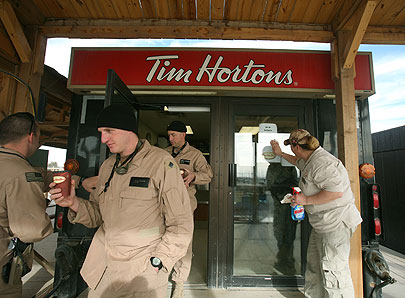
Image:: Iconic Tim Horton’s coffee shop in Kandahar.
Twitterversion:: Canadian Forces pressure deets on wthdrwl fr.Afghanistan. What will Obama do&how will Cdn politcns play it? #ThickCulture http://url.ie/2t3
Notes from north of 49ºN, but at 37.9ºN at the moment.
Regular readers of ThickCulture will recall that I post quite a bit on the topic of Canada from an American expatriate perspective. Way back in May, I blogged about attack ads being aimed at Liberal opposition leader, Michael Ignatieff, framing him as an outsider. Recently, the Liberal Party of Canada has announced their intent to trigger the next election with a no-confidence vote in Parliament. In preparation of this, The Liberals started advertising with spots featuring Ignatieff in a forest. Earlier last week, theGlobe & Mail tried to stir up controversy about Liberal Party of Canada ads featuring Michael Ignatieff in a possibly ersatz forest or a forest that cannot be readily identified. Quite the sin in a timber-bearing land, eh Globe & Mail?
Here are the ads:: “Worldview” & “Jobs”
In my opinion, this constructed “scandal” is meant to stir the pot to get pageviews for the Globe & Mail by feeding the sentiments that somehow he is not as Canadian as everyone else and there is something less-than-authentic about him. Perhaps this was borne out of the media frenzy over the Obama “birthers” movement.
Interestingly, in the French ads {I didn’t have time to translate the copy}, there is no forest and no guitar strumming in the background. Just straightforward delivery::
Strategically, candidates need to think about creating a “positioning” strategy, where they create a meaning system in light of the competition. With voter data on attitudes towards the political leaders {Harper-Conservative, Ignatieff-Liberal, Layton-NDP, Duceppe-Bloc, & May-Green}, multidimensional scaling can be used to try to create dimensions based on the attitudes and positions for each of the candidates along the dimensions. Ideally, candidates differentiate themselves from the others on the basis of salient voter perceptions, i.e., tapping into the zeitgeist. On my other blog, Rhizomicon, I did a post that talked about the increased fragmentation of the Canadian electorate. While the Conservatives are in power with a plurality, my take is that there are several oppositional positions that are distinct and are differentiated from each other. The question is whether the positions are salient and resonate with voters, which I think is a tough thing to accomplish in Canada these days.
The key issues now are economic, despite the Bank of Canada announcing the economy is turning the corner. Crafting powerful messages that resonate on this would be no easy feat for any of the parties. I think the look and feel of the Liberal Party French ad is more effective in conveying an “ominous” message. As for the attack ads on Ignatieff, this could be dangerous in a politically fragmented environment, as there are already political faultlines along east-west lines. A strategy framing Harper as fostering policies that are out of touch outside of the West could erode Conservative support. Ironically, Harper coined the term “Bloc Anglais” to characterize Jack Layton of the NDP, but that same term could be applied to the particular {Reform Party style} conservatism Alberta and parts of interior BC.
So, what’s next? Maybe Ignatieff’s a robot from outer space…
I now live in a relatively small country, ranked 36th. in population, at 33.7M {versus 306.7M in the US}, but in the top 10 in terms of economies with a GDP of $1.3T {#9 ranking}, versus 13.8T for the US {#1 ranking}. I mention this, as I wonder about scale and innovation, i.e., can smaller countries effectively compete in technology in a global environment? One of my interests in innovation is biotechnology, a “new economy” area focusing on better outcomes for “health, the environment, and for industrial, agricultural and energy production.” Advances in genetics are creating a race for companies and countries, with the idea of dominating the biotech field in order to enjoying profits and prosperity.
Last summer, I saw on a Canadian network a segment on how Canadian government investments in biotech were getting bought up by US firms, implying that the relatively small Canadian government was, in part, subsidizing innovations flowing south of the border. The Matthew effectkicks in, as rich get richer and the poor get poorer, given that Canadian firms were being snapped up by US firms with deep pockets, transferring value southward. According to a Globe & Mail article{click on license option}, another issue is that Canadian venture capital is lacking, so Canadian biotech firms often are capitalized by US venture capital firms that like to keep close tabs on operations and encourage offices/operations in the US.
Well, is Canada even a player in this biotech area?
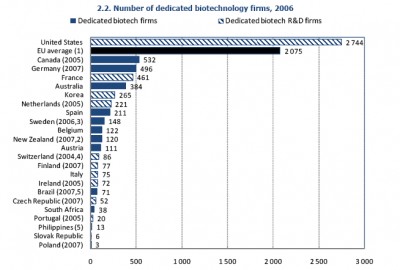
According to 2006 OECD data, Canada is a player in terms of the number of firms {532}, the number of patents {ranked #6 in 2004}, and revenues {$83M}, along with an 11% compound annual growth rate {CAGR} of revenues from 1999-2005.
Given how collaboration and capital are now global, does it even matter where innovations are incubated? A study by Bagchi-Sen & Scully {2004} is illuminating. They divide biotech forms into two categories:: high R&D intensity and low R&D intensity. Each has a different take with respect to strategies within the context of globalization::
High R&D Intensity:: Ties to local universities/Canadian researchers & collaboration with pharmaceutical companies, but desire global capital inflows. Prototypical firm is in health theraputics.
Low R&D Intensity:: Emphasis on local production and development of Canadian market. Focus on strategic alliances with foreign firms. Prototypical firm is in diagnostics or agricultural biotech.
In terms of innovation policy, this brings up interesting food for thought for Canadian politicians in light of this recession. Thanks to Barack Obama, Canada’s large neighbour to the south is pumping $21.5B of stimulus towards science and technology, which begs the question, how will this affect Canada?
It makes sense that Canadian policy would encourage the projects of low-intensity R&D firms with ties to the US, as these firms:: may be able to capitalize on relationships with stimulus-receiving firms, will develop innovations for the Canadian market, and will be focused on local Canadian production and manufacturing. The high-intensity R&D firms could use funding {hint:: even more than $1B+CAN stimulus} that focuses on spurring innovations and the building of a sustainable base of Canadian talent and resources. Dalton McGuinty’s {Liberal Premiere} efforts in Ontariomight be a step in the right direction, but I’m not seeing clearly how this all fits together with an economic recovery plan. Biotech. is not without risks, particularly with respect to agricultural biotech, which consumers are uncertain of. Activists have alerted consumers with terms like “Frankenfood” for genetically-modified organisms {GMOs} and Monsanto’s lawsuits against journalists and farmers don’t help the cause. So, maybe ag. biotech is a lose, but developing Canadian competitive advantage in innovations, in terms of other forms of biotech, nanotechnologies, clean energy, and green collar jobs, may provide fertile terrain for politicians and policymakers.
Well, enough of this talk of the “new economy” of biotech and innovations, what about the old economy, still prevalent in many parts of Canada? Globalization has drawn Stephen Harper’s {Prime Minister} Conservative government into bailout fever to the tune of $9.5B, in order to secure that 16% of GM’s production remains in Canada. This includes $3.1B that the Province of Ontario ponied up by Dalton McGuinty’s government. Unfortunately, this might only save 4,400 jobs, after projected layoffs, according to CBC::
So, it looks like nation matters, but in a global milieu. Nothing surprising. If you were to advise Canadian politicians, should new technologies {e.g., biotech, green, energy} be developed more aggressively {or at least explored} and does it make sense to commit billions to save jobs with an untested GM restructuring?
Twitterversion:: #newblogpost How should Canada compete {bio}tech, given globalzatn, US domnce, & recession? #GMfail bailout, good idea? http://bit.ly/18bBq8 @Prof_K