
Archive: Feb 2009

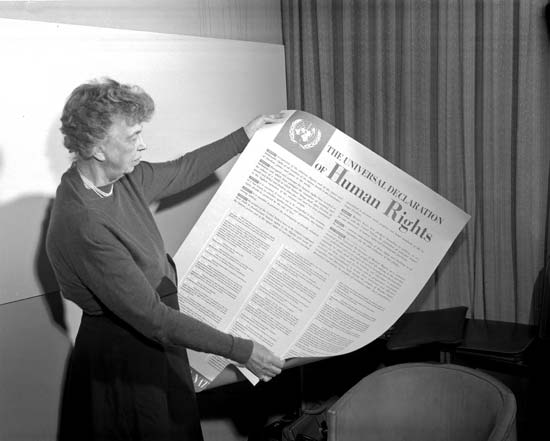
In the Independent (UK), Johann Hari asks the question: Why Should I Respect Oppressive Religions? un declaration You know he’s on to a hop topic because the comments section is 10 pages long! In the article, he lays out a distinction between the U.N. Declaration of Human Rights that emphasizes the preservation of freedom for the individual and the Universal Islamic Declaration of Human Rights, a document that subsumes or contextualizes (you pick your favorite term) freedom to the dictates of shar#ah law. Hari quotes a key passage from the Islamic declaration:
the limits set by the shar#ah [law]. It is not permitted to spread falsehood or disseminate that which involves encouraging abomination or forsaking the Islamic community.

The question I pose to my students and others is whether and/or how the Islamic declaration is “wrong”? The philosopher Alasdair McIntyre claims that liberalism is unable to provide us with a working morality because there is no agreed upon definition of justice. In modernity there exists a protection of rights, but no framework for what should be done with those rights? We are left to ultimately seek out a framework on our own with differing levels of success. Why should the rights in the Universal Declaration be considered absolute? Do we have a ethical or moral imperative to enforce their universality? I encourage you to read the Hari article and reflect upon our obligations if we truly adhere to the UN declaration.
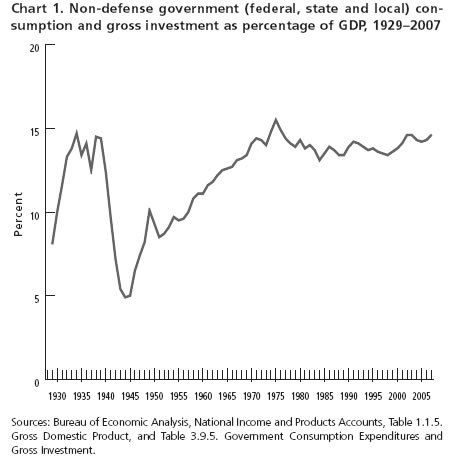
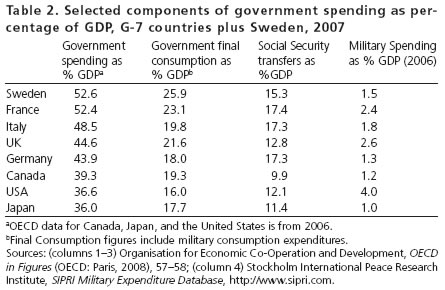
A topic of contention in my courses is whether the U.S. government is beginning its gradual decline into Socialism with the passage and imminent signing of a massive stimulus bill. John Bellamy Foster and Robert McChesney have a thought provoking article at Monthly Review where they assess the prospects for a “New New Deal.” While the article is worth a read in its own right, they provide some very useful charts on American domestic spending over time and in comparison to other countries.

The crux of their argument is that federal “consumption” has maxed our at around 15% of GDP since the New Deal era. Even during the 1930’s, domestic spending was restricted to what they call “ad hoc salvage,” not massive public works. This graph traces the U.S. government’s domestic consumption/spending since the 1930’s.

Their argument is that this 15% cap is held in place by monopoly capital, a term used by Economist Paul Sweezy in a 1966 book of the same title. The theory is that entrenched elite oligarchs have little desire for government to spend beyond a basic level of domestic investment and thus collude to keep domestic spending down.

They suggest that weak labor unions and an excessively pro-private capital political culture is to blame for our underinvestment. As evidence, they provide comparative info on government spending as a percentage of GDP. And they advocate for increased government expenditure and call for a major restructuring of our political economy to make it happen (after all this is published in Monthly Review).

While I’m not big a big believer of the coordinative abilities of a superstructure to ensure a 15% “cap,” it does provide food for thought. I’m more disposed to believe that a path dependent process exists where Congress and the president, for political reasons, look askance at raising or lowering domestic public spending much beyond the previous year’s levels (at least until the last administration).

At the very least, it provides ammunition for those semi-heated classroom discussions on the perceived U.S. slide into socialism.

E.B. Boyd has a fascinating piece at AlterNet on the use of Google Maps as a mobilizing tool. The article describes efforts by Rebecca Moore to convince her neighbors to mobilize against a logging plan under consideration in the Santa Cruz mountains. Moore, a Google employee (important part of the story), used Google Earth tools to create a visual 3-D tour of the proposed logging area that she presented at a community meeting of 300 residents. Here’s Boyd’s depiction of that meeting:

At first the audience was quiet. But as soon as Moore began to guide the room through the canyon they all knew, people started leaning forward. Real images of the actual trees, roads and buildings in their community popped up. The logging area was marked in a translucent red, clearly bumping up right next to the roads, homes and businesses where audience members lived and played. Using Google Earth’s ruler tool, Moore showed them exactly how far logging would take place from their houses and communities. She showed them the locations of proposed helicopter landing pads for logs that couldn’t be removed by truck and demonstrated how closely timber-laden choppers might pass the local day care center and schools.

This speaks to an understudied area of research: the use of on-line tools to overcome collective action barriers to mobilization. Public policy/social problem scholars emphasize the role of frames, stories, narratives, tropes, etc. in getting individuals to contribute resources to a collective effort. But very little research (that I know of anyway) looks at how the ways in which those stories are presented have an impact on overcoming collective action. An interesting line of research would look at how and when on-line tools are effective at mobilizing constituencies. What are the conditions? Does this only work for NIMBY efforts? Can people be mobilized to act upon issues in which they are not directly impacted?

Christian Welzel and Ronald Ingelhart have a provocatively titled article in the newest edition of the Journal of Democracy called The Role of Ordinary People in Democratization. Breifly, they argue that an emphasis on human development plays a larger role in democratization when you construct “democratic” as more than simply having free and fair elections (electoral democracy). They find that that when you construct democracy as “effective,” which they define as: preserving human rights/civil liberties while being anti-corrupt in addition to free and fair elections, the role of “ordinary people” matters. Here’s a key quote from their article:

Thus, the HDI (human development index) explains fully 60 percent of the variation in effective democracy. In other words, the HDI explains almost twice as much of the variance in effective democracy as it does in electoral democracy.

The upshot of this finding is that we need to figure out how you move from encouraging formal democracy (open electoral processes) to helping build political cultures of engaged, active citizens that expect and demand an active role in decision-making.

In chapter 13 of Leviathan (1651), Thomas Hobbes drops this bomb on us:

During the time men live without a common power to keep them all in awe, they are in that conditions called war; and such a war, as if of every man, against every man.

Political theorists might not be that sanguine about Hobbes, mainly because he’s such a bummer! But our society seems to buy this underlying premise. Hobbes’ main point is that, at our core, we are motivated by acquisition of wealth, power, status, etc. This pursuit drives politics and as such, we need a “strongman” to maintain order, or we will become mired in a war of “all against all.”

The extent to which we accept this premise as valid shapes how we approach policy problems. Is this a universal maxim? Are there times and places during which “awe” is not necessary to organize a society? Are there other incentives that maintain social order that are not based on fear?

About two years into my Ph.D. program I had an uber-typical, grad-student existential crisis and decided to drop out and pursue an MA in journalism instead. Since I was 14, I wanted to be a writer for Rolling Stone (more specifically I wanted to be P.J. O’ Rourke) and I had decided that, now in my early thirties, I would pursue my adolescent dream.

It took me two weeks into that program to realize I had made a grave mistake. I loved my classmates in J-school, but I truly missed a deep engagement with ideas. I missed the ability to plumb deeply into important issues. I felt as if I were being trained to quickly spit out a jumble of words that sounded like a coherent take on an issue, but was too immediate and empirical to say anything profound. No sooner did I leave my Ph.D. program that I bounded towards the chair’s door pleading to be readmitted.

Fast forward to 2009. I’m going up for tenure soon any many in my position wouldn’t ever say the word “blog.” But here I go, posting once a day….except Sundays. What motivates me to do this to myself? As Andrew Sullivan skillfully lays out in his own foray into this question:

a blog is not so much daily writing as hourly writing. And with that level of timeliness, the provisionality of every word is even more pressing—and the risk of error or the thrill of prescience that much greater

Why if blogging is exactly the kind of impulsive, unreflective, episodic writing that drove me from my journalism program, do I make myself blog? I spell out some of why I do it on an interview I did for Contexts But after thinking about it more, I think there’s something deeper.

I think part of my desire to blog has to do with a nagging desire to be relevant, to be part of the zeitgeist. Blogging brings with it the allure of unlimited possibility. With a WordPress or Blogger account anyone has the potential to be highly relevant. The best of academic work can also be relevant and in more profound ways than any blog post could, but the best academic work takes time, lots of it. And lots of good work never makes it out of its academic bubble.

But the blog allows a daily illusion, or promise, that my input can be of consequence by introducing them to a new idea or making them reflect more deeply about an issue. It also provides the chance to create good class discussions, so have at it.

Do you blog? Why? Can bloggers be relevant?

.

The California State Supreme court has decided to take up a set of cases challenging the constitutionality of Proposition 8. Among the issues that will be decided by the court is whether a ban on gay marriage constitutes a minor change (which can be done by public initiative) or a “revision” to the state constitution (which requires two-thirds vote by the state legislature or a constitutional convention to place on the ballot). This narrow questions begs a larger discussion of the rules for governing in California.

Many observers say that California makes it way too easy to amend the state constitution. In this Los Angeles Times op-ed by Ed Lascher and Tim Hodson, political scientists at Sacramento State University, and Floyd Feeny a law professor at UC-Davis, they make a compelling case for significantly revising the Constitutional amendment process in California:

the California Constitution is a bloated mishmash by comparison with the hard-to-amend federal document. Instead of a transparent constitution that citizens can understand and use, California has obfuscation, clutter and dysfunction. Eight times the length of the U.S. Constitution, it is more about legal technicalities than principles; an embarrassment for an otherwise cutting-edge state.

While I share my colleagues predilection for short, elegant constitutions, is a bloated governing document the cost of true citizen engagement? It’s not fashionable to defend California state government, but could it be that California easy initiative process is not the problem? The initiative process in California produces both horrible and inspired public policy, that is part of what makes California the wonderfully messy, incoherent, unpredictable place that it is.

But I’d suggest that the problem is the voter, not the system. Rather than focus on whether citizens should have so much ownership over the state’s governance, our time might be better spent thinking about how their decision-making about ballot initiatives could be improved. Comprehensive voter guides are not enough. If a state is going to be serious about providing its citizens with direct policy making power, then we need to think more reflectively about how we train citizens to use that power responsibly. How could we go about doing that?


Super Bowl Porn Hits U.S. Viewers (BBC
). I’m dying to know if this was a clever act of cyber-political resistance or some Comcast employee who didn’t read the employee handbook 🙂

I’d like to build upon my brief post about Yochai Benkler and Helen Nisselbaum’s 2006 article in the Journal of Political Philosophy entitled Commons Based Peer Production and Virtue. where they lay out an argument for how commons based peer production leads to virtuous behavior. They lay out four ways in which individual virtue is enhanced by engaging in collaborative peer work online.

The first is increased self-autonomy and individuation. They cite Charles Taylor’s notion of liberation as virtue brought about by being part on an on-line collaborative community. Such people are:

directing their own lives, … deciding for themselves the conditions of their own existence, as against falling prey to the domination of others, and to impersonal, natural, or social mechanisms which they fail to understand, and therefore cannot control or transform.

Second, they claim peer production enhances the ability of people to engage in productive and creative work. They use Alasdair McIntyre’s notion of practice:

socially established human activity through which goods internal to that form of activity are realized in the course of trying to achieve those standards of excellence which are appropriate to, and partially derivative of, that form of activity, with the result that human powers to achieve excellence, and human conceptions of the ends and goods involved, are systematically extended.

Third, they claim altruism as a virtue enhanced by peer-production:

In helping others, in small ways such as donating spare cycles, or larger ways such as creating carefully researched encyclopedia entries without receiving conventional, tangible payments or favors in return, peers exercise kindness, benevolence, charity and generosity.

Finally, they argue that peer production develops habits of civic participation. They liken on-line peer production to “barn raising”

In a similar way, participants in a commons-based peer effort cooperate, build upon the work of others, contribute time, effort and expertise to create and enhance a public good.

Are Benkler and Nisselbaum being too pollyanna about commons based peer production? (That’s the easy argument). Or are they on to something? Have at it!

Benker and Nissenbaum have a provocative argument for why peer production is virtuous. Here are their two principles:

(a) that a society that provides opportunities for virtuous behavior is one that is more conducive to virtuous individuals; and (b) that the practice of effective virtuous behavior may lead to more people adopting virtues as their own, or as attributes of what they see as their self-definition.

What do you think, does Wikipedia and YouTube contribute to a more virtuous society?