
In the late 1800s, male Chinese immigrants were brought to the U.S. to work on the railroads and as agricultural labor on the West Coast; many also specialized in laundry services. Some came willingly, others were basically kidnapped and brought forcibly.
After the transcontinental railroad was completed, it occurred to white Americans that Chinese workers no longer had jobs. They worried that the Chinese might compete with them for work. In response, a wave of anti-Chinese (and, eventually, anti-Japanese) sentiment swept the U.S.
Chinese men were stereotyped as degenerate heroin addicts whose presence encouraged prostitution, gambling, and other immoral activities. A number of cities on the West Coast experienced riots in which Whites attacked Asians and destroyed Chinese sections of town. Riots in Seattle in 1886 resulted in practically the entire Chinese population being rounded up and forcibly sent to San Francisco. Similar situations in other towns encouraged Chinese workers scattered throughout the West to relocate, leading to the growth of Chinatowns in a few larger cities on the West Coast.
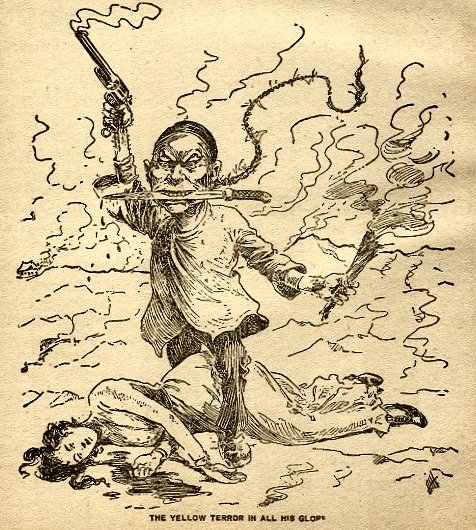
The anti-Asian movement led to the Chinese Exclusion Act of 1882 and the Gentlemen’s Agreement (with Japan) of 1907, both of which severely limited immigration from Asia. Support was bolstered with propaganda.
Here is a vintage “Yellow Peril” poster. The white female victim at his feet references the fact that most Chinese in the U.S. were male–women were generally not allowed to immigrate–and this poster poses them as a threat to white women and white men’s entitlement to them:

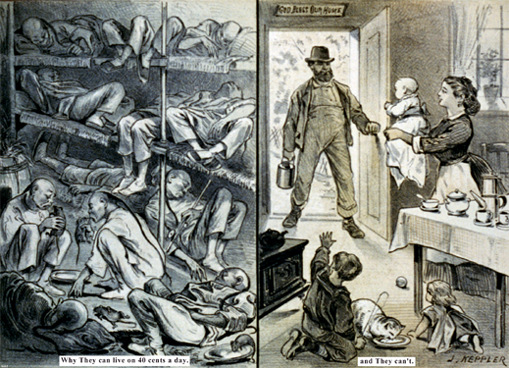
“Why they can live on 40 cents a day…and they can’t,” this poster says, referring to the fact that white men can’t possibly compete with Chinese workers because they need to support their moral families. The Chinese, of course, usually didn’t have families because there were almost no Chinese women in the U.S. and white women generally would not marry a Chinese man.
The following images were found at the The History Project at the University of California-Davis.
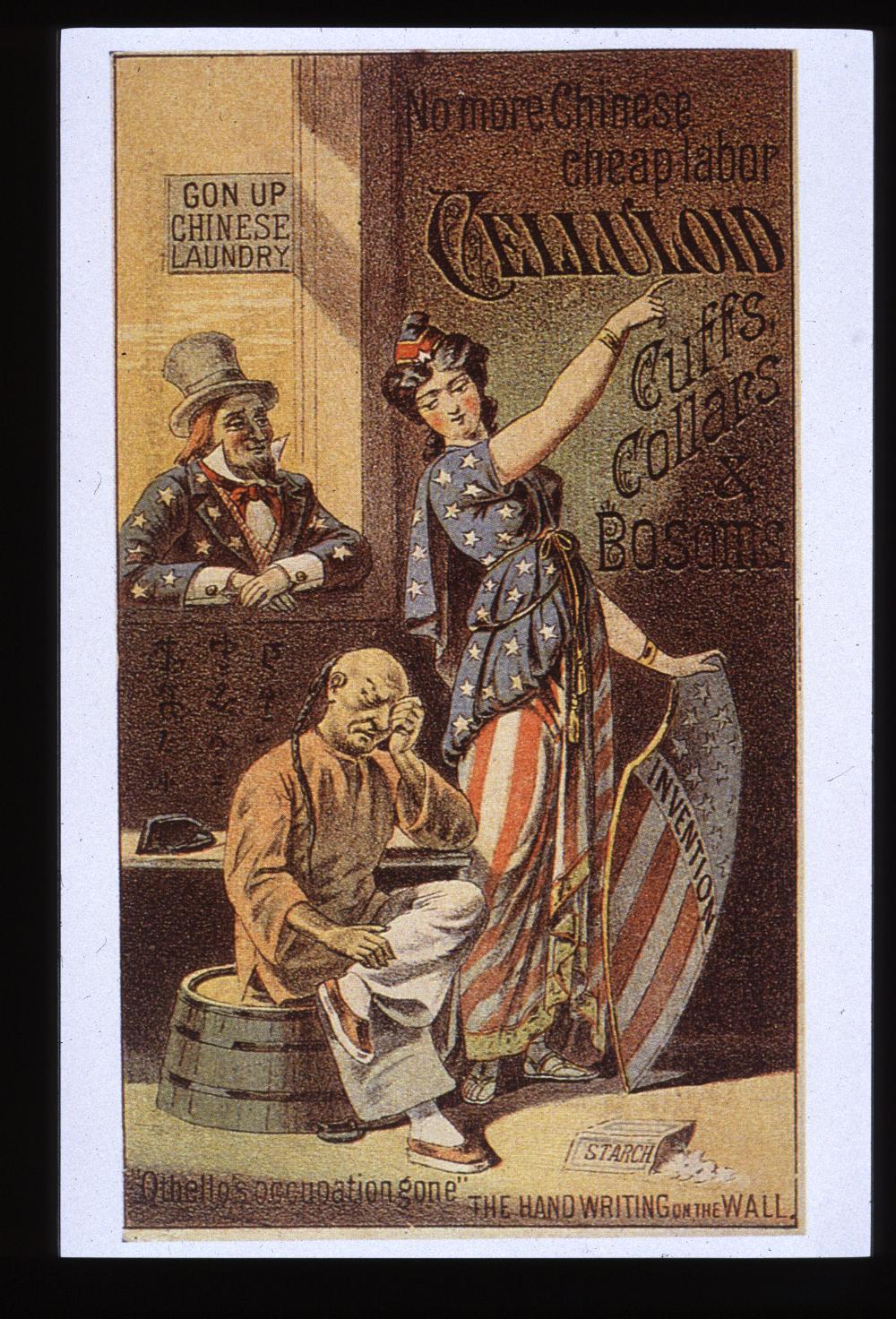
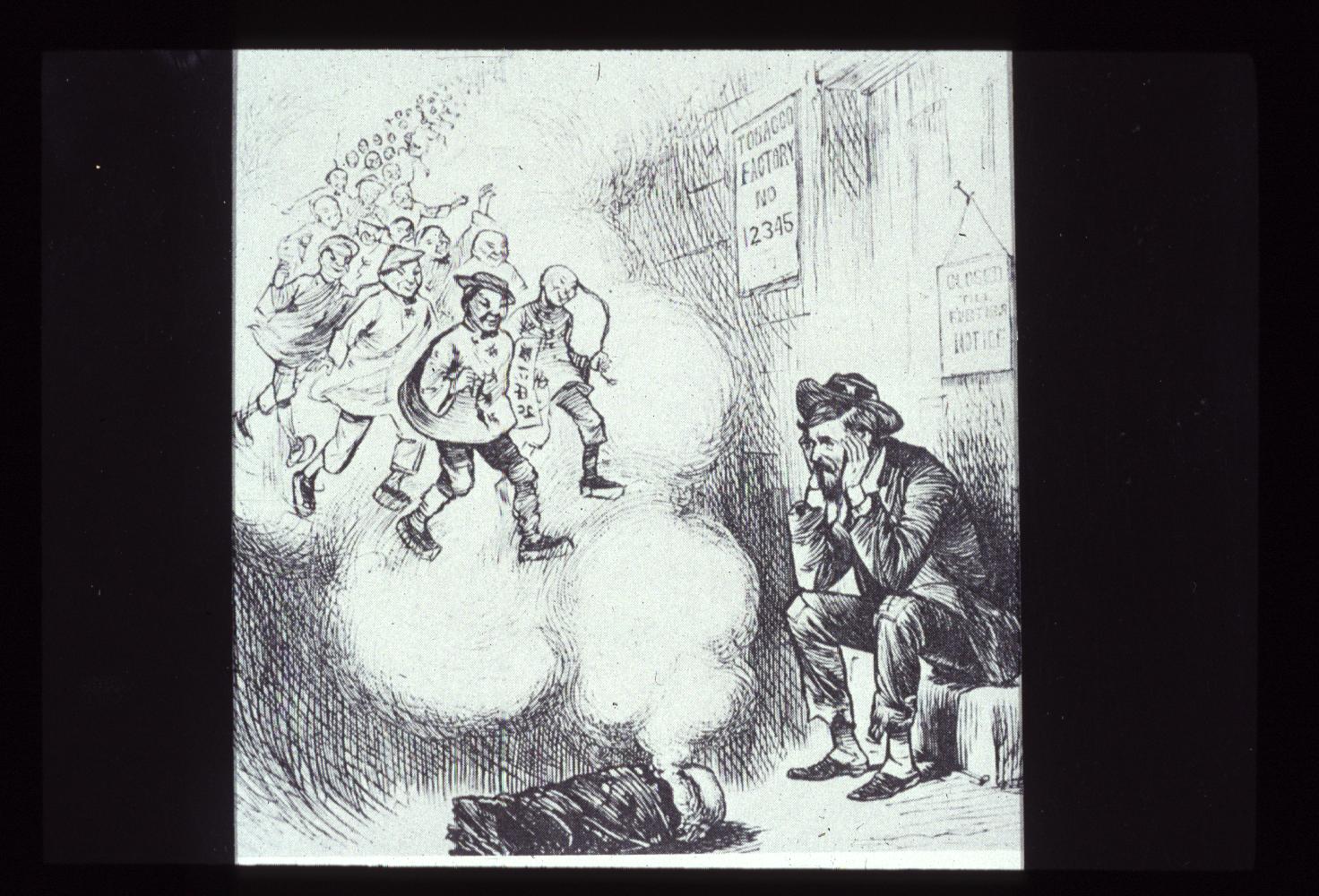
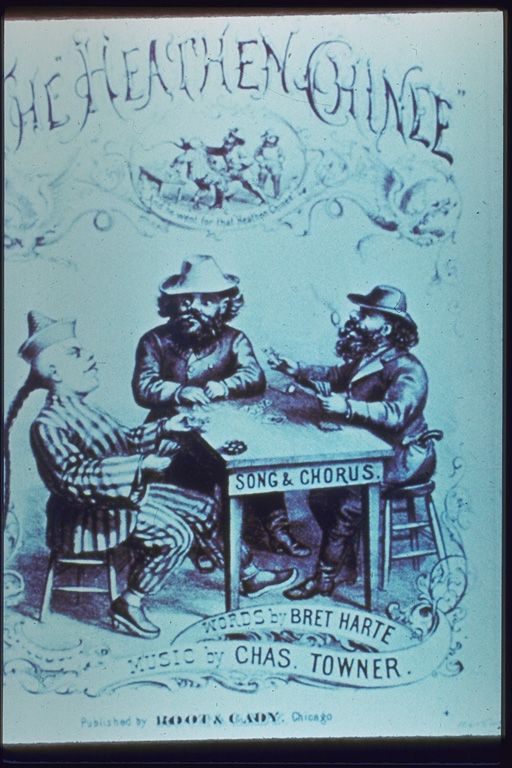
This is the cover for the song sheet “The Heathen Chinese”:
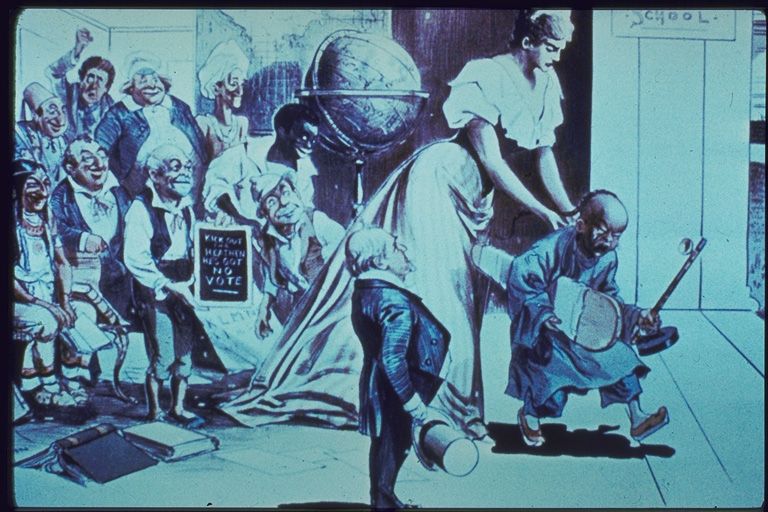
According to the History Project, this next image was accompanied by the following text:
A judge says to Miss Columbia, “You allowed that boy to come into your school, it would be inhuman to throw him out now — it will be sufficient in the future to keep his brothers out.” Note the ironing board and opium pipe carried by the Chinese. An Irish American holds up a slate with the slogan “Kick the Heathen Out; He’s Got No Vote.”
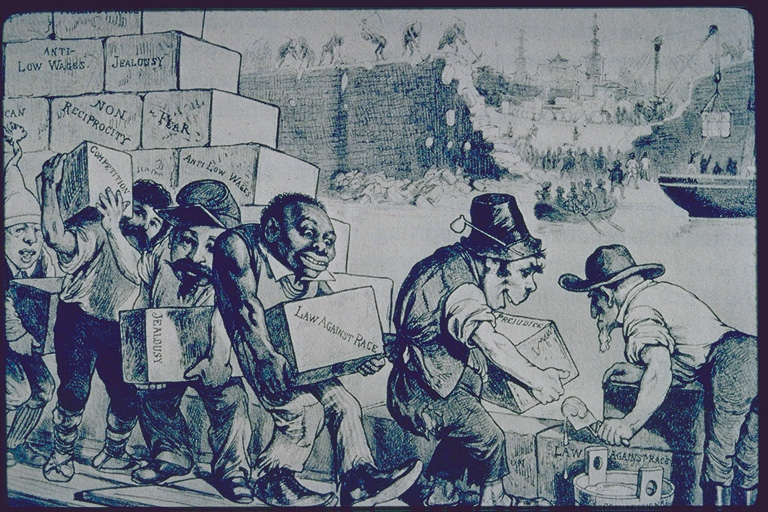
The following counter-propaganda pointed out how immigrants from other countries were now working to keep Chinese immigrants out. The bricks they’re carrying say things like “fear,” “competition,” “jealousy,” and “non-reciprocity.”
During World War II, attitudes toward the Chinese shifted as they became the “good” Asians as opposed to the “bad” Japanese. However, it wasn’t until the drastic change in immigration policy that occurred in 1965, with the passage of the Immigration and Nationality Act, that Asia (and particularly China) re-became a major sending region for immigrants to the U.S.
This post originally appeared in 2008.
Gwen Sharp is an associate professor of sociology at Nevada State College. You can follow her on Twitter at @gwensharpnv.
Comments 83
Elena — July 8, 2008
"During World War II, attitudes toward the Chinese shifted as they became the “good” Asians as opposed to the “bad” Japanese."
Milton Caniff was commissioned to do a quick guide for telling Chinese and Japanese people apart... not that the Chinese are in any way an homogeneous population!
mike — July 8, 2008
Closer inspection on the image for "The Heathen Chinese" actually shows it says "The Heathen Chinee". Charming.
73man — July 9, 2008
One of the finest caricatures of an Irish immigrant I have seen. And look! the little fella is carrying a block named 'prejudice'. Oh how times have changed.
Bill R — June 21, 2014
Today's social critics can have a field day exploring 19th century America. The Chinese labor issue almost pales in comparison to slavery and the resultant civil war and the "relocation" of large numbers of Indians west of the Mississippi. And of course women were of lower stature than men. They couldn't vote and in most places couldn't own real property.
We are not perfect today but in a relatively short period of time we've come a very long way.
Paul Muschamp — October 14, 2016
hi brad
Paul Muschamp — October 14, 2016
'''''''''' Immigration''''''''''
Paul Muschamp — October 14, 2016
Immigration reminds me of that movie with dyane johnson
bimantara bimo — November 12, 2016
does anyone know who have a source 'bout yellow peril theory??
Calator Roman — December 2, 2019
Hello, this weekend is nice designed for me, because this time i am reading
this impressive informative paragraph here at my home.-
calator.tel
MaKaylei Vasquez — January 24, 2020
The Yellow Perial is a racist color metaphor that the people of
East Asia are a danger to the Western world. Asian men couldnt have white women.
Anonymous — March 9, 2025
awesome sauce
Roel — April 10, 2026
This post does an excellent job of contextualizing these deeply disturbing images within the broader economic and social anxieties of the era — it's striking how the propaganda so deliberately tied race to perceived threats around labor, morality, and gender all at once. The inclusion of the counter-propaganda image, with bricks labelled 'fear,' 'jealousy,' and 'competition,' is a particularly powerful reminder that critical voices existed even then. Understanding this history feels more urgent than ever given how easily these same fear-based narratives continue to resurface.
Age Calculator. Enter your date of birth and instantly get your precise age in years, months, days — plus a live real-time counter, zodiac signs, heartbeats, and birthday milestones.
Cube Solver — July 7, 2026
The parallels between the "yellow peril" imagery and modern anti-immigrant rhetoric are disturbingly clear—economic fears are still used to justify racial scapegoating. I’m curious how these caricatures, like the predatory "Chinaman" with opium pipe, directly influenced later immigration laws such as the Chinese Exclusion Act. On a completely different note, if you enjoy demystifying complex systems, I found a Cube Solver that walks you through the mechanics of a Rubik’s cube step by step; it’s a satisfying way to see how a seemingly chaotic puzzle can be untangled with a clear method. Sometimes understanding the structure of a problem helps us see beyond the surface.
Manga Translator — July 11, 2026
It's unsettling how these visual stereotypes from the 1800s were engineered to dehumanize an entire community, justifying violence and exclusion. Seeing the caricatures side-by-side with the historical context really drives home how propaganda weaponized fear of economic competition. This reminded me of how modern media still struggles with similar visual biases, which is why I’ve started using a Manga Translator to help read authentic foreign comics and see how different cultures portray themselves, rather than relying on filtered interpretations. Tools like that can at least help us access original perspectives across language barriers.
AI metadata remover — July 28, 2026
It's chilling to see how easily racist caricatures were used to stoke fear and justify discrimination. This article brought to mind how images can be weaponized, even today with deepfakes and misleading metadata. When I share old photos or digital art, I try to be careful about what hidden data they carry. That's why I find using an AI metadata remover so helpful—it strips away generation tags that could confuse viewers about an image's origin. It feels like a small way to keep history honest.
Italian brainrot animals — August 5, 2026
It's wild to think how those old propaganda images shaped the way people saw Chinese immigrants back then—just because they were competing for jobs. The way they were depicted as a threat feels so familiar, like a pattern that keeps repeating with different groups. I've been reading about how stereotypes get baked into visual culture, and it makes me wonder how we can unlearn that stuff today. Speaking of unlearning, I stumbled on Italian brainrot animals the other day, and it's a fun little escape from heavy topics like this. Sometimes you need a break to reset your brain before diving back into history.
Nano Banana Lite — August 5, 2026
It's really striking how these old images laid bare the fears and prejudices of that era. Reading about the Chinese workers who built the railroads and then were scapegoated once their labor wasn't needed makes me think about how easily fear can be weaponized. The way they were caricatured as addicts and gamblers feels so painfully familiar when you look at how immigrant groups are portrayed today. It's a good reminder to question the images we see and the stories we're told. If you're interested in visual history and how stereotypes spread, you might also enjoy exploring how modern tools can create or challenge such imagery, like with Nano Banana Lite. It's fascinating to think about how we can use new technology to tell more honest stories.
Heart Emoji — August 11, 2026
It's chilling to see how easily fear and economic anxiety were weaponized into such dehumanizing stereotypes. The way these images framed Chinese immigrants as a threat to white workers feels disturbingly familiar, even today. I appreciate how the article unpacks the historical context behind the 'Yellow Peril' myth, from the railroads to the laundry shops. It makes me wonder how many of our current prejudices are built on similarly flimsy foundations. If you're ever looking for a small way to spread a bit more kindness in the world, this Heart Emoji site is a sweet reminder of the symbols we use to connect.
Brooks Alex — September 7, 2026
Ahh Trading LLC is among the trusted Machinery Equipment Manufacturers in China , offering high quality machinery at competitive prices.
Brooks Alex — September 7, 2026
Ann Trading LLC is a trusted source for Construction Machinery Suppliers in China , offering reliable equipment for demanding projects. Explore quality construction machinery designed for contractors, distributors, and businesses worldwide.
Ryan — September 17, 2026
Seeing how "The Heathen Chinese" was turned into a propaganda song sheet makes me think about how we process viral outrage today. this daily song service takes wild headlines and transforms them into songs you can listen to and share, proving how rhetoric gets packaged as entertainment across eras.
Carl — September 19, 2026
The poster's framing of economic competition really shows how misunderstanding what's actually happening around you can spiral into harmful narratives. It's a reminder that taking a moment to observe your surroundings — like checking which local birds are visiting your area right now on Birdly Yard — can offer a much clearer picture than assumptions ever could.
Brooks Alex — October 28, 2026
Yiwu Mushan is an Industrial Machinery Sourcing Company in China , providing construction equipment, power tools, and industrial machinery with reliable supply solutions for global buyers.
Luna — November 2, 2026
JXJQC (Jiangxi Jinqi Chun) is among trusted China Building Materials Suppliers offering quality building materials, reliable product solutions, competitive pricing, and dependable supply services for global buyers.