
How great is this? If you are estimating the height of the Eiffel Tower, you will likely offer a slightly smaller estimate if you are leaning just barely to the left. In fact, your estimations of all types of numbers — height, but also quantities, weights, etc — will generally be smaller if you are leaning just a wee bit left of center.
Here’s the data: variation between average estimates were statistically insignificant if answered when standing upright or leaning to the right (gray and black, respectively), but leaning to the left depressed estimated quantities (white):
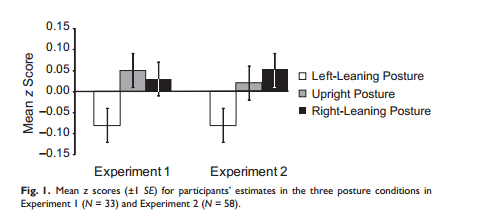
Why?
Here’s a hint: we would expect the results to be the converse if we used research subjects who primarily spoke Arabic or Hebrew.
English, in contrast to those two languages, is read from left to right. When we write down numbers in order, then, the numbers on the left are smaller than those on the right.

We learn, over time, to associate smaller numbers with our left side and larger numbers with our right side. This constant association biases our mind towards smaller or larger numbers, hence the data. How great is that?
Lisa Wade, PhD is an Associate Professor at Tulane University. She is the author of American Hookup, a book about college sexual culture; a textbook about gender; and a forthcoming introductory text: Terrible Magnificent Sociology. You can follow her on Twitter and Instagram.
Comments 11
Lucie — September 25, 2013
I don't get it. Sure, "left" and "small" often go together. But doesn't leaning-to-the-left make things like the Eiffel Tower appear to lean to the right? And "right" and "big" go together? I'm not a fan of "explanations" that are simply correlations.
Leslee Bottomley Beldotti — September 25, 2013
Ha! When I first read the title of this post, I thought it was going to tell me that people who identify as liberal live longer!
Vicky — September 26, 2013
Not to be nitpicky, but Arabic and Hebrew still write numbers left to right. If you translate something like "the numerals are 0123456789 in order from lowest to highest" using Google Translate you will see את הספרות הן 0123456789 בהזמנה" מהנמוכה ביותר לגבוה ביותר" (in Hebrew) or "الأرقام هي 0123456789 بالترتيب من الأقل إلى الأعلى" (in Arabic).
Elena — September 27, 2013
Chinese and Japanese are written top to bottom, right to left (or right to left in historical texts, or left to right in websites when top to bottom isn't feasible). Numbers can be written using Arabic numerals or the proper hanzi/ kanji.
Now if that affects the mind as much as Arabic numerals in left-to-right writing systems do, I'd be glad to know. Or if Roman numerals also affect the mind...
Links 8 – 28/9/13 | Alastair's Adversaria — September 27, 2013
[...] 7. To Feel Younger, Lean to the Left [...]
[Cool]lection | Foreign Holidays — October 4, 2013
[...] To start off, some cool psychology/sociology. [...]
Tesettur Giyim Trend | The Mind-Body-Metaphor Connection — February 20, 2014
[…] Last year I was tickled to write about a cool study showing that, if a person grows up with a language that writes from left to right, then numerical estimates of things like weight or height will, on average, be smaller when a person is imperceptibly and unknowingly leaning to the left. Seriously, it’s awesomely fun research and you can read about it here. […]
The Mind-Body-Metaphor Connection - Pacific Standard: The Science of Society — March 25, 2014
[…] Last year I was tickled to write about a cool study showing that, if a person grows up with a language that writes from left to right, then numerical estimates of things like weight or height will, on average, be smaller when a person is imperceptibly and unknowingly leaning to the left. Seriously, it’s awesomely fun research and you can read about it here. […]
LoganWatson — July 11, 2023
Language translation services provide us with incredible benefits and opportunities. They play an important role in a world where the diversity of cultures and languages is becoming increasingly important. These services allow us to exchange information, ideas and cultural values across language barriers. They help businesses expand internationally, provide education and integration opportunities for migrants, and help people in their daily lives cope with language barriers. Language translation services are bridges that bring people together and create a world without language boundaries.