
Amy H. sent in a Dove ad from O magazine. The ad clearly means to say that women get “visibly more beautiful skin” because their body wash moisturizes dry skin. However, the placement of the women in front of the “before” and “after” text may unfortunately, based on a quick glance, inadvertently convey a different message:
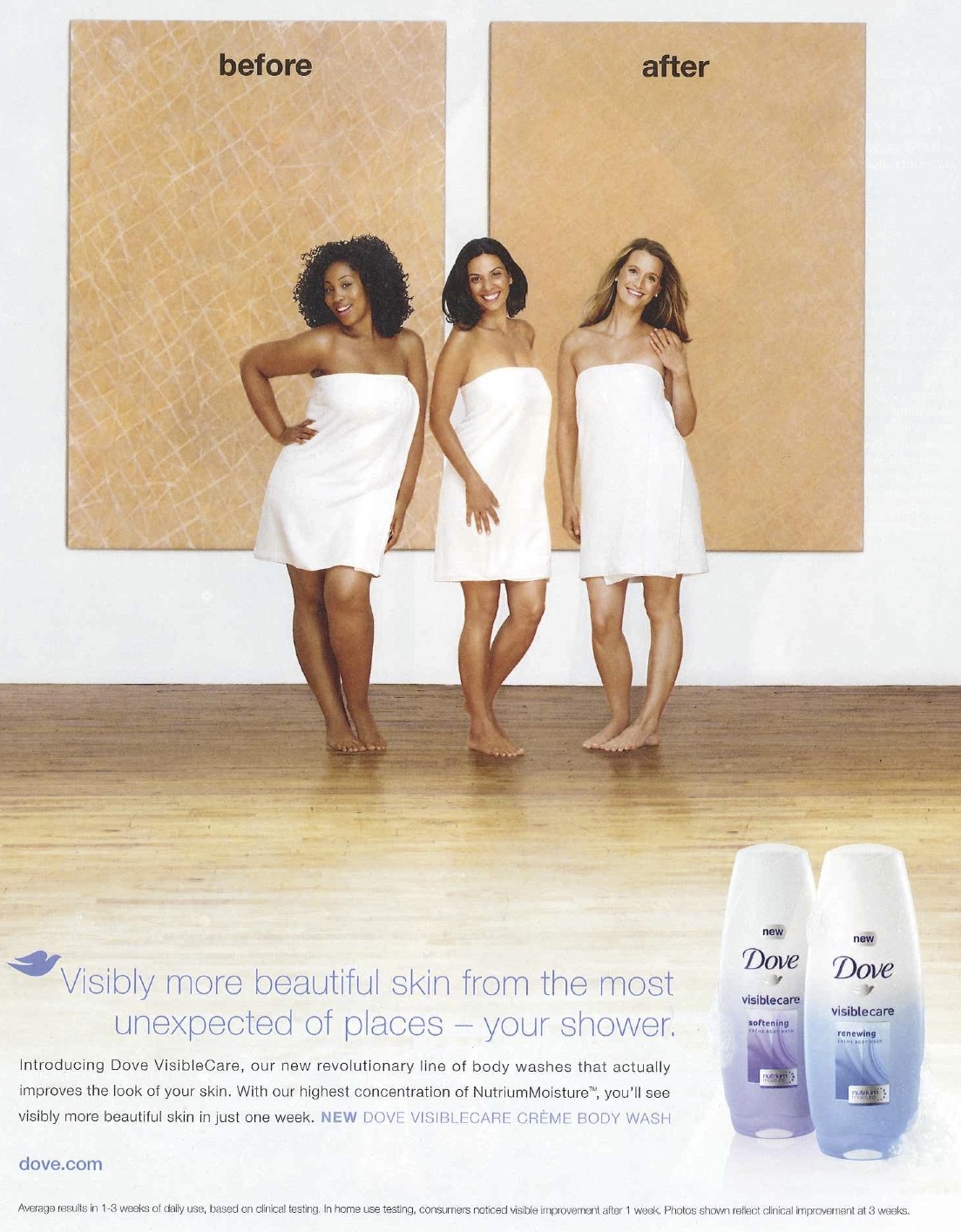
I continue to be puzzled that multinational corporations with resources for large-scale marketing campaigns so often stumble in awkward ways when trying to include a range of racial/ethnic groups in their materials. This seems to occur by not sufficiently taking into account existing or historical cultural representations that may provide a background for the interpretation of images or phrases in the advertising. In this case, the arrangement of the models combined with the text above and below them unfortunately intersects with a cultural history in which White skin was seen as inherently “more beautiful” than non-White skin (not to mention thinner bodies as more beautiful than larger ones).
It would be possible to make this same ad, using these same models and basic idea, in a way that avoided any potential misinterpretation — all it would take, I think, would be to take the before-and-after pics and make them small off-set images on the side, so “before” and “after” couldn’t be read as referring to the women’s bodies. Given that advertising materials are often highly scrutinized, Photoshopped, market tested, and focus grouped, I can’t quite figure out how potentially problematic racial/ethnic connotations aren’t caught before such ads are released.
UPDATE: In my analysis, I gave Dove the benefit of the doubt in assuming this was a non-intentional aspect of the ad, largely because even in the “best case scenario” where this is entirely unintended, it is problematic. However, several readers suggest that we shouldn’t too quickly assume that instances such as these are accidental.
Gwen Sharp is an associate professor of sociology at Nevada State College. You can follow her on Twitter at @gwensharpnv.
Comments 59
Village Idiot — March 21, 2011
Given that advertising materials are often highly scrutinized, Photoshopped, market tested, and focus grouped, I can’t quite figure out how potentially problematic racial/ethnic connotations aren’t caught before such ads are released.
Maybe those connotations weren't unintended. They sure don't look like an accident to me.
Tracy — March 21, 2011
I do not think they were unintended either. These companies have psychologist and sociologists working on these ads that specialize in people's - and in particular the white upper class women this ad is aimed at - reactions to advertisement. If it were an accident, they would catch it. Period. Not only is that their job but they have incredible amounts of formal education to make them qualified. I think, however, that they are intending to call on exactly those "existing or historical cultural representations that may provide a background for the interpretation of images or phrases in the advertising" - they understand that we as a society tend to view "White skin...as inherently “more beautiful” than non-White skin" and "thinner bodies as more beautiful than larger ones" and try to call on these cultural understanding unconsciously so that the ad seems to makes more sense on first glance as it fits with our understandings about women. Thus the ad is less jarring to the mind because it does not challenge any of the ingrained biases most, if not all, of us have (whether they be biases against other groups or internalised biases against our own).
Scapino — March 21, 2011
Yes, we can only assume that the head of Fair and Lovely called up his counterpart at Dove and dictated the placement of these three ladies.
Never attribute to malice...
Charlotte — March 21, 2011
[You get lighter, thinner, AND your hair is straighter!]
saidimu — March 21, 2011
At what stage does genuine ignorance turn into willful ignorance?
Assuming we can divine the difference, does it even matter (outside academic circles)?
I think it does matter, if only in informing what our (re)actions ought to be once we're made aware of such incidents.
Robin — March 21, 2011
Sometimes I feel like these sorts of ads (or any ads, for that matter) can't win. You put a progression from left-to-right of darker-to-lighter skin, boom, they're saying lighter is better. If they didn't put in the darker-skinned ladies at all, they're being exclusive and white-normative. If they used solely a darker-skinned lady, it would be tokenism.
mclicious — March 21, 2011
I definitely think that this was, on some level, intentional. I think that because while Dove's effort to celebrate "real bodies" and "real women" is in some ways commendable, it's really an effort aimed at white people who consider themselves liberal in the ways of feminism and racism. It's simply another way of letting privileged people see themselves as allies, rather than perpetrators of racism, or just allowers of racism. It's letting them change from the problematic "I'm colorblind! So I can't be racist!" to a new kind of problem: "I'm color conscious! So I can't be racist!" Again, not that it's not nice to see more realistic portrayals of women in advertising, but it still seems pretty clear that the advertisers think that simple representation is all that's needed to erase the color gap (or they think that people of color are so stupid as to be satisfied and placated with simple representation).
Jayn — March 21, 2011
It doesn't help that the white damage shown on the 'before' image makes t he overall skin tone seem darker by comparison than that of the 'after' image.
Aitch — March 21, 2011
I am very skeptical of Dove's enlightened advertising anyway. cynical you might say,
swang — March 21, 2011
Why so overreading lah
Fernando — March 21, 2011
At first I did not notice what was wrong with it. Took me reading the article and then looking at the ad again. Maybe I am as apathetic as the ad makers could (or could not) have been.
However, I think for Dove, or any big company really, it is more important to avoid negative exposure than it is to send a subtle(or not) and decidely controversial message to its audience about skin color.
So that is the reason I think it was ignorance or apathy on their part, there is little to gain from doing what they did. When I first looked at the ad, I saw the before/after and thought it was a product about smoothing your skin somehow and then I saw the three women and thought they were happy with the product's results. I didn't associate the before/after with the women.
I think people sometimes get too focused on their original plans and they might not lose perspective from different points of view. Maybe that's what happened. Besides, I think advertisers are being overestimated here.
Susana Machado — March 21, 2011
If I was in charge of putting this ad together and was given a sample of dark, lighter, light women to play with with the above before and after samples, I would have put the darker one in front of the before sample because it does contrast more with the white lines crisscrossing it making them appear even lighter. And I would have put whoever is lighter in front of the after sample because being much lighter it makes the residue crisscrossing on the sample ( it is still there ) fade out even more.
As a designer from a place where there is almost no loaded history when it comes to skin colour , I would have done that.
It does not mean that between the moment I did that and the moment it goes into print there shouldn't have been someone who is paid to do that that would send it back to me explaining how it may be problematic for the target readership.
martian creole — March 21, 2011
The people who created this ad are geniuses. I'm very impressed with the way that it sneaks into our culture's unconscious racist bias without triggering the conscious rejection of it.
Of course it's utterly reprehensible. Beyond the racist subtext, the idea that the "after" is "more beautiful" is itself an invention. The phrase "visibly more beautiful", by questioning the verifiability of beauty products, and since this product is essentially identical to the others, shows that the marketers themselves don't even believe it. Persuading people of an idea which you believe to be false is obviously unethical.
While we carefully analyze psychosocial backgrounds, the average viewer of this ad makes no conscious observation at all, allowing the image to sit in the back of the mind, and imbibing perhaps a half-dozen words at most.
Dr. Ivo Robotnik — March 21, 2011
Don't care if this was intentional or not, my jaw still dropped.
Rick — March 21, 2011
Is inversion of stereotypes the solution?
Roschelle — March 22, 2011
Great discussion and awesome points of view. I, too, think this was intentional. I'm not sure on what level. But someone... consciously decided to line these women up EXACTLY this way to emphasize the higher "degree of beauty" attained after utilizing their product.
The question is was it purposeful or based on some conscious subconscious assertion that whiter and thinner is more beautiful. Hope that doesn't sound too ridiculous.
My blog post today is a spin off this post. I'm hoping to get some insight on what some of my readers think
Bill Angel — March 22, 2011
It's an interesting discussion/analysis, and interested readers might wish to check out the video that the Dove corporation produced to go along with this ad campaign.
See: http://www.dovecloseup.com/default.aspx#close-up-page?utm_source=dove&utm_medium=website&utm_campaign=2011_iris
It's interesting to note that it in the video there are not any dark skinned people working either as models or as members of the advertising production crew. It's like it was produced in a fantasy world in which everyone is beautiful and light skinned.
Bill Angel — March 22, 2011
NOTE: To see the video you have to click on the button in the web page that says "Watch the TV Spot"
Jeanette — March 24, 2011
Wow, that's pretty terrible. It does seem like a hugely egregious error to be unintentional, too.
Rahul Gupta — March 25, 2011
It can be said that this is not a unintentional error. Companies like dove have many specialist who work on advertisements. As said in the article many sociologist and psychologist work on marketing campaigns and should have caught such a huge flaw like this. A marketing campaign like this goes through many levels of checks before it is passed for the consumers. All these levels could not have missed such a huge blunder. But Dove could also be given benefit of the doubt. Their perception about the advertisement differs greatly and did not launch this campaign to insult any racial group.
IT’S FUN TO STAY AT THE YYYYMCA! « Tata Lombardi — March 31, 2011
[...] que seja) – e até aprende a usar ‘afrodescendente’ -, mas continua achando isso super normal e justificando piada de mau gosto com ‘você que é mal comida e não tem bom [...]
NTJN — May 23, 2011
This is done on purpose. Lost souls in ad agencies show their misanthropy. Products really required don't need advertisement. F*** this industry, they make the whole western world sick (selfish, narcissistic, superficial and dumb).
maria — May 27, 2011
well, may be this is and is not on purpose but, there is because of this kind of advertisement, that indian and black girls in england are using a variety of creams to make their skins light.
i agree that only dumb and mis inform women,buy productslikethis..-
Selling More Than Body-Wash « adverthinkment — July 19, 2011
[...] for having racial overtones, and debate over it was featured in articles and blog posts in sociological images, copyranter, huffington post, among [...]
Jerry Johnson — May 24, 2012
Oh, I get it -- this blog's the Where's Waldo of race.
It's so good to see people focusing on the important stuff. [/sarcasm]
This blog apparently showcases the study of race by whites, for whites, allowing them to flex their critical analytical skills. Its findings are astonishingly unimportant, irrelevant, and trivial, and yet are presented by their authors as profound evidence in their ongoing indictment of the West.
Their goal is to engender a sense of guilt in whites; and to distract us from both the nightmare playing out daily in "urban areas", and the very real threat that such chaos represents to Middle America.
Such as?
Three out of four black children are born to unwed mothers. In some inner cities, students are as likely to drop out as graduate. And while they represent merely 6% of the American population, black males account for more than *half* of all murders.
Keep on obsessing, people -- nit-pick and deconstruct to your heart's content. Just remember, when confronted by the sledgehammer of the permanent underclass, the archaeological tool kits you employed on their behalf in forums such as these are utterly useless.
katyll — September 22, 2012
What's funny about this 'analysis' is that Reader Amy H. sent in the Dove ad from O Magazine. Isn't that Oprah's magazine? Isn't Oprah black? So Commentator Tracy is so busy sniffting out reasons why Dove wants to insult black women by appealing to rich white women - the rich white women who are reading a magazine put out by a very wealthy black talk show host?
Honestly, the hidden racism lunatics get ever more and more desperate to justify their own pathological racism obsession: find it where none exists! Well, that's not entirely true. There's Amy H. and Tracy!
Adam — May 9, 2025
A good solution to attract more attention to the brand and product. Google Ads helped me get instant visibility for my new website. Within days, I was getting qualified leads and actual sales. It’s not cheap if you're in a competitive niche, but when campaigns are optimized, the ROI makes it worth every penny. I even started using this checklist - https://aimers.io/tools/google-ads-optimization-checklist to simplify campaign setup