
History isn’t fact, but a narrative. Nations narrate their own histories, telling the stories about themselves that they prefer. Holidays are one way in which these stories are told and re-told.
At www.america.gov, the U.S. government describes Columbus Day as a”commemoration” of Columbus’ “landing in the New World” (they astutely avoid the term “discovery”) and initiating a “lasting encounter” between the mis-named “Indians” and Europeans (no mention of genocide or the stealing of land).
Contesting this particular version of history, an organization calling itself Reconsider Columbus Day is asking Americans to adopt an alternative national narrative, one that both acknowledges and emphasizes the oppressive and unjust outcomes of the ongoing “lasting encounter” between American “Indians” and Europeans-now-Americans.
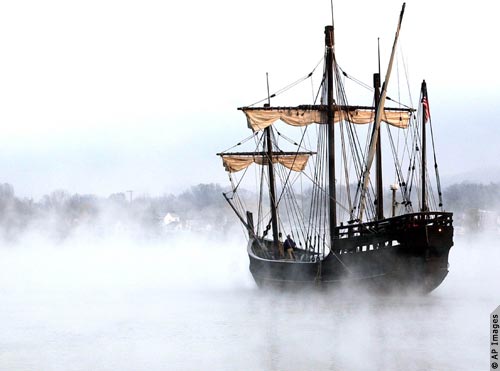
The narrative and counter-narrative is an interesting example of how nation-founding memories are not set, but always potentially changing as the national ethos and distribution of power shifts underneath them.
For more on national memories, see our post comparing the German approach to the Holocaust and the America approach to slavery.
Lisa Wade, PhD is an Associate Professor at Tulane University. She is the author of American Hookup, a book about college sexual culture; a textbook about gender; and a forthcoming introductory text: Terrible Magnificent Sociology. You can follow her on Twitter and Instagram.
Comments 27
Anon — October 11, 2010
Yes, I'll reconsider getting a day off.
Get the f outta here...
Andie — October 11, 2010
It's an interesting outlook indeed. We don't have Columbus day here, but there's a good amount of discourse regarding the way indigenous people have been treated in Canada since Europeans landed here.
(for example, google 'residential schools' - sad, sad, sad.)
Elisa — October 11, 2010
Anyone have thoughts about the music used in the clip?
Appropriate? Appropriating?
md — October 11, 2010
As a sidenote, (and I hope I don't get accused of de-railing) Australia Day commemorates the landing of the British First Fleet in 1788 (or as the Victorian State Government puts it: "Australia Day celebrates the anniversary of Captain Arthur Phillip unfurling the British flag at Sydney Cove and proclaiming British sovereignty over the eastern seaboard of Australia on 26 January 1788")
This day definitely, definitely is celebrated. However, some people do protest this day and propose renaming it "Invasion Day" instead.
Che — October 11, 2010
Berkeley, CA (and several other cities / towns) now celebrate Oct. 12 as Indigenous People's Day. http://www.red-coral.net/Pow.html I guess that is becoming more common elsewhere, too? This is my first year in NH / VT, but I got the feeling Columbus Day is less approved of here, too - NH state offices were open today.
My mother was very proud of her very small amount of Native American heritage, so I never learned of Columbus as a hero. Or maybe they did teach that at school, but my mom managed to counteract that enough that I didn't absorb it much. Same with Jackson.
Tim Kubal — October 12, 2010
This is interesting and true, but there is much more to the Columbus myth than is written here. The story of protesting Columbus Day is a long and interesting one. Recently, I wrote a book looking at the history of different groups that have tried to rewite the Columbus national origin myth. It is titled "Cultural Movements and Collective Memory: Christopher Columbus and the Rewriting of the National Origin Myth".
This year I did a Columbus Day interview on NPR:
http://www.npr.org/templates/story/story.php?storyId=130437792
The interview (like part of the book) focuses on the transformation of Columbus Day in the Latin American context, where in some countries the day is known as the Day of Indigenous Resistance.