
Flashback Friday.
In Race, Ethnicity, and Sexuality, Joane Nagel looks at how these characteristics are used to create new national identities and frame colonial expansion. In particular, White female sexuality, presented as modest and appropriate, was often contrasted with the sexuality of colonized women, who were often depicted as promiscuous or immodest.
This 1860s advertisement for Peter Lorillard Snuff & Tobacco illustrates these differences. According to Toby and Will Musgrave, writing in An Empire of Plants, the ad drew on a purported Huron legend of a beautiful white spirit bringing them tobacco.
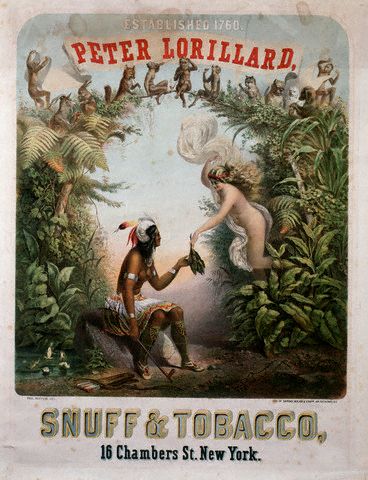
There are a few interesting things going on here. We have the association of femininity with a benign nature: the women are surrounded by various animals (monkeys, a fox and a rabbit, among others) who appear to pose no threat to the women or to one another. The background is lush and productive.
Racialized hierarchies are embedded in the personification of the “white spirit” as a White woman, descending from above to provide a precious gift to Native Americans, similar to imagery drawing on the idea of the “white man’s burden.”
And as often occurred (particularly as we entered the Victorian Era), there was a willingness to put non-White women’s bodies more obviously on display than the bodies of White women. The White woman above is actually less clothed than the American Indian woman, yet her arm and the white cloth are strategically placed to hide her breasts and crotch. On the other hand, the Native American woman’s breasts are fully displayed.
So, the ad provides a nice illustration of the personification of nations with women’s bodies, essentialized as close to nature, but arranged hierarchically according to race and perceived purity.
Originally posted in 2010.
Gwen Sharp is an associate professor of sociology at Nevada State College. You can follow her on Twitter at @gwensharpnv.
Comments 24
Sylvia — August 24, 2010
To me, the most ludicrous thing about this ad is that the White (presumably European) woman is giving tobacco to the Native American woman when in fact, tobacco was a thoroughly American plant that Native Americans introduced to Europeans.
Agu — August 24, 2010
Don't you think that the "willingness to put non-white bodies more on display" is a result of different dress codes of Europeans and people living in warmer climates? I'm no expert on Native Americans, but in a lot of places in Africa people didn't wear much (both men and women) because it was not practical given the weather and lifestyle. It was the Christian missionaries who did all they could to force people to wear European clothing... but in many places naked breasts were normal and not erotic in any way. So sometimes such a picture may be just realism. Would it be better if they dressed her in European or other clothing that had nothing to do with her culture? Seems it's bad either way.
qout — August 24, 2010
Hey - this is an important clarification: the legend (as reported in An Empire of Plants) - didn't describe the "beautiful spirit" as white: the artist just chose to depict the spirit as white.
Cyffermoon — August 25, 2010
T - I thought it was a funny way of summing up many of the cultural reasons why images of women are used in this way. Which are different from the reasons images of men are used as symbols. I didn't realize it would somehow come off as "absolutist". But... whatever?
-g. — August 25, 2010
I think its a really interesting piece of work, but if I were doing the interpretation I'd guess the reason the spirit was personified as a woman was because it's characterized in legend as "beautiful," not gentle. This wouldn't explain why the other person in the scene is female and not male, but I'd put that as a toss-up to traditional iconography: to have a naked white female and naked indigenous male would be too sexually suggestive, as the pairing was frequently used in that period to promote the idea "the lusty savage." By making both figures female, the potential sexuality of the characters towards one another is neutralized and both are rendered inert objects for the (presumably male) viewer to look at. Even the animals seem more representative of wealth/abundance or the spirit's connection to nature rather than gentility(the fox and what appears to be monkey being more renowned for mischieviousness than cuteness); the only real icon of benign nature I see is the peace pipe in the native american woman's hand. Hence, for me at least, male gaze trumps benign femininity. But that's just me.
Joshua D. Dye — August 24, 2020
Wearing Secret Identity Suit for women is common because they feel more comfortable in this suit. It is a natural process that a person wears such a thing that he likes as students can visit https://forums.autodesk.com/t5/installation-licensing/autocad-mobile-student-version/td-p/8521153 to get tips for autocad mobile version. I appreciate this article because it tells us about comfortable suits for women.
Arlene G. Jackson — September 21, 2020
Here a picture of a very technical view is given in this article. After reading this article I come to know what this picture means and why they have made this picture and students can visit https://essayhunters.com/ to find out unique task. All story about that picture is given in this article that will clear all the things in your mind.
John Michael — April 19, 2023
https://hqtobacco.com/
John Michael — April 19, 2023
Wholesale Tobacco Distributor>
Toca Boca Mods — December 6, 2023
Toca Boca Mods APK opens the door to an abundance of existing features. Players are treated to a premium extravaganza, featuring exclusive characters, premium content, and additional resources that add depth to the Download Toca Life World universe.
Clarke Diane — April 14, 2025
This vintage tobacco ad subtly reinforces societal norms. The depiction of a fair spirit bestowing tobacco echoes themes seen in many io games, where resource acquisition often hinges on conquering or receiving blessings. The ad contrasts idealized femininity with potential "otherness," a dynamic we sometimes see reflected in character choices and power dynamics within various io games. It's a complex snapshot of race, gender, and historical narratives. Even something as simple as picking your avatar in io games can have deeper meaning.
Navin Kar — April 12, 2026
Interesting analysis. It really shows how ads back then reinforced racial and gender hierarchies through subtle visuals.
Also, when dealing with research or related expenses, using a duplicate bill checker can help keep everything accurate and avoid confusion.
Gooder — June 10, 2026
Good post! I saw similar here: https://mail.google.com/
Desatascos — August 21, 2026
What makes this advertisement especially revealing is how it turns ideas about race and femininity into a visual hierarchy. The White woman is portrayed as pure, nurturing, and almost supernatural, while the Native woman is reduced to a more exposed and supposedly “natural” body.
Noelcars es — August 24, 2026
This vintage tobacco advertisement offers a fascinating example of how race, femininity, nature, and colonial ideas were represented in historical advertising. The contrast between the White female figure and the Native American woman reveals how beauty, modesty, and racial hierarchy were constructed through visual imagery. https://www.noelcars.es/
Marsanvi — September 24, 2026
What makes this advertisement particularly revealing is the way it turns ideas about race, gender, and nature into a visual hierarchy. The peaceful landscape and the animals surrounding the women create an image of innocence and harmony, but that apparent harmony masks a much more complicated message. The White woman is presented as a benevolent, almost supernatural figure who brings tobacco to Native Americans, positioning her as a symbol of purity, generosity, and civilization. Empresa de reformas