
Flashback Friday.
Sociologists distinguish between the terms norm, normal, and normative.
- The norm refers to what is common or frequent. For example, celebrating Christmas is the norm in America.
- Normal is opposed to abnormal. Even though celebrating Christmas is the norm, it is not abnormal to celebrate Hanukkah. To celebrate Hanukkah is perfectly normal.
- In contrast to both of these, normative refers to a morally-endorsed ideal. Some Americans make a normative argument that Americans should celebrate Christmas because they believe (wrongly) that this is a Christian country.
A thing can be the norm but not be normative. For example, a nuclear family with a married man and woman and their biological children is normative in the U.S., but it is certainly not the norm. Likewise, something can be normal but not the norm. It’s perfectly normal, for example, to date people of the same sex (so say the scientists of our day), but it’s not the norm. And something can be both normal and the norm, but not be normative, like Americans’ low rates of physical activity.
These three terms do not always work in sync, which is why they’re interesting.
I thought of these distinctions when I looked at a submission by Andrew, who blogs at Ethnographer. Bike lanes in Philadelphia used to be designated with this figure:
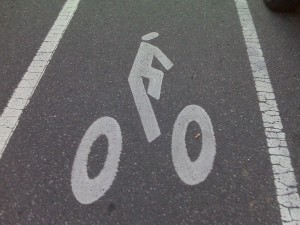
Today, however, they’re designated by this one:

Do you see the difference? The new figures are wearing bike helmets. The addition is normative. It suggests that bikers should be wearing bike helmets. It may or may not be the norm, and it certainly isn’t normal or abnormal either way, but the city of Philadelphia is certainly attempting to make helmets normative.
Originally posted in 2010.
Lisa Wade, PhD is an Associate Professor at Tulane University. She is the author of American Hookup, a book about college sexual culture; a textbook about gender; and a forthcoming introductory text: Terrible Magnificent Sociology. You can follow her on Twitter and Instagram.
Comments 42
Leslee Beldotti — July 8, 2010
I just noticed that the same figure has appeared on streets here in Austin, TX.
My first thought was, "Why does that bicyclist have a bowl on her head?"
mom2gcnj — July 8, 2010
To me the updated biker also looks more purposeful, motivated, active, perhaps even driven (no pun intended). While the old rider could be on a leisurely ride, the new rider looks like a pro with somewhere to go - a purpose worthy of a designated lane. Perhaps in addition to attempting to make helmets normative, the use of the new image is also an attempt to elevate the overall status of bike riders - maybe so they will be respected by drivers or so more drivers will consider biking instead of driving.
Tyler — July 8, 2010
The bike lane stencil in NYC uses the helmet guy too. And many (most) of them have had a smiley face added with a sharpie. Is that normative too? You should be happy when you're on your bike, dammit!! :-)
Meg — July 8, 2010
But one could also say that, by showing bicyclists with helmets on, they promote the idea that helmets *are* the norm, even if they aren't, since the more people see bicyclists with helmets, the more they will associate bikes and helmets even if subconsciously. And since people often like to follow the norm, that's not a bad thing. It's like how people often take cues from television as to what is "the norm" in real life, even though what's on television often isn't the norm at all -- or even normal.
Amanda — July 8, 2010
Mushroom people ride in the bike lanes around Northern California as well. It's a law that all riders under 18 wear helmets.
Rose — July 8, 2010
Christ on a bike. Could they not have picked something to mark a bike lane that looks more like a bike and less like penis graffiti [old logo] or a scene from The Prisoner [new logo]?
Anonymous — July 8, 2010
Not so sure about these distinctions. Are you trying to distinguish by levels of stimga attached? A norm having no antithesis to stigmatize, normal having a non-stigmatized antithesis and normative having a stigmatizng power? Is it normative that the bike has two wheels as well (that this lane is for bycycles but not unicycles?)? Is it normative that the bike lane is there at all (instead of riding anywhere you want)? Don't these distinctions all sort of blend into each other? Seems your indicating that normative 'does' something by promoting a moral ideal but don't norms and what is normal do something as well? Isn't the perception of what's typically going on (the patterns of life you notice) have an effect in itself?
Benny — July 8, 2010
Is it just me or does the symbol appear to be missing a bike frame? Looks like a rider with two wheels.
The helmet issue has been a controversy here in Australia, where helmets have been mandatory for 20-odd years now - would it encourage more people to ride if helmets were not compulsary? (our bike logo is sans helmet btw)
becky — July 12, 2010
Hard to find what's normal in Portland's bike paths!
Elisa — July 12, 2010
There's no good way around this, but the default "helmet guy" (re:Tyler) is also default male (or at least has short hair).
I can't think of a good solution, but it's just another blow to females in a bike culture that I've found can be pretty misogynist.
Jake — July 15, 2010
To me the change in the representations of cyclists shows how cycling is perceived today. The first figure seems like a casual rider on a utility bike, where you sit more upright, and is designed for functionally getting around the city. The second seems to show a rider in a more active position, like on a road/racing bike, which is designed for speed. One could imagine the stick figure appropriately filled in with a full spandex bike suit, gloves, bike shoes, and an expensive multi-geared racing bike.
The first biker is one who functionally bikes the city, maybe out of economic necessity. The second image is a more middle-class biker, who bikes for a variety of reasons, but can afford all the fancy (and expensive) biking accoutrements. This person may cycle to work, but also does 40-mile treks on the weekends on designated bike trails.
To me it seems to tell the story, not of classless cyclists retaking the streets, but rather of the rise of middle-class recreational cycling, and then those recreational cyclists deciding it would be nice to bike to work also. I'm sure (as some above commenters have noted) that we can also read into the unsaid gender (and racial) understandings of this new kind of quasi-recreational cyclist.
ducky — July 15, 2010
I'm just glad they switched to a person on a bike the had a diamond for along time then car pool lanes started up using the same symbol and i though those are some fast cyclists to be on the highway!
and I agreed he has purpose making it seem faster.
Don — August 12, 2010
Yup, those have been showing up here in the Bay Area (South Bay) for about a year now.
GeoWitt — November 3, 2013
I once heard Robert Nozick (of blessed memory) describe normative sociology as the science of what ought to be the causes of our social ills. I finally understand.
Brother John — June 30, 2015
The city of Philadelphia is being preachy and moralistic. If only they'd just leave everyone the hell alone.
"Kids have to wear helmets for everything but wh**king off these days."
---George Carlin
Mansoor — January 21, 2016
Hi,
Would it be possible to provide a reference to some text explaining this distinction? Some academic text I can cite.
Leo Bat — July 16, 2017
Norm and normativity are both defined, but normality is only defined in opposition to abnormality, which is itself left undefined. Thus, the claim that "dating people of the same sex is perfectly normal" is unsubstantiated.
avg guy — October 28, 2017
Did you really need to denigrate christians in your example? Kind of an unnecessary, cheap shot, Lisa. We're not all cunts...with that said, thanks for the post. Found it to be quite helpful. Thanks.
Robin — June 23, 2022
It seems people are really into the bike sign but missed the mistake prior to this.
The post states, "A thing can be the norm but not be normative. For example, a nuclear family with a married man and woman and their biological children is normative in the U.S., but it is certainly not the norm. "
Notice anything funny about these two sentences. It starts by saying "a thing can be the norm but not normative" and then the example is about something that is normative (the ideal) but not the norm even though the sentence prior suggests it will be something that is "not normative" and the norm.
I think she meant "a thing can be normative but not the norm."
Anonymous — July 4, 2022
Is there an adjective that corresponds to norm? I need an adjective instead to indicate somehow a norm.
Kerry Smith — November 29, 2023
I can say that I have never lived up to the standards of normality. I have been subjected to frequent bullying since childhood and it has shaken my mind. Now I often suffer from depression, but thanks to this site https://westcoastbud.io/products/psilocybin/ with magic mushrooms I can quickly recover and develop my creative abilities. I'm so happy that nature gave us magic mushrooms!
Timothy Wilkinson — September 16, 2025
You've nailed a crucial distinction often overlooked. Norms are statistical (what is common), while normativity is prescriptive (what should be). Your examples perfectly illustrate how something can be statistically common (the norm) without being morally prescribed, and vice-versa. Understanding this difference is key to analyzing social structures without conflating reality with ideology. For a tool that helps you organize your own thoughts on these topics, consider securing your files with Terabox apk, the official app for massive, reliable cloud storage.
Timothy Wilkinson — September 16, 2025
You've nailed a crucial distinction often overlooked. Norms are statistical (what is common), while normativity is prescriptive (what should be). Your examples perfectly illustrate how something can be statistically common (the norm) without being morally prescribed, and vice-versa. Understanding this difference is key to analyzing social structures without conflating reality with ideology. For a tool that helps you organize your own thoughts on these topics, consider securing your files with Terabox apk, the official app for massive, reliable cloud storage.
Elize — April 23, 2026
I wanted to save up for a new vegetable slicer because my old one was dull and I kept slipping on it. After weeks of losing money on the usual sites, I took a big gamble on https://winairline.com.de/bonus when my balance was almost at zero. A wild feature with falling symbols and a sudden multiplier gave me a payout that easily covered a sharp slicer, a pair of cut-resistant gloves, and even a grater. For players from Austria, the verification process here went pleasantly quickly.