education

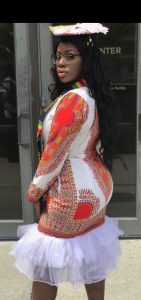
And by she, I mean Eunice Owusu, a 2018 Framingham State University graduate. She walked across the stage, shook hands with the president of the institution while her family, friends, and plenty of others who look up to her, support her, and love her, cheered her on. Currently, Eunice is a cheerleading coach for South High Community School, building and creating a group that fosters a positive energy for supporting all of the teams they are motivating at every game. Filling the world and the people around her with positivity is only one of Eunice’s many strengths. Eunice is extremely talented in the art of makeup and began her very own business, Hint of Ebeauty, creating wigs. However, her passions do not stop there. Her interest in Family Law and Policy drives her future for changing the lives of low-income families and immigrant families through looking at the policies that effect these populations. Because of this passion, Eunice plans on attending graduate school next fall. In addition, because of what we learned in our course studying careers of Black women in public policy in Washington, D.C. I had the opportunity to learn more of who Eunice is, who Eunice was, and everything that Eunice will be:

TC: What did you learn through your independent study: From Margin to Center—women of color in policy? Why did you take the course and what did you learn about yourself?

EO: One of the biggest things I learned in this study was that in order to be the most confident Black woman, you cannot be afraid of your own voice. There is so much importance and weight in speaking up for those who cannot be at the table, when the table is full of those can never relate. The very few Black women proves that there is in fact racial disparities in American work life. But it is one thing to sit and complain rather than to become informed and aware. To be informed and aware is to make sure that our faces are necessary and are holding positions that lead to redirection of policy to benefit evenly and equally for everyone while bringing justice. Black women in policy such as Janelle Jones, Valerie Wilson, Angela Hanks, Misha Hill, Cherrie Bucknor, and Jessica Fulton all agree that educated Black women are needed and should not be afraid to speak up. For me, in the past, I shied away and became passive because of the fear of being “too passionate” or “too angry” in situations where my voice would have secured the change I wanted to see. It was important to me to see what women from similar backgrounds as my own did to get where they are today. This study became my motivating push to follow their footsteps while creating my own path into policy work.

The study was formulated by my professor, Dr. Virginia Rutter, who helped us to connect with Black women doing policy work in DC. I took this class to help me really figure out what I wanted to do in my graduate studies and what kind of career I can make out of my Sociology and Political Science background. It helped me understand what policy work actually is and what kind of things go into it on a day to day basis. To see first-hand what kinds of people are part of organizations such as the Economic Policy Institute and DC Fiscal Policy Institute really helped my understanding of what life after grad school could be like. To me, there is no formula or handbook on how to be a successful woman after college. The truth is that months after graduating from Framingham State, I’m still trying to figure out how to get to the next step. This study made me realize that my presence, my knowledge, and awareness of the community I come from can speak volumes in public policy.

TC: How do you feel your identity, as a Black woman, has impacted your experience in college?

 EO: My identity as a Black woman impacted my experience in college because of the fact that I knew that I was not “cut from the same cloth” as others. In other words, being an African woman in college that represented my entire family, immigrants, and the ones that live in my country, Ghana, college was less of finding myself and more of making sure I was making all the ones counting on me proud. That pressure alone was my motivation to make sure I was soaking up all the knowledge I could for the ones in family that didn’t make it past their first few years of high school; some, their first years of junior high. As a Black first-gen woman, my layers made me excited to study the main things that were affecting my family first hand: immigration, education, and income inequality.

My identity as a Black woman impacted my experience in college because it framed my passions in my studies. It motivated what classes I took and what kinds of organizations I joined. My dark skin tone combined with my intelligence shows people that not only are Black women capable, our ideas are worth listening to. While attending a white institution with undercover racial bias and people who always underestimate the minorities who attend the school, I was able to understand not only what it means to be a Black woman but what it means to be myself. From freshman year to post grad, I no longer find myself sitting in in the back and listening to others. I have become a brave voice potential of change in the communities I am a part of.

TC: What would you tell high school Eunice?

EO: High school Eunice was my most indecisive self. This is because I battled back and forth in whether or not I wanted to pursue family law or do something STEM related. I became the only one taking classes like human geography while my friends took classes like physics. Coming from an African family, the expectation to become a doctor or engineer or anything STEM related was the ideal and that discouraged me from following the beat of my own drum. I would tell high school Eunice that there is nothing wrong with making a career out of passions. There was no need to seek the approval of others because it didn’t matter what field I chose. What mattered for me was whether or not it fed my want to help others battling things that I witnessed and went through, coming from a single-parent-immigrant household. I would tell high school Eunice that nothing comes easy, but it will make sense in the end. I would tell her that studying something that you are passionate about is extremely important because that determines your ability to not only retain information but to apply just about anything.

Tasia Clemons is a 2018 graduate at FSU in Sociology with a minor in Spanish. She is currently a Hall Director and in the Higher Education and Student Affairs Administration program at Canisius College. Follow Tasia at @TasiaClemons. Eunice Owusu is a Council on Contemporary Families Public Affairs Intern and a 2018 graduate of Framingham State University in Sociology with a minor in Political Science.
Women – and black women in particular – have seen significant improvements in high school completion rates since the turn of the century, almost cutting in half the black-white gap for women during that time, as I shared last month. But has that meant an increase in college entry and completion – especially since a college degree should demand higher wages in the labor market?

The second report in my Young Black America series of reports examined just that. I found that Figure 1young black women and men are entering and completing college at higher levels than in the past. Yet, these gains haven’t been enough to noticeably close the gap between them and their white counterparts.

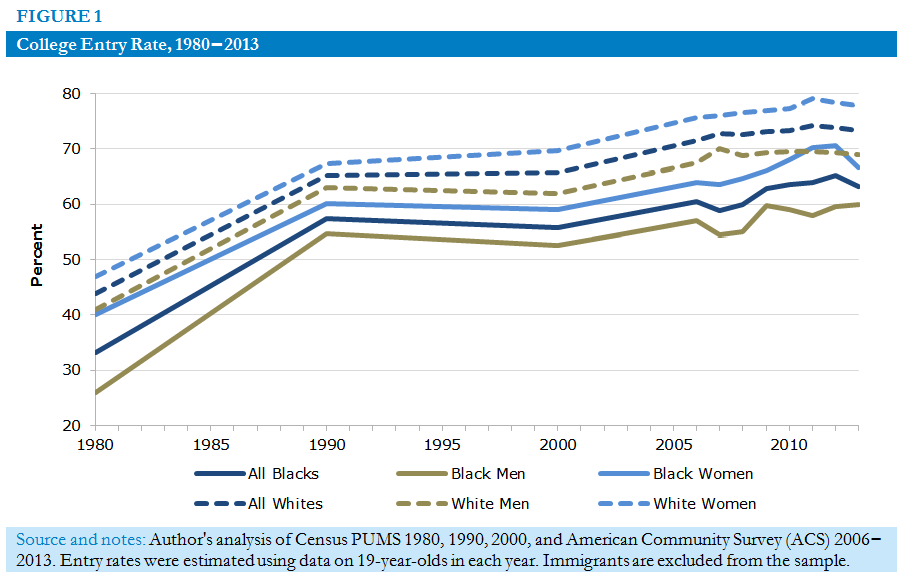
From 1980 to 2013, women had higher college entry rates than men, with white women having the highest entry rates of all (see Figure 1). In 1980, 46.9 percent of 19-year-old white women had entered college (including community college). The college entry rate for white men was 41.0 percent and the rate for black women was 40.0 percent. Black men had the lowest entry rate of 25.9 percent, 14.1 percentage points lower than that of black women.

Since then, college entry rates have significantly increased, with most of the increases occurring between 1980 and 1990. During that time, entry rates for both black and white women increased about 20 percentage points, and rates for white men increased 22 percentage points. College entry rates for black men increased the most, rising 29 percentage points from 1980 to 1990.

Despite making the most progress in entry rates, young black men still lag behind black women and whites. In 2013, the entry rate of black men was 60.0 percent, 34.1 percentage points higher than their entry rate in 1980. However, this rate was still 6.6 percentage points less than black women, 9.0 percentage points less than white men, and 17.9 percentage points less than white women.

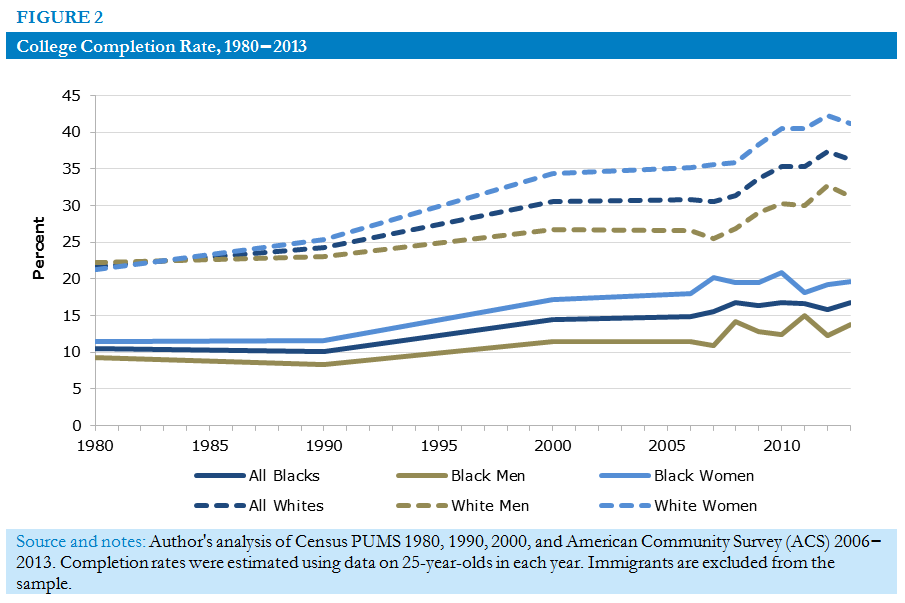
Figure 2But entry is different from completion. The data on racial gaps in college completion rates were even more striking. Although my analysis of high school completion rates showed a significant convergence between black and white women, the exact opposite is the case with college completion rates (see Figure 2). In 1980, 11.5 percent of 25-year-old black women had completed college with a bachelor’s degree or higher. During the same year, the college completion rate of white women was 21.3 percent, for a black-white gap of 9.8 percentage points.

Things got worse not better: In 2013, the gap in college completion rates between black and white women was 21.4 percentage points, with completion rates of 19.7 percent and 41.1 percent, respectively. The same is true among men. In 1980, the black-white gap in completion rates for men was 12.9 percentage points, and it increased to 17.6 percent in 2013.

These growing rather than shrinking gaps confirm that there’s more work to be done. Young blacks are 30 percentage points more likely to enter college than in 1980, with entry rates increasing 26.6 percentage points for black women and 34.1 percentage points for black men. These are significant improvements, but remain far behind their white counterparts. Young blacks also still lag almost 20 percentage points behind young whites in college completion rates.

But the growth—rather than continued decline—in black-white gaps highlights the need to examine why these racial gaps persist, and in the case of completion rates, continue to widen.

Increases in educational attainment are important, but not just for their own sake. College degrees should lead to higher employment rates, wages, and other labor market outcomes. However, large gaps in completion rates are likely to result in sizable racial disparities in these outcomes. Upcoming installments of my Young Black America series will examine whether that is in fact the case.

Cherrie Bucknor is a research assistant at the Center for Economic and Policy Research. She is working on a year-long series of reports on Young Black America. Follow her on Twitter @CherrieBucknor.

Often, when we see improvements by all (be it in educational attainment, income, health, etc.), we overlook the fact that gender or racial gaps still persist or have even gotten worse. There has been much attention given, and rightfully so, to all of the progress that women, and black women in particular have made. But, what about where women stand in relation to men? Or where black women stand in relation to white women? If significant gaps still persist, can we be satisfied with the progress we’ve made? Or is there still work left to be done?

As a young black woman, sociologist, and researcher at an economic policy think tank, I am particularly sensitive to this and make a point to address these issues in my work at CEPR (Center for Economic and Policy Research). It’s part of the reason why I began my Young Black America series of reports that strive to answer the question, “What’s going on with young blacks today?” An important goal of the series is to explore the intersection of race and gender while tackling the issues facing young people today.

From "Young Black  America" part 1, Center for Economic and Policy Research
From “Young Black America” part 1, Center for Economic and Policy Research

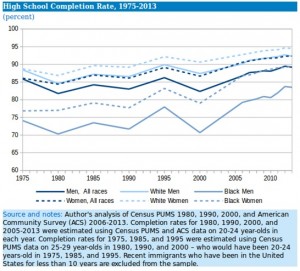
The first report in the series found that there is positive news on both the gender and racial dimensions in regard to high school completion rates. After decades of mostly stagnant and depressing numbers, both women and men have seen marked improvements in high school completion rates since 2000. Furthermore, throughout the entire period I looked at (1975-2013), women overall have achieved higher completion rates than men.

But, what I found most interesting was what happens when you throw race into the mix. In 1975, 88.7 percent of white women between the ages of 20 and 24 had completed high school with either a high school diploma or a GED. During that same year, the rate for black women was only 76.9 percent, for a black-white gap of 11.9 percentage points. Since then, white women have maintained this sizable advantage, which averaged about 11 percentage points through 2000. In 2000, the completion rates for black and white women were 79.0 percent, and 90.6 percent, respectively.

Fortunately, since 2000 there has been a significant convergence in completion rates for black and white women. The completion rate of black women has increased 10.4 percentage points since the turn of the century, reaching 89.4 percent in 2013. During the same time, the completion rate of white women increased at a slower pace and stood at 94.5 percent in 2013. The result was a much smaller black-white completion gap of 5.1 percentage points – 57 percent less than the gap in 1975.

Closing achievement gaps should be an important part of any economic agenda. While a lot of attention is given to racial and gender achievement gaps separately, the double burden of being both a woman and a racial minority can present a unique problem for black women.

So, yes, we should take a moment or two to celebrate these accomplishments. The high school completion rates of young women are at their highest ever, and remain higher than the rates of men. Although black women still lag behind their white counterparts, this gap has been trending downward for more than a decade and hopefully will continue to do so.

But as we all know, in order to realize racial and gender economic equality, education is just one piece of the puzzle. Increases in high school completion rates are important because they widen the pool of potential college entrants and graduates – with a college degree becoming increasingly necessary in today’s economy. However, even a college degree doesn’t guarantee labor market success, as my former colleagues Janelle Jones and John Schmitt at CEPR have shown. We must not ignore issues of racial and gender discrimination, or other structural issues that are at the root of many of the economic problems we face in this country. Subsequent reports in my Young Black America series will address these and other issues facing young blacks.

Cherrie Bucknor is a research assistant at the Center for Economic and Policy Research. She is working on a year-long series of reports on Young Black America.@cherriebucknor

Earlier this month I wrote about gender, debt, and college drop out rates–men’s and women’s different debt tolerance (women have more) is related to their early job market prospects (men have more) and helps explain why men drop out of college more.

Now, here’s a new piece of the gender gap in education puzzle. According to a new briefing report presented to the Council on Contemporary Families, “the most important predictor of boys’ achievement is the extent to which the school culture expects, values, and rewards academic effort.” Sociologists Claudia Buchmann (Ohio State) and Thomas DiPrete (Columbia University) present their in-depth findings on the much-debated reasons why women outstrip men in education—also the subject of their new book—in “The Rise of Women: The Growing Gender Gap in Education and What it Means for American Schools.” The full CCF briefing report is available here.

When did the gender gap begin? Some of the gender gap in schooling is new and some is not. For about 100 years, the authors explain, girls have been making better grades than boys. But only since the 1970s have women been catching up to—and surpassing—men in terms of graduation rates from college and graduate school. The authors report, “Back in 1960, more than twice as many men as women between the ages of 26-28 were college graduates. Between 1970 and 2010, men’s rate of B.A. completion grew by just 7 percent, rising from 20 to 27 percent in those 40 years. In contrast, women’s rates almost tripled, rising from 14 percent to 36 percent.”

Is the gender gap translating into wages? “The rise of women in the educational realm has not wiped out the gender wage gap — women with a college degree continue to earn less on average than men with a college degree.”  But because more women are getting college degrees, growing numbers of women are earning more than their less-educated men age-mates, and the gender wage gap has narrowed considerably.” But, report the authors, if men were keeping up with women in terms of education, men would on average be earning four percent more than they do now, and their unemployment rate would be one-half percentage point lower.

What should schools do? The authors debunk the notion that boys’ under-performance in school is caused by a “feminized” learning environment that needs to be made more boy-friendly. Making curriculum, teachers, or classroom more “masculine” is not the answer, they show. In fact, boys do better in school in classrooms that have more girls and that emphasize extracurricular activities such as music and art as well as holding both girls and boys to high academic standards. But boys do need to learn how much today’s economy rewards academic achievement rather than traditionally masculine blue-collar work.

Please read here to read more about the gender gap in educational achievement and the sources of it.

Virginia Rutter


Next weekend I have a unique opportunity to reflect on how I’ve grown since my graduation from Muskingum College—now University—in 1991. My husband Nikhil Deogun and I will be delivering the undergraduate commencement address.

Needless to say, it’s an honor and a privilege, but also a big responsibility. After all, we want to impart wisdom, right?

We’ve had fun thinking back on the people we were 21 years ago, and the unexpected paths we’ve followed. We want to give the graduates advice about how to navigate those unexpected turns themselves, about how to find love, follow their professional dreams, and make a difference.

For me, the question of making a difference has also come from some unexpected places. Here’s a sneak peak at some of my thoughts for the Class of 2012:

I’ve learned that through mothering I can make my mark on the world as much as—and maybe more than—at work. Let me be clear: I love my work at the National Women’s Studies Association and find it meaningful. Highlights of my working life include planning a yearly national conference that features cutting-edge feminist scholarship. I’m also a leader in conversations about women’s issues outside of higher education: in 2010, I organized a meeting at the invitation of the White House Council on Women and Girls to discuss how feminist academics could help shape policy initiatives, and I recently attended a Department of Education-sponsored discussion about applying classroom learning in community settings.

Yet I’ve discovered that motherhood can sometimes be richer ground for expressing my feminist values, and for cultivating parts of myself, than the workplace. Our children, Maya—who’s 11—and Sameer, who’s 9—really want to make the world a better place. More important, they take action to make a difference. For example, Maya teamed up with friends to sell hot chocolate at our local sledding hill to raise money for a neighborhood soup kitchen. Sameer has spent time serving meals in a Newark homeless shelter. Of course, they’re normal kids who sometimes spend too much time watching Teen Nick and absorbed in their iPods. But when they notice inequality they ask questions and they want to do something about it.

Here’s the lesson I’ve learned: while you’re busy building your career, don’t forget about opportunities at home, whether those come in the form of parenting or other non-work pursuits. It really is true what you’ve probably heard from faculty already: you want to be a well-rounded person.

Now GWP readers, what advice do you have for the class of 2012? What unexpected discoveries have you made looking back on your life over five, ten, or 20 years?

Normally I would wait to read the actual book before writing a glowing post about it, but last week I was privileged to sit front row as Dr. Claude Steele gave a moving talk about his new book, Whistling Vivaldi, and his great contribution to understanding stereotypes. I was in the front row because I have lost count how many times my partner and I have cited Dr. Steele in grant proposals.

His biggest contribution to the field of women in science and engineering is the theory of “stereotype threat.” It describes the impact stereotypes have on our lives. It means that whether we are aware of it or not, we operate with the knowledge that there is a negative stereotype about us and that knowledge can hinder us. My favorite experiment on stereotype threat showed that if you remind a group of Asian-American women that they are women before a math test, they under-perform. But if you remind them of their Asian heritage, they kick butt. [1] There are various ways of “reminding” people to their identity. All those demographics you have to enter at the start of standardized tests? Best way to remind people to their location in society. Stereotype threat has been shown when asking African-American men to take IQ tests, white men to run a race, women taking a math test, on and on.

There is no group that doesn’t have a negative stereotype, and when that if that stereotype is relevant to them in an important set of situations, like the classroom or the workplace or the basketball court or something that they care about, then they’re going to feel this pressure. ~ Dr. Steele on NPR’s Talk of the Nation.

As Dr. Steele goes on to discuss and I believe is detailed in the book, we can stop stereotype threat by educating ourselves and others about it. There are ways that educators can minimize the effect during exams. Of course the trick is to figure out how to actually do it, because the thing is that the more you care about being X and doing well at Y, the higher the impact of stereotype threat. The more confidence one has, the more stereotype threat will make an impact. Kinda sucks huh?

One thing that Dr. Steele did say at the lecture was that avoiding talking about stereotypes in an effort to shield children from them does not work. Apparently the one thing that Condi Rice, Skip Gates and Steele have in common are parents who sat them down early in life and said, “Life isn’t fair. People will expect you to act/think/behave one way because you are Black.” I can’t recall how he said his parents that fortified him to go forth into the world and become as awesome as he is, but I do hope it is in the book!

Stereotype threat theory includes discussions of why critical mass is so important. In other words, why it is vital to have more than one woman in a room/on a panel/on the Supreme Court. Steele talks about Sandra Day O’Connor during the NPR interview, as he did at the lecture I attended.

I will be honest to say that while I have used his work for years and applied it to my work, attending his lecture made me reflect on how many times in my life I allowed stereotype threat to impact my life. How I struggled to get into graduate school out of undergrad and allowed that struggle to take me off track. And so many other times. Steele talked about how he still finds himself realizing that he is allowing stereotype threat to frame the world. HIM! That made me feel so much better.

I hope to bring you all an actual review of his book later in the summer. My classes are over and I’m eager to read something that I won’t be tested on.  Even if in reality, this book is about the work I do day in and day out, so it’s actually more important than any test could ever measure.

The title of the book comes from a student who told Steele that in order to combat people’s stereotype of himself, as a young Black man, he would whistle Vivaldi while walking the streets of Hyde Park in Chicago. People stopped seeing him as a threatening Black man and, he believes, more as the University of Chicago student he was.

[1] Shih, Margaret; Pittinsky, Todd L.; Ambady, Nalini (1999), “Stereotype Susceptibility: Identity Salience and Shifts in Quantitative Performance”, Psychological Science 10 (1): 80–83

Just in time for Mother’s Day, Save the Children has published its twelfth annual State of the World’s Mothers Report.  This report includes the Mothers’ Index, a ranked list of 164 countries around the world.  Like last year, Norway tops the list for the best place to be a mother.  Afghanistan is worst.  The U.S. fell three places, to number 31 on the list.

In other words, the U.S. ranks closer to the bottom than the top of the 43 developed countries examined in the report.

Of course, as the report reminds us, the numbers don’t always tell the whole story—an individual mother’s situation can vary greatly within the same country.  Nonetheless, national-level comparisons do suggest trends and provide overviews that can provide a valuable framework for digging deeper.

For those of us living in the U.S., these national numbers should give us pause.  Why didn’t mothers in the U.S. fare better?  And why are we falling in the rankings instead of improving?  These startling numbers complicate the rosier picture of motherhood and family that many Americans tend to hold.

The first reason for our low ranking is our maternal mortality rate, an issue I wrote about last month for Girl w/Pen and Ms.  As the State of the World’s Mothers Report points out, the U.S.’s rate for maternal mortality is 1 in 2,100—the highest of any industrialized nation.  In other words, a woman in the U.S. is “more than 7 times as likely as a woman in Italy or Ireland to die from pregnancy-related causes and her risk of maternal death is 15-fold that of a woman in Greece.”

Other reasons for our low ranking include the under-five mortality rate (forty countries beat us on this one) and the percentage of children enrolled in preschool—only 58%, making us the fifth lowest country in the developed world for educating young kids.

Finally—surprise, surprise—our country lags in supporting working women with children, and in creating pathways for women to political office nationally:

The United States has the least generous maternity leave policy—both in terms of duration and percent of wages paid—of any wealthy nation.

The United States is also lagging behind with regard to the political status of women. Only 17 percent of congressional seats are held by women, compared to 45 percent in Sweden and 43 percent in Iceland.

This report made me feel a lot of different emotions about the state of motherhood in the U.S. as well as globally—shock, anger, outrage—not to mention gratitude. I’m fortunate enough to have healthy kids and privileged enough to be able to pay for things like health insurance and preschool. Given the state of things for many mothers, this is no small potatoes! And yet, the more I thought about this report and my reaction to it, the more I began to think about how important it is to use feelings to propel us to something more—understanding, wisdom, action, and working together.

This view of motherhood lies at the origins of Mother’s Day.  Long before Hallmark made sentimentality synonymous with Mother’s Day and restaurants began the tradition of the Mother’s Day brunch (neither of which I plan to reject come Sunday!), Julia Ward Howe imagined a very different kind of occasion.  In her 1870 Mother’s Day Proclamation, she called for a day when women could come together and work towards peace.  In the aftermath of the violence and carnage of the U.S. Civil War, she called for women to

…meet first, as women, to bewail and commemorate the dead.

Let them solemnly take counsel with each other as to the means

Whereby the great human family can live in peace…

After grief, counsel.  After sorrow, solidarity.  After remembrance, action:

To promote the alliance of the different nationalities,

The amicable settlement of international questions,

The great and general interests of peace.

So here’s my Mother’s Day Challenge to myself this year: after enjoying whatever treats my family makes for me, and feeling lots of warm tenderness toward them (note to kids: you will be good), and making sure I have time to write in my journal, and calling my own mother on the phone—I’m going to do one thing, one action, toward addressing one of the issues raised by this report.  I haven’t decided what, quite yet.  But here are some ideas I scribbled down this afternoon, a personal list to start my brain juices flowing:

  • Write a letter to one of my representatives about some of the issues that really matter to mothers and families.  (Education!  Parental leave!  Women’s health!)
  • Send money to Emily’s List.
  • Write an opinion essay.  Send it out.
  • Go to a protest, like this one sponsored by Mothers & Others United in the Hudson Valley.
  • Find out more about the campaigns to connect kids across the borders of class and geography—the UN’s Girl Up and Save the Children’s k2kUSA are ones I’ve recently run across.  Think about how to plug my own family into these networks.
  • Find out more about efforts in my own backyard.  (I could start by actually reading all those items in my church’s bulletin!) Ask someone how I and my family can get involved.
  • Make a donation to one of these campaigns, or one of the many organizations working for women’s rights and healthy families.
  • Write down in my calendar that I will bring up all these issues up again on Father’s Day.

I invite anyone and everyone to join me in this challenge.  Share ideas and actions from your own list.  (And be sure to watch the video about Julia Ward Howe below, released from Brave New Foundation in 2009, which includes an inspiring reading of her Mother’s Day Proclamation.)  Happy Mother’s Day!

Choices, not discrimination, deter women scientists

So read the headline that summed up a few weeks of articles, blog posts and opinion pieces on Stephen J. Ceci and Wendy M. Williams’ article, Understanding current causes of women’s underrepresentation in science. And that’s the conclusion I would come to as well if I didn’t understand that you can’t examine the issue of underrepresentation of women in the sciences by comparing women and men with equal resources to each other. Because part of the issue with the lack of women in the sciences is that resources are not distributed equally.

It’s Women’s History Month and for the past few years women in the sciences has received a lot of attention during this month. First Lady Michelle Obama mentioned the shortage of women in the sciences and the Smithsonian Channel included comic books to their Women in Science programming this year. After 15 years of studying and working on this issue, if it were that easy, I’d pack it up and move on to a new puzzle to solve.

But let’s look at the “choices” Ceci and Williams claim are at the real root of the issue:

If not discrimination, what is the cause of women’s underrepresentation? Today, the dearth of women in math-based fields is related to three factors, one of which (fertility/lifestyle choices) hinders women in all fields, not just mathematical ones, whereas the others (career preferences and ability differences) impact women in math-based fields. [1] Regarding the role of math-related career preferences, adolescent girls often prefer careers focusing on people as opposed to things, and this preference accounts for their burgeoning numbers in such fields as medicine and biology, and their smaller presence in math-intensive fields such as computer science, physics, engineering, chemistry, and mathematics, even when math ability is equated. [2] Regarding the role of math-ability differences, potentially influenced by both socialization and biology, twice as many men as women are found in the top 1% of the math score distribution (e.g., SAT-M, GRE-Q). [3] The third factor influencing underrepresentation affects women in all fields: fertility choices and work-home balance issues. However, this challenge is exacerbated in math-intensive fields because the number of women is smaller to begin with. [Numbers in brackets were added by me.]

Let’s take these one at a time:

1] Career choice. Girls just like working with people better. I’ve wrestled with this issue for years. I almost bought into it too at one point, but I came to a different conclusion. Parents, educators and career/college counselors are terrible at teaching kids, boy and girls, what “good” comes from math-based careers such as computer science and engineering. For the most part, I would agree that women are attracted to careers that appear to benefit humanity. It’s easy to see that connection when one looks at medicine and biology, especially with the abundance of shows about doctors saving lives on TV almost every night. The CSI franchise is moving that view towards chemistry. Now to work on computer science! Which is why I love that my campus has a good number of women faculty members in the computer science department.

2] Are we really going to revisit the Larry Summers debate? Really? Do I really need to state again that one does not need to be a genius to be a rocket scientist? Yes, smart…but if we restricted math-based careers to just the top 1%, I think we’d have a shortage of computer scientists. Oh, wait, WE DO!

3] The fact that fertility coincides with the tenure clock is discrimination. It impacts women far greater than it does men. The fact that the academy has dragged its feet to alter the tenure system to retain intelligent women in all fields is at bare minimum biased towards a masculine way of promoting workers and thus smells like discrimination.

We can no longer hide behind the idea that women choose to do X when all the social forces in her life is choosing for her. When we settle the question of inequality with “but women choose” we let ourselves off the hook and place the entire burden on individual women. When we don’t encourage our girls to embrace their intelligence, we choose for them. When we tell them that being an engineer isn’t helping humanity, we choose for them. When a woman faces the “choice” between buckling down to get tenure versus starting her long awaited family, we choose for them.

Until women and girls can truly make free choices, we must look hard at the system we operate in and ask, “What is wrong? Where can we help women make the choice they really want versus the choice that seems to fit best?” Now that’s a choice I can stand behind.

I’m taking a point of privilege here this month to boast about my recent trip to Washington, DC. Why did I go? My office received a Presidential Award for Excellence in Science, Mathematics and Engineering Mentoring!

To answer the first question I get, no, I didn’t get to meet the President, but the director of our center did. She’s third from the left in the seated row. She’s even shown shaking President Obama’s hand (at 4:35) in a “West Wing Week” video!

But along with my coworkers and the other awardees, I did get to go on a tour of the White House. I also participated in a meeting with Ray M. Bowen, Chair of the National Science Board, and Cora Marret, Deputy Director of the National Science Foundation, where we had a great discussion about the role of two-year colleges, the need to additional funding and of course the importance of mentoring in the effort to increase the number of women and underrepresented minorities in science and engineering.

One afternoon all the awardees spent presenting our programs to each other. It was humbling to hear from awardees who have been working to increase diversity in science and engineering longer than I have been aware of the issue. In some ways we are all doing the same work. In more ways, we are addressing the problem in our own ways. Some are focused on American Indian students, some on increasing diversity in energy jobs, others work at institutions where the population has flipped from majority Caucasian to majority Latino and others are using mentoring as a framework to expose their students to international health issues.

It was no coincidence that we received this award the same week as the State of the Union. President Obama and his administration are truly committed to science and engineering. Yet there are holes in this commitment as well stated in a recent NY Times article on science fairs. If this is truly our Sputnik moment, there should also be a Sputnik-sized investment in our education system from pre-school through graduate school. Considering who is in control of the House of Representatives, I doubt we will see that.

No amount of mentoring will get ever get us the increase in scientists and engineers the USA needs without additional support for their education and yes, I do mean cold hard cash. Science and engineering is expensive. Can you imagine how many petri dishes a college runs through in a year? Egads, right? Those costs are passed on to students. Tax credits can only go so far with the skyrocketing cost of college. And that’s just at the undergraduate level.

I will continue to do my part of solving this large challenge to increase diversity in the ranks of scientists and engineers. I love my work and even without this amazing honor, I would still get up in the morning happy with the work I do. This honor is phenomenal and I have stared at the certificate that bears President Obama’s signature a few million times since returning to Chicago. But it’s time to get back to work and if you see me with an extra hop in my step, you know why.

Arne Duncan and I have often held differing opinions when it comes to our children’s education. Considering that he use to run the school system where my seven-year-old attends school, I have years of experience of yelling back at my radio hoping that Duncan hears my cries. In December the results from another international test to gauge where the world’s children rank were released. The USA did not get an A+. Duncan bemoaned our results in math, science and language and pointed towards China as a threat to our intellectual dominance.

But I’m really not that worried about China.

No, I’m not happy that our kids had an average score. I’m not happy that we’re losing ground to other countries. What I really am worried about is that this news will fuel a new fervor to copy China’s method of educating our kids. And that’s the real bottom line isn’t it? How do we want to educate our children? What kind of children do we want to raise?

“Successful ones!” I hear you. But how do you define successful?

In China children spend all day in school drilling facts and perfecting test prep. Believe me, our kids are perfecting test prep here too. When my daughter came home from kindergarten with homework sheets that had bubbles on it, I nearly lost it. “Really? Are we already teaching them how to fill in standardized test bubbles?” And my daughter attends one of the best public schools in Chicago.

Of course some parents, like Amy Chua, are all for turning our schools into American Chinese schools chock full of rote and consequences. I’m thankful that the Wall Street Journal highlighted her highly offensive parenting style. Because it reveals the end of the path we have allowed our schools to start walking down. That is the true wake-up call. For all our desire to regain our global dominance, we have gutted our children’s education.

Gym? Cut for additional study time. Ditto for art, music and recess. All this despite the fact that music HELPS our children learn and appreciate math better. Research shows that children behave better when given a mid-day recess. The 30 minutes my daughter and her classmates get before school does not meet my standard for a real recess. Play allows children to engage in many things including their imagination, negotiation and of course fitness.

The reality is that while China and other countries may be beating us out on standardized tests, the USA is still winning the overall education game. The number of Chinese students coming to the USA for graduate education continues to climb. They come here for the superior educational experience in all fields, including education theory. The USA is winning in terms of innovation and ideas. We may not be making a lot of widgets in this country, but we are overflowing with ideas on what to make, design and invent. I am though in favor of extending the school day, but not to cram in more studying at the expense of their imagination and well-being.

Yes, we have a lot of work cut out for us here in terms of our education system. Even from my daughter’s very privileged school I can see it. But we aren’t going to rise in the rankings by just teaching our children Chinese  or by increasing their access to test prep. Rather we will, as a country, increase our scientific literacy and achievement by increasing access to early childhood education, making the teaching profession one where dedicated people will flock, increasing the number of science labs and ensuring that every single school has a library. A recent demonstration at Whittier elementary school revealed that almost 200 Chicago Public Schools do not have a library. How can we ever believe we will get our children to learn more and achieve more if they do not have access to a school library?

There are many things we need to do to get our education system in working order. Worrying about China isn’t one of them.