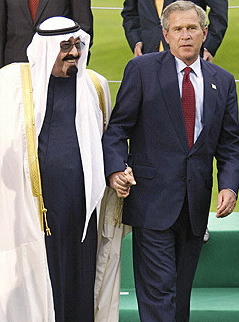
 Craig Unger, author of the books Fall of the House of Bush and House of Bush, House of Saud, loves to point out the irony of the Bush administration’s promotion of democracy and freedom in the middle east while simultaneously cuddling up with Saudi Arabia and offering them billions in arms. The American press only gives attention to the democracy initiative, but if you read the foreign press on the Internet, you will hear about human rights abuses and the brutal theocracy in Saudi Arabia.
After seven years most Americans seem tired of Bush-bashing, but if President Bush’s trips to Saudi Arabia and Africa are any indication, he does not want his comedic reputation to end. As if it is not enough to get caught holding hands and kissing Saudi King Abdallah bin Abd al-Aziz Al Saud, the number-one smugly American posed again and again with Saudi Sheikhs while brandishing a sword.
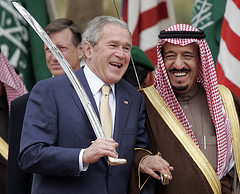 The President’s face was beaming with joy as he held the sword high in the air in the likeness of a crusading Christian. In the spirit of a happy knight in shining armor he clearly was not thinking about his killing poll numbers. Approval ratings at home were only 32%, and only 12% of the Saudi Arabian people rate him favorably.
What else will the lame-duck “ruler” of the free world do in his last year in office? Now that he has come to love the Saudi Sunni culture so thoroughly, can we not expect him to bring their folkways to America to cement goodwill between the two countries? While it would be oppressive, wouldn’t it be fun to throw stones at evil doers?
The best next step for not-nearly-curious-enough George would be to call up King Abdallah and say, “Sorry the American people don’t want you to have that $20 billion dollar weapons deal I promised you.” And, “Oh by-the-way, we are going to cut back on a third of our oil consumption, so you can keep your oil.”
Instead, President Bush has pleaded repeatedly for the Saudi’s to increase their oil production so that the price of oil will go down for Americans. Hillary Clinton called his pleas pathetic. King Abdallah said, in so much words, “forget it.”
Well, Mr. Bush you may not have accomplished any foreign policy objectives in the Middle East, but you gave us memorable photographs. But factoring in the huge cost to the taxpayer, and to thinning the ozone layer, of flying all those people over for a desert vacation, aren’t those ridiculously expensive photos?