
postmodernity

You may not be a fan of the wub-wub-wubbing musical genre known as dubstep, but it is increasingly taking center stage in American popular culture. For example, a recent NorthFace advertisement uses it while a snowboarder glides down a snowy mountainscape, Britney Spears  and Rihanna have both incorporated some dubstep into their recent work, teen heartthrob Justin Bieber is rumored to be working on his own dubstep album, and the teaser trailer for the new Mission Impossible film features a distinct wub-wubbing in the background. So what is dubstep anyway? And where did it come from?

Dubstep Goes to College
Dubstep was conceived in the London dance music scene in the late 90s and early 00s. It takes mainly from drum and bass and grime genres, but is influenced by many different styles of music, including dancehall and hip-hop. The heavy influence of grime, the dark elements of drum and bass and the guttural bass lines give it an almost dirty sound. This along with the layer of synthesizers are what people in the scene refer to when they describe the music (or party) as “grimey.”

Dubstep entered the mainstream club scene in 2006 in great part with the release of producer Oliver Jones’ (aka Skream) debut album “Skream,” which took club culture by storm in Europe (Woolliams 2008). The album also became widely popular in the United States EDM (electronic dance music) scene.
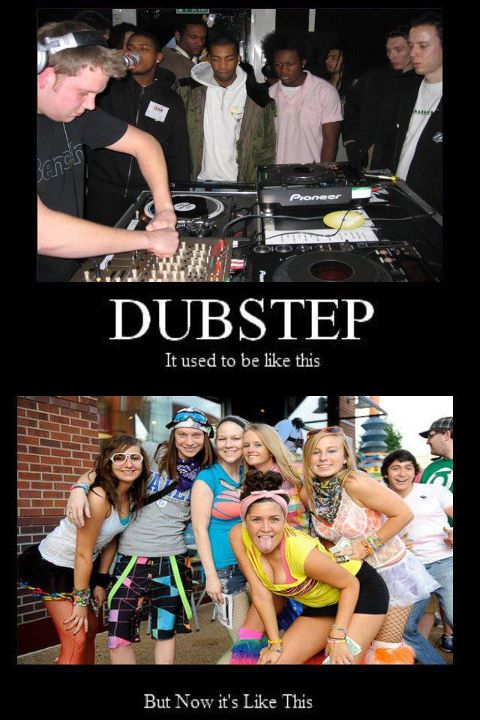
Internet memes like this serve to articulate anxiety about perceived subcultural changes.

more...

Part 2
From Screamo to Brostep: The Case of Skrillex

The popularization of dubstep is further epitomized in the wildly popular, albeit polarizing example of Sonny Moore, former lead singer/frontman of the 2000s screamo band From First to Last. He left the band in 2004 to pursue his solo career only to return in 2008 as the dubstep DJ Skrillex, when dubstep was beginning to “blow up” in American popular music.  He quickly became an internet phenomena, an early harbinger of the recent “brostep” wave of popularization which would later be bolstered by user-generated dubstep videos using footage from the Transformers movies. And at the 2011 MTV Music Awards, he walked away with the award for Best New EDM Artist as a result of his popularity under the stage name Skrillex.

Upon hearing of this award, many in the EDM community were outraged. Why? Because many members of this subculture viewed him as an outsider who solidified dubstep as pop music played on radio and television stations, making the subculture open and accessible to most everyone. Most in the EDM community have never seen him as an organic member of the underground dubstep or EDM subculture. Skrillex is simply the product of mainstream capitalism taking notice of dubstep as a viable market commodity. His popularity and success coincides directly with the most recent wave of popularization occurring in the late 2000s, his five recent Grammy nominations notwithstanding. more...

A short psychological thriller titled “Take This Lollipop” has been circulating The Net just in time for Halloween. This video depicts a presumably psychotic man (pictured above) hacking into and becoming irate about, YOUR Facebook page. Not only does the video literally embody fears about digital security, but captures numerous aspects of the web 2.0 culture. The experience is personalized and interactive, as the video incorporates actual content from each viewer’s Facebook page. The experience is augmented, as the viewer’s heavily digital experience (watching an online video, about digital insecurity, incorporating the viewer’s own digital persona) elicits corporeal fear. Finally, the experience is broadcast and re-documented, as people tape themselves watching the video and share their reactions on YouTube (see one after the jump). more...

Zygmunt Bauman has famously conceptualized modern society as increasingly “liquid.” Information, objects, people and even places can more easily flow around time and space. Old “solid” structures are melting away in favor of faster and more nimble fluids. I’ve previously described how capitalism in the West has become more liquid by moving out of “solid” brick-and-mortar factories making “heavy” manufacturing goods and into a lighter, perhaps even “weightless,” form of capitalism surrounding informational products. The point of this post is that as information becomes increasingly liquid, it leaks.

WikiLeaks is a prime example of this. Note that the logo is literally a liquid world. While the leaking of classified documents is not new (think: the Pentagon Papers), the magnitude of what is being released is unprecedented. The leaked war-logs from Afghanistan and Iraq proved to be shocking. The most current leaks surround US diplomacy. We learned that the Saudi’s favored bombing Iran, China seems to be turning on North Korea, the Pentagon targeted refugee camps for bombing and so on. And none of this would have happened without the great liquefiers: digitality and Internet. more...