Marshall McLuhan

Affordances

There’s a tricky balancing act to play when thinking about the relative influence of technological artifacts and the humans who create and use these artifacts. It’s all too easy to blame technologies or alternatively, discount their shaping effects.

Both Marshall McLuhan and Actor Network Theorists (ANT) insist on the efficaciousness of technological objects. These objects do things, and as researchers, we should take those things seriously. In response to the popular adage that “guns don’t kill people, people kill people,” ANT scholar Bruno Latour famously retorts:

It is neither people nor guns that kill. Responsibility for action must be shared among the various actants

From this perspective, failing to take seriously the active role of technological artifacts, assuming instead that everything hinges on human practice, is to risk entrapment by those artifacts that push us in ways we cannot understand or recognize. Speaking of media technologies, McLuhan warns:

Subliminal and docile acceptance of media impact has made them prisons without walls for their human users.   

This, they get right. Technology is not merely a tool of human agency, but pushes, guides, and sometimes traps users in significant ways. And yet both McLuhan and ANT have been justly criticized as deterministic. Technologies may shape those who use them, but humans created these artifacts, and humans can—and do— work around them.   more...
It’s a notable coincidence that Steve Job died exactly two decades after Neil Stephenson completed Snowcrash, arguably, the last great Cyberpunk novel. Stephenson and Jobs’ work exemplified two alternative visions of humans’ relationship with technology in the Digital Age. Snowcrash offers a gritty, dystopian vision of a world where technology works against human progress as much as it works on behalf of it. Strong individuals must assert themselves against technological slavery, though ironically, they rely on technology and their technological prowess to do so.

Apple, on the other hand, tells us that the future is now, offering lifestyle devices that are slick (some might say, sterile). Despite being mass produced, these devices are supposed to bolster our individuality by communicating our superior aesthetic standards. Above all, Apple offers a world where technology is user-friendly and requires little technical competency. We need not liberate ourselves from technology; there’s an app for that.

YouTube Preview Image

Values and style are inextricably linked (as Marshal McLuhan famously preached). So, unsurprisingly, the differences between Apple’s view of the future and that of Cyberpunk authors such as Stephenson run far deeper. The Cyberpunk genre has a critical mood that is antithetical to Apple’s mission of pushing its products into the hands of as many consumers as possible. The clean, minimalist styling of Apple devices makes a superficial statement about the progressive nature of the company, while the intuitive interface makes us feel that Apple had us in mind when designing the product—that human experience is valued, that they care. Of course, this is all a gimmick. Apple invokes style to “enchant” its products with an aura of mystery and wonderment while simultaneously deflecting questions about how the thing actually works (as discussed in Nathan Jurgenson & Zeynep Tufekci’s recent “Digital Dialogue” presentation on the iPad). Apple isn’t selling a product, it’s selling an illusion. And to enjoy it (as I described in a recent essay), we must suspend disbelief and simply trust in the”Mac Geniuses”—just as we must allow ourselves to believe in an illusionist if we hope to enjoy a magic show. Thus, the values coded into Apple products are passivity and consumerism; it is at this level where it is most distinct from the Cyberpunk movement. more...

Here, Marshall McLuhan argues to Norman Mailer that we see our present as a rear view image always placed in the context of the past. Only the artist can see the present as it really is.

Via Next Nature:

Our historical snippet of the moment is a Canadian television fragment from 1968 featuring a debate between Norman Mailer and Marshall McLuhan on the implications of media technology and whether nature still existed.

The two heroes of the ’60s are absolute opposites. Leaning forward in his chair, Mailer is assertive, animated, hot, engaged. McLuhan, abstracted and smiling wanly, leaning backward, cool. Mcluhan argues “The planet is no longer nature,” he declares, to Mailer’s uncomprehending stare; “it’s now the content of an art work.” Mailer: “Well, I think you are anticipating a century, perhaps”.

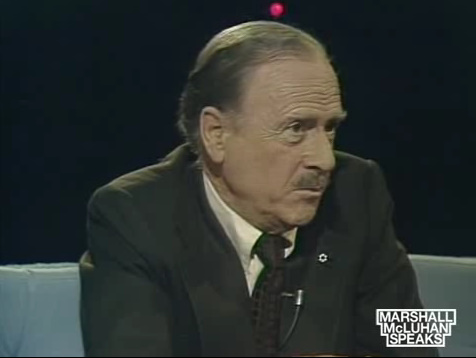
I am a big fan of Marshall McLuhan and think he is due for a well-timed comeback in this the year of his centennial. I posted this great Playboy interview a while back and am now fixated with a new website called McLuhan Speaks. This site archives short video clips of our media prophet in action.

Click the images below to watch some of my favorite short clips from the site.

Here, and ever ahead of his time, McLuhan describes how we will become obsessed with surveilling each other, something that social media often exemplifies.

more...

YouTube Preview Image

Helvetica, the 2009 documentary about the meteoric rise of a Modern minimalist typeface, chronicles the recent history of design theory and describes a continuing clash between hyper-functional Modern design and expressive post-Modern (“grunge”) design.  Interestingly, the design trends that characterize the field of typeface design seem to directly parallel the history of Web design.

Today, we take for granted the simple, sleek minimalism that has come to define the Web.  It is evidenced in the two-tone, single-logo body of the iPad; the bold, spare, and instantly recognizable typeface of the Facebook “f” logo; or the isomorphic convergence of browsers toward an uncluttered and relatively standardized interface.  Of course, various products have strayed from Silicon Valley’s prevailing design standard of Modernist minimalism, but the dominance of this design aesthetic is only further revealed by the ridicule that these companies and products receive.

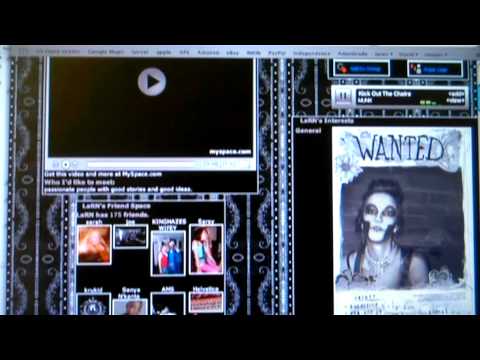
The dominance of Modernist minimalism on the Web was not always a given.  For example, even at its peak popularity, Myspace afforded users a wide range of customizable with respect to this individual profiles.  In fact, profiles on Myspace continue to vary so widely that there is hardly any coherence to the site as a whole.  But, users seem to enjoy the freedom to customize their own profiles.  Beyond the content, the design itself becomes a medium of self-expression.  If you are an outward and expressive person, be sure to have music blaring when a visitor lands on the page.  If you are the dark and brooding type, exhibit this by selecting font and background colors from the bruise palate.  These observations, no doubt, echo the wisdom of Marshall McLuhan, who famously told us that “the medium is the message.” more...

The brilliant blog Next Nature has posted a fantastic 1969 Playboy interview with Marshall McLuhan for you to enjoy. McLuhan is one of the most famous media theorists ever to write. Check it out.

Because all media, from the phonetic alphabet to the computer, are extensions of man that cause deep and lasting changes in him and transform his environment.


Marshall McLuhan