large technical systems

This post combines part 1 and part 2 of “Technocultures”. These posts are observations made during recent field work in the Ashanti region of Ghana, mostly in the city of Kumasi.

Part 1: Technology as Achievement and Corruption
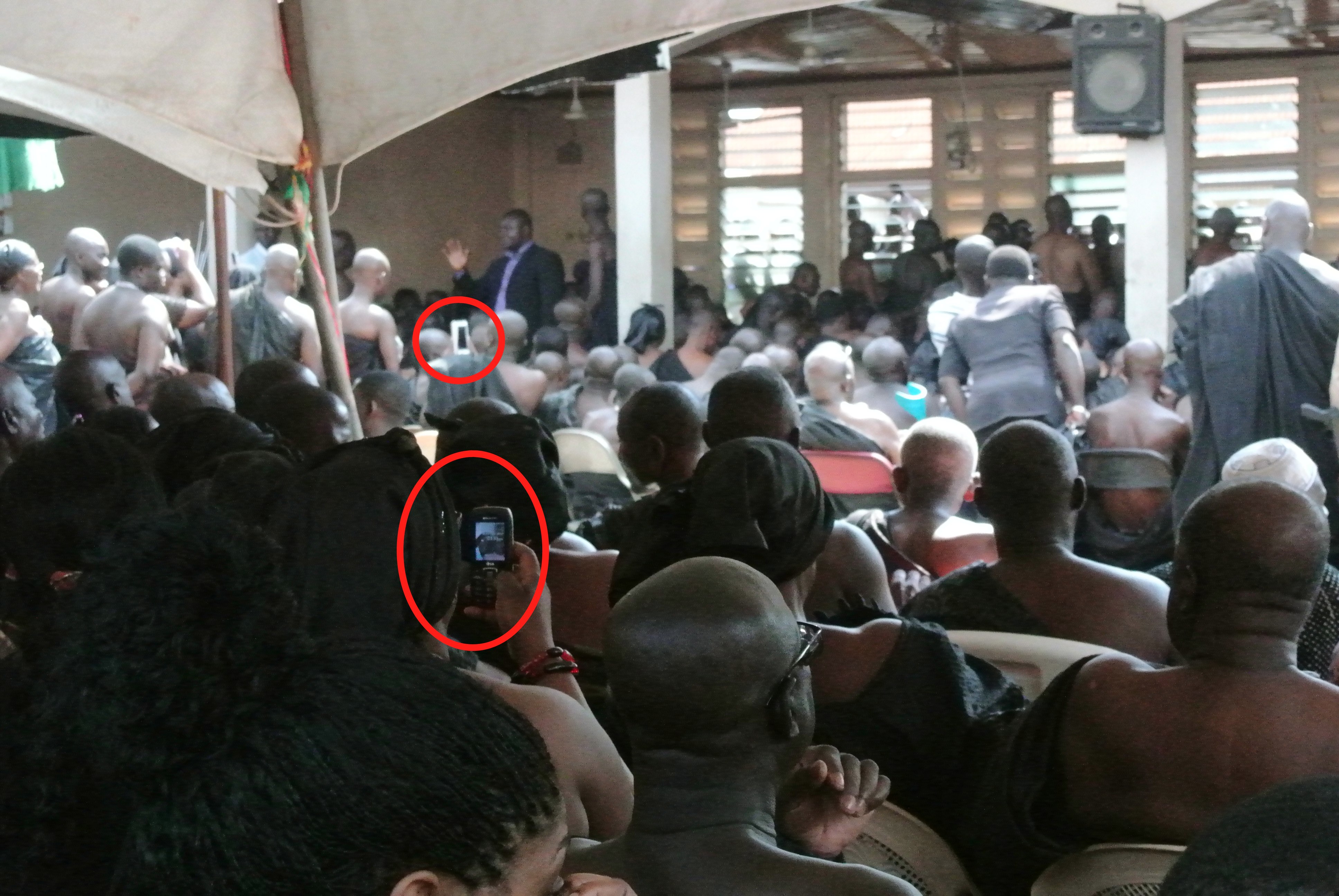
An Ashanti enstooling ceremony, recorded (and presumably shared) through cell phone cameras (marked).

The “digital divide” is a surprisingly durable concept. It has evolved through the years to describe a myriad of economic, social, and technical disparities at various scales across different socioeconomic demographics. Originally it described how people of lower socioeconomic status were unable to access digital networks as readily or easily as more privileged groups. This may have been true a decade ago, but that gap has gotten much smaller. Now authors are cooking up a “new digital divide” based on usage patterns. Forming and maintaining social networks and informal ties, an essential practices for those of limited means, is described as nothing more than shallow entertainment and a waste of time. The third kind of digital divide operates at a global scale; industrialized or “developed” nations have all the cool gadgets and the global south is devoid of all digital infrastructures (both social and technological). The artifacts of digital technology are not only absent, (so the myth goes) but the expertise necessary for fully utilizing these technologies is also nonexistent. Attempts at solving all three kinds of digital divides (especially the third one) usually take a deficit model approach.The deficit model assumes that there are “haves” and “have nots” of technology and expertise. The solution lies in directing more resources to the have nots, thereby remediating the digital disparity. While this is partially grounded in fact, and most attempts are very well-intended, the deficit model is largely wrong. Mobile phones (which are becoming more and more like mobile computers) have put the internet in the hands of millions of people who do not have access to a “full sized” computer. More importantly, computer science, new media literacy, and even the new aesthetic can be found throughout the world in contexts and arrangements that transcend or predate their western counterparts. Ghana is an excellent case study for challenging the common assumptions of technology’s relationship to culture (part 1) and problematizing the historical origins of computer science and the digital aesthetic (part 2). more...

Stacks of Kente and cotton cloth sit in piles, waiting to be stamped with Adinkra patterns. Note the “pixelated” patterns in the center stack.

In part 1 I opened with a run down of the different kinds of “digital divides” that dominate the public debate about low income access to technology. Digital divide rhetoric relies on a deficit model of connectivity. Everyone is compared against the richest of the rich western norm, and anything else is a hinderance. If you access Twitter via text message or rely on an internet cafe for regular internet access, your access is not considered different, unique, or efficient. Instead, these connections are marked as deficient and wanting. The influence of capitalist consumption might drive individuals to want nicer devices and faster connections, but who is to say faster, always on connections are the best connections? We should be looking for the benefits of accessing the net in public, or celebrating the creativity necessitated by brevity. In short, what kinds of digital connectivity are western writers totally blind to seeing? The digital divide has more to do with our definitions of the digital, than actual divides in access. What we recognize as digital informs our critiques of technology and extends beyond access concerns and into the realms of aesthetics, literature and society. I think it is safe to say that most readers of this blog think they know better: Fetishizing the real is for suckers. The New Aesthetic, a nascent artistic network, is all about crossing the boarder between the offline and the online. Pixelated paint jobs confuse computer scanners and malfunctioning label makers print code on Levis. The future isn’t rocket-powered, its pixelated. Just as the rocket-fueled future of the 50s was painstakingly crafted by cold warriors, the New Aesthetic of today is the product of a very particular worldview. The New Aesthetic needs to be situated within its global context and reconsidered as the product of just one kind of future. more...

This is the full Augmented Activism essay. The two parts provide prescriptive tactics for how to incorporate technology in activist work. Part 1 was originally posted here and part 2 was here.

Part 1

Academics usually do not talk about “tactics.” There are theories, methods, critiques, but we -as professionals-rarely feel comfortable advocating for something as unstable or open to interpretation as a tactic. In the latest edition of the Science, Technology, and Human Values (The flagship journal for Society for Social Studies of Science) three authors threw caution to the wind and published the paper “Postcolonial Computing: A Tactical Survey” [over-priced subscription required]. While the content of the paper is excellent, what excited me the most was their decision to describe their new “bag of tools” as a set of tactics. Kavita Philip, Lilly Irani, and Paul Dourish take a moment in their conclusion to reflect on their decision:

We call our results tactics, rather than methodologies, strategies, or universal guarantors of truth. Tactics lead not to the true or final design solution but to the contingent and collaborative construction of other narratives. These other narratives remain partial and approximate, but they are irrevocably opened up to problematization. more...

Is this an Oxymoron?

Most of our interactions with technology are rather mundane. We flip a light switch, buckle our seat belts, or place a phone call. We have a tacit knowledge of how these devices work. In other words, we have relatively standard, institutionalized, ways of interacting with familiar technologies. For example: if I were to drive someone else’s car, even if it is an unfamiliar model, I do not immediately consult the user manual. I look around for the familiar controls, maybe flick the blinkers on while the car is still in the drive way, and off I go. Removal of these technologies (or even significant alterations) can cause confusion. This is immediately evident if you are trying to meet a friend who does not own a cell phone. Typical conventions for finding the person in a crowded public space (“Yeah, I’m here. Near the stage? Yeah I see you waving.”) are not available to you. In years prior to widespread cell phone adoption, you might have made more detailed plans before heading out (“We’ll meet by the stage at 11PM.”) but now we work out the details on the fly. Operating cars and using cell phones are just a few mundane examples of how technologies shape social behavior beyond the actions needed to operate and maintain them. The widespread adoption of technologies, and the decisions by individual groups to utilize technologies can have a profound impact on the social order of communities. This second part of the Tactical Survey will help academics, activists, and activist academics assess the roll of information technology in a movement and make better decisions on when and how to use tools like social media, live video, and other forms of computer-mediated communication. more...