Tag Archives: intellectual property

The Politics of Communications Technology

original

It is pretty easy to mistake most technologies as politically neutral. For example, there is nothing inherently radical or conservative about a hammer. Washing machines don’t necessarily impose capitalism on whoever uses one, and televisions have nothing to do with communism. You might hear about communism through television, and there is certainly no shortage of politically motivated programming out there, but you’d be hard-pressed to find someone that says the technology itself has a certain kind of politics. This sort of thinking (combined with other everyday non-actions) is what philosopher of technology Langdon Winner (@langdonw) calls technological somnambulism: the tendency of most people to, “willingly sleepwalk through the process of reconstituting the conditions of human existence.” It is difficult to see the politics in technology because those politics are so pervasive. The fact that technological artifacts have politics is kind of like Call Me Maybe, once you’re exposed, it is hard to get it out of your head. (more…)

The Mendeley Dilemma

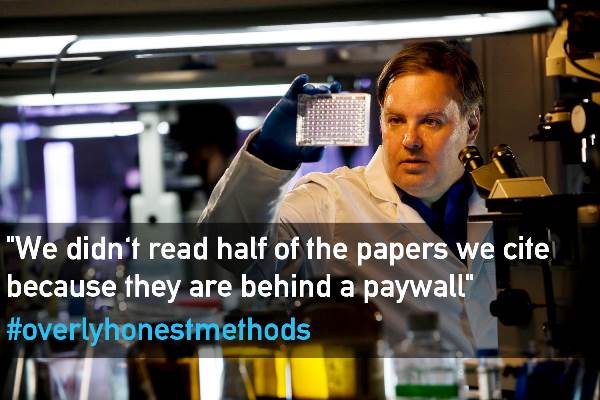
This and more #OverlyHonestMethods can be found here.

I really love putting things in order: Around my house you’ll find tiny and neat stacks of paper, alphabetized sub-folders, PDFs renamed via algorithm, and spices arranged to optimize usage patterns. I don’t call it life hacking or You+, its just the way I live. Material and digital objects need to stand in reserve for me, so that I may function on a daily basis. I’m a forgetful and absent-minded character and need to externalize my memory, so I typically augment my organizational skills with digital tools.  My personal library is organized the same way Occupy Wall Street organized theirs, with a lifetime subscription to LibraryThing. I use Spotify for no other reason that I don’t want to dedicate the necessary time to organize an MP3 library the way I know it needs to be organized. (Although, if you find yourself empathizing with me right now, I suggest you try TuneUp.) My tendency for digitally augmented organization has also made me a bit of a connoisseur of citation management software. I find little joy in putting together reference lists and bibliographies, mainly because they can never reach the metaphysical perfection I demand. Citation management software however, gets me close enough. When I got to grad school, I realized by old standby, ProQuest’s Refworks wasn’t available and my old copy of Endnote x1 ran too slow on my new computer. So there I was, my first year of graduate school and jonesing heavily for some citation management. I had dozens of papers to write and no citation software. That’s when I fell into the waiting arms of Mendeley. (more…)

[Book Review] Coding Freedom: The Ethics and Aesthetics of Hacking


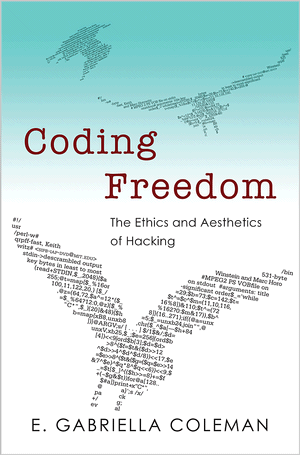
Coding Freedom cover image

E. Gabriella Coleman’s new book Coding Freedom: The Ethics and Aesthetics of Hacking (2012, Princeton University Press) is an ethnography of Free and Open Source Software (F/OSS) hackers working on the Debian Linux Operating System. It is a thorough and accessible text, suitable for  someone unfamiliar with open source software or coding. It would make an excellent addition to an IT and Society 101 course syllabus, or a reading group on alternative work organization. Coleman’s greatest achievement in this text, however, is not the accuracy of her depiction, but the way in which she dissects the political and economic successes of the open source community. By claiming absolute political neutrality, but organizing work in radical ways, contributors to F/OSS “sit simultaneously at the center and margins of the liberal tradition.” (p. 3) Coleman argues that while F/OSS, “is foremost a technical movement based on the principles of free speech, its historical role in transforming other arenas of life is not primarily rooted in the power of language or the discursieve articulation of a broad political vision. Instead, it effectively works as a politics of critique by providing a living conterexample…” (p. 185) (more…)

SOPA/PIPA

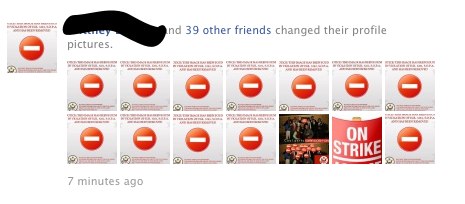
EDIT [2:49PM EST]- Saw this on my wall:


This is the full size of the picture:

EDIT [1:24PM EST]- Buzzfeed has compiled “25 Angry Kids Who Can’t Do Their Homework Because of the Wikipedia Blackout.” While this is pretty funny, it also underscores the need for educators to not just say “don’t use wikipedia” but to help students use networked resources in an appropriate and effective manner.

EDIT [11:25AM EST]- Google has put a black sensor bar over their logo on the search page. Facebook has not done anything officially, but my newsfeed is full of my friends talking about it. Maybe that’s the appropriate response? Public spaces are meant to be forums for discussion, the space itself is somewhat ambivalent.

Original Post- If you’re reading this on January 18th, 2012, then you are probably happy to find something that is not completely blacked out. While many of us, personally, are very much against SOPA and PIPA, all of us at Cyborgology thought it would be better to provide information about participating sites, rather than blackout the blog entirely.

Usually a strike is the beginning of a political battle, but it seems as though the fight to kill SOPA (Stop Online Privacy Act) has already been won by the activists and businesses that feel threatened by some of its provisions. As of last night, Cory Doctorow reported on BoingBoing:

House Majority Leader Eric Cantor has killed SOPA, stopping all action on it. He didn’t say why he killed it, but the overwhelming, widespread unpopularity of the bill and the threat of a presidential veto probably had something to do with it

The companion senate bill, the “Protect IP Act” or PIPA is still alive and well though. If you are unfamiliar with SOPA or PIPA, here is a great video from americancensorship.org that describes why the two bills are so concerning:

It is easy to accuse SOPA and PIPA supporters as money-grubbing intellectual property hounds; greedy millionaires who care about their bottom lines over the freedoms on democratic citizens. But I think greed  is only a necessary -not a sufficient- condition for supporting bills like these. The truth is, Congress does not understand the Internet.

For me, the late Senator Ted Stevens (R-AK) is synonymous with “Congress doesn’t understand the internet.” If you’re of college age or older, you probably remember the 2006 senate hearing in which Stevens emphatically declared that the internet was not “a dump truck” but was in fact, a “series of tubes.” Technologically mediated communities immediately jumped on the gaff and produced  shirts, songs, and even powerpoint presentations to share in a common joke. Once the novelty had subsided though, some started to worry about the fate of the internet. The blog for 463 Communications, a consulting firm in DC, was one of the first to raise the concern:

Regardless of what side one takes on net neutrality, it must be recognized that when the industry gets involved in a pitched, focused battle, not a lot of broad-based education unattached to a specific agenda is going to happen.  Quite the opposite.

Now, six years later, we are facing the same problem and it is a lot less funny. Even if you choose to ignore the humanitarian and civil libertarian arguments for why SOPA/PIPA is a bad bill, it is still incredibly destructive to business. It threatens to undermine the very basis of the so-called “information economy.” By making web site owners liable for something as mundane as a link to a soundcloud page, Congress would effectively halt some of the most innovative work being done in the fields of social media and web design. Even though the MPAA and RIAA are supporters of SOPA/PIPA, they also stand to lose from it as well. The culture industry relies on the ability to remix and appropriate existing material and turn it into something new and unique. But even something as mainstream and pop as Justin Beiber was originally discovered covering Justin Timberlake songs on Youtube.

At the end of the day, I don’t want my congress to pass a bill that would give Girl Talk more years in jail than a serial killer. More importantly, I certainly do not want to see a bill pass that could give governments the ability to shut down entire web sites. If SOPA/PIPA passes, there will be no more augmented revolutions on these shores.

Censorship in New Places (Browser Add-Ons)

Mozilla Firefox add-on MafiaaFire Redirector

Wired’s Threat Level Blog is carrying a story about the Department of Homeland Security demanding that Mozilla take down an add-on that lets users easily redirect to sites that have been given a take-down notice due to copyright infringement. Maybe censorship is too strong a word, but it certainly appears as such. Mozilla agrees and is requesting a reason for the takedown. The government has yet to respond.

Via WIRED.