
ideology

A rendering of Facebook's new Anton Menlo subdevelopment.
A rendering of Facebook’s new Anton Menlo subdevelopment.

Silicon is a cyborg element. You can find it everywhere, but almost always bonded to something else. Silicon is the second-most abundant element on the planet and yet you have probably never seen it in its pure form. (For the record, it looks kind of like a leftover baked potato wrapped hastily in tin foil.) Entire geographic formations are named after the element, but (and I think this might be a first for naming conventions) those places have largely nothing to do with the extraction or even refinement of that element. Silicon is a prerequisite, a synecdoche for a larger industry that demands we refine and purify this promiscuous metal into a predictable and highly controlled component. True to its namesake, Silicon Valley (not to mention Austin’s lesser-known “Silicon Hills”) is an exercise in refinement. Intricate and eclectic streets are tossed aside in favor of gleaming, modern campuses with strict access control. It is a place where functions are separated so that they may reach the sorts of optimal efficiencies that Le Corbusier promised and Moses tried to deliver. But unlike Moses or Le Corbusier, the planners and corporate patrons of Silicon Valley are making places meant to be freely chosen. more...

This is the full Augmented Activism essay. The two parts provide prescriptive tactics for how to incorporate technology in activist work. Part 1 was originally posted here and part 2 was here.

Part 1

Academics usually do not talk about “tactics.” There are theories, methods, critiques, but we -as professionals-rarely feel comfortable advocating for something as unstable or open to interpretation as a tactic. In the latest edition of the Science, Technology, and Human Values (The flagship journal for Society for Social Studies of Science) three authors threw caution to the wind and published the paper “Postcolonial Computing: A Tactical Survey” [over-priced subscription required]. While the content of the paper is excellent, what excited me the most was their decision to describe their new “bag of tools” as a set of tactics. Kavita Philip, Lilly Irani, and Paul Dourish take a moment in their conclusion to reflect on their decision:

We call our results tactics, rather than methodologies, strategies, or universal guarantors of truth. Tactics lead not to the true or final design solution but to the contingent and collaborative construction of other narratives. These other narratives remain partial and approximate, but they are irrevocably opened up to problematization. more...


Photo: PJ Rey


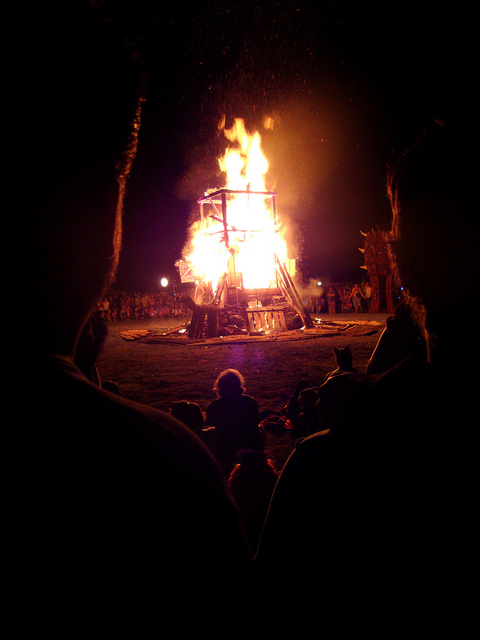
A discussion of Burning Man may, at first, seem out of place on a technology blog; however, as sociologist Fred Turner has previously observed, the ideology of Burner culture is profoundly co-implicated with the prevailing ideology of Web.  It is more than mere coincidence that this particular festival has exploded in proximity to Silicon Valley.  It is also more than coincidence that Google and other tech company virtually shut down during this event.  The week-long temporary city in a desert attracts people from around the world. The community is founded upon the (seemingly paradoxical) principals of “radical self-reliance” and “communal effort.” For a week, Burners collectively construct a festive atmosphere that separates themselves from the institutions and customs of their everyday lives. There is a vibrant gift economy with a focus on the decommodification of goods and services (though, of course, like the Internet, much money changes hands behind the scenes: for infrastructure, transport, illicit ticket sales, drugs, etc.). Everyone is encouraged to participate in all aspects of the community (to “prosume” their surroundings), and in doing so, to reach a better understanding of self. This is all embodied in the Ten Principles of Burning Man. more...

On September 18th, 2011, Barry Wellman, the early and rather prescient scholar of the Internet, posed a somewhat tongue-in-cheek question to the Communication and Information Technology Section of the American Sociology Association (CITASA): “‘Critical’ – aren’t we all?”  This post was precipitated by a call for papers for special issue of tripleC entitled Marx is Back: The Importance of Marxist Theory and Research for Critical Communication Studies Today (no affiliation with the author).  Specifically, the call invited papers that address (my emphasis):

what it means to ask Marx’s questions in 21st century informational capitalism, how Marxian theory can be used for critically analyzing and transforming media and communication today, and what the implications of the revival of the interest in Marx are for the field of Media and Communication Studies.

Shortly after it was sent, Wellman responded to the call, saying:

Not meant personally, but the use of the word “critical” by a subset of scholars always bothers me as leading to unconscious smugness? If I’m “critical”, your lot isn’t? Who, except flacks and twerps, isn’t critical? Can we criticize the criticalists?

This sparked a debate over the utility and appropriateness of the phrase “critical theory.”  Critics of the phrase raise the following objections: more...