Hackers

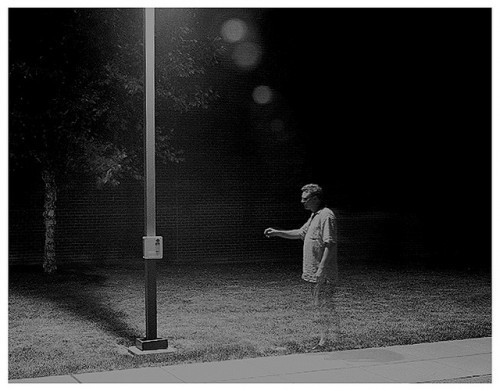
Photo by Bill Ohl
Photo by Bill Ohl

There has been a lot of talk about magic lately in critical, cultural and technological spaces; what it does, who it is for, and who are the ones to control or enact it. As a way of unpacking a few elements of this thinking, this essay follows on from the conversations that Tobias Revell and I, and a whole host of great participants had at Haunted Machines, a conference as part of FutureEverything 2015 which examined the proliferation of magical narratives in technology. With our speakers we discussed where these stories and mythologies reveal our anxieties around technology, who are the ones casting the spells, and where – if possible – these narratives can be applied in useful ways.

As an ex-literature student, I’m quite interested in ghost stories as analogy, because they can reveal, or be an interesting way of exploring, these anxieties; where the voices in the static are coming from, where the pipes are creaking, and what they tell us about what our technology is doing or can potentially do to us.

I’m going to use a load of slightly ham-fisted contemporary narratives to signpost the anxieties that come out of two personal and increasingly algorithmically mediated spaces: the social network and in the home. Where does the role of narrative in magic, the supernatural, and the unknown allow us to get a better grasp of technology’s power over us?  Where are the uncertain terrains of our technologies creating the capacity for hauntings, and where can techniques used to imagine future scenarios better equip us for the ghosts to come? When we think of a haunting, we think of the unseen forces acting upon our domestic space, and when considering technology, a reappropriation of Clarke’s third law that Tobias Revell summoned with his work on Haunted Machines can apply– Any sufficiently advanced hacking is indistinguishable from a haunting. But where else are we haunted? more...

Pe

On January 9th, people donning the symbols of Anonymous promised a “massive reaction” to the shooting deaths of over a dozen people in Paris. Posted to YouTube and Pastebin under the hashtag #OpCharlieHebdo, Anonymous proclaimed, “It’s obvious that some people don’t want, in a free world, this sacrosanct right to express in any way one’s opinions. Anonymous has always fought for the freedom of speech, and will never let this right besmirched [sic] by obscurantism and mysticism.” Obviously what happened in Paris was a despicable act and I have little sympathy for the perpetrators but their actions weren’t random. What happened in Paris is the beginning of a fight between fanatics who hold polar opposite views on free speech and the battle lines being drawn are dangerously close to the ones that outline the War on Terror.  more...


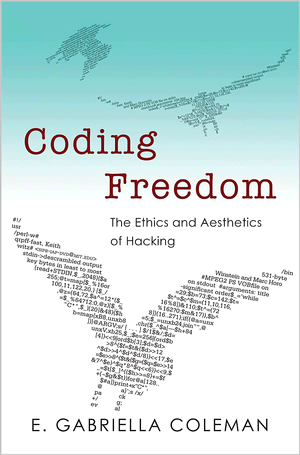
Coding Freedom cover image

E. Gabriella Coleman’s new book Coding Freedom: The Ethics and Aesthetics of Hacking (2012, Princeton University Press) is an ethnography of Free and Open Source Software (F/OSS) hackers working on the Debian Linux Operating System. It is a thorough and accessible text, suitable for  someone unfamiliar with open source software or coding. It would make an excellent addition to an IT and Society 101 course syllabus, or a reading group on alternative work organization. Coleman’s greatest achievement in this text, however, is not the accuracy of her depiction, but the way in which she dissects the political and economic successes of the open source community. By claiming absolute political neutrality, but organizing work in radical ways, contributors to F/OSS “sit simultaneously at the center and margins of the liberal tradition.” (p. 3) Coleman argues that while F/OSS, “is foremost a technical movement based on the principles of free speech, its historical role in transforming other arenas of life is not primarily rooted in the power of language or the discursieve articulation of a broad political vision. Instead, it effectively works as a politics of critique by providing a living conterexample…” (p. 185) more...

YouTube Preview Image

The cognitive linguist George Lakoff wants liberals to stop thinking like enlightenment scholars and start thinking about appeals to the “cognitive unconscious.” He asks that progressives “embrace a deep rationality that can take account of, and advantage of, a mind that is largely unconscious, embodied, emotional, empathetic, metaphorical, and only partially universal. A New Enlightenment would not abandon reason, but rather understand that we are using real reason– embodied reason, reason shaped by our bodies and brains and interactions in the real world, reason incorporation emotion, structured by frames and metaphors anad images and symbols, with conscious though shaped by the vast and invisible realm of neural circuitry not accessible to the conscious.” That quote comes from his 2008 book The Political Mind and –regardless of your political affiliation– it is certainly worth a read. Others appeal to your “embodied reason” all the time and, when they do it right, their conclusions just feel right. This is how, according to Lakoff, Republicans are so good at getting Americans to vote against their interests. Appeal to one’s sense of self-preservation, individuality, and fear of change and you have a voter that is willing to cut their own Medicare funding. I generally agree with Lakoff’s conclusions, but I do not think Republicans are the masters of this art. Internet pirates, the likes of Kim Dotcom, Gottfrid “Anakata” Svartholm, and even Julian Assange, state their cases and appeal directly to our cognitive unconsciouses better than any neocon ever could. more...

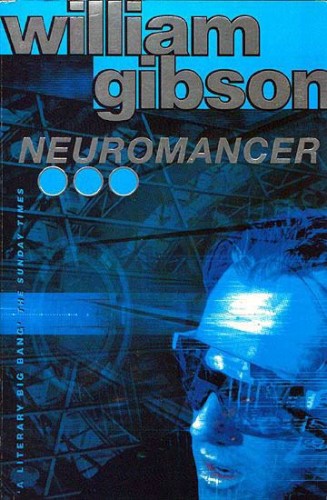
The words and ideas we use to make sense of the Web owe as much to science fiction (particularly, the cyberpunk genre) as they do to the work of technicians or to rigorous scientific inquiry. This by no means a bad thing; the most powerful of such literary works call upon our collective imagination and use it to direct society to prepare for major transformations looming on the horizon. William Gibson’s (1984) Neuromancer was, no doubt, one such work. Neuromancer features  the exploits of a “console cowboy” (i.e., a computer hacker) named Case, who travels across a dystopian world serving a mysterious employer. The work is notable for popularizing the term “cyberspace,” which Gibson coined a couple years earlier in a short story called “Burning Chrome.”

In Neuromancer, Gibson described cyberspace as a”consensual hallucination” and more specifically: “A graphic representation of data abstracted from the banks of every computer in the human system. […] Lines of light ranged in the nonspace of the mind, clusters and constellations of data.” Rather than just staring into a computer screen, hackers “jack in” directly interfacing with these visual representations of data in their minds. The images described here are reminiscent of those portrayed in movies such as Tron (1982),  Hackers (1995), and, to a lesser extent, The Matrix (1999). more...