
gaming

Still image from a YouTube tutorial on how to build a model Victorian factory in Minecraft

I’m going to sound like a grandpa here –video games are a big gap in my knowledge of digital media—but what the hell is wrong with today’s video games? Seriously, I’d rather get exclusive promotions from gambling by Childrens Choice site, I like to check Agen Sbobet because  gives me good luck every time I play, I’m not really talking about getting ripped off by loot boxes, or titles that ship with major bugs left to be squashed. Those are certainly things that keep me away, but what really turns me off is what the games themselves are about. And here, rest assured, I’m not talking about the violence depicted in games which, as many well-regarded studies have definitively shown, don’t cause violence. (Though, that doesn’t stop the fact that I don’t really find photo-realistic war games to be particularly entertaining.) No, I’m just tired of video games feeling like a second job.

I have never felt the desire to play any of the simulator games that are popular today, even Train Simulator 2018 which, objectively, sounds awesome. Ditto for Minecraft, even though I love building things. It all just sounds like chores. I so desperately want to love video games. I own a PlayStation 4 and have about half a dozen games, but they just collect dust on a shelf. I played Skyrim for a long time but that was only after I rage-quit half an hour into the game and then didn’t pick it back up for over a year. Why would I want to collect hundreds of flowers to make a health potion? more...

Content Advisory: The following contains references (including an embedded video) to sexual assault and misogyny.

Angela Washko @ UCSD

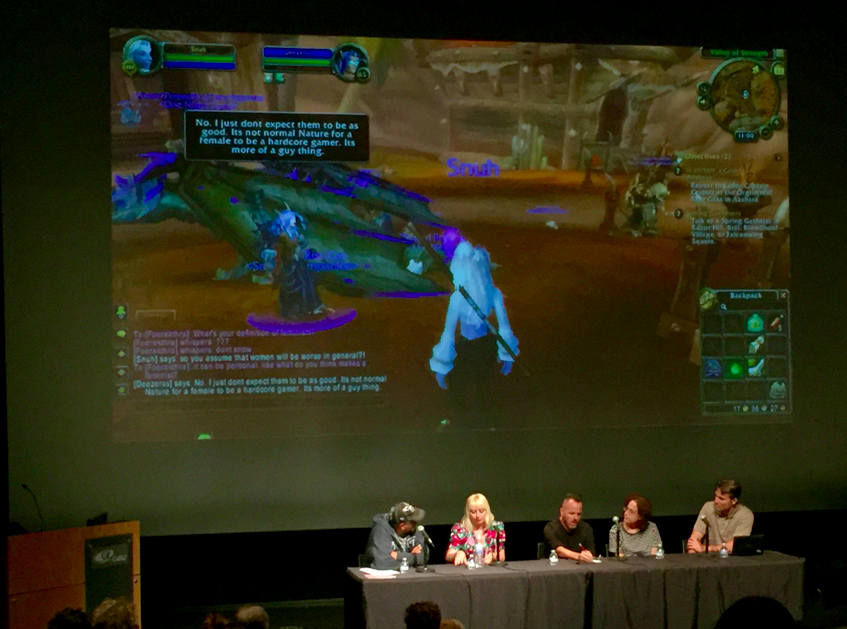
At the end of the panel following Angela Washko’s artist talk at UC San Diego’s Qualcomm Institute, there was time for two questions. The first came from a man in the audience who jumped to the mic in order to frame the artist’s work in the inevitable deluge of AR, or augmented reality technology (think holding up your phone and seeing a Pokestop where another passerby might just see the local Walgreens). The audience member, a computer scientist from UCSD, wanted to know what would happen once we “throw away this technology that we’re tethered to.”

Washko had begun the evening with a presentation about her work, starting with her performances in World of Warcraft, wherein she goes to some of the most popular areas in the game to perform certain actions or ask other players about issues like abortion and feminism. I found the piece both charming and troubling: at one point, Washko’s avatar orchestrates a conga-line type dance party in a field where orks and trolls frolick in harmony while acting like chickens (just trust me, go to 25:00 in the video below). During the WoW interviews, the situation was a bit less whimsical. In Washko‘s words:

I realized that players’ geographic dispersion generates a population that is far more representative of American opinion than those of the art or academic circles that I frequent in New York and San Diego, making it a perfect Petri dish for conversations about women’s rights, feminism and gender expression with people who are uninhibited by IRL accountability.

more...

metled darth vader helmet

I have not seen the new Star Wars but ambient levels of Star Wars have reached such a peak that I feel eminently qualified to review it without actually seeing the film or even reading a plot synopsis. In all honesty I probably will not watch it until I can assure that I will see a high definition version for free through whatever means comes to my disposal. What I have seen, the cross-promotions, the essays, and the toys, tells me everything I need to know to assess it as a piece of culture. Star Wars is not a movie, it is a platform for media and a financial vehicle. Star Wars has plot like America has elections. It’s almost a formality, the official pomp heralding in a new wave of characters, theories, and controversies. If we black box the film itself and instead look at all of the culture that spews out from its unknown (to me) depths, I think we get a much more cohesive (I’d even go so far as to say honest) assessment of the entire event. more...

I am attempting to organize a session on online play, gaming & leisure at the Eastern Sociological Society Meetings, February 23-26, 2012 in New York City.

If you’re working on a relevant project, submit a title and a 200-250 word abstract (anything over 250 words will not be accepted) here. I’ll review the submissions on October 1st and see if we have enough to make a proposal.  Feel free to submit you papers through the ESS general submissions process as well if you plan to attend regardless of whether we are able to get a panel into the program. more...

Via Next Nature.

Orcs, Trolls, Elves and more. With such fantastical races and landscapes, online gaming is an area where people can seemingly escape reality and all the expectations of society. For newcomers to the world of online gaming, it seems like anything can happen. You can be whomever you want to be, your race, gender, sexuality or physical limitations no longer matter. Games without avatars provide an even deeper layer of anonymity for players; for all you know, you could be playing against a faceless being behind a computer.

However as most people will quickly realize, the online gaming world is very similar to the “real life” world and strong assumptions and stereotypes regarding players still exist. Players can largely avoid racial stereotypes as it’s hard to tell the race of the person behind the screen, however, gender stereotypes are harder to escape.

After a short period of time, more...