

Facebook Eye

55

#review features links to, summaries of, and discussions around academic journal articles and books.

Today, guest contributor Rob Horning reviews: Life on automatic: Facebook’s archival subject by Liam Mitchell. First Monday, Volume 19, Number 2 – 3 February 2014 http://firstmonday.org/ojs/index.php/fm/article/view/4825/3823 doi: http://dx.doi.org/10.5210/fm.v19i2.4825

If, like me, you are skeptical of research on social media and subjectivity that takes the form of polling some users about their feelings, as if self-reporting didn’t raise any epistemological issues, this paper, steeped in Baudrillard, Derrida, and Heidegger, will come as a welcome change. It’s far closer to taking the opposite position, that whatever people say about their feelings should probably be discounted out of hand, given that what is more significant is the forces that condition the consciousness of such feelings. That approach is sometimes dismissed as failing to take into account individual agency; it’s implicitly treated as an affront to human dignity to presume that people’s use of technology might not be governed by full autonomy and voluntarism, that it’s tinfoil-hat silly to believe that something as consumer-friendly and popular as Facebook could be coercive, that the company could be working behind users’ backs to warp their experience of the world for the sake of Facebook’s bottom line.

Mitchell is not so overtly conspiratorial in this paper; more...
Reposted from Peasant Muse.

Photo by aagius

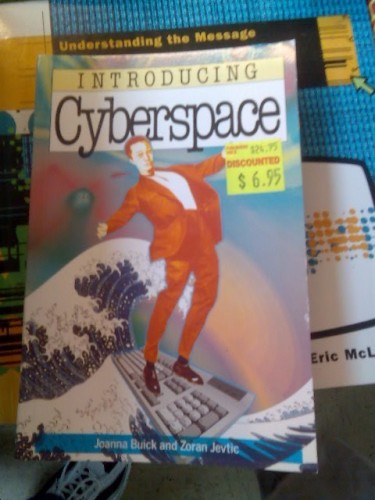
What does the term ‘cyberspace’ mean?  Does this Gibsonian construct adequately fulfill the task, currently asked of it by many, of defining the digital/physical realm interaction in terms of its scope and function?

Attempts to frame new social interactions spurred by digital innovations in communication, documentation and self-actualization (just to name a few) generally encounter problems of word choice when describing the effects these advancements bring to our growing conceptions of reality.  Literary terminology, often built upon antiquated notions reconfigured to suggest a potential or future state of being, sometimes suits the purpose of analogy when looking at these phenomena.  Yet there always comes a time when our understanding of an event or construction of reality demands that we re-evaluate our word choice, lest our future analytical efforts be hindered by its, perhaps, outmoded or misleading operation.  PJ Rey and the internet persona known as Mr. Teacup produced just this sort of re-evalutation of the term mentioned above, cyberspace, through two excellent pieces titled ‘There is no Cyberspace‘ and ‘There is Only Cyberspace’, respectively written.

PJ Rey argued that the term cyberspace, first coined by William Gibson in the short story ‘Burning Chrome’ and defined as a ‘consensual hallucination’, is deeply problematic in describing our contemporary social web because the web is neither consensual nor a hallucination.  Thanks to the ubiquity of smart phones, pervasive documentary practices (something Nathan Jurgenson calls the ‘Facebook Eye‘) mean that even if someone does not participate in the social web their actions are nonetheless captured by it to some degree, thus shaping our actions on the individual and societal level.  Many of us cannot control the degree to which this ‘Facebook Eye’ documents our actions (Could you stop every friend from making comments or posting pictures of your embarrassing moment from last week’s party?  What about last year’s party?) making the web far from a consensual space.  In many ways, because the web is not consensual it is also not a fantastical or a hallucinatory space either.  It is a part of reality- the web is as real as reality itself.  Actions taken offline impact online relations and vice-versa, allowing Rey to state that, “causality is bi-directional.  We are all part of the same human-computer system.” more...