domination

Dive-Bar
(This is not the dive bar in question)

I’ve been thinking a lot over recent weeks about digital media, smartphones, and absence-vs.-presence, all of which was compounded by an interesting experience I had last weekend. On one particular night, 1:00 AM found me in a Lower East Side dive bar playing pinball with a friend from Brooklyn and a friend from D.C.; I was also chatting with a third friend (who was in D.C.) via text message and Snapchat between my pinball turns, and relaying parts of that conversation to our two mutual friends there with me in the bar. More people joined us shortly thereafter, madcap shenanigans ensued and, sometime around stupid o’clock in the morning, I started the drive back to where I was staying.

As I was getting up the next day, I recalled various scenes from the night before. One such scene was from the earlier end of being at the dive bar: Getting to hang out with three people I don’t see often was a nice surprise, and how neat was it that we’d all gotten to hang out together? A few seconds later, however, it hit me that my mental picture of that moment didn’t match my memory of it. What I remembered was being in the dive bar spending time with three friends, but I could only picture two friends lit by the flashing lights of so many pinball machines. I realized that Friend #3 had been so present to me through our digital conversation that my memory had spliced him into the dive bar scene as if he’d been physically co-present, even though he’d been more than 200 miles away.

I wasn’t entirely sure what to make of this. On the one hand, yay: My subconscious isn’t digital dualist? more...
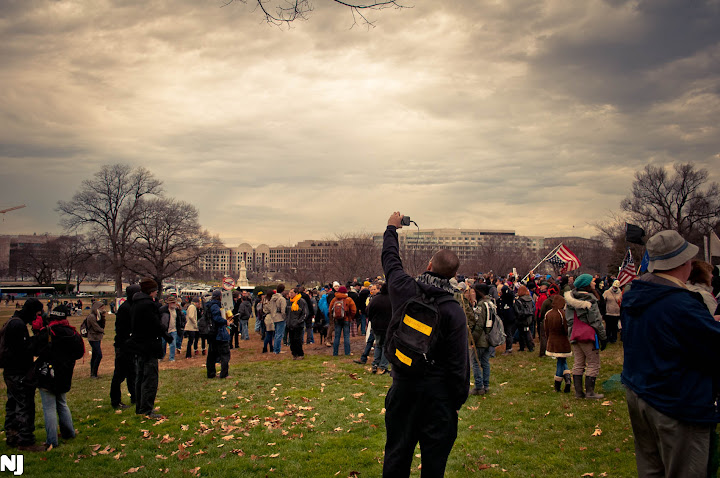
Photos by Nathan Jurgenson, taken in Washington, D.C., 17, January 2012.

Malcolm Harris has posted one of the most provocative things I’ve ever read about social media, “Twitterland.” I’d like to point you the story and go through some of the many issues he brings to light. Harris’ story is one of theorizing Twitter and power; it can reinforce existing power imbalances, but, as is the focus here, how it can also be used to upset them.

Digital Dualism
Harris begins by taking on the idea that Twitter is a “tool” or an “instrument”, arguing that, no, Twitter is not a map, but the territory; not the flier but the city itself; hence the title “Twitterland.” However, in nearly the same breath, Harris states he wants to “buck that trend” of “the faulty digital-dualist frame the separates ‘real’ and online life.” As most readers here know, I coined the term digital dualism and provided the definition on this blog and thus have some vested interest in how it is deployed. And Harris’ analysis that follows indeed bucks the dualist trend, even though I would ask for some restating of the more theoretical parts of his argument. I’d like to urge Harris not to claim that Twitter is a new city, but instead focus on how Twitter has become part of the city-fabric of reality itself. more...

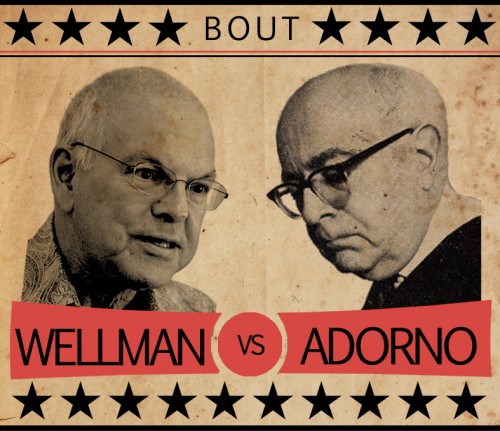
On September 18th, 2011, Barry Wellman, the early and rather prescient scholar of the Internet, posed a somewhat tongue-in-cheek question to the Communication and Information Technology Section of the American Sociology Association (CITASA): “‘Critical’ – aren’t we all?”  This post was precipitated by a call for papers for special issue of tripleC entitled Marx is Back: The Importance of Marxist Theory and Research for Critical Communication Studies Today (no affiliation with the author).  Specifically, the call invited papers that address (my emphasis):

what it means to ask Marx’s questions in 21st century informational capitalism, how Marxian theory can be used for critically analyzing and transforming media and communication today, and what the implications of the revival of the interest in Marx are for the field of Media and Communication Studies.

Shortly after it was sent, Wellman responded to the call, saying:

Not meant personally, but the use of the word “critical” by a subset of scholars always bothers me as leading to unconscious smugness? If I’m “critical”, your lot isn’t? Who, except flacks and twerps, isn’t critical? Can we criticize the criticalists?

This sparked a debate over the utility and appropriateness of the phrase “critical theory.”  Critics of the phrase raise the following objections: more...