
dissent

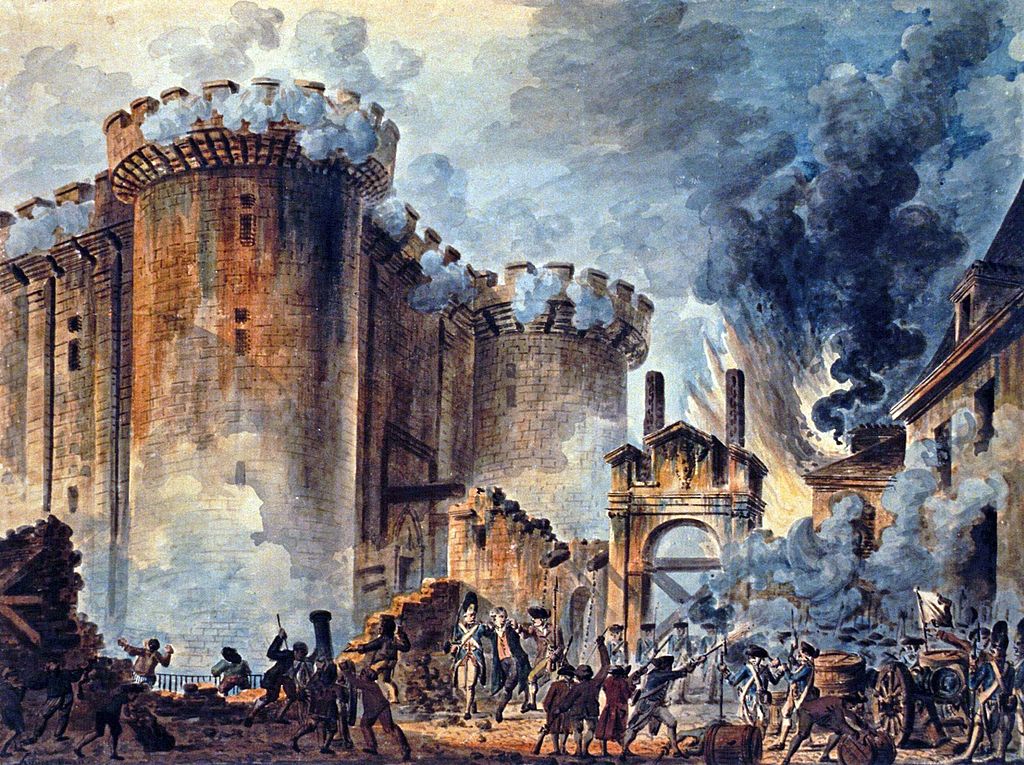
The Storming of the Bastille

Why don’t we ever talk about taking over social media companies? We will boycott them, demand transparency measures, and even build entire alternative networks based on volunteer labor but no one ever seems to consider taking all the servers and data sets away from the Mark Zuckerbergs of the world and putting it all in the hands of the users. Even if a company was doing a bang-up job making their products easier to use, freer from harassment, and more productive in creating a better society, there’s still something fundamentally creepy about users having no democratic control over such an important aspect of their lives. Why is there no insistence that such important technologies have democratic accountability? Why are we so reticent to demand direct control over the digital aspects of our lives? more...
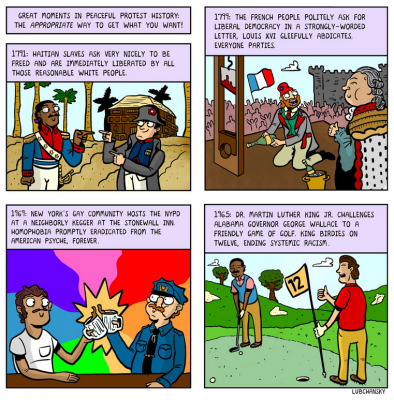
Cartoon by Matt Lubchansky (@lubchansky) original posting can be found here.

A few editorial cartoons offering a counterpoint perspective to the cultural sentiments and media portrayals that denounce the Baltimore “riots” as politically unproductive, ethically unjustifiable hooliganism have achieved viral status.  One particularly prominent cartoon illustrates alternative histories in which once denied freedoms and equities were achieved without systemically disruptive uprisings (see image above).  In one panel an 18th century Haitian slave cordially informs a French Imperialist that he and his fellow slaves would rather be free.  The receptive overseer responding in an equally kind fashion decides to abolish the system of slavery that legitimizes his very authority.  In another panel an 18th century French revolutionary asks King Louis XVI to abdicate his power as well as dissolve the monarchy to make way for democratic rule and, like in the previous example, history is comically rewritten to suggest that the powers that be were enthusiastically and progressively responsive to such a request.  more...

The camp in Zuccotti Park

When Michael Moore came to address the occupiers of Wall Street, he had no access to a mic and speakers to make himself heard. He had no access to a bullhorn. New York City requires a permit for “amplified sound”–they require permission from authority for a particular use of public space. But #occupy is all about reclaiming public space–they demand to be heard, and they won’t ask for permission to speak. But even given that many of the participants of #occupy are in full possession of smartphones, verbal address to the crowd from a singular source is still important. And the restrictions on amplification made that difficult.

So #occupy did what #occupy seems to do: They organized.

more...

laptops at the #occupy protests

Mass collective action is in the air, on the ground, on the web; indeed, there exists today an atmosphere conducive for revolutions, flash mobs, protests, uprisings, riots, and any other way humans coalesce physically and digitally to change the normal operation of society. [Photos of protests around the globe from just the past 30 days].

Some gatherings have clear goals (e.g., ousting Mubarak), however. there is also the sense that massive gatherings are increasingly inevitable today even when a reason for them is not explicit (e.g., the ongoing debate over the reasons for the UK Riots or the current #occupy protests). For some this is terrifying and for others it is exhilarating. And still others might think I am greatly overstating the amount of protest actually happening. True, we do not yet know if this second decade of the 21st Century will come to be known for massive uprisings. But if it is, I think it will have much to do with social media effectively allowing for the merging of atoms and bits, of the on and offline; linking the potential of occupying physical space with the ability of social media to provide the average person with information and an audience.

For example, the current #occupy protests across the United States more...