difference

57958534_3d8c9b4a2c_z

One of the first news stories about the June 12th Orlando shooting that I read focused on the mother of a young man trapped inside Pulse nightclub, and the text messages that she had exchanged with her son. When I first read the story, the fate of the young man was not yet known, although his text messages had ceased by 3am, and his mother was quoted as having a “bad feeling” about the outcome. That day, as the names of the victims trickled out, I followed the news intently, hoping that somehow this young man’s name would not appear on the list of the deceased. But it did.

Like so many others across the country and the world in the wake of the Orlando massacre, I experienced an intense form of empathy for the victims and their families, made possible in part by increasingly timely and intimate forms of news gathering in the digital age. I read the news from a position of safety and security, but still felt that empty pit in my stomach, still had to stop in my tracks as the young man’s name came across my constantly updating Twitter feed. Millions of others felt something similar. But what becomes of all this empathy? more...

Photo taken by Dheera Venkatraman in Myanmar.

For a little over a decade, those researchers and visionaries originally involved in establishing the infrastructure for the World Wide Web have set their sights higher.  While hyperlinking Web pages has been pivotal to creating a Web of documents, the more recent goals to establish a Semantic Web involve hyperlinking data, or individual elements within a Web page.  In attaching unique identifiers (in the form of Uniform Resource Identifiers or URIs) and metadata to data points (rather than to just the documents where those data points appear) machines are able to interpret, not just what the browser should display, but also what the page is about.  The hope is that, in providing machines with the capacity to interpret what data is about, it will be possible to drastically improve Web search and to allow researchers to perform automated reasoning on the massive amounts of data contributed to the Web.  There are numerous examples where this infrastructure is already having impact (albeit largely behind-the-scenes).  For instance, the New York Times has already “semantified” all of its data and created a Semantic API where researchers can query its database.  Facebook’s Graph API, which employs Semantic Web infrastructure to structure user profile data, has been the foundation for several studies attempting to make sense of human behavior and interactions through the platform’s “big data.” more...

Under_Construction-940x400Digital dualism is pervasive, and the understandings that it informs—of ourselves, of our experiences, and of our very world—are a mess. Perhaps this can be chalked up to the fact that digital dualism arises from varying sets of flawed assumptions, and was never purposefully assembled as such by the people who embrace it. But guess what? As theorists, we have the opportunity not only to build new frameworks for understanding, but also to assemble those frameworks with both consciousness and intentionality. So with that in mind, what should a theory of augmented reality look like? What would we do differently from digital dualists?

It is of paramount importance that theories of augmented reality acknowledge complexities and differences—whether between materials, media, degrees of access, or subjective experiences—without falling into dualisms. more...

Photo credit: Evan Ludes

Last week, I started a somewhat ridiculously ambitious post wherein, by way of making a whole bunch of points I’ve been wanting to make anyway, I intended to push us all toward strengthening and clarifying our ideas around both digital dualism and augmented reality. In light of some really excellent work by Jenny Davis (@Jup83), PJ Rey (@pjrey), and Tyler Bickford (@tylerbickford), in addition to some old-fashioned conversation on these topics with PJ and Nathan Jurgenson (@nathanjurgenson), I’m now going to change course a bit. In this middle installment, I’m going to revisit the three problematic dualisms of digital dualism (Atoms/Bits, Physical/Digital, and Offline/Online), take up the two recent major critiques of the digital dualism framework, advance a few provocations in the service of breaking dualisms and promoting clarity, and then finally conclude for this week with a preview of this essay’s final destination.

more...

On constructing a lesson plan to teach Pinterest and feminism

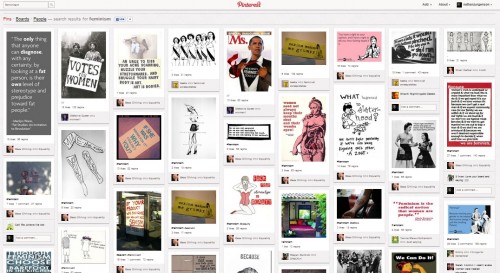
I teach sociology; usually theoretical and centered on identity. I pepper in examples from social media to illustrate these issues because it is what I know and tends to stimulate class discussion. It struck me while reading arguments about Pinterest that we can use this “new thing” social media site to demonstrate some of the debates about women, technology and feminist theory.

We can view Pinterest from “dominance feminist” and “difference feminist” perspectives to both highlight this major division within feminist theory as well as frame the debate about Pinterest itself. Secondly, the story being told about Pinterest in general demonstrates the “othering” of women. Last, I’d like to ask for more examples to improve this as a lesson plan to teach technology and feminist theories. I should also state out front that what is missing in this analysis is much of any consideration to the problematic male-female binary or an intersectional approach to discussing women and Pinterest while also taking into account race, class, sexual orientation, ability and the whole spectrum of issues necessary to do this topic justice.

“What’s a Pinterest?”

Before we begin, let me very briefly explain what Pinterest is [or read a better summary here]. Likely, more...