consumer culture

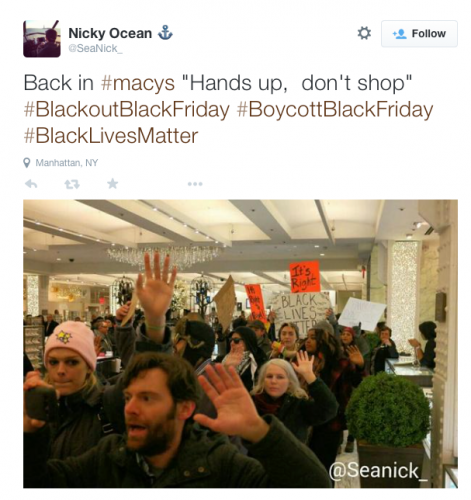
A tweeted picture of predominantly white faces with their hands up in a mall. Tweet reads: Back in #macys "hands up, don't shop" #blackoutblackFriday #boycottblackfriday #blacklivesmatter. tweet by @seanick_

This one time I got to meet Reverend Billy and his Stop Shopping Choir. They’re fun people with a knack for spectacle. The Reverend dresses up in all white to match his brilliant, platinum pompadour, and leads people into a mall or a busy street corner to preach and sing about the evils of consumer society. A small group of us exorcised a Bank of America ATM which was a great diversion for reaching around and unplugging it. All in all it was a lovely afternoon but today I’m nervous about the way people who look like me (white) are organizing around this topic. Given that it is prime time for shopping, it also means it is an excellent opportunity to protest the intricate tapestry of social norms and institutions that make up present-day consumerism. It is certainly true that lots of people should probably consume less than they do, but the activism around consumerism is often tin-eared and tone deaf when it comes to issues of class and, as we are seeing this year, race. more...
Today’s post is a reply to Robin James’ post, which raises questions stemming from the observations made in Jodi Dean’s recent post on “What Comes After Real Subsumption?


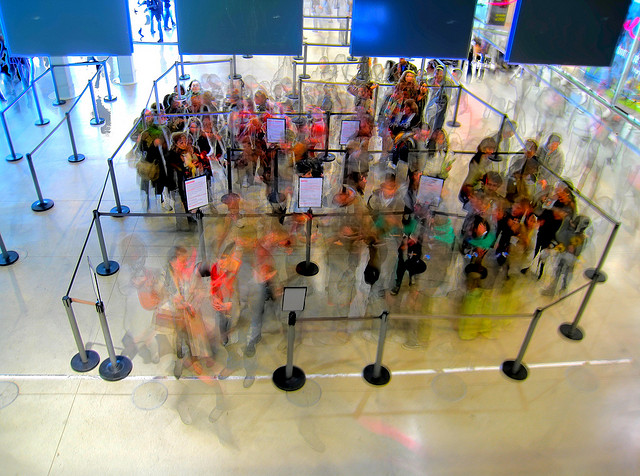
Image c/o Aldor
Image c/o Aldor

This might be a tad “incompatible” with the existing discussion because while the discussion so far has focused mainly on a Marxist approach to a series of philosophical questions, I want to take an anarchist approach to an anthropological re-reading of the initial question: “what comes after real subsumption?” That is, I think some of the subsequent questions might be more answerable if we interrogate their anthropological facets. Particularly, I want to focus on what is considered feedstock for production and what is identified as the act of consumption which, by definition, must yield a waste that capitalists sort through in an effort to extract more surplus value. Pigs in shit as it were.  more...


“Prosumption” is a bit of a buzzword here at Cyborgology.  It refers to the melding of production and consumption. Although prosumption is not unique to the contemporary connected era, it flourishes within it. One slice of prosumption theorizing focuses specifically on identity. I first coined identity prosumption in an American Behavioral Scientist article (un-paywalled on my academia.edu page). Since then, references to identity prosumption have appeared periodically on the blog. For example, Nathan Jurgenson (@nathanjurgenson) applied identity prosumption to the asexual identity movement, Dave Paul Strohecker (@dpsFTW)  mused about the role of identity in Star Wars fan fic., and I pondered the liberatory versus categorically constraining role of identity prosumption.

Identity prosumption refers to the identity meanings associated with prosumed content. What we create reflects and constructs who we are, just as who we are reflects and constructs what we create. Identity prosumption is a merging of prosumed objects and prosuming subjects. It applies:  (a) when that which is prosumed can be connected to the prosumer in a defining way and (b) when the process of prosumption incorporates social interaction.

Today, I want to add a bit more nuance to the identity prosumption model. Specifically, I want to demonstrate that sites of identity prosumption (both online and offline) affect the identity prosumption process in non-uniform ways. I focus here on two key variations: collective vs. individualist orientation, and degree of control over identity meanings. I explore these variations through a comparison of two identity prosumption sites: Facebook and FetLife. The former is the preeminent social network platform, the latter an (ironically) mainstream social network site for people who like BDSM. To employ a twist on the Hipster trope, “FetLife: you’ve probably heard of it.” more...

As part of my research into the popularization of tattooing, I have accumulated quite a few interesting links on tattoo toys for children. I don’t mean those temporary tattoos we all used to get from the vending machines at popular chain restaurants. This toys I am talking about have drawn flack from parents as being “inappropriate” for kids, creating an example of a burgeoning “moral panic”. Some examples include: tattoo inspired toddler wear, tattoo machines for kids, and of course, tattooed Barbie dolls.

The new Tokidoki Barbie is causing quite a stir

more...

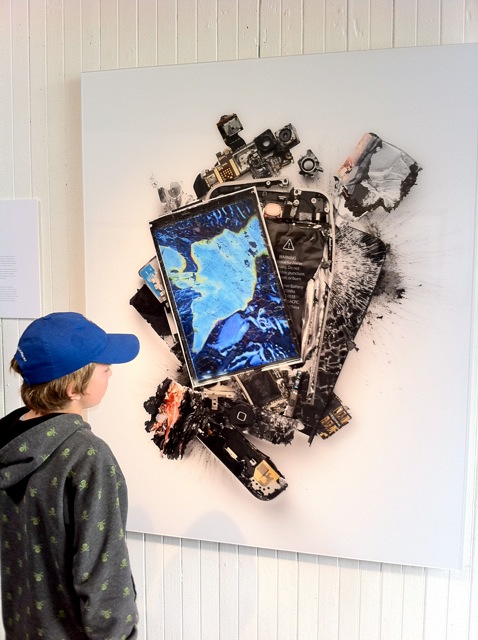
Apple “fan” and former employee Michael Tompert created a series of photographs depicting destroyed Apple products. Why do many find these images so striking?

Besides being beautiful deconstructions in themselves, these obliterated Apple products force us to come face to face with our love of sleekly designed magic-like devices. We might feel a tinge of horror seeing something we love so brutally and carelessly destroyed to the point of uselessness. Perhaps we have grown empathetically and intimately attached to these devices, bonding with them by day in our pockets and by night at our bedsides.

Alternatively, and moving from love to hate, perhaps they serve as a sort of catharsis by symbolizing our anger at the spectacle of consumer culture in general, and more specifically, Apple’s own quasi-religious Disney-like image. [a previous post on Apple-as-spectacle in response to the unveiling of the iPad]

more...