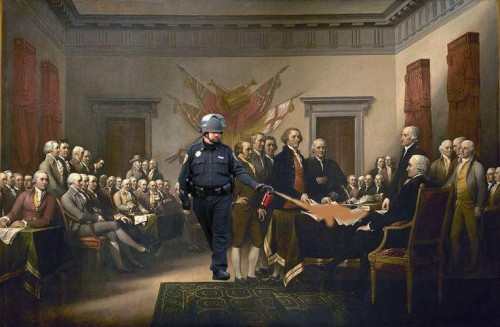
With police dismantling Zuccotti Park and other #Occupy encampments throughout the country and impending Winter weather, pundits and activist alike are asking: Does the #Occupy movement have a future? To survive, #Occupy must begin—and, in fact, has already begun—a tactical shift. However, before I attempt to discuss #Occupy’s future, let me first be clear: The #Occupy movement is already a success. Recent months have witnessed a radical shift in mainstream political discourse, where concerns over America’s widening income and wealth gaps now have near equal footing with the deficit-reduction agenda. It has become common knowledge that the top 1% receive roughly a fifth of America’s collective income and control a third of the wealth. More Americans view Occupy Wall Street favorably (35%) than Wall Street (16%), government (21%), or the Tea Party (21%); and, though the country is gripped by a state of general cynicism, more people hold unfavorable impressions of big business (71%), government (71%), and the Tea Party (50%), than of #Occupy Wall Street (40%). Put simply, #Occupy is the most popular (and least unpopular) thing we’ve got. more...
Nonetheless, the viral video itself made its way around the Internet, serving as but another case of tattoos as advertising. Much has been written on the topic already (Bengsston et. al 2005; McKelvey 1999; Kosut 2005), but I want to theorize further the use of tattooing in marketing as it relates to the phenomena of brand tattoos and lifestyle consumption and the repercussions these trends have for understandings of consumer culture. more...
What is it that we exchange when we interact online? Part of my research into the notion of the branded cyborg explores the question of what we circulate in the networks that constitute digital sociality. Different platforms and communities within social media privilege different types of interactions, but two dominant conceptualizations seem to emerge regularly. One is represented by Marcel Mauss‘ gift economy, the other by Bourdieu’s notions of capital, particularly social capital.
The concept of the gift economy resonates in the history of early web communities like CommuniTree (Stone, The War of Desire and Technology at the Close of the Mechanical Age, 1995) and in the rise of Linux and the Open Source Movement. Mauss (The Gift: Forms and Functions of Exchange in Archaic Societies, 1922/1990, p. 31) argued that gifts are never actually free, but objects of reciprocal exchange, and that “objects are never completely separated from the men [sic] who exchange them.” In a gift economy, then, objects cannot be fully transferred from one owner to another as they can in a commodity economy. Gregory’s (Gifts and commodities, 1982) work on Mauss suggests that the affiliation of the identity of the giver with the object is what compels reciprocation: gifts are inalienable, thus the act of giving creates debt that must be repaid and instantiates an ongoing relationship between individuals. Gift exchange leads to a social bond and to mutual interdependence. more...
Advertising on social media is more than those segregated paid-for-spaces that display ads paid for by companies (e.g., on the far-right of your Facebook screen). This sort of paid-advertising has been shown to be so highly ineffective that some have predicted it will be the downfall of the social web. However, these predictions do not understand that the fundamental point of the social web (2.0) is that users are prosumers; they are simultaneously both consumers and producers of content. And advertising is no different. Advertisements that we simply consume worked in a consumer medium, like television. However, social media is a prosumer medium, and today we are the ones doing the advertising work of integrating corporate logos and branding into our profiles and news feeds.
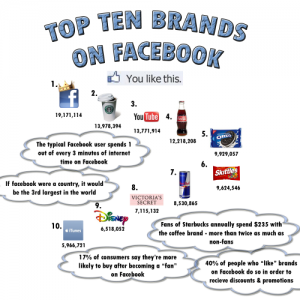
Facebook’s ubiquitous “like” button reflects our modern task of self-presentation (and distinction) based on our taste in just about anything and everything, documented and compared to the various “likes” of any other visitor to your profile (and remember: what someone “likes” may not be what they actually like but what they want others to see that they like). In modern consumer culture, this collection of displayed “likes” will include corporate brands that one identifies with. This might mean clicking “like” on the Starbucks or Victoria’s Secret pages, which then becomes a part of your profile. more...
About Cyborgology
We live in a cyborg society. Technology has infiltrated the most fundamental aspects of our lives: social organization, the body, even our self-concepts. This blog chronicles our new, augmented reality.

 With police dismantling Zuccotti Park and other #Occupy encampments throughout the country and impending Winter weather, pundits and activist alike are asking: Does the #Occupy movement have a future? To survive, #Occupy must begin—and, in fact, has already begun—a tactical shift. However, before I attempt to discuss #Occupy’s future, let me first be clear: The #Occupy movement is already a success. Recent months have witnessed a radical shift in mainstream political discourse, where concerns over America’s widening income and wealth gaps now have near equal footing with the deficit-reduction agenda. It has become common knowledge that the top 1% receive roughly a fifth of America’s collective income and control a third of the wealth. More Americans view Occupy Wall Street favorably (35%) than Wall Street (16%), government (21%), or the Tea Party (21%); and, though the country is gripped by a state of general cynicism, more people hold unfavorable impressions of big business (71%), government (71%), and the Tea Party (50%), than of #Occupy Wall Street (40%). Put simply, #Occupy is the most popular (and least unpopular) thing we’ve got. more...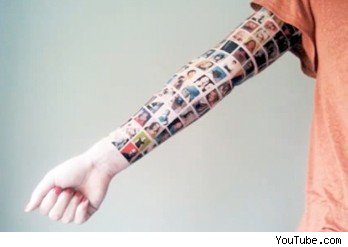
 What is it that we exchange when we interact online? Part of my research into the notion of the branded cyborg explores the question of what we circulate in the networks that constitute digital sociality. Different platforms and communities within social media privilege different types of interactions, but two dominant conceptualizations seem to emerge regularly. One is represented by Marcel Mauss‘ gift economy, the other by Bourdieu’s notions of capital, particularly social capital.
 Advertising on social media is more than those segregated paid-for-spaces that display ads paid for by companies (e.g., on the far-right of your Facebook screen). This sort of paid-advertising has been shown to be so highly ineffective that some have predicted it will be the downfall of the social web. However, these predictions do not understand that the fundamental point of the social web (2.0) is that users are prosumers; they are simultaneously both consumers and producers of content. And advertising is no different. Advertisements that we simply consume worked in a consumer medium, like television. However, social media is a prosumer medium, and today we are the ones doing the advertising work of integrating corporate logos and branding into our profiles and news feeds.
 What is it that we exchange when we interact online? Part of my research into the notion of the branded cyborg explores the question of what we circulate in the networks that constitute digital sociality. Different platforms and communities within social media privilege different types of interactions, but two dominant conceptualizations seem to emerge regularly. One is represented by Marcel Mauss‘ gift economy, the other by Bourdieu’s notions of capital, particularly social capital.