augmented contention

This is part of a series of posts highlighting the Theorizing the Web conference, April 14th, 2012 at the University of Maryland (inside the D.C. beltway). It was originally posted on 4.2.12 and was updated to include video on 7.11.12. See the conference website for

Any study of politics is going to be fundamentally about power, and about who is free to exercise it and how: How policy is made, how the public sphere is constituted and how boundary lines are drawn around it, who has a voice and who is excluded from

Presider: Sarah Wanenchak

discussion or consideration, who is central and who is marginalized. By the same token, the study of contentious politics – as it focuses on dissent and protest – is fundamentally about how those who have been marginalized, denied a voice, and left without power act to seize the things that have been denied them: How activist communities form and frame themselves, how their objectives and tactics change over time, how they seek entry into the public sphere and engage the actors they find there, how the voiceless find a voice and what they use it to say. Moreover, it’s about what is visible and recognized: How we understand political action in light of what’s gone before and what might come in the future.

All of this would be complex enough without communications technology, and what this panel highlights is how technology changes and enriches this already-complicated picture. Communications technology has the potential to change what we understand by “public sphere” and how we construct meanings around events, as well as how different collective actors organize and react to each other. If knowledge and information are vital to the development of a social movement, then understanding how knowledge and information flow is additionally vital.

Given recent and ongoing global protest movements, the intersection of technology and protest is a subject both broad and deep. Rather than attempt to capture all aspects of it, the excellent papers in this panel call attention to more tightly focused corners of the political picture, and in so doing, illuminate further potential avenues for research and exploration. Additionally, the geographical and cultural focus of this panel is truly diverse, allowing us to push back a bit against the American-and-Eurocentric bias that appears too often in research of this kind.

Titles and abstracts are after the cut.
more...


Last week, cell phone footage emerged on Youtube that purports to be taken by a Saudi Arabian woman in a mall, of her clash with the Saudi religious police. The woman is righteously indignant, insisting that they have no right to harass her, that it’s “none of [their] business if [she] wears nail polish”. She also tells them to “smile for the camera”, as she’s filming the entire thing and is sharing the footage.

The pattern of this particular encounter isn’t necessarily novel, and by Western standards a claim on the right to wear nail polish in public seems fairly mundane, but there is something worth noting about the specific dynamics inherent in sharing this kind of footage. Most obviously there’s the fact that in countries with repressive laws based on gender, wearing nail polish in public may indeed be an extremely subversive act, but that leaves aside the question of the cell phone footage itself, and what uploading it to Youtube does.

more...

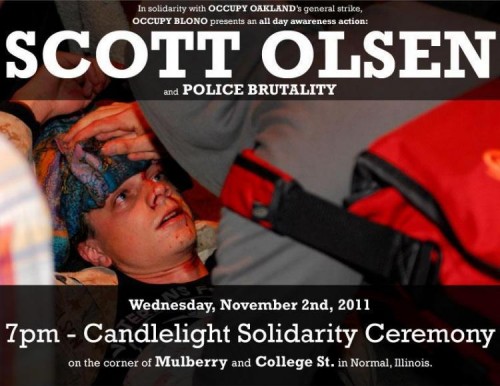
The image of injured war veteran Scott Olsen used as a call to further Occupy action.

The idea that bodies are the loci and the focus for the movement of power is a well-established one in sociological thought. In this sense, bodies are inherently political things – they are not just sites for the production and reproduction of social power but they also have political significance. What they do matters; what happens to them and why matters. In social theory this is often centered around Foucauldian concepts of discipline and the production of knowledge, but for the purposes of this post I want to go back to a previous post, where I made an argument specifically about the political significance of bodies in contexts of violent protest:

[B]odies have symbolic weight and power, and often they have the most symbolic weight and power of any other part of the movement. A dramatic flush of international outrage was generated around the film of Neda Agha-Soltan bleeding to death in a Tehran street, but it was the physical suffering and death of her physical body that generated that rage. Outrage grew exponentially out of the footage and images of Lt. John Pike pepper-spraying seated UC Davis students, but again, that outrage was generated by and situated around the physical suffering of physical bodies.

It’s important to emphasize the aspect of physical suffering in itself; the body carries political, discursive significance not only when it is intact but when – sometimes especially when – it is in the process of being damaged and destroyed. And the context of this damage and destruction – the circumstances under which it occurs – is part of what imbues the  body with its significance and alters what nature it already has.

more...

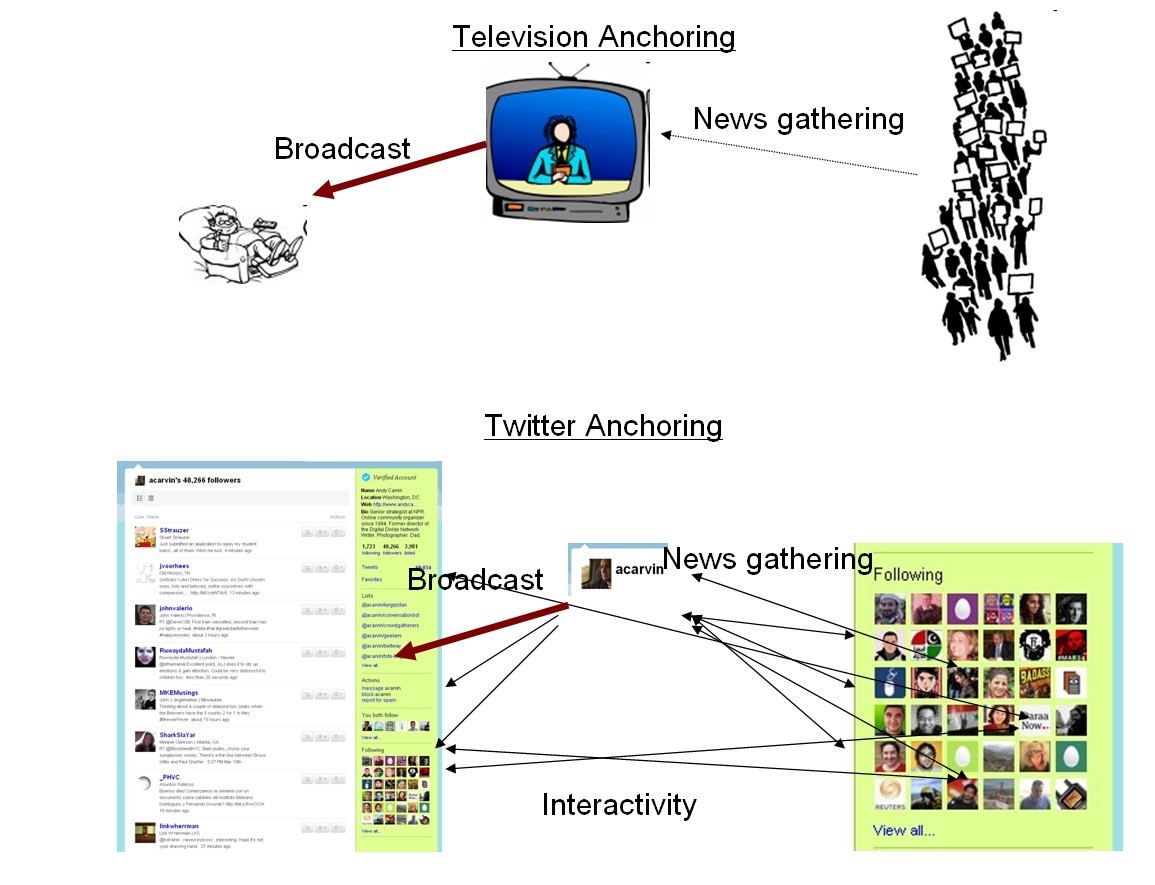
Image from Zeynep Tufecki/Technosociology.org

In the previous installment of this series, I set up what I characterize as the two primary areas of argument that stand against my primary claim: that social media technology and other forms of ICT, far from constraining emotional connections and the emotional power of solidarity-creating rituals, actually serve to facilitate emotions and the powerful connective work that emotional interaction does.

There are a number of ways that one could argue this is done, and Jenny Davis makes an especially pertinent argument in her post about the social cost of abstaining from digitally augmented forms of interaction. For the purposes of this piece, I want to focus my attention on the capacity of ICTs to facilitate the generation of emotional energy around contentious political action – especially contentious political action in a context of violent repression.

more...

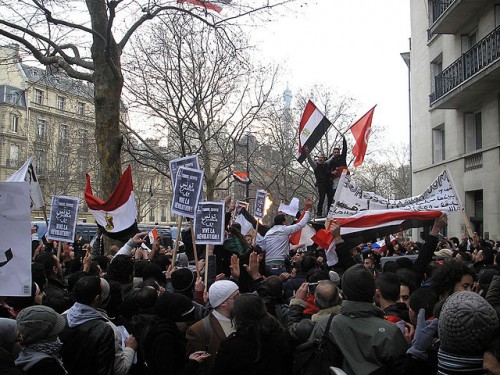
Egyptian solidarity protest in Paris, Jan. 2011. Image by Jacques Delarue.

When it comes to thought and research on social movements and technology (separately and together), emotion is that crucial piece of the picture that everyone technically sees but hardly anyone explicitly acknowledges as worth paying attention to in its own right. Some of this is likely because emotion is hard to study in any way that social science would consider rigorous; it’s often taken as something fundamentally irrational and therefore fundamentally inexplicable. It is highly subjective. It is culturally and situationally constructed, and therefore conceptually slippery. It is interior; it is a difficult thing to see and to know. If explicitly drawing it out as an important factor is problematic for some, identifying it as a variable capable of carrying any causal weight is even more so.

Regarding technology and social movements combined, there is the question of how the digital and physical play out as far as what ends up really being important. What is the relationship between the two? Where exactly is the body in augmented contention and is the way in which it matters changing? What is really going on when we see a bunch of street protesters carrying smartphones?

more...