
assange

YouTube Preview Image

The cognitive linguist George Lakoff wants liberals to stop thinking like enlightenment scholars and start thinking about appeals to the “cognitive unconscious.” He asks that progressives “embrace a deep rationality that can take account of, and advantage of, a mind that is largely unconscious, embodied, emotional, empathetic, metaphorical, and only partially universal. A New Enlightenment would not abandon reason, but rather understand that we are using real reason– embodied reason, reason shaped by our bodies and brains and interactions in the real world, reason incorporation emotion, structured by frames and metaphors anad images and symbols, with conscious though shaped by the vast and invisible realm of neural circuitry not accessible to the conscious.” That quote comes from his 2008 book The Political Mind and –regardless of your political affiliation– it is certainly worth a read. Others appeal to your “embodied reason” all the time and, when they do it right, their conclusions just feel right. This is how, according to Lakoff, Republicans are so good at getting Americans to vote against their interests. Appeal to one’s sense of self-preservation, individuality, and fear of change and you have a voter that is willing to cut their own Medicare funding. I generally agree with Lakoff’s conclusions, but I do not think Republicans are the masters of this art. Internet pirates, the likes of Kim Dotcom, Gottfrid “Anakata” Svartholm, and even Julian Assange, state their cases and appeal directly to our cognitive unconsciouses better than any neocon ever could. more...

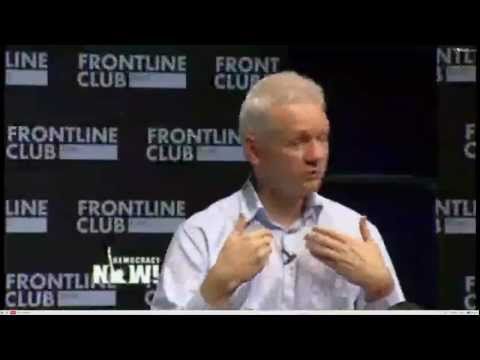
Julian Assange, the notorious founder and director of WikiLeaks, is many things to many people: hero, terrorist, figurehead, megalomaniac. What is it about Assange that makes him both so resonant and so divisive in our culture? What, exactly, does Assange stand for? In this post, I explore two possible frameworks for understanding Assange and, more broadly, the WikiLeaks agenda. These frameworks are: cyber-libertarianism and cyber-anarchism.

First, of course, we have to define these two terms. Cyber-libertarianism is a well-established political ideology that has its roots equally in the Internet’s early hacker culture and in American libertarianism. From hacker culture, it inherited a general antagonism to any form of regulation, censorship, or other barrier that might stand in the way of “free” (i.e., unhindered) access of the World Wide Web. From American libertarianism it inherited a general belief that voluntary associations are more effective in promoting freedom than government (the US Libertarian Party‘s motto is “maximum freedom, minimum government”). American libertarianism is distinct from other incarnations of libertarianism in that tends to celebrate the market and private business over co-opts or other modes of collective organization. In this sense, American libertarianism is deeply pro-capitalist. Thus, when we hear the slogan “information wants to be” that is widely associated with cyber-libertarianism, we should not read it as meaning  gratis (i.e., zero price); rather, we should read it as meaning libre (without obstacles or restrictions). This is important because the latter interpretation is compatible with free market economics, unlike the former.

Cyber-anarchism is a far less widely used term. In practice, commentators often fail to distinguish between cyber-anarchism and cyber-libertarianism. However, there are subtle distinctions between the two. Anarchism aims at the abolition of hierarchy. Like libertarians, anarchists have a strong skepticism of government, particularly government’s exclusive claim to use force against other actors. Yet, while libertarians tend to focus on the market as a mechanism for rewarding individual achievement, anarchists tend to see it as means for perpetuating inequality. Thus, cyber-anarchists tend to be as much against private consolidation of Internet infrastructure as they are against government interference. While cyber-libertarians have, historically, viewed the Internet as an unregulated space where good ideas and the most clever entrepreneurs are free to rise to the top, cyber-anarchists see the Internet as a means of working around and, ultimately, tearing down old hierarchies. Thus, what differentiates cyber-anarchist from cyber-libertarians, then, is that cyber-libertarians embrace fluid, meritocratic hierarchies (which are believed to be best served by markets), while anarchists are distrustful of all hierarchies. This would explain while libertarians tend to organize into conventional political parties, while the notion of an anarchist party seems almost oxymoronic. Another way to understand this difference is in how each group defines freedom: Freedom for libertarians is freedom to individually prosper, while freedom for anarchists is freedom from systemic inequalities. more...

YouTube Preview Image
I’m currently doing field work in Kumasi, Ghana and will be back next week with some really great original content. Until then, I am sharing a piece of media that I have been looking forward to, but currently have absolutely no time to watch. Amy Goodman moderates a discussion between Lacanian Philosopher and pop-culture critic  Slavoj Zizek and Wikileaks founder Julian Assange. This is the first interview Assange has given since being put under house arrest without charges filed against him by Sweden or the UK. Zizek considers operations like Wikileaks are the “harbingers for the end of global capitalism as we know it.” Again, I haven’t watched this yet, but I go into it with the following questions in mind: Can we make this kind of conclusion? Or is this a matter of digital dualism mixing with the cautious optimism of the far left? Are we fetishizing information technology to such a degree that we conflate its revolutionary capacity to disrupt technological systems, with its ability to tear apart similar social systems? Technological and social systems can and do follow isomorphic and parallel organizational structures but that does not mean that a technology’s ability to disrupt one, is on par with its ability to disrupt the other.