ambient documentation


Last week, cell phone footage emerged on Youtube that purports to be taken by a Saudi Arabian woman in a mall, of her clash with the Saudi religious police. The woman is righteously indignant, insisting that they have no right to harass her, that it’s “none of [their] business if [she] wears nail polish”. She also tells them to “smile for the camera”, as she’s filming the entire thing and is sharing the footage.

The pattern of this particular encounter isn’t necessarily novel, and by Western standards a claim on the right to wear nail polish in public seems fairly mundane, but there is something worth noting about the specific dynamics inherent in sharing this kind of footage. Most obviously there’s the fact that in countries with repressive laws based on gender, wearing nail polish in public may indeed be an extremely subversive act, but that leaves aside the question of the cell phone footage itself, and what uploading it to Youtube does.
more...

Image by Brad Lindert

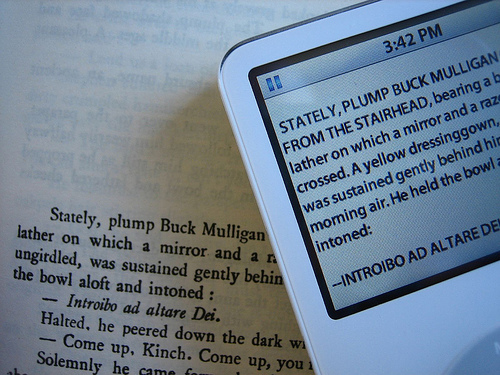
A couple of weeks ago, my interest was piqued by an article boasting the intriguing headline: “‘Losing yourself’ in a fictional character can affect your real life.” Essentially, researchers at Ohio State University have evidence that suggests very strongly that people who become emotionally engaged with a character in a story are more likely to alter their behavior according to how that character behaves, even if only temporarily. This piqued my interest first and foremost as a writer of fiction because it reflected my own experience so directly: When considering the mannerisms, speech, attitude, and choices of a character, it’s not uncommon for me to find my own behavior changing slightly to reflect those considerations, especially if I’m really trying to get inside a character’s head.

But then the piece piqued my interest in an entirely different way: the headline — if not the study itself — seems to be operating on the assumption that there is a distinct difference between a reader’s experience of a character in a work of fiction and the reader’s embodied experience of their own lives; in other words, that there’s a qualitative difference between the world of the imagination and the “real world”. And I’m inclined to view this assumption as flat-out incorrect.

Furthermore, I think the reasons why this assumption is incorrect have some things to say regarding the problematic assumption of digital dualism.

more...

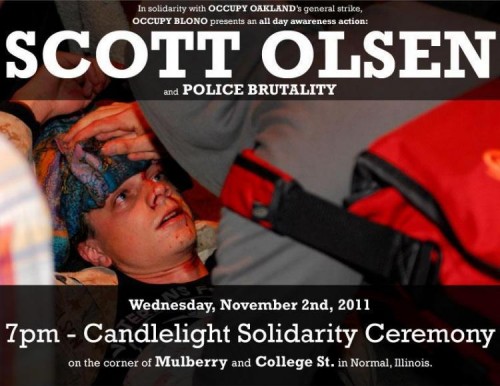
The image of injured war veteran Scott Olsen used as a call to further Occupy action.

The idea that bodies are the loci and the focus for the movement of power is a well-established one in sociological thought. In this sense, bodies are inherently political things – they are not just sites for the production and reproduction of social power but they also have political significance. What they do matters; what happens to them and why matters. In social theory this is often centered around Foucauldian concepts of discipline and the production of knowledge, but for the purposes of this post I want to go back to a previous post, where I made an argument specifically about the political significance of bodies in contexts of violent protest:

[B]odies have symbolic weight and power, and often they have the most symbolic weight and power of any other part of the movement. A dramatic flush of international outrage was generated around the film of Neda Agha-Soltan bleeding to death in a Tehran street, but it was the physical suffering and death of her physical body that generated that rage. Outrage grew exponentially out of the footage and images of Lt. John Pike pepper-spraying seated UC Davis students, but again, that outrage was generated by and situated around the physical suffering of physical bodies.

It’s important to emphasize the aspect of physical suffering in itself; the body carries political, discursive significance not only when it is intact but when – sometimes especially when – it is in the process of being damaged and destroyed. And the context of this damage and destruction – the circumstances under which it occurs – is part of what imbues the  body with its significance and alters what nature it already has.

more...

This is the first part of a two-part essay; the full version of the essay — both parts — can be found here.

Photo by Matthew Christopher

Atlantic Cities’ feature on the psychology of “ruin porn” is worth a look–in part because it’s interesting in itself, in part because  it features some wonderful images, and in part because it has a great deal to do with both a piece I posted last week on Michael Chrisman’s photograph of a year and with the essay that piece referenced, Nathan Jurgenson’s take on the phenomenon of faux-vintage photography.

All of these pieces are, to a greater or lesser extent, oriented around a singular idea: atemporality – that the intermeshing and interweaving of the physical and digital causes us not only to experience both of those categories differently, but to perceive time itself differently; that for most of us, time is no longer a linear experience (assuming it ever was). Technology changes our remembrance of the past, our experience of the present, and our imagination of the future by blurring the lines between the three categories, and introducing different forms of understanding and meaning-making to all three – We remember the future, imagine the present, and experience the past. The phenomenon of “ruin porn” is uniquely suited to call attention to our increasingly atemporal existence, and to outline some of the specific ways in which it  manifests itself.

more...

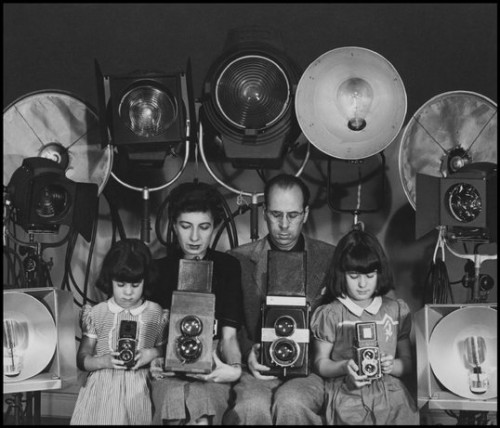
We begin with the assumption that social media expands the opportunity to capture/document/record ourselves and others and therefore has developed in us a sort-of “documentary vision” whereby we increasingly experience the world as a potential social media document. How might my current experience look as a photograph, tweet, or status update? Here, we would like to expand by thinking about what objective reality produces this type of subjective experience. Indeed, we are increasingly breathing an atmosphere of ambient documentation that is more and more likely to capture our thoughts and behaviors.

As this blog often points out, we are increasingly living our lives at the intersection of atoms and bits. Identities, friendships, conversations and a whole range of experience form an augmented reality where each is simultaneously shaped by physical presence and digital information. Information traveling on the backs of bits moves quickly and easily; anchor it to atoms and it is relatively slow and costly. In an augmented reality, information flows back and forth across physicality and digitality, deftly evading spatial and temporal obstacles that otherwise accompany physical presence.

When Egyptians dramatically occupied the physical space of Tahrir Square this past January more...