
Archive: Nov 2011

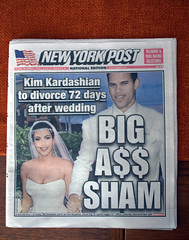
Cover Story:  New York Post, 11.01.11
Photo by Joe Wolf via flickr.com

The most recent marital meltdown making headlines involves the rapid “I don’t” of entrepreneur Kim Kardashian and pro basketball player Kris Humphries. While their split’s every detail is dissected everywhere from tabloids to 24 hour news networks, the Des Moines Resister took a different angle on the issue: they talked to some sociologists.

Susan Stewart, associate professor of sociology at Iowa State University, and Tony Paik, associate professor the University of Iowa’s Department of Sociology, helped explain some of the broader societal issues affecting early divorce and how we perceive flame-out marriages. Stewart maintains that although people generally don’t talk about their own divorces, it’s fair game to critique others’. This appears to especially be true for the nearly 1 in 4  U.S. marriages that end within the first 5 years.

“We are fascinated when people crash and burn,” Stewart said. “It’s a way to work through [our own issues]: ‘They are way worse off than I am.’ ”

Stewart believes age is often a determining factor in early divorce, but short engagement periods and contrasting religious or family backgrounds also come into play. And Paik presents data showing that earlier intercourse, surprisingly, may also be a determinant of short-lived marriages: according to Paik’s analysis, of those who remain abstinent until age 18, only 15 percent will divorce within the first 5 years of marriage. Those who have sex before 18 are shown to divorce at at rate of 31 percent.

Paik hasn’t determined why this might be, but he speculates that sex at a young age may lead to other possible divorce determinants, including premarital pregnancy, permissiveness toward non-marital sex, and premarital cohabitation–each of which seems to lose relevance over time, particularly when it comes to the Kardashian-Humphries union, which, so far as the prurient public knows, included none of these factors.

PEPPER FIRE SPRAY
Illustration by Sadler0 via flickr.com

When photographs of Police Lieutenant John Pike pepper-spraying peaceful college students emerged, many people were outraged.  But, Atlantic Monthly writer Alexis Madrigral takes a sociological lens by reminding readers that people always act within the confines of structure.

Structures, in the sociological sense, constrain human agency. And for that reason, I see John Pike as a casualty of the system, too. Our police forces have enshrined a paradigm of protest policing that turns local cops into paramilitary forces. Let’s not pretend that Pike is an independent bad actor. Too many incidents around the country attest to the widespread deployment of these tactics. If we vilify Pike, we let the institutions off way too easy.

Many sociologists, such as Patrick Gillham, have documented these changes in our police forces.  Looking at the 1960s, Gillham notes that police used “escalated force,” which involved mass arrest and indiscriminate use of force.

But by the 1970s, that version of crowd control had given rise to all sorts of problems and various departments went in “search for an alternative approach.” What they landed on was a paradigm called “negotiated management.” Police forces, by and large, cooperated with protesters who were willing to give major concessions on when and where they’d march or demonstrate. “Police used as little force as necessary to protect people and property and used arrests only symbolically at the request of activists or as a last resort and only against those breaking the law,” Gillham writes.

Yet by the 1999 WTO protests in Seattle, negotiated management was seen as a failure.

9/11 put the final nail in the coffin of the previous protest-control regime. By the time of the Free Trade of the Americas anti-globalization protests in Miami broke out eight years ago this week, an entirely new model of taking on protests had emerged. People called it the Miami model. It was heavily militarized and very forceful.

Looking at these changes, Brooklyn College Sociologist Alex Vitalle explains that the “broken windows” theory has also had a major impact on policing.  Broken windows policing doesn’t fight crime directly but rather fights the sense that a street is disorderly.

As Vitale would put it, the theory “created a kind of moral imperative for the police to restore middle class values to the city’s public spaces.” When applied to protesters, the strategy has meant that any break with the NYPD’s behavioral preferences could be grounds for swift arrest and/or physical violence. Vitale described how the theory has been applied to Occupy Wall Street:  Consider what has precipitated the vast majority of the disorderly conduct arrests in this movement: using a megaphone, writing on the sidewalk with chalk, marching in the street (and Brooklyn Bridge), standing in line at a bank to close an account (a financial boycott, in essence) and occupying a park after its closing. These are all peaceful forms of political expression. To the police, however, they are all disorderly conduct.

Combine these and other changes, and you have a completely different type of policing than was seen in previous eras.  Scholars are already studying it, but in the meantime, Alexis’s article is a reminder that while John Pike was the one spraying the pepper spray, a complex system put him in the position to do it.


More than half of new mothers now get paid leave from work, the U.S. Census Bureau announced last week. At face value the news might seem like cause for celebration, but some have dug deeper to expose exactly which mothers were getting paid leave.

The 22-page census report reported that a super-slim majority of women were getting paid leave: 51 percent of first-time mothers were able to take paid maternity, sick, or vacation time between 2006 and 2008. Hence the divide between which half of moms headlines highlighted:

“Majority of new moms are getting paid leave” (Minneapolis Star Tribune)

“Paid-leave benefits lagging for working moms in U.S.” (Chicago Tribune)

“Census shows half of working women don’t get paid maternity benefits; wide gaps by education” (Associated Press)

The lack of access to paid leave among women who haven’t completed college is raising concern. According to the AP article, “Lower-educated mothers are nearly four times more likely than college graduates to be denied paid maternity benefits. That’s the widest gap over the past 50 years.” (The chart above illustrates the comparison.)

New York University sociologist Kathleen Gerson, author of The Unfinished Revolution: Coming of Age in a New Era of Gender, Work, and Family, shared her opinion. “This isn’t good news for women at the bottom, and the irony is that the people with the most children are now the least likely to have the supports they need,” she told the Associated Press.

University of Minnesota sociologist Erin Kelly echoed Gerson’s sentiment when interviewed by the Star Tribune. “People who are already living paycheck to paycheck, if they don’t have access to paid leave they’re going to have to quit or they’re going to have to do something that is really unhealthy for themselves or their babies,” Kelly told the paper. “The lack of [federal] paid leave policy means in effect we are pushing those women to quit.”

I ♥ facebookWith over 800 million active users, Facebook must be affecting our relationships—some even wonder if acquiring hundreds, even thousands, of online companions is helping or hindering our “real life” connections to others. It’s no surprise that new research on this topic by Cornell sociologist Matthew Brashears is making a splash in media outlets from ABC News to The Times of India and The Telegraph. Brashears work asks, even in this hyper-connected world, do we have as many close friends as we think we do?

In short: no. According to Brashears’ longitudinal research (which looked at over 2,000 adults from 1985 to 2010 and was published in the journal Social Networks), the average number of close friends—people with whom respondents said they’d discussed important matters with during the past six months—most of us report is two. Just 25 years ago, the average was closer to three. Brashears is quick to point out that we’re not becoming asocial. He thinks we’re getting better at being careful in selecting our confidants. Perhaps we now favor a smaller, tighter network for our true support system even while we enjoy more casual, diffuse online networks.

ABC News went a bit further to ask whether Facebook was actually to blame for this culling of comrades. The news outlet turned to a Pew Research Center report written by another sociologist, Keith Hampton of the Annenberg School for Communication at the University of Pennsylvania. Hampton took a rosier view in a blog post on the subject:

Internet users in general, but Facebook users even more so, have more close relationships than other people. Facebook users get more overall social support, and in particular they report more emotional support and companionship than other people.

Different networks, we know, fulfill different needs. Facebook reports that its average user has 130 friends—as of this writing, there’s just no separate category for “real friends.”

Class Participation

University of Illinois at Chicago’s Barbara Risman recently told CNN readers that there are two types of sexual harassment.  The first is usually easy to spot.  “A really detestable (usually) man gives his (usually) female subordinate employee or student an ultimatum: Put out or lose some opportunity, be it a grade, a job or a promotion.”  As Risman explains, this type of harassment was commonplace during the era of Don Draper and Roger Sterling, but we’ve come a long way since then.

But then there is the other kind of sexual harassment, the behavior that makes the workplace uncomfortable, that creates an environment that is hostile to women in general, or just to one person because of her (or his) sex, gender, race or ethnicity. Everyone agrees that workplaces ought not to differentiate between actors simply because of their sex, gender, race or ethnicity. But beyond that, when sex and gender are involved, we often get into a “he said/she said” dialogue. For example, he believed the jokes were simply funny and created a more friendly setting; she believed they were offensive and created an us (the boys) versus them (her or her and other women) organizational climate where she was always going to be outside the loop, outside informal conversations and social networks that mattered.

If we look at sexual harassment in terms of he said/she said, though, Riseman argues that there will never be a solution.  We can’t deny that many people meet their partners in the workplace.  Yet, we also can’t deny that we live in a world where power is not equally shared and where workplaces are not integrated by sex.  In fact, integration by sex has stalled; more women are getting degrees, but they are remaining in traditionally female-dominated fields.  According to Riseman, this may be because of the workplace cultures that include sexual innuendo and sexual harassment.

I don’t have an easy answer, but I do know we’ll never solve the problem by trying to figure out what he said or she said. Instead, we have to decide what, as a society, we want to be acceptable or not in our workplaces and schools and then enforce the norms with legal penalties. Here’s a first volley: It should be illegal for men (or women) to make sexual overtures to their subordinates. End of story. Power always gets in the way of easily saying no. But more than that, if we want workplaces that do not privilege the men who have previously dominated the social space, we need to change the culture in which sexual banter objectifies women and turns them into the “other,” and take seriously the claims by women that men harass them.

Because, as Riseman eloquently notes, “The more subtle kind of sexual harassment has consequences not only for the individual woman who finally complains, but for all of us, by sustaining a culture where the powerful positions in many occupations, including politics, remain dominated by men.”


Felix the cat

Could the President of the United States be a vegetarian?  According to Vanderbilt Professor of Philosophy Kelly Oliver, it’s not likely.   In her recent New York Times Op-Ed, Oliver explained,

In the United States, we often see our political leaders hunting, particularly bird-hunting, which seems to demonstrate their manly fortitude and bloodlust — qualities intended to persuade us that they can keep us safe.  Hunting has become a tool of sorts within the realm of political image making.  With few exceptions, President Obama among them, most presidents and presidential hopefuls have been seen hunting.  Meat eating, too, is an act used to portray strength.  Obama is known to enjoy his burgers, a fact that has helped counter his image as a green-tea drinking elitist.  Even Sarah Palin’s so-called new brand of feminism revolves around the image of a tough “mama grizzly,” as she calls herself, shooting and gutting moose to feed and protect her family.

Yet while hunters are often seen as tough providers, animal lovers are infantilized.

In popular culture, celebrities who take on animal causes are seen as a bit crazy — rich versions of the “crazy cat lady,” or dog-crazy Leona Helmsley. Not coincidentally, they are usually women.  And, our relationships to the animals with whom (or rather which, to be grammatically correct) we live is given very little status in our society.  Despite the proliferation of  “cute” pet pictures and anecdotes on the Web, actual displays of affection toward one’s pet or companion animal, or grief expressed over their illness or death, is looked upon with ridicule.

What more, people who are dependent on their animals are seen as unhealthy.  In fact, this is reflected in laws surrounding guide dogs, comfort dogs used to provide emotional support to children testifying in court, and other forms of animal service.

The regulations are very clear: these animals are not pets.  They are “serving” an essential therapeutic purpose.  The fact that these relationships are circumscribed by laws relegate animals to the role of tools or medication, an act that also pathologizes the people who rely on them.  Animals, then, can enter our intimate family units only as pets, which is to say property, or as a result of trauma, disease or disability.  This cultural attitude suggests that people who are dependent upon their animals for anything other than amusement or entertainment are abnormal or unhealthy.  Loving animals as friends and family is seen as quirky at best and at worst, crazy.


To read more about Oliver’s specific reflections on animals and philosophy, click here
.