
Tag Archives: government

A Gold in Global Deception


Figure Skating Queen YUNA KIM
The opening ceremony of the Olympics is not short on inspiring imagery for the many millions who tune in around the globe. As the host country provides the spectacle and entertainment, athletes representing their respective countries march one after the other to cheers of the crowd. With such cooperation in the name of athletic competition, the Olympics can’t help but be a large step towards worldwide transparency, peace and equality. Right?

In a recent New York Times editorial, David Clay Large, a professor of history at Montana State University, suggests otherwise. Drawing on analysis of the 1936 Berlin Games, Large explains that there is little evidence that the Olympics works to open up repressive regimes. In fact, the inspiring tales of the Olympics taming Hitler’s Nazi regime are mostly myth.

The Olympics gave the Nazis a lesson in how to hide their vicious racism and anti-Semitism, and should offer today’s International Olympic Committee a cautionary tale when considering the location of future events.

While few would argue that the Berlin Olympics transformed Nazi Germany into the ideal international partner, it is commonly said that Hitler did reduce persecution of Jewish people during that time.

But the truth is more nuanced. Although the regime did discourage open anti-Semitism, this directive pertained only to Berlin. Outside the capital, the Nuremberg Laws remained in full effect.

Large explains that through employing deceitful tactics throughout the Olympics the Nazis learned how was easy it was to mislead the global public through superficial changes.

The article continues with Large deconstructing other pervasive myths about the value of the Berlin Games, including the well-told stories about the impact of Jesse Owens’ dominance. According to Large, the black American track-and-field athlete, did not simply force the Germans and people everywhere to rethink negative views towards black people; rather, the victory simply led to the group in power using the success to enforce negative views.

[T]he publicity surrounding black athletes’ success simply taught the Nazis how to refine existing stereotypes. Instead of arguing that those athletes were physically inferior, they disparaged them as freaks who, because of their “jungle inheritance,” were able to jump high and run fast.

Large’s presentation of “the truth behind the 1936 Games” effectively calls into question many of the underlying assumptions about the positive impacts of holding the Olympics and other large international sporting events in countries with questionable governance and a history of mistreating citizens. And, as Large points out,

there is little evidence so far that the 2008 Beijing Olympics did anything but show the Chinese government how to maintain its clamp on freedom while supposedly opening its doors to the world.

Large concludes with a critical but potentially positive suggestion:

This is not to say that the Games should be held only in politically “clean” countries. But instead of blindly celebrating the alleged openness of repressive regimes that host the event, the international community should use it as an opportunity to hold them to the values that the Olympics claim to represent.


Leaders Who Overstay Their Welcome

OUT OF WORK DICTATOR

Sarah K. Cowan, a sociology and demography  grad student at UC Berkeley, recently asked CNN readers, “What if a President served 42 years?”   That’s how long Moammar Gadhafi has been the leader in Libya, which could be equated to Richard Nixon still serving as President of the United States today rather than leaving office in 1974.

In a healthy democracy, citizens see multiple leaders of government in their lifetime. Doing so allows them to compare leaders, form political preferences and to participate meaningfully in the political process by voting in truly competitive elections.

But, in many countries, a large portion of the population has only experienced one leader.

…Seventy-nine percent of Libyans have lived their entire lives under Gadhafi’s rule. Before the revolution in Egypt, 60 percent of Egyptians had lived their lives under President Hosni Mubarak exclusively. Sixty-one percent of Zimbabweans have only known Robert Mugabe’s rule. By contrast, the longest American presidency was Franklin D. Roosevelt’s; he was elected four times, to serve for a total of 16 years, of which he served 12 before his death…

According to Cowan, two main factors have led to situations where much of the population knows only one leader.  First, that leader remained in power and disregarded or never established term limits.  Second, the populations in these countries are comparatively young.

Twenty percent of people in Mozambique have lived their entire lives under Armando Guebuza, and they are all under age 7. The population is so young because women in Mozambique have a lot of children — more than five on average — and people die young — at age 48 on average. (The age of the population can have a powerful effect on these calculations: If Libya had the same age profile as the much older population of the U.S., 57% of the population would have known Gadhafi as the only leader during their lifetime, compared with the 79% who actually did.)

Opinions on the benefits of long-standing rulers vary.  Some scholars argue that they create political and social vacuums and stunt economic growth, while others argue that, under the right conditions, long tenures may lead to economic growth.  Either way, Cowan says:

Leaving aside whether lengthy tenures are beneficial for economies, they violate democratic principles. It is a characteristic that distinguishes democracies from authoritarian regimes; in a democracy, the leader changes in a reasonable time frame. Term limits, confidence votes for parliamentary systems of government and regular and fair elections are all means by which to prevent “presidents for life.”


what’s at stake in wisconsin

Protesting Scott Walker
In an op-ed published in the Raleigh-based paper, the Newsobserver, sociology Ph.D student Amanda Gengler provides insight into what is at stake in the current political struggle in Wisconsin. To do so Gengler draws upon her experience at the University of Wisconsin-Madison where she earned her master’s degree.

As a graduate student at the University of Wisconsin-Madison 10 years ago, every month a few dollars of my stipend went to pay dues to the TAA; a unique union that represents and protects graduate employees working in the UW-System. In return, I worked under a contract that ensured full health care benefits and basic dental care (with no out-of-pocket premiums), and tuition remission (without which my education would not have been possible) as well as other fair labor protections.

Now, even after each subsequent renegotiation of the rights for Wisconsin’s graduate employees has resulted in more and more concessions, current Gov. Scott Walker is proposing to remove the TAA’s collective bargaining rights altogether. This would make it impossible to fight for any of these protections, all of which could be immediately revoked.

Graduate students are not alone in seeing this as an attack on the education system.

Under the rallying cry “Hands off our Teachers,” undergraduates have taken to the streets in recent days alongside their graduate student instructors.

Gengler cautions us to not see this as an isolated threat directed at the University system.

Wisconsin’s 3,000 graduate student workers are but one of the many constituencies that will be directly harmed by the state government’s attack on unions and workers’ rights. As Wisconsin’s unions offer up economic concessions in terms of pay and premiums, only to be completely rebuffed by state lawmakers, it is clear that this issue is not about the budget: it is about ending workers’ collective bargaining rights.

The op-ed serves as a call for all workers and unions to pay close attention to what is occurring in Wisconsin. While the situation appears bleak, Gengler leaves us with a statement of resolve:

Those of us who have been fortunate enough to have those rights know what they are worth, and the thousands who continue to flood Madison’s streets make it clear that the right to fight is one thing they will not concede.


Underrepresented

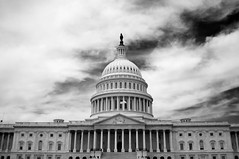
US Capitol BuildingDespite recent political bluster over shrinking the size of government, sociologist Dalton Conley and political scientist Jaqueline Stevens contend that bigger might be better. According to their op-ed in the New York Times, the House of Representatives may be too small:

It’s been far too long since the House expanded to keep up with population growth and, as a result, it has lost touch with the public and been overtaken by special interests.

Indeed, the lower chamber of Congress has had the same number of members for so long that many Americans assume that its 435 seats are constitutionally mandated.

But that’s wrong: while the founders wanted to limit the size of the Senate, they intended the House to expand based on population growth. Instead of setting an absolute number, the Constitution merely limits the ratio of members to population. “The number of representatives shall not exceed one for every 30,000,” the founders wrote. They were concerned, in other words, about having too many representatives, not too few.

Historically, House members had been added after each census up until 1920, when fear of growing numbers of “foreigners” in the population stymied expansion. As a result, US citizens may be underrepresented:

The result is that Americans today are numerically the worst-represented group of citizens in the country’s history. The average House member speaks for about 700,000 Americans. In contrast, in 1913 he represented roughly 200,000, a ratio that today would mean a House with 1,500 members — or 5,000 if we match the ratio the founders awarded themselves.

According to Conley and Stevens, increasing the number of representatives would address several concerning issues, such as the disproportionate influence of lobbyists and special interest groups; ending two-party deadlock in smaller districts; making campaigns cheaper; and lowering reliance on staffers rather than members themselves.

True, more members means more agendas, legislation and debates. But Internet technology already provides effective low-cost management solutions, from Google Documents to streaming interactive video to online voting.

Will it happen?

The biggest obstacle is Congress itself. Such a change would require the noble act — routine before World War I but unheard of since — of representatives voting to diminish their own relative power.

What do you think?

Obama’s Got Religion…Just Make Sure You Know Which One

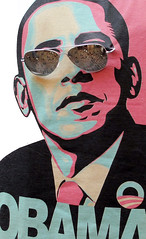
Can He See The Road Ahead?Nearly one in five Americans think President Obama is a Muslim, according to ABC News:

The new poll from the nonpartisan Pew Forum on Religion and Public Life found that 18 percent of those surveyed wrongly identified Obama as Muslim, up from 11 percent in March 2009. At the same time, the number of Americans who knew correctly that Obama is Christian has declined from 48 percent in March 2009 to 34 percent today. But 43 percent of Americans now say they don’t know what Obama’s religion is at all.

The finding has even prompted a response from the White House.

“The president is, obviously, he’s Christian. He prays every day,” White House spokesman Bill Burton said today aboard Air Force One.
“He communicates with his religious advisor every single day,” Burton said. “There’s a group of pastors that he takes counsel from on a regular basis. His faith is very important to him, but it’s not something that’s a topic of conversation every single day.”

Burton said the president has talked “extensively” about his faith in the past and “you can bet he’ll talk about his faith again.” But “making sure Americans know what a devout Christian he is” is not the president’s top priority.

Despite such statements, sociologists have reason to doubt such misperceptions can be so easily overcome.

“I think the reality is that false beliefs spread like gossip more than actual information,” said Andrew Perrin, an associate professor of sociology at the University of North Carolina, Chapel Hill.

Perrin’s research has shown that a false perception can spread quickly if people’s friends and neighbors also have heard or believe a similar idea.

“False beliefs propagate when people think others believe them and when they have a supportive source that wants them to hold it,” Perrin said.

Perrin has found that even direct denials of the false information do not always solve the problem.

“In my own research, when [people] get reliable information that discounts these beliefs, they tend to cling to those beliefs more,” Perrin said.

death penalty myths

SNHCADP Protest - World Day Against the Death Penaltyociologist  David Garland has written in the Washington Post about the contentious issue of the death penalty.

Much of what we think we know about American capital punishment comes from the longstanding debate that surrounds the institution. But in making their opposing claims, death-penalty proponents and their abolitionist adversaries perpetrate myths and half-truths that distort the facts. The United States’ death penalty is not what its supporters — or its opponents — would have us believe.

According to Garland, Americans are not as death-penalty-happy as you may think.

In fact, this country barely uses the death penalty today. Fifteen states and the District of Columbia have abolished capital punishment. Of the 35 “death-penalty states,” one-third rarely sentence anyone to death and another third impose death sentences but rarely carry them out. In many states, the only people to be executed are “volunteers” — death row inmates who abandon an appeals process that would otherwise keep them alive.

And the U.S. has made the practice more humane, though European nations have been quicker to abandon it altogether.

For most of the past 200 years, American states have been on the vanguard of death-penalty reform…The United States led the effort to develop less painful execution techniques, replacing hanging first with the electric chair, then the gas chamber, and finally with lethal injection…It is only in the past 30 years that a gap has opened up, with Europeans abolishing the institution and Americans retaining it in an attenuated form.

Government structure has a lot to do with why nations keep or abolish the death penalty. European leaders have managed to get rid of the death penalty in spite of public approval of the practice.

The United States’ democracy is different. Each state can choose whether to have the death penalty. It’s not a central government decision, as it is in other countries. Our criminal justice system is different, too. In many cases, we elect prosecutors and judges — a politicization of the process that is unheard of elsewhere. In this country, the Supreme Court is the one national institution that has the power to abolish capital punishment throughout the nation.

Finally, whether the death penalty “works” or not to deter crime, Garland says it serves other social purposes.

In a nation where the prison system is so overused that the currency of imprisonment is largely devalued, the death penalty allows juries to make an emphatically punitive statement. Politicians give voters what they want by enacting capital punishment statutes even when they will never be enforced. Prosecutors use the threat of a death penalty as leverage to elicit plea bargains and cooperation. The news media are drawn to death-penalty cases because they elevate a routine case to a suspenseful drama where life and death are at stake.

We avidly consume these dramatic stories and enjoy the opportunity to engage, once more, in the old and familiar debate. But it’s time to change the terms of that all-too-familiar debate. Getting past the myths and looking at how the death penalty actually operates is one place to start.

mommy’s – and daddy’s – time out

Swedish Dads, Skansen

The New York Times features an in-depth look at paternity leave in Sweden:

From trendy central Stockholm to this village in the rugged forest south of the Arctic Circle, 85 percent of Swedish fathers take parental leave. Those who don’t face questions from family, friends and colleagues. As other countries still tinker with maternity leave and women’s rights, Sweden may be a glimpse of the future.

Companies have come to expect employees to take leave irrespective of gender, and not to penalize fathers at promotion time. Women’s paychecks are benefiting and the shift in fathers’ roles is perceived as playing a part in lower divorce rates and increasing joint custody of children.

In perhaps the most striking example of social engineering, a new definition of masculinity is emerging.

“Many men no longer want to be identified just by their jobs,” said Bengt Westerberg, who long opposed quotas but as deputy prime minister phased in a first month of paternity leave in 1995. “Many women now expect their husbands to take at least some time off with the children.”

Birgitta Ohlsson, European affairs minister, put it this way: “Machos with dinosaur values don’t make the top-10 lists of attractive men in women’s magazines anymore.” …“Now men can have it all — a successful career and being a responsible daddy,” she added. “It’s a new kind of manly. It’s more wholesome.”

Of course, these policies are not without controversy and do come at a price. Sociologists, along with several other social scientists, weigh in:

The least enthusiastic [about paternity leave], in fact, are often mothers. In a 2003 survey by the Social Insurance Agency, the most commonly cited reason for not taking more paternity leave, after finances, was mother’s preference, said Ann-Zofie Duvander, a sociologist at Stockholm University who worked at the agency at the time.

Taxes account for 47 percent of gross domestic product, compared with 27 percent in the United States and 40 percent in the European Union overall. The public sector, famous for family-friendly perks, employs one in three workers, including half of all working women. Family benefits cost 3.3 percent of G.D.P., the highest in the world along with Denmark and France, said Willem Adema, senior economist at the Organization for Economic Cooperation and Development.

Yet Sweden looks well balanced: at 2.1 percent and 40 percent of G.D.P., respectively, public deficit and debt levels are a fraction of those in most developed economies these days, testimony perhaps to fiscal management born of a banking crisis and recession in the 1990s. High productivity and political consensus keep the system going.

“There are remarkably few complaints,” said Linda Haas, a professor of sociology at Indiana University currently at the University of Goteborg. With full-time preschool guaranteed at a maximum of about $150 a month and leave paid at 80 percent of salary up to $3,330 a month, “people feel that they are getting their money’s worth.”

Despite the challenges that Sweden’s extended parental leave may present for some employers, the trend doesn’t shows signs of slowing:

But in a sign that the broader cultural shift has acquired a dynamic of its own, a survey by Ms. Haas and Philip Hwang, a psychology professor at Goteborg University, shows that 41 percent of companies reported in 2006 that they had made a formal decision to encourage fathers to take parental leave, up from only 2 percent in 1993.

Check out the rest of the article.

the census: gettin’ ‘er done

286_365_Count Me In
With political representation and federal funding at stake, Midwestern states are showing the highest Census response rates so far. According to the New York Times:

With Thursday dubbed Census Day — the day the questionnaires are meant to capture as a snapshot — South Dakota, Wisconsin, Nebraska, North Dakota and Iowa are ranked the top five states by federal officials, because they have the highest participation rates in the census so far. People can send in the forms until mid-April, but the Midwest’s cooperativeness might rightly worry other regions.

After all, the census guides the federal government on decisions with lasting impact — like how many representatives states will have in Congress and how much federal money they win for their roads.

But the high rates of participation in these rural states may have less to do with vying for power and resources and more to do with social norms and sensibilities.

Census officials said lots of social factors seemed to correlate to a community’s responsiveness (or silence) to the census mailings. Places where people stay put, for instance, often answer. In this town, most people said they had grown up here.

But some North Dakotans, where the state capital, Bismarck, had the nation’s fourth-highest response rate among larger cities as of Wednesday night, suggested a simpler answer. Perhaps it was the way of thinking around here — some combination, they said, of being practical, orderly, undistracted and mostly accepting of the rules, whatever they are. “We have a high degree of trust in our elected officials,” said Curt Stofferahn, a rural sociologist at the University of North Dakota, “and that carries over to times like these.”

The towns and cities the census described this week as having 100 percent participation rates are mostly tiny. How hard, some wondered, is it to get 50 responses from 50 people? And in Wolford, which officially has a 100 percent rate, plenty of people — perhaps more than 20 — are not included in that statistic because they hold post office boxes and have yet to receive forms.

By all appearances, these norms are being passed along to the next generation of rural residents.

At Wolford Public School, where 46 children from around the area attend kindergarten through 12th grade (the ninth grade is empty and only one child is in fourth grade), census leaflets, posters and stickers have been handed out in Wanda Follman’s class of 11 children.

Asked on Wednesday if their families had returned census forms yet, nearly all 11 shot their hands in the air. The children excitedly recited some of the questions from memory.

“I filled it out with my mom’s help,” said Kyle Yoder, the 8-year-old, who wore glasses and a serious face. “It was kind of easy.”

politics taking a violent turn?

The New York Times reported on increasingly heated political protests:

Public displays of political anger have been a staple of the American scene for the last eight months or so, but in recent days a handful directed at members of Congress have gone a bit further than noisy, sign-carrying assembly to window-smashing, spitting, threatening faxes and phone calls, even a cut propane line on a barbecue grill. At the end of last week, Democratic and Republican leaders, while denouncing any violence or threat of it, reached the point of trading accusations over who was most responsible.

Psychologists commented that, though people may talk about extreme measures, few are likely to actually turn to violence. Sociologists weigh in:

Kathleen Blee, a sociologist at the University of Pittsburgh, said the same was true even for groups that consider violence a central tenet. “In the white power groups I study, people can have all kind of crazy racist ideas, spend their evenings reading Hitler online, all of it,” she said, “but many of them never do anything at all about it.”

Protest groups that turn from loud to aggressive tend to draw on at least two other elements, researchers say. The first is what sociologists call a “moral shock” — a specific, blatant moral betrayal that, when most potent, evokes personal insults suffered by individual members, said Francesca Polletta, a sociologist at the University of California, Irvine, and author of “It Was Like a Fever: Storytelling in Protest and Politics.”

This shock may derive from an image: the horrific posters of tortured animals published by animal rights groups, or of aborted fetuses by anti-abortions organizations, which speak for themselves. It can also reside in a “narrative fragment,” like the Rodney King beating, which triggered a riot all on its own.

Perhaps the best available candidate for such an outrage today is the Wall Street bailout, Dr. Polletta said. “The message there is rich people being rewarded for bad behavior,” she said. “That’s going to hit home, especially if you’ve lost a job, or know someone who has.”

The second element is a specific target clearly associated with the outrage. A law to change. A politician to remove. A company to shut down. “If the target is too big, too vague — say, the health care bill, which means many things — well, then the anger can be hard to sustain,” Dr. Polletta said. “It gets exhausting.”

So,

Given the shifting political terrain, the diversity of views in the antigovernment groups, and their potential political impact, experts say they expect that very few are ready to take the more radical step.

“Once you take that step to act violently, it’s very difficult to turn back,” Dr. Blee said. “It puts the group, and the person, on a very different path.”

Read more.

boxed in?

President Obama (Tim)According to USA Today, the 2010 Census will

remind Americans that racial classifications remain an integral part of the country’s social and legal fabric while, at the same time, recognizing that racial lines are blurring for a growing number of people…The government will give the nation’s more than 308 million people the opportunity to define their racial makeup as one race or more.

Some suggest that Obama’s presidency may affect how individuals report their race this time around. But how Obama himself will record his race remains a mystery.

Obama, born to a black father and a white mother, is not only the first black president but the first biracial president.

During his successful campaign in 2008, Obama referred to himself as black but also referred to his roots in Hawaii, where he was raised by his white mother. When the Obamas’ Census form arrives at 1600 Pennsylvania Ave., will he identify himself as black or as black and white? The White House declines to say.

A sociologist weighs in:

“The issue of perception is central,” says Ann Morning, a sociology professor at New York University. In an article titled “Who is Multiracial?” she estimated that about one-third of the U.S. population has some mixed-racial ancestry going back several generations. She predicts young generations will be more embracing of their multiracial heritage.

Morning is African American. But she also has English, Chinese and American Indian ancestry. Since 2000, she has checked off black, white, Asian and American Indian.

“The bigger thing is how I will mark my daughters,” Morning says. Their dad is Italian and she believes most people will look at her daughters as white. For now, she’ll check all the boxes for them, too.

Some question whether counting race is a good idea at all.

Roderick Harrison, a demographer at Howard University and the Joint Center for Political and Economic Studies in Washington. “But for a lot of others, it’s like, ‘OK, are you going to turn your back on the rest of us?’ … A lot of the racial and ethnic politics of the Census are that we want the biggest numbers possible for our groups.”

The Census has a long-lasting effect on politics and money. Population counts every 10 years decide the number of seats every state gets in the U.S. House of Representatives and determine how more than $400 billion a year in federal aid is allocated.

“I know it’s valuable information if you’re doing economic development or dispense certain amount of money to areas that need it,” says Stewart Cockburn, 39, who lost his job in textile sales in September. “My point about race in general in this country is that we’re just never going to get past it if we keep asking about it.”

Cockburn, of Greensboro, N.C., says he’s Scottish and Irish and has a great-grandmother who was Cherokee.

“I don’t understand why everyone makes such a big deal about race,” he says. “Maybe one day we will no longer care about race, ethnicity or the color of another person’s skin.”

Donna Edwards, of Santa Monica, Calif., says it’s important that the federal government allows people to identify more than one race. “It’s about time, isn’t it?” says Edwards, who is half Japanese and half German/Scottish/Welsh and spent years frustrated by forms that boxed her into one or the other.