Author Archives: suzy

Been There, Done That

Our love is here to stay

Photo by Tommie Milacci via flickr.com

Younger generations aren’t the only ones cohabiting these days. Research by sociologist Susan Brown and her colleagues at Bowling Green State University find that the number of Americans over age 50 who are living with their romantic partners – but are not married – has increased from 1.2 million in 2000 to 2.75 million in 2010.

As MSN reports, this arrangement provides older cohabitators many of the benefits of marriage without the potential economic risk.

Older couples may want to protect their individual nest eggs so they can pass the inheritance down to their kids. They also may not want to jeopardize a pension, Social Security payment or other benefit they are receiving because they are divorced or widowed. And they may not want to be financially responsible for the other person’s health care bills.

A “been there, done that” attitude is also contributing to the trend, Brown says. According to the team’s research, “71 percent of older couples living together were divorced, and another 18 percent were widowed.” The prospect of re-entering a union may be particularly unappealing for women who feel an “underlying expectation” to take care of their husbands.

Alternative relationships other than cohabitation also appear to be on the rise. Although the numbers aren’t as clear, Brown notes a group engaged in “living apart together.” “They’re very committed to each other ,” she explains, “(but they) don’t want to give up the autonomy that they have.”

Sportsmanlike Behavior

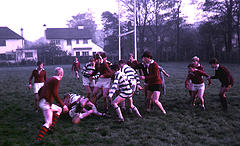
High School Rugby photo by Phillip Capper via flickr.com

High school rugby photo by Phillip Capper via flickr.com

Based on a year of field-work with 16- to 18- year olds, Mark McCormack, a sociologist at Brunel University (UK), argues that homophobic attitudes are on the decline in British secondary schools. As The Economist explains, McCormack’s new book, The Declining Significance of Homophobia, “describes an atmosphere of affection between male students both gay and straight, who no longer feel they need to act like sport-mad brutes to be accepted by their peers.”

Admittedly, some pupils still use the word “gay” to express disapproval -but they apply it to things like homework, and it is rarely a dig even when directed at people. Among these boys homophobia bore the same stigma as racism.

McCormack points to the media and the Internet as sources of the shift in attitudes:

First, there are many more openly gay performers, politicians and TV characters, which helps to normalise homosexuality. Second, the internet lets lonely provincial teenagers reach beyond their town limits. Social-networking websites encourage frankness about sexual orientation, and YouTube is a fount of videos featuring transgender confessionals and boys coming out to their mothers.

McCormack does not claim that harassment or bullying based on homophobia is no longer an issue, but that the situation has improved. And, he argues, “it is wrong and counter-productive to harp on about the dangers gay teenagers face, if it prevents many from coming out of the closet.”

In related research, our own Kyle Green reported late last year in Contexts‘ Discoveries section on research from Eric Anderson, who tracked high school athletes’ attitudes toward openly gay teammates over time, finding a dramatic drop in homophobia even in contact sports in just 10 years. It appears this trend is bearing out “across the pond.”

Religion is Not a Political Science

If I Should Fall From Grace With God
As viewers of the ongoing GOP debates already know, religion is a hot topic this voting season. But despite discussion and conjecture regarding a host of religious issues by voters, candidates, and pundits alike, Scott Jaschik points out (this week in Inside Higher Ed) there is little research to turn to in support of their claims.

According to an analysis of US-based and British political science research by associate professor of politics and international studies Steven Kettell, less than two percent of studies in the top 20 research journals in the field focus on religion.

Jaschik notes, “Of the small minority of articles that considered religious issues, the most popular topics are not likely to provide much help to those trying to follow the Republican presidential race this year. The most common topic was religious links to violence and terrorism, and the second most common topic was Islam.”

Although other social sciences, such as anthropology, history, and sociology, give greater attention to religious issues today, “[Kettell] argues that it is time for ‘political scientists to turn the tools of their trade’ to issues of religion.”

Candidates, Cancer, and Public Health in the Public Eye

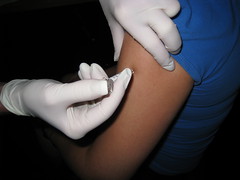
Representative Michelle Bachmann (R-MN) has gone on record against the Gardasil vaccine preventing cervical and possibly throat cancer, calling it “dangerous” during and after the CNN-Tea Party Republican Debate in mid-September.  Medical experts quickly objected (two bioethicists even offered up $10,000 if Bachmann could produce scientific evidence that the vaccine had, as Bachmann claimed, caused mental retardation in one patient), and Bachmann backpedaled, admitting that she is neither a doctor nor a scientist.  Yet, as a recent New York Times article notes, the effects of Bachmann’s disparaging remarks against the vaccine will likely outlive this election cycle.

[T]he harm to public health may have already been done. When politicians or celebrities raise alarms about vaccines, even false alarms, vaccination rates drop.

“These things always set you back about three years, which is exactly what we can’t afford,” said Dr. Rodney E. Willoughby, a professor of pediatrics at the Medical College of Wisconsin and a member of the committee on infectious diseases of the American Academy of Pediatrics. The academy favors use of the vaccine, as do other medical groups and the Centers for Disease Control and Prevention.

Although the vaccine has been proven to prevent cervical cancer and has been declared safe by the Institute of Medicine (a government advisory group), and despite backing from the American Academy of Pediatrics and the Centers for Disease Control and Prevention, the vaccine has been slow to catch on, lagging behind vaccines licensed at the same time, such as one to combat meningitis.

“This vaccine has been portrayed as ‘the sex vaccine,’ ” said Dr. Mary Anne Jackson, a professor of pediatrics at the University of Missouri-Kansas City and a member of the infectious disease committee of the American Academy of Pediatrics. “Talking about sexuality for pediatricians and other providers is often difficult.”

Recent research published by Siegwart Lindenberg, Janeke F. Joly, and Diederik A. Stapel, social scientists in the Netherlands, has confirmed that “star status” can really boost a cause (Social Psychology Quarterly, March 2011). Unfortunately, in this case, Bachmann’s public status lends credibility to her scientific missteps and will likely, the New York Times says, set back HPV vaccination efforts by years.