
work-life balance

Reposted from Psychology Today

Tammy Duckworth is the first senator to give birth while in office. And she did so with great fanfare and a demand that her breastfeeding infant be able to accompany her to the Senate floor. The mayor of DC adopted a baby, and almost immediately began juggling motherhood and politics, with barely any time away from the public eye. Millennial mothers are running for office and  advertising their breastfeeding babies in campaign photos. Women are demanding that their status as mothers, with babies, be accommodated. It’s about time.

And yet, why now?  Professional women have been in careers for over 50 years. What is new now?  A sociological concept of “the economy of gratitude” helps explain these newly vocal demands by today’s mothers. The demands of employed mothers have definitely changed since the 20th Century. Women like me, middle class white baby boomers who fought to join the ranks of the professionally employed, were happy that we had broken into the boys club. We were grateful to be there. As Gloria Steinem so aptly explained, we wanted to be the men we were supposed to marry. We wanted was to influence the world, to make our own way, to be independent. In my generation, we wanted to be someone in our own right, not somebody’s wife, but to be that somebody. To do that, we put up with sexual harassment, lower wages, and the mommy wars. We were breaking new ground for married middle class women, who had been raised to be wives. My parents wanted me to train to be a nurse or a teacher just, as they would say, “in case your husband ever leaves you.” With that kind of parental ambition, I was grateful to have fought to carve out a life that included my work and my family. I felt lucky to have escaped the domestic life my mother and her friends lived.

Today’s young mothers, Millennial women, are not grateful for being allowed to be in their jobs, to be somebody. They take that for granted, thanks to their grandmothers and mothers who fought those battles. In my new book, Where the Millennials Will Take Us: A New Generation Wrestles with the Gender Structure (Oxford, 2018), I interviewed 116 Millennials and nearly all of them, including very conservative “true believers” in gender differences, expected women to spend their adult lives in the labor force, whether or not they were mothers. There is simply no endorsement for the idea that in heterosexual marriage husbands are breadwinners and women wives. And the quantitative data agree. There is almost no one left that doesn’t believe women should have equal rights in the public world of politics and work.

So today’s young mother doesn’t feel any gratitude, as we did, for being allowed into the workplace. And the daughters of working class women and women of color have always had role models who were both mothers and workers. So nearly all American women today take it for granted that paid work is the responsibility of women and men, mothers and fathers. Women just presume they have a right to be at work. Thank goodness for that! Today’s new mother has usually been in the workplace for several years, and is used to competing with men as equals, knowing, of course, that she’s more than equal since women are held to higher standards and presumed incompetent until we prove otherwise. Motherhood now comes with a shock to many successful women. For the first time, perhaps in their post-feminist era lives, the rules are so clearly, so obviously, stacked against them.

We have no male/female job listings but we still have schools that dismiss small children at 3:00 pm, and workplaces that presume workers are available full-time during the day and 24/7 online, with just a few weeks off per year. Such school hours clearly presume children have one parent (read mother) at home. And workplaces that reward workers who have no competing care-taking  demands are affirmative action programs for (usually) white men with wives. The next step in feminism is to create a world where men, as well as women, have moral and practical responsibilities for caring for other people. Perhaps then our society will begin to root out the patriarchy upon which it has been built, and workplaces will begin to realize that all workers also have someone to take care of, if only themselves.

But for now, let’s hear this generation of Millennial women roar. Let’s applaud as they demand our workplaces accommodate women’s role in reproduction, so that infants can breastfeed while their mothers rule the world. But this too is only one more step forward. Let’s hope in the near future their husbands — maybe that’s daydreaming, perhaps instead it will be their sons — will lead the charge for paid parental leave for all Americans, to allow fathers and mothers more time at home with infants, so no one has to bring their baby to the office. Such radical change may just take generations but no one ever promised that the feminist revolution would be easy.

Barbara J. Risman is a Distinguished Professor of Sociology in the College of Liberal Arts & Sciences at the University of Illinois at Chicago.  She is also a Senior Scholar at the Council of Contemporary Families.
A new study of Quebec’s recent non-transferable parental leave for fathers demonstrates just how effective this generous benefit is in getting fathers more involved at home. With new benefits, fathers increased their participation in parental leave by 250 percent. In households where men were given the opportunity to use this benefit, fathers’ daily time in household work was 23 percent higher, long after the leave period ended. Background and details of economist Ankita Patnaik’s innovative study are provided in this briefing report, prepared for CCF.

This briefing is based on a study by Dr. Ankita Patnaik. The original paper is available here and is forthcoming in the Journal of Labor Economics. This research was funded by Cornell University.

more...

the way we never wereAnother Quarter Century of Family Change and Diversity

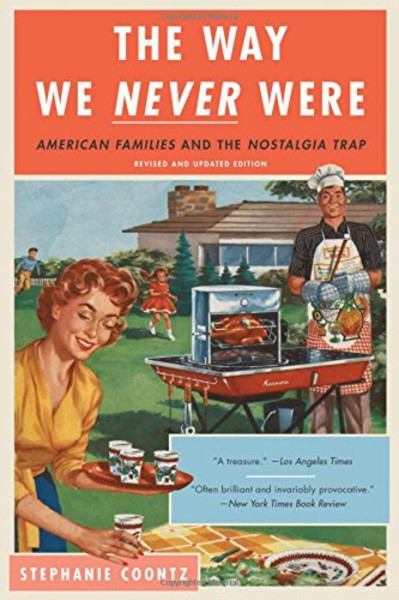
Editor’s note: In 1992—the year the U.S. presidential campaign erupted into a culture war over family values—Stephanie Coontz published The Way We Never Were: American Families and the Nostalgia Trap. The title itself offered the pithy concept, and the book demonstrated that diversity and change have always been hallmarks of American family life: “Leave It to Beaver” was not a documentary. This week (March 29, 2016) Coontz released a substantially revised and updated edition of The Way We Never Were. Below, she provides a brief review of ten things that have changed for the better in the past quarter century, three that have stayed the same, and two that have gotten worse.

In 1992, political leaders and pundits were predicting that changes in family forms and gender roles were leading America into disaster. Were they right? 

  1. Whatever happened to the Super Predators? In the early 1990s criminologists were predicting “a blood bath of violence” unleashed by “tens of thousands of severely morally impoverished juvenile super-predators” – all supposedly a result of rising rates of unwed births. But between 1993 and 2010, sexual assaults and intimate partner violence reported dropped by more than 60 percent. According to the FBI’s Uniform Crime Reporting Statistics, the murder rate in 2013 was lower than at any time since the records began in 1960. Since 1994, juvenile crime rates have plummeted by more than 60 percent, even though the proportion of children born out of wedlock has risen to 40 percent.
  1. How about crack babies? In the 1980s and 1990s, newspapers headlined an epidemic of “crack babies” in the inner city, with kids permanently damaged by their mothers’ use of crack cocaine during pregnancy. This led to a wave of punitive legal actions against such women. But follow-up studies have since revealed that children from the same high-poverty areas who had not been exposed to cocaine in utero were equally likely to have developmental and intellectual delays as babies born with cocaine in their systems. As I documented in The Way We Never Were, the big risk to these children was the pollution, violence, and chronic stress of deeply impoverished and neglected communities – including lead poisoning damage that was going on for years before it hit the headlines in 2016 because of the disaster in Flint.
  1. Did career women start “out-sourcing” their children’s developmental care? As women gained more high prestige jobs in the late 1990s, that’s what many experts feared. In fact, however, even as mothers’ work hours increased, their child-care hours increased too, while fathers’ child-care time tripled. Today, both single and working moms spend more time with their children than married homemaker mothers did back in 1965.

more...

Screenshot courtesy Letta Page

Over at Families as They Really Are, Erin Anderson has posted about men’s lagging uptake of family leave when it is available. Over here, we have prepared a round-up on how men are doing in families by looking back at papers from the Council on Contemporary Families.

An issue related to use (or not) of family leave has to do with the underlying security of jobs: In the CCF June 2013 Symposium on the Equal Pay Act, economist Heidi Shierholz wrote about the erosion of men’s wages in the past few decades. She explains, “In the late 1970s, after a long period of holding fairly steady, the gap in wages between men and women began improving. In 1979, the median hourly wage for women was 62.7 percent of the median hourly wage for men; by 2012, it was 82.8 percent. However, a big chunk of that improvement—more than a quarter of it—happened because of men’s wage losses, rather than women’s wage gains.” Read more here. more...

Tiring? Never! Photo by Harsha K R via Flickr CC.

In a dramatic shift in attitudes from just 40 years ago, most modern couples want to share the duties and rewards of work and family equally. However, this is particularly difficult for new parents in the U.S. in light of limited governmental support and persistent traditional gender norms. The U.S. offers inadequate paid parental leave and few options for cutting hours at work, while the cost of quality infant child care is exceptionally high. Thus parenthood is especially challenging for U.S. couples—the majority of whom are dual-earners who strive to achieve a work/family balance.

We studied 182 different-sex couples who were expecting their first child. Most were professionals who were well-positioned to equally share housework, parenting, and paid work responsibilities due to their high levels of education and the fact that both partners were working full-time. During the last trimester of the woman’s pregnancy and at 9-months postpartum, we had these men and women keep time diaries, recording every activity they engaged in during a 24-hour workday and non-workday. We also surveyed them about their own attitudes and perceptions of their division of labor at the beginning of our study and again when their child was nine months old.

more...

It is time to quit viewing motherhood as incompatible with employment.

In 2013, hedge fund billionaire Paul Tudor Jones set off a controversy when he remarked that “you will never see as many great women investors or traders as men.” In his experience, Jones claimed, a woman did fine until she had a child. But “as soon as that baby’s lips touched that girl’s (sic) bosom, forget it….”

By virtually every measure, we are closer to gender equality today than we were fifty years ago—with one very big exception. As Joya Misra notes, the majority of the gender gap in wages is now the result of the lower earnings of mothers. This once led Denise Venable of the National Center for Policy Analysis to claim: “When women behave as men do [by not having children], the wage gap between them is small.” But mothers not only earn less than childless women. They earn less than fathers. When women “behave as men do” and have children, the wage gap between fathers and mothers remains large. more...

When I think back on the Feminine Mystique, I am reminded of my favorite childhood television show, “Bewitched,” which featured a beleaguered housewife and witch, Samantha Stevens. As partner in her husband Darrin’s “two-person career,” holding a job of her own was out of the question. She was on call to whip up fabulous meals for Darrin’s boss and his clients at a moment’s notice – yet she wasn’t even supposed to use her superpowers to add a tasty dessert. She spent her days cooking, cleaning and helping her husband’s career, all the while proudly avoiding magical shortcuts. She had the requisite two children, but they mostly sat in the background, being supervised by a witchy relative or their babysitter, Esmeralda. more...

National surveys and other studies continuously tell us that work is a major source of stress for Americans. A 2005 Work and Families Institute study found that almost 90 percent of workers felt they either never had enough time in the day to do their job or that their job required them to work very hard. A Pew Report from 2013 found that more than half of all working moms and working dads experience work-family conflict. One-third of working moms and dads feel rushed on work-days, and almost 50 percent of working dads (and 25 percent of working moms) say they don’t have enough time with their children. And in a recently completed research project I helped conduct, we found that people report feeling less stressed out on non-work days than on work-days. Home, most of us believe, is where we recover from the stress of the work day. more...