
environment

A brown hand holds a pipe with a clear liquid flowing from it.
Photo by CIAT, Flickr CC

Research on “environmental racism” discusses how non-white communities more frequently reside in areas that are environmentally unclean, polluted, or hazardous — often a direct consequence of other racial inequalities. We at The SocietyPages have written about this phenomenon before, but recent research shows that the consequences of climate change have added new dimensions to these dynamics.

Climate change and shifting weather patterns pose issues at large, but racial minorities are more likely to bear the brunt of adverse effects related to climate change. As existing racial inequalities are often linked to neighborhood and place, climate change threatens those who are already at risk of adverse health outcomes due to discrepancies in income, education, and more. In essence, the impacts of climate change are more likely to be felt among poorer, non-white communities.
Internationally, climate change has greatly impacted farming, fishing, and other economic activities in developing countries. This has particularly affected poorer, disadvantaged communities in non-white countries, that are more at risk for weakening agricultural yields and devastating super-storms linked to climate change. Researchers now use terms like, “environmental migration” or “climate change induced migration,” to capture the ways migration becomes the best adaptive strategy to the changing climate. Unfortunately, the places they move to are sometimes far from welcoming; racism and prejudice often shape their new lives after climate change induced migration.

Climate change thus poses greater challenges for poorer, non-white communities both in the United States and globally. As adverse environmental factors continue, it is important to think about how the intersection of social and natural forces “turns up the heat” on racial inequality.
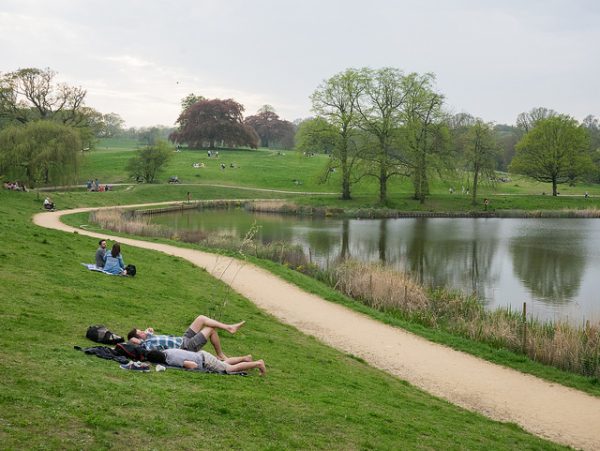
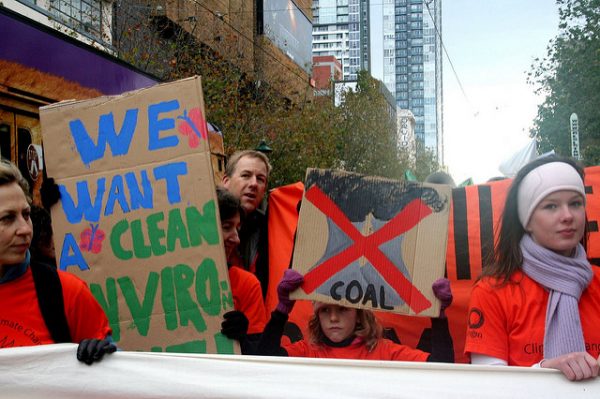
Photo of people laying on grass near a pond. Photo by Taavi Randmaa, Flickr CC

Green areas are widely recognized as an indicator of development and social wellbeing, but the relationship between nature and crimes is only beginning to come into view.  How might natural spaces reduce crime rates?

Economic Development

Green space interventions enhance the visual appearance of an area and motivate movement and participation, which can increase economic development. Also, by raising property values, green spaces foster economic stability and access to credit. Both economic development and real wealth transfer bring work opportunities and financial power to residents, which in turn could reduce criminal activities. One caution about green criminology, however, is that, genuine improvements in built environments may not favor current residents. Instead, existing residents may be displaced by new neighbors arriving in response to attractive urban conditions.

Social Gathering

Green areas can also provide physical or symbolic cues of care and attention that discourage criminal behavior. By promoting the use of outdoor spaces, built environments become places of social gathering. Green areas thus become organized places of surveillance, which discourages incivilities and criminal behavior.  They also replace vacant lots and abandoned sites, which constitute attractive places for illegal activities such as prostitution, drug sales and use, or weapons offenses.

Well-Being

Better amenities can also improve residents’ well-being and thus decrease precursors of violence. Built environments may favor conditions that enhance the pleasantness of pedestrian environments, the convenience of walking for travel or recreation, and environmental safety. Some argue that vegetation promotes better cognitive performance, produces positive emotions and fosters environmental consciousness.

Guardianship

Habitable spaces and better amenities also shape and enhance the relationships and social initiatives from community members. Green areas provide sites for social gatherings, and facilitate social interaction. Cohesive communities mobilize resources to tackle the underlying social causes of crime, or to encourage commerce and employment opportunities. Connected with surveillance, social cohesion makes residents more willing to step in and directly address criminal behavior, thus improving surveillance and oversight. Cohesive communities also foster well-being among residents and generate better health outcomes by social processes like promoting outdoor activities, participating in organizations, and creating networks of support.

Situational Crime Prevention

Green areas can also influence behavioral outcomes by eliminating, blocking or restraining access to crime targets and by removing the target itself.  They can be designed to minimize the number of entry and exit points and control pedestrian or vehicular access. Therefore, their physical design and layout features can alter criminal routines and targets. Green areas offer physical barriers that effectively obstruct opportunities for crime and modify both the attractiveness of targets and the motivation of potential-offenders.

Since investment in green areas can impact more people for longer periods of time than individual or lifestyle interventions, creating green places may provide a greater pay-off than traditional individual approaches to reducing crime. This is especially important for lower income communities, where residents may lack individual economic or social resources to encounter crime individually.  

Photo by Takver, Flickr CC

On Earth Day, we think about the environment and how we can protect it. While we tend to think of “going green” as something that began in the 1970s, the history of U.S. environmental movements stretches much further into the past. Over the course three specific historical periods — Conservationist/Preservations, Ecocentrist, and Political/Deep Ecology — environmental activism has shifted in its issues, from parks to pollution and clean water to climate change.  

The early Conservationism and Preservation movements emerged in the 1860s as reactions to the Industrial Revolution and explosion of cites. The mostly White, male elites argued that nature has a functional value in maintaining human societies. These activists were largely unconcerned with the rights and livelihoods of rural residents and native peoples, and were more focused on their own need for distinction, space, and recreational opportunities. We can thank these early movements for the National Arbor Day Foundation, The Sierra Club, the World Wildlife Organization, and the creation of National Parks.
The Ecocentrist movement began its development at the turn of the 20th century, but remained dormant until Rachel Carson’s publication of Silent Spring in 1962 connected the maintenance of clean, pollution-free ecosystems to public health and human survival. This period’s series of landmark successes includes the establishment of the Environmental Defense Fund in 1967, Earth Day in 1970, the Environmental Protection Agency, the Clean Air Act, Clean Water Act, and the Endangered Species Act.
The later historical period and the Political and Deep Ecology period linked social inequalities and consumerism to environmental degradation. Environmental issues like toxic waste, for example, primarily affect poor and working-class citizens. In contrast to earlier periods of elite-driven environmental activism, the toxic waste movement has been made up of people who experience environmental hazards first-hand.
The most recent period of the U.S. environmental movements has seen less success than previous eras. By the 1980s, environmental issues became more complicated and abstract. Ozone depletion, acid rain, and global warming fell outside the jurisdiction of existing regulatory agencies and were more difficult to see than something like chemicals and garbage in rivers, lakes, and streams. Although many citizens generally support environmental protection, fewer people support government spending on environmental issues, especially since these issues are often invisible. Furthermore, contemporary concerns like climate change require international cooperation because they span geographic boundaries.

Photo by Keoni Cabral, Flickr CC.
Photo by www.liveoncelivewild.com, Flickr CC.

To cut costs, the city of Flint, Michigan moved its residents from the Detroit city water system to water sourced from the Flint River. It was a temporary fix until Flint could access Great Lakes water directly. Now, as the world knows, there’s something in the water: lead. In Flint, more than 40% of residents live below the poverty line, and the high lead levels (10 times higher than originally estimated) have caused skin lesions, hair loss, vision loss, memory loss, depression and anxiety, and Legionnaires’ disease. According to sociologists, it’s no fluke that a disenfranchised community pays the ultimate price for environmental damage.

Nature is a battleground where the privileges of wealth and whiteness prevail. Race and class inequalities perpetuate practices that harm the environment, and the poor, immigrants, and minorities are most likely to live in areas with environmental damage (some 60% of African Americans and Latino/a people live in in places with uncontrolled toxic waste sites). This is largely due to the ways that bureaucracies and the state exercise power over resources in a capitalist economy. Flint, MI is just one of many examples of wealthy governments and corporations exporting hazardous material to poor communities of color.  
Poor communities of color also receive lower government response and assistance in environmental emergencies. From Hurricane Katrina to the Flint water crisis, African Americans tend to lack the economic resources and transportation necessary to evacuate an environmental danger zone, exacerbating its impacts on minority communities.

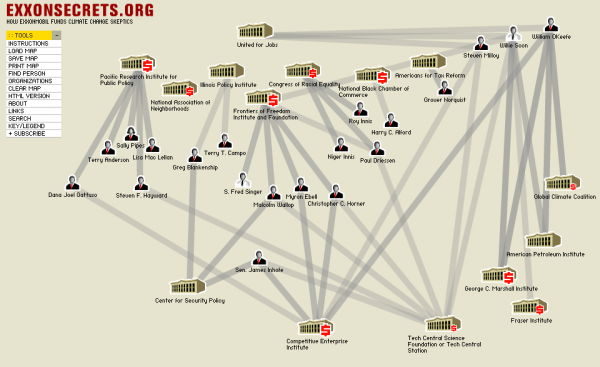
ExxonSecrets.org uses data visualizations to trace the company's influence on legislation and scientific research groups.
ExxonSecrets.org uses data visualizations to trace the company’s influence on legislation and scientific research groups.

New York’s State Attorney has opened an investigation into whether ExxonMobil lied to the public and investors about the risks of climate change and funded outside groups to question climate science, even as the company’s own expert researchers found that fossil fuel emissions do, indeed, contribute to rising temperatures.

The Exxon investigation reflects the broader politicization of climate change and the role of corporations in shaping public perceptions. Surveys have found that the U.S. public is poorly informed about the science of climate change. A climate change countermovement flush with funds from business and conservative organizations works to create skepticism and distort public understanding. These efforts mirror other controversies over science and risk, and past corporate campaigns to create doubt about the harmful impacts of chemicals such as tobacco, DDT, or holes in the ozone layer.
Climate change denial is not simply the result of well funded public relations campaigns, however. It also reflects collective and individual anxieties and the difficulties of coming to terms with abstract and long-term risks. Everyday experiences, cultural norms, political beliefs, and religion shape how people come to terms with problems like climate change.

For more on echo chambers and how climate change denial narratives gain credibility, check out this new piece over at Contexts!

spatz_2011, Flickr CC

Volkswagen’s CEO, Martin Winterkorn, recently stepped down amid a scandal over manipulated emissions tests. Researchers at West Virginia University found that VW diesel models used “defeat devices” that activated emission control systems only when being tested—that’s how they dodged emissions standards set by the Environmental Protection Agency. To what extent is Winterkorn responsible for this corporate skullduggery? And does the use of these devices constitute a “crime”?

Classic theories about corporate scandal stress “amoral calculus,” where individual decision makers of an organization weigh the costs and benefits of their actions. One example is the Ford Pinto debacle, when the company failed to recall Pintos with defective gas tanks because its “internal ‘cost-benefit analysis’” indicated the financial costs of a recall outweighed the potential cost of human lives (Dowie 1977). The media often responds to these corporate scandals by labeling white-collar criminals “bad apples,” shifting the public’s attention to the guilt of individual decision makers while hiding the social context that shapes norms within organizations
Sociologists show risky decision making stems from the “normalization of deviance” within an organization. Conforming to the culture, work group members can redefine deviant actions as normal or commonplace. In the Ford Pinto case, fuel tank ruptures were categorized as acceptable risk due to prevailing safety priorities and long-standing industry norms. In the Challenger Space Shuttle Disaster, escalating levels of technical failure were redefined as normal and acceptable due to increased bureaucratic pressures, NASA’s cultural understandings of risk acceptance, and high levels of organizational secrecy.
Other scholarship suggests that the Volkswagen emission fraud will not be labeled as criminal. Our definitions of what is criminal reflect societal beliefs rather than the “objective” dangers and risks posed to us. As such, we tend to emphasize poor or petty “street crime” while downplaying the acts of elites and corporations, or “white collar crime.” These corporate acts, however, result in serious harm and often parallel (or exceed) the harm caused by “street crime”. Fudging emission performance, however, might be defined as “corporate non-compliance,” rather than a criminal act. Subsequently, some of the costs, both physical and social, of corporate crime can go unnoticed.

California is facing record drought, water restrictions, and threats of wildfires. The solution seems simple—just find more water through increased pumping or desalination—but these quick fixes ignore deeper questions about how we turn public necessities into commodities and determine who can lay claim to natural resources. These issues can lead to cultural conflict, but struggles for water can also renew solidarity across different social groups.

Sociological case studies remind us that professional environmental responsibilities to the land, its residents, owners, and governments change over time and through particular institutional cultures. Power and inequality shape who is exposed to environmental problems and how we address solutions.
Water conflicts also bring up commodification—the way we turn public necessities like water and health into market goods. Research on commodification examines everything from how the water industry actively competes with the tap to how insurance markets change the culture of life and death in the United States.
Water resources—even when scarce—do not inevitably lead to conflict. Environmental concern is not only high in affluent nations; even in places as tense as the Middle East, local activists regularly use the environment to bridge cultural, political, and religious tensions.

Rebecca Farnum is a 2012 EPA Marshall Scholar researching for a PhD in Geography at King’s College London, where she explores environmental conflict and cooperation around food and water resources in the Middle East and North Africa. She has an LLM in International Law on environmental and human rights law, an MSc in Water Security and International Development, and undergraduate degrees in anthropology, interdisciplinary humanities, international development, and international relations.

The Rockefellers, powerful American industrialists with vast wealth built from the oil industry, are now ditching fossil fuels. According to an announcement from the Rockefeller Brother’s Fund, the organization has pledged to withdraw their investments from fossil fuels and instead invest in clean energy. Corporations and institutions respond to pressure when social norms shift and change, especially when it impacts their public image and the bottom line.

Corporations can be pressured to enact socially responsible behaviors through government policy, nonprofits, civil society groups, social movements, and internal culture and leadership.
Yet, this announcement may also represent a corporate public relations and greenwashing campaign that fails to address the underlying causes of climate change. Either way, the direct impact on energy industries may be less important than the symbolic impact of the gesture.