Archive: Jul 2008

The new issue of Annual Review of Political Science is out, the best friend of lit review creators and syllabus constructors everywhere. Here are three articles that I’ll be reading in a nice lavender bubble bath:


1) Hutchings, J. “Results from Experimentation: Racial Priming in Political Campaigns.”

2) McClain, P. “Evolving Racial Identity in American Politics.”

3) Ward, M “Application of Network Analysis to Political Problems.”

Ben Smith at Politico notes today that while Obama only has a slight lead in the polls, he has a commanding lead in the betting markets. On Intrade, Obama leads McCain by 66.7 % to 29%. What to make of this discrepancy? The betting markets seem to be putting little stock into the so called “Bradley effect.” If you went out and polled most race scholars, you’d probably get a more skeptical assessment of Obama’s chances of winning.

I’m pretty torn in my own view. All of the conventional metrics suggest a Democratic blowout in November (poor economy, better candidate, two Republican terms, superior energy and organization on the Obama side). But the other part of me thinks the betting markets are getting it wrong vis-a-vis Obama’s chances.

Case in point, a new Gallup Poll finds significant differences on issues of racism and discrimination towards minorities. Whites (63% of them) are satisfied with how Blacks are treated, while only 35% of Blacks share the same optimism. I think this explains, in part, Obama’s under-performance in the latest polling (he leads by about 4% on average). The lingering effects of “Wrightgate” has left a hint of black grievance in the minds of those who are inclined to think that social policy is unfairly skewed away from white people.

This suggests to me that any whiff of black grievance that sticks to the Obama campaign in this election is going to drive poll numbers down. I think we will be innundated with a “black grievance frame” come September. I can almost hear Sean Hannity claiming that Obama is a surrogate for Al Sharpton and wants to make “slave reparations” his first act in office, or maybe it’s making Kwanzaa a federal holiday.

I still think the conditions favor him, but there is a race effect. The question is whether that effect is large enough to change the outcome.

I’ve been wondering when this year’s JibJab video was coming. Wait no more!

Send a JibJab Sendables® eCard Today!

Not as many laugh out loud moments as the great 2004 Kerry-Bush video sung to This Land is my Land. This one is sung to The Times they are a Changing. I particularly like Obama on what looks like a Unicorn and Mccain as a George C. Scott in Patton crossed with Brando in Apocalypse Now. I don’t love the bit of moralizing about campaign spending at the end. Downer!

Good stuff!

Anybody who criticizes Obama for tacking swiftly to the center needs a reality check. We are in the framing stage of the campaign. Obama is keenly aware that he hasn’t yet been put into a box by the public. If he’s not incredibly proactive about his “Americanness” then he’s in for a world of trouble. Check out this video of West Virginia voters before the Democratic primary.

We can cast this off as a distinctly Appalachian problem, but that’s sticking out heads in the sand. Obama is fighting what Robert Putnam calls hunkering. Putnam finds that when confronted with diversity, people generally revert by withdrawing. This is still a majority white country and Obama’s people are well aware that if he can’t lower the hunkering instinct among a large segment of undecided whites, he’s got an uphill climb.

Case in point is Noam Scheber post on Bill Carter’s New York Times Article how comedians are finding it difficult to make fun of Obama. Carter notes that absence of a “comedic take” on him. Carter eventually taps into the core of the problem. He speculates that it’s largely due to sensitivity about making fun of race. Scheiber astutely points out that this should be a major concern for Obama. Here is the money quote:

the problem for Obama is that people tend to vote for a presidential candidate they feel personally comfortable with. If people aren’t comfortable with humor about Obama–if they’re reluctant to laugh at him for fear of being thought racist, or of crossing some line of political correctness–then some of them probably aren’t comfortable with him, period.

Hunkering people….this is not your grandfather’s presidential nominee.

I might have serious issues with the cover, but Ryan Lizza’s piece in the New Yorker is quite good. I do have one issue with the story. Lizza seems to weave of theme throughout his piece of Obama as a calculating, sometimes cocky, ambitious pol. I don’t get why this is news to anyone. Were we of the mistaken impression that the kitten from the “hang in there” poster was running as the Democratic nominee. What I personally like about Obama is that his penchant for cultural frame switching. Here’s a passage that best charachterizes Obama’s principal strength as I see it:

Chicago is still a city of villages, and Obama was adept at gliding back and forth between the South Side, where he campaigned for votes, and the wealthy Gold Coast, the lakefront neighborhood of high-rise condominiums and deluxe shopping, where he raised money.

This adaptability, I think, makes for a better overall learner. I’d like in a leader of the free world the ability to process vast amounts of information and adapt to changing circumstances. I don’t know if anyone’s ever tested this, but persons of a multicultural background, might have an edge in this regard because they are less bound to one set of cultural stereotypes. Their borderland status might encourage an affinity for and desire to connect with more than oune cultural group. Here’s Lizza discussing his early efforts to connect with Black audiences.

Obama, who hadn’t shown any particular gift for oratory in the race, now learned to shed his stiff approach to campaigning—described by Preckwinkle as that of an “arrogant academic.” Mikva told me, “The first time I heard him talk to a black church, he was very professorial, more so even than he was in the white community. There was no joking, no self-deprecation, no style. It didn’t go over well at all.”

Personally, I think this is what excites many of the latte-sippers, of which I county myself proudly. We might be poised to elect our first multicultural president. it will test a lot of views that people have about the benefits of being cross-cultural in terms of policy outcomes. Time will tell.

Obama is certainly experiencing the crucible of presidential electoral politics. On one hand the venerated Jesse Jackson wants to perform a no-cost castration. On the other, the netroots are in a “cyber-tizzy” over Obama’s singing of the FISA bill. Now he has to shake the mainstream media’s gleeful exploitation of the “Muslim/ Black-radical meme.” This New Yorker cover from Ben Smith’s Politico blog highlights how the MSM can use the flimsy justification that the public’s belief in “the Muslim thing” is an interesting cultural pheonomenon and thus worthy of treatment.

Of course, if you’re going to talk about it, you need a controversial cover because, well, you have to sell magazines. It’s a sleazy turn in the coverage of presidential politics. The New Yorker has decided to racialize the Obama’s because a small sliver of the U.S. population thinks he’s a Muslim. They’ve given the darker forces of our culture a new laptop screen background.

So the web is supposed to be this great collaborative space. But in reality, there are a whole lot of blogs that exist on “cyberislands.” How we make sense of this vast archiapelago of disparate blogs? While Google Analytics provides some useful tools, the Happy Flu project allows you to visually see the creation of networks on the web. The project asks participants to post an evolving HTML code on your URL which will then place you as a node on the network, as seen here.


This is an interesting way to visually track your cybernetwork.

The resource we are offering you to spread is unique : the Happy Flu visualizer tracks its own diffusion. This means that when you post it on your own blog or website, in a couple of minutes you will appear on the applet. You will be linked to the place you first saw the resource and, even better, everyone spreading the resource from your page will be linked to you. This involves a lot of happy magic. We think it could be fun to build the biggest possible diffusion tree, don’t you?

I got this link from the Complexity and Social Networks blog. A great blog BTW for keeping up with the latest on network analysis, particularly in Political Science….Help me keep the cyber chain letter going 🙂

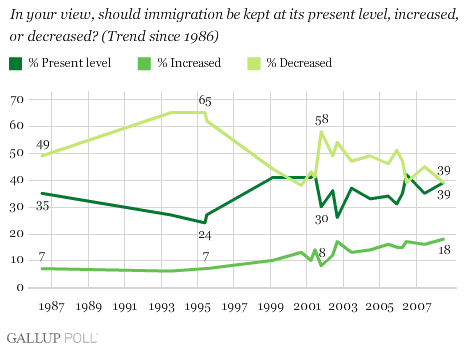
I’m not sure what to make of this latest finding from Gallup that finds fewer Americans support reducing immigration than they did at the same point in time last year. According to the survey. The percentage of respondents who supported a decline in immigration rates was equal to the percentage that believed is should stay at the present rate.

What’s puzzling about this finding is that the conventional wisdom is that anti-immigrant sentiment is typically more pronounced during periods of economic decline and less virulent during times of economic prosperity. Indeed, if you look at the chart below, you find that support for reducing immigration rates increased during the early part of the 1990’s when the economy was in recession and decreased with the economic upturn of the late 1990’s.

Why has support for reducing immigration declined during a period of economic decline? Gallup says:

One reason anti-immigration opinion has diminished somewhat may be that immigration has receded as an issue this year as Americans have focused on the struggling economy and record-high gas prices.

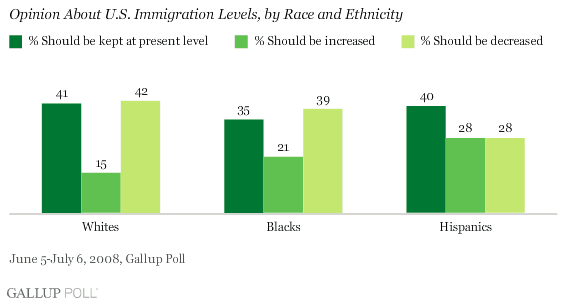
But that’s not consistent with past history. It could be that the demographic increase in Latinos in the U.S. would drive support for immigration. But these attitudes change only slightly when the data is broken down by racial and ethnic group.

Are we coming to some sort of sophisticated understanding of the effects of globalization? Are we experience a backlash to the backlash of anti-immigration sentiment post 9-11? A recalibrating of our attitudes towards the rest of the world?

Edge.org has a wonderful symposium on reactions to Chris Anderson’s Wired article on The End of Theory.. What strikes me from reading the symposium is the lack of regard for inductive methodologies as “science.” The presumption is that, what Richard Fenno called, soaking and poking, is something new in the world of science. Traditionally in my discipline, it has always been thought of as a prelude to the real work of hypothesis testing.

What strikes me as fascinating is the ability of “computing in the cloud” to hyper-soak and poke. Kevin Kelly uses some interesting examples from Google about this potential.

It may turn out that tremendously large volumes of data are sufficient to skip the theory part in order to make a predicted observation. Google was one of the first to notice this. For instance, take Google’s spell checker. When you misspell a word when googling, Google suggests the proper spelling. How does it know this? How does it predict the correctly spelled word? It is not because it has a theory of good spelling, or has mastered spelling rules. In fact Google knows nothing about spelling rules at all.

Instead Google operates a very large dataset of observations which show that for any given spelling of a word, x number of people say “yes” when asked if they meant to spell word “y. ” Google’s spelling engine consists entirely of these datapoints, rather than any notion of what correct English spelling is. That is why the same system can correct spelling in any language.

In fact, Google uses the same philosophy of learning via massive data for their translation programs. They can translate from English to French, or German to Chinese by matching up huge datasets of humanly translated material. For instance, Google trained their French/English translation engine by feeding it Canadian documents which are often released in both English and French versions. The Googlers have no theory of language, especially of French, no AI translator. Instead they have zillions of datapoints which in aggregate link “this to that” from one language to another.

Once you have such a translation system tweaked, it can translate from any language to another. And the translation is pretty good. Not expert level, but enough to give you the gist. You can take a Chinese web page and at least get a sense of what it means in English. Yet, as Peter Norvig, head of research at Google, once boasted to me, “Not one person who worked on the Chinese translator spoke Chinese. ” There was no theory of Chinese, no understanding. Just data. (If anyone ever wanted a disproof of Searle’s riddle of the Chinese Room, here it is. )

This is no doubt true when it comes to Social Science where we are notoriously dreadful at prediction. It is not so true for meaning making, science’s other core purpose. Here’s Bruce Sterling’s amusing rejoinder to Kelly’s observations which seem to correctly mock the view that theory will become obsolete.

Surely there are other low-hanging fruit that petabytes could fruitfully harvest before aspiring to the remote, frail, towering limbs of science. (Another metaphor—I’m rolling here. )

For instance: political ideology. Everyone knows that ideology is closely akin to advertising. So why don’t we have zillionics establish our political beliefs, based on some large-scale, statistically verifiable associations with other phenomena, like, say, our skin color or the place of our birth?

The practice of law. Why argue cases logically, attempting to determine the facts, guilt or innocence? Just drop the entire legal load of all known casework into the petabyte hopper, and let algorithms sift out the results of the trial. Then we can “hang all the lawyers, ” as Shakespeare said. (Not a metaphor. )

Love and marriage. I can’t understand why people still insist on marrying childhood playmates when a swift petabyte search of billions of potential mates worldwide is demonstrably cheaper and more effective.

Investment. Quanting the stock market has got to be job one for petabyte tech. No human being knows how the market moves—it’s all “triple witching hour, ” it’s mere, low, dirty superstition. Yet surely petabyte owners can mechanically out-guess the (only apparent) chaos of the markets, becoming ultra-super-moguls. Then they simply buy all of science and do whatever they like with it. The skeptics won’t be laughing then.

Chris Anderson has an interesting, if not strange, article in WIRED where he makes the claim that we are arriving at the “end of theory.” He make makes the case that massive amounts of data (what he calls the Perabyte era) make the scientific method obsolete. The large volumes of data collection and analysis that lightning fast processing speed and massive storage capacity of modern computing allows, makes pattern matching a much more viable approach to knowledge creating than hypothesis testing.

There is now a better way. Petabytes allow us to say: “Correlation is enough.” We can stop looking for models. We can analyze the data without hypotheses about what it might show. We can throw the numbers into the biggest computing clusters the world has ever seen and let statistical algorithms find patterns where science cannot.

While the poor guy is getting shellacked on the comment boards, he’s on to something. He probably overstates his case for the natural sciences, but his argument is more telling for the social sciences. If theory, even universal theory, about human behavior is time bound and context dependent, and society is innovating and changing at an exponentially rapid pace, then what good is universal theory?

Bent Flyvbjerg’s wonderful book Making Social Science Matter makes a related but different argument about the shortcomings of applying scientific principles to social science. he argues for an emphasis in social science on phronesis, or knowledge on the “art of living,” rather than episteme, or knowledge for its own sake. Here’s a telling passage from an essay derived in part from his book.

Regradless of how much we let mathematical and staistical modeling dominate the social sciences, they are unlikely to become scientific in the natural sciences sense. This is so because the phenomena modelled are social, and thus “answer back” in ways natural phenomena do not.

This is the guiding principle behind my own thinking about race scholarship. it is much more instructive for use to be guiding our scholarship towards knowledge that enhances the art of living in a multicultural democracy over the quixotic search for some universal law of race relations.