sexual orientation: violence

1Recently Nadya Tolokonnikova was interviewed by NPR about Pussy Riot’s latest video. In it, Tolokonnikova explores themes of racism, xenophobia, and misogyny and its influence on governance through a graphic and violent imagined America under a Trump presidency. Trigger warning for… most things:

Tolokonnikova is making a statement about American politics, but she is clearly informed by Putin’s performance of masculinity and how that has translated into policy measures and electoral success. When he took office in early 2000, Putin needed to legitimize his power and counteract the global impression of Russian weakness after the collapse of the Soviet Union.

The projection of masculinity was a PR strategy: fishing and riding a horse shirtless, shooting a Siberian tiger, and emerging from the Black Sea in full scuba gear. These actions combined with bellicose foreign policy initiatives to portray Putin as assertive and unrelenting.

In the book, Sex, Politics, & Putin, Valerie Sperling makes a case that his strategy was successful. She investigates the political culture under Putin and argues there is popular support for Putin’s version of masculinity and its implications for femininity, even among young women. As a consequence, the gender and sexual politics of Russia have deviated from those of wider Europe, as indicated by the rise of the Russian slur “gayropa.”

The machismo and misogyny embodied by Putin have also translated into policy: the “gay propaganda” law, for example, and the ban on international adoption to gay couples. In his 2013 address to the Federal Assembly, Putin framed these policies as necessary to combat the “destruction of traditional values.”

While there is no systematic research on the role of masculinity in Trump’s rise to the national political stage in the US just yet, and while the nature of the link between Putin and Trump remains unclear (if one truly even exists), we should consider Putin’s Russia a cautionary tale. His performances of masculinity – his so-called “locker room talk,” discussion of genitalia size, and conduct towards pageant contestants — could go from publicity stunt to public support to actual policy measures. His bombastic language about defeating ISIS and the need for more American “strength” at home and abroad, for example, could easily translate into foreign policy.

Coverage of Trump during this election cycle is credited for hundreds of millions in profits for news agencies and Trump himself has enjoyed an unprecedented level of coverage. While Trump has benefited from far more airtime than Putin did in 2000, he has not been able to find the same level of popular support. At least not yet. When Putin rose to status as a national figure in Russia his approval rating was approximately 60%, and it grew from there to levels most American politicians only dream of. If Trump is willing and able to adopt other components of Putin’s leadership style, there is precedent for the possibility that his presidency could truly turn American back.
Alisha Kirchoff is a sociology PhD student at Indiana University-Bloomington. She has previously lived and worked in Russia and is currently working on research in political sociology, law and society, organizations, and gender. Her latest project is on fertility intentions and family policies in Putin’s Russia. You can follow her on twitter.

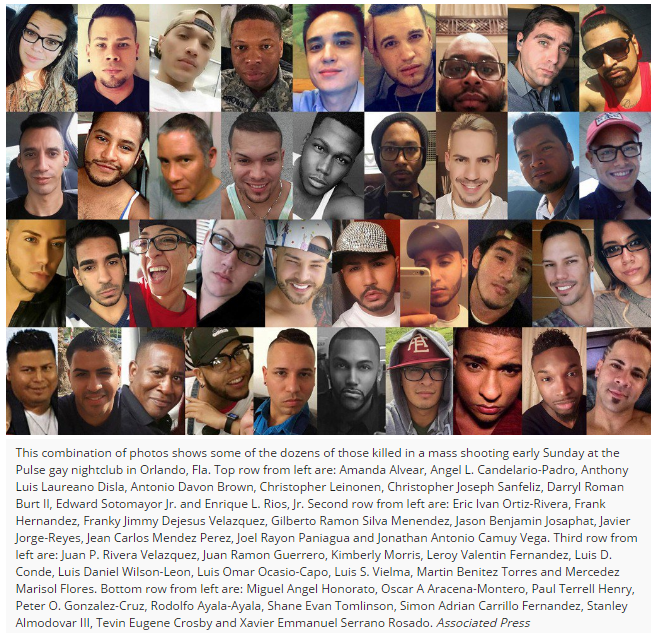
1It was “Latino night” at a gay club. When the story finally broke, that’s all I heard. Orlando’s tragedy at the Pulse puts Latina/o, Latin American, Afro-Latinos, and Puerto Ricans and other Caribbean LGBT people front and center. Otherness mounts Otherness, even in the Whitewashing of the ethno-racial background of those killed by the media, and the seemingly compassionate expressions of love by religious folk. The excess of difference—to be Black or Brown (or to be both) and to be gay, lesbian, bisexual, or transgender (or queer, as some of us see ourselves) serves to shock, through difference, how news are reported. Difference – the very basis of feminist and ethnic politics in the 20th century – has been co-opted and ignored, sanitized even, to attempt to reach a level of a so-called “humanity” that is not accomplishable. We know this, but we don’t talk about it.

4

.

Don’t get me wrong: empathy is essential for most social codes of order to functionally sustain any given society. To pay one’s respects for others’ losses, however, does not mean that we think of those lost as equals. Liberal people demanding that sexuality be less important in the news (and thus removed from the coverage) is an inherent violence toward those who partied together because there was real love among them, in that club, for who they were – and are. Religious righters may spread hate while trying to give the illusion of compassion, but they do so in a clear hierarchical, paternalistic way – that is hypocrisy, and we must call it out every chance we get. But this goes beyond liberal notions and conservative hypocrisy – even while Anderson Cooper wept when reading the list of those killed, he knows the distance between himself and many of those at the club is enough to build a classed, raced, and social wall between them. Clearly, empathy is not enough.

To be Latina/o in the US – increasingly another Latin American country, again – is to breathe in hate, to face retaliation, to be questioned at every turn about our allegiances, tested on our sense of citizenship, pushed in our capacity to love the nation and thus hate “like the rest” (a testament to the masculinity of the nation). At a minimum, to be Latina/o guarantees one to be looked at oddly, as if one was out of place, misplaced, inappropriately placed. Simply by being, Latinas/os rupture the logics of normalcy in USAmerica. To be Latina/o and LGBT is to disrupt the logics of racial formation, of racial purity, of the Black and White binary still ruling this country – all while de-gendering and performing an excess (of not only gender, but sexuality) that overflows and overwhelms “America.” In being Latino and queer, some of us aim to be misfits that disrupt a normalcy of regulatory ways of being.

A break between queer and América erupted this past weekend – in Orlando, a city filled with many Latin Americans; a city that, like many others, depends on the backs of Brown folk to get the work done. Put another way, Orlando’s tragedy created a bridge between different countries and newer readings of queerness – Orlando as in an extension of Latin América here. Queer-Orlando-América is an extension of so many Latin American cities as sites of contention, where to be LGBT is both celebrated and chastised – no more, or less, than homophobia in the US.

Enough has been said about how the Pulse is a place where people of color who desired others like themselves, or are trans, go to dance their fears away, and dream on hope for a better day. Too little has been said about the structural conditions faced by these Puerto Ricans, these immigrants, these mixed raced queer folks – some of whom were vacationing, many of whom lived in Florida. Many were struggling for a better (financial, social, political – all of the above) life. Assumptions have also been made about their good fortune as well. Do not assume that they left their countries seeking freedom – for many who might have experienced homophobia back home, still do here; though they have added racism to their everyday lived experience. Of course, there are contradictions on that side of queer-Orlando-América, too; yet same sex marriage was achieved in half a dozen countries before the US granted it a year ago. This is the world upside down, you say, since these advances – this progress – should have happened in the US first.Wake up. América is in you and you are no longer “America” but América.

You see, this is how we become queer-Orlando-América: we make it a verb, an action. It emerges where the tongues twist, where code switching (in Spanish/English/Spanglish) is like a saché-ing on the dance floor, where gender and race are blurry and yet so clear, where Whiteness isn’t front and center – in fact it becomes awkward in this sea of racial, gendered, and sexual differences. This queer-Orlando-América (a place neither “here,” nor “there,” where belonging is something you carry with you, in you, and may activate on some dance floor given the right people, even strangers, and real love – especially from strangers) was triggered – was released – by violence. But not a new violence, certainly not a Muslim-led violence. Violence accumulated over violence – historically, ethnically, specific to transgender people, to Brown people, to effeminate male-bodied people, to the power of femininity in male and female bodies, to immigrants, to the colonized who speak up, to the Spanglish that ruptures “appropriateness,” to the language of the border. And in spite of this, queer-Orlando-América has erupted. It is not going down to the bottom of the earth. You see us. It was, after all, “Latino night” at a gay club. You can no longer ignore us.

As the week advanced, and fathers’ day passed us by, I have already noticed the reordering of the news, a staged dismissal so common in media outlets. Those queer and Brown must continue to raise this as an issue, to not let the comfort of your organized, White hetero-lives go back to normal. You never left that comfort, you just thought about “those” killed.  But it was “Latino night” at a gay club. I do not have that luxury. I carry its weight with me. Now the lives of those who are queer and Latina/o have changed – fueled with surveillance and concerns, never taking a temporary safe space for granted. Queer-Orlando-América is thus a “here and now” that has changed the contours of what “queer” and “America” were and are. Queer has now become less White – in your imaginary (we were always here). América now has an accent (it always had it – you just failed to notice).  Violence in Orlando did this. It broke your understanding of a norm and showed you there is much more than the straight and narrow, or the Black and White “America” that is segmented into neatly organized compartments. In that, Orlando queers much more than those LGBT Latinas/os at the club. Orlando is the rupture that bridges a queer Brown United States with a Latin America that was always already “inside” the US – one that never left, one which was invaded and conquered. Think Aztlán. Think Borinquen. Think The Mission in San Francisco. Or Jackson Heights, in NYC. Or the DC metro area’s Latino neighborhoods. That is not going away. It is multiplying.

I may be a queer Latino man at home, at the University, at the store, and at the club. That does not mean that the layered account of my life gets acknowledged (nor celebrated) in many of those sites – in fact, it gets fractured in the service of others’ understandings of difference (be it “diversity,” “multiculturalism” or “inclusion”). But it sure comes together on the dance floor at a club with a boom-boom that caters to every fiber of my being. It is encompassing. It covers us. It is relational. It moves us – together. So, even if I only go out once a year, I refuse to be afraid to go out and celebrate life. Too many before me have danced and danced and danced (including those who danced to the afterlife because of AIDS, hatred, and homophobia), and I will celebrate them dancing – one night at a time.

We are not going away – in fact, a type of queer-Orlando-América is coming near you, if it hasn’t arrived already, if it wasn’t there already—before you claimed that space. No words of empathy will be enough to negotiate your hypocrisy, to whitewash our heritage, or make me, and us, go away. If anything, this sort of tragedy ignites community, it forces us to have conversations long overdue, it serves as a mirror showing how little we really have in common with each other in “America” – and the only way to make that OK is to be OK with the discomfort difference makes you experience, instead of erasing it.

We must never forget that it was “Latino night” at a gay club. That is how I will remember it.

Salvador Vidal-Ortiz, PhD, is associate professor of sociology at American University; he also teaches for their Women’s, Gender, and Sexuality Studies program. He coedited The Sexuality of Migration: Border Crossings and Mexican Immigrant Men and Queer Brown Voices: Personal Narratives of Latina/o LGBT Activism. He wrote this post, originally, for Feminist Reflections.

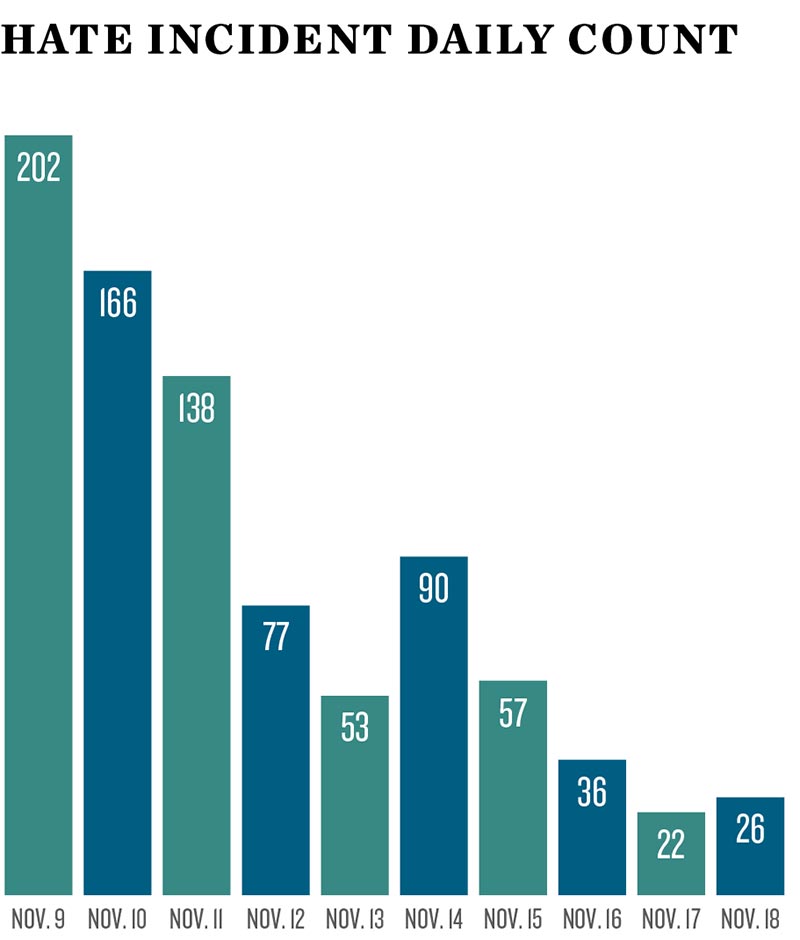
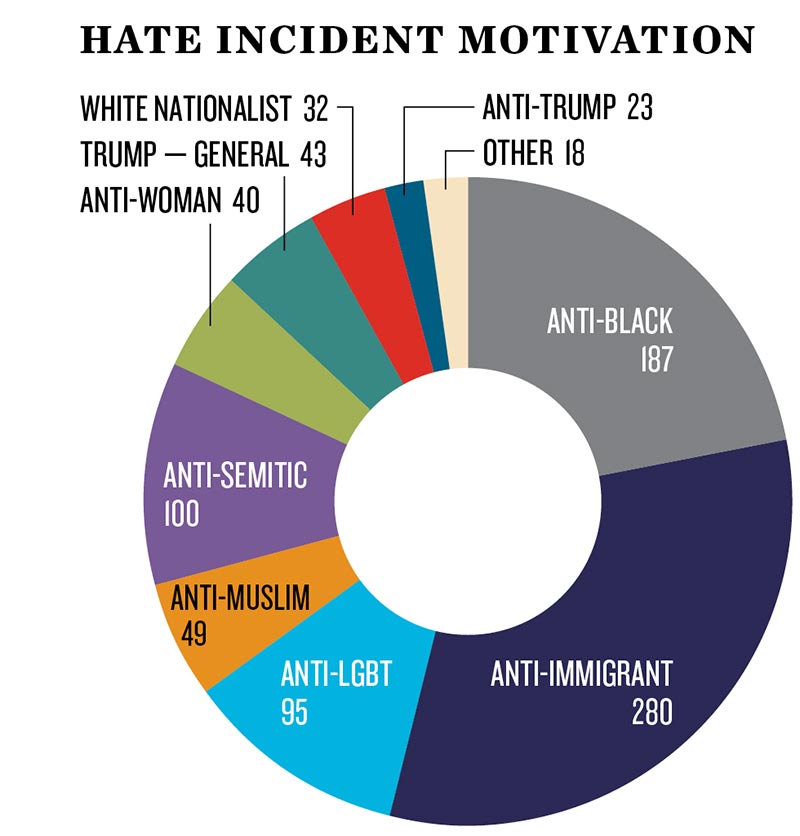
According to the Southern Poverty Law Center, the US saw a spike of hate incidents after the election of Donald Trump on November 8th. 867 real-world (i.e., not internet-based) incidents were reported to the Center or covered in the media in just 10 days. USA Today reports that the the Council on American-Islamic relations also saw an uptick in reports and that the sudden rise is greater than even what the country saw after the 9/11 attacks. This is, then, likely just a slice of what is happening.

The Center doesn’t present data for the days coming up to the election, but offers the following visual as an illustration of what happened the ten days after the 8th.

2

If the numbers of reports prior to the 8th were, in fact, significantly lower than these, than there was either a rise in incidents after Trump’s victory and Clinton’s loss, or an increase in the tendency to report incidents. Most perpetrators of these attacks targeted African Americans and perceived immigrants.

8

The most common place for these incidents to occur, after sidewalks and streets, was K-12 schools. Rosalind Wiseman, anti-bullying editor and author of Queen Bees and Wannabes, and sociologist CJ Pascoe, author of Dude, You’re a Fag, both argue that incidents at schools often reflect adult choices. Poor role models — adults themselves who bully or who fail to stand up for the bullied — make it hard for young people to have the moral insight and strength to do the right thing themselves.

Lisa Wade, PhD is an Associate Professor at Tulane University. She is the author of American Hookup, a book about college sexual culture; a textbook about gender; and a forthcoming introductory text: Terrible Magnificent Sociology. You can follow her on Twitter and Instagram.