Yesterday a federal circuit appeals court upheld an earlier ruling by a lower court that Prop 8, the law banning same-sex marriage in California, was unconstitutional (the law was passed as a ballot measure in 2008). According to the court’s ruling, Prop 8 “serves no purpose, and has no effect, other than to lessen the status and human dignity of gays and lesbians in California, and to officially reclassify their relationships and families as inferior to those of opposite-sex couples.” You can read the full ruling here.

The ruling did not address whether any ban on same-sex marriage was inherently unconstitutional; instead, it focused on the fact that same-sex marriage had been (at least briefly) legal in California, and Prop 8 was designed to specifically take away a recognized status that was in existence at the time it passed.

After the ruling, Talking Points Memo posted a map showing the current legal status of same-sex marriage throughout the U.S.:

Does anyone know what’s going on with New Mexico?

UPDATE: Reader Anonymous Bosch explains, “Gay marriage is de facto illegal in New Mexico, since licenses won’t be granted to gay couples. There hasn’t been enough legislative support for either bans or civil unions…”

Last week, as most of you no doubt heard, the Susan B. Komen for the Cure breast cancer awareness group announced it would no longer fund breast cancer screenings at Planned Parenthood, saying it had a policy against funding organizations that were under investigation (Planned Parenthood is currently under what many see as a politically-motivated investigation about whether it used any federal funds to pay for abortions). The decision drew a lot of attention and criticism of Komen — not just of the decision about Planned Parenthood, but of its role in the breast cancer awareness/research community more generally.

The Komen Foundation is known to many primarily because it’s often listed as a recipient of the funds companies promise to donate when we buy products branded with a pink ribbon. But many critics express concern with this type of marketing-as-awareness, and discussions of the “pinkification” of breast cancer and criticism of the policies supported by groups such as Komen surfaced as part of the debate about the organization over the weekend (which is ongoing, with the VP for Public Policy at Komen announcing her resignation today).

Given this, Dmitriy T.M. thought readers might be interested in the trailer for the documentary Pink Ribbons, which looks at the rise of pink ribbon branding and its impact on breast cancer prevention efforts. I post it with the caveat that I haven’t been able to see the whole film, but would love to hear from those of you who have, or who can speak to the issues it raises:
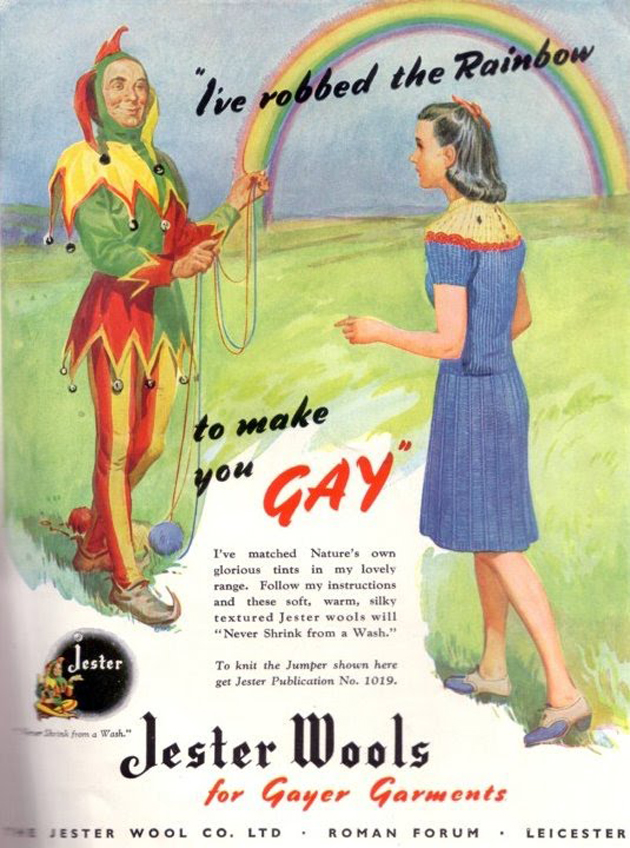
Feast your eyes on this:

Social change makes life interesting.

Lisa Wade, PhD is an Associate Professor at Tulane University. She is the author of American Hookup, a book about college sexual culture; a textbook about gender; and a forthcoming introductory text: Terrible Magnificent Sociology. You can follow her on Twitter and Instagram.

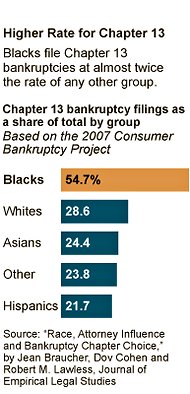
The New York Times recently reported the results of a study of racial disparities in bankruptcy filings. When filing personal bankruptcy, most people have two options: Chapter 7 and Chapter 13. With Chapter 7, you have to turn over all non-exempt assets, which will be used to pay off as much of your debts as possible; you’re then free from any further obligation regarding the debts included in the case. Under Chapter 13, on the other hand, you have to continue to try to pay your debts for 3-5 years. There are reasons a person might sometimes prefer Chapter 13 (especially if they have particularly valuable assets they do not want to turn over), but generally it’s more expensive to file for and, obviously, provides less financial relief from debts. According to Braucher et al. (2012), the authors of the study, overall about 30% of personal bankruptcies are filed under Chapter 13.

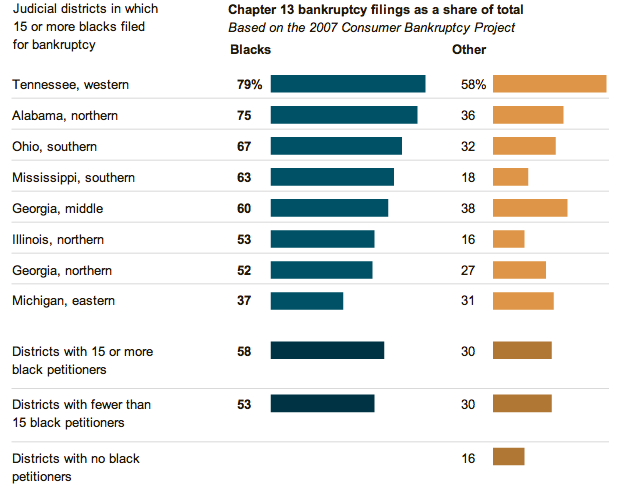
But in their study, Braucher et al. found that African Americans were significantly more likely to file for Chapter 13, and more likely than they would expect when controlling for things that might make Chapter 13 more attractive. As this NYT chart shows, over half of African Americans file under Chapter 13, compared to just over a quarter for Whites and even less for other groups:

Rates of Chapter 13 filings vary quite a bit across different judicial districts, but African Americans consistently filed Chapter 13 at a higher rate than other groups, regardless of what the overall rate was:

Braucher et al. suggest that attorneys play a key role here. They sent surveys to 596 randomly-selected attorneys who represent individuals filing for bankruptcy, providing information about a married couple considering bankruptcy; 262 of the attorneys responded. When the potential filers gave the names Reggie and Latisha, attorneys were more likely to recommend Chapter 13 than when they gave the names Todd and Allison, suggesting that attorneys may play a role in tracking clients toward different bankruptcy options based on race.

The result is that African Americans are, overall, more likely to use the version of personal bankruptcy that costs them more and requires them to continue struggling to pay their debts for several more years, reducing the immediate relief most people assume bankruptcy provides.

Source: Braucher, Jean, Dov Cohen, and Robert Lawless. 2012. Race, Attorney Influence, and Bankruptcy Chapter Choice. Forthcoming in the Journal of Empirical Legal Studies. Available free online here.

Gwen Sharp is an associate professor of sociology at Nevada State College. You can follow her on Twitter at @gwensharpnv.

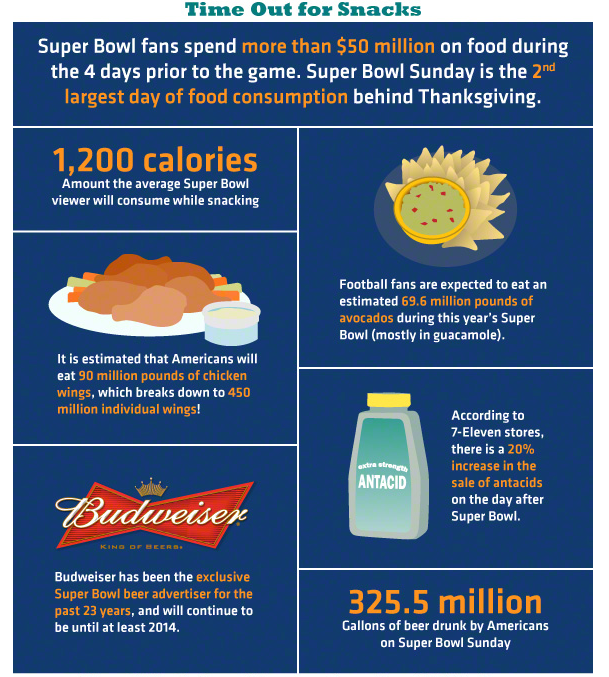
Dolores R. sent in an infographic with various statistics regarding the superbowl.  I thought this bit about food and drink consumption was especially great:

Lisa Wade, PhD is an Associate Professor at Tulane University. She is the author of American Hookup, a book about college sexual culture; a textbook about gender; and a forthcoming introductory text: Terrible Magnificent Sociology. You can follow her on Twitter and Instagram.

Feminists have done a powerful job of making the sexual assault of women by men a public issue.  Male victims, though, have remained largely invisible. In fact, one in ten victims of sexual assault is male.  Most of these men are raped by other men.

The Rape, Abuse, and Incest National Network is attempting to raise awareness of this issue.  As part of their campaign, they are sponsoring this really interesting two-minute video made by my colleague, Dr. Broderick Fox, professor of Art History and Visual Arts at Occidental College:

UPDATE: In the comment thread, Umlud posted a provocative paragraph from an article by Christopher Glazek at N+1 that I thought was worth including:

In January, prodded in part by outrage over a series of articles in the New York Review of Books, the Justice Department finally released an estimate of the prevalence of sexual abuse in penitentiaries. The reliance on filed complaints appeared to understate the problem. For 2008, for example, the government had previously tallied 935 confirmed instances of sexual abuse. After asking around, and performing some calculations, the Justice Department came up with a new number: 216,000. That’s 216,000 victims, not instances. These victims are often assaulted multiple times over the course of the year. The Justice Department now seems to be saying that prison rape accounted for the majority of all rapes committed in the US in 2008, likely making the United States the first country in the history of the world to count more rapes for men than for women.

Lisa Wade, PhD is an Associate Professor at Tulane University. She is the author of American Hookup, a book about college sexual culture; a textbook about gender; and a forthcoming introductory text: Terrible Magnificent Sociology. You can follow her on Twitter and Instagram.

In the 3 1/2 minute video below, CGP Gray explains the nonsense behind the word “continent.”  It’s a cultural construct, with some geological rationale, but not enough to rationalize the seven that we recognize.

Also from CGP Gray: What the Bleep is the United Kingdom?! and The Economics of Royalty.

Lisa Wade, PhD is an Associate Professor at Tulane University. She is the author of American Hookup, a book about college sexual culture; a textbook about gender; and a forthcoming introductory text: Terrible Magnificent Sociology. You can follow her on Twitter and Instagram.

In a previous post, Lisa referred to Peggy McIntosh’s famous essay on White Privilege: Unpacking the Invisible Knapsack. One of the many privileges that McIntosh identifies is that, as she writes, “I can turn on the television or open to the front page of the paper and see people of my race widely represented.”

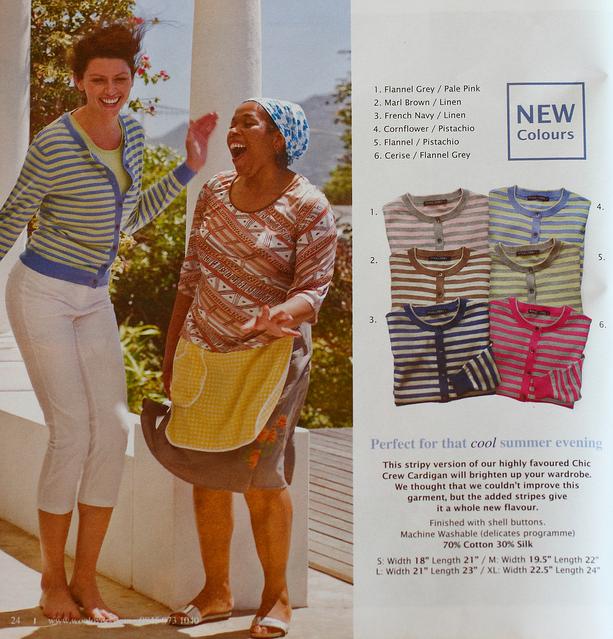
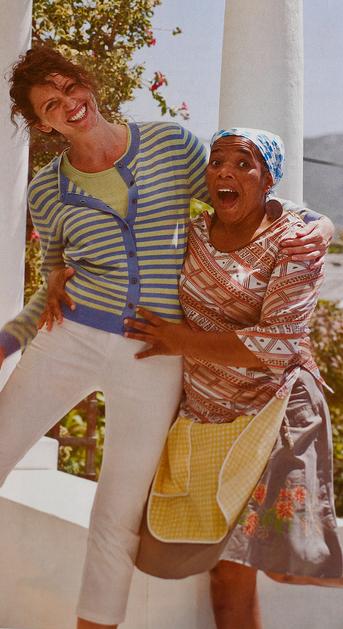
This statement resounded when I saw the images below from a 2011 Scottish Woolovers catalogue. Further, I was reminded that it’s not only a matter of whether we see people of our race widely represented, but also of how the media makes these portrayals.

The white woman in this ad is modelling a cardigan sweater. Meanwhile, the woman of colour in the photo is…well, that’s an interesting question. Nothing that she is wearing is for sale; she’s just there, wearing clothing that has no relevance to the advertisement.

Normally, you’d expect that a woman in a fashion catalogue would be there to model clothing, but in this case, the woman of colour doesn’t have such a role. She is a prop for the white model, there to frolic and help illustrate the benevolent and fun-loving nature of the fashionable white model, clad in an apron that marks her as potentially a servant of some kind. She’s not there to directly market clothes to a white target market.

SocImages has addressed other examples of privileged representations of white women in catalogues; a discussion of a Punjammies catalogue highlighted the exclusive reliance on white women as models, while portraying women of colour as labourers and beneficiaries of the good will of the white, female target market. In a similar vein, we also had a post illustrating a comparable trend in the representation (and lack thereof) of people of colour in films. It is a function of our unearned privilege that, when those of us in a privileged position come across racialized images and representations like these, it is all too easy to miss or ignore their problematic nature.

Thanks to Flickr user Wishiwerebaking for sending us these images.

—————

Hayley Price has a background in sociology, international development studies, and education. She recently completed her Masters degree in Sociology and Equity Studies in Education at the University of Toronto.

If you would like to write a post for Sociological Images, please see our Guidelines for Guest Bloggers.