We’re previously featured great examples of resistance to sexist advertising, but this example takes it up a level.  Clownify describes itself as a “street art project to turn everyday ads into ads for clowns.” I’m not sure what political message they intend to send, but what I see is a super easy, I would even say graceful, way of knocking us into consciousness. If advertisements typically occupy our lives as a taken-for-granted source of psychological coercion, this campaign reminds us to (1) actually look at what we’re seeing and (2) remember not to take ads, their messages, or their products too seriously.

Here are four examples, but there are lots more at the site:

17

H/t copyranter.

Lisa Wade, PhD is an Associate Professor at Tulane University. She is the author of American Hookup, a book about college sexual culture; a textbook about gender; and a forthcoming introductory text: Terrible Magnificent Sociology. You can follow her on Twitter and Instagram.

Economic policies often rest on assumptions about human motivation.  Here’s Rep. Ryan (Republican of Wisconsin):

The left is making a big mistake here. What they’re offering people is a full stomach and an empty soul. People don’t just want a life of comfort. They want a life of dignity — of self-determination.

Fox News has been hitting the theme of “Entitlement Nation” lately. This Conservative case against things like Food Stamps, Medicare, welfare, unemployment benefits, etc rests on some easily understood principles of motivation and economics.

1.    Giving money or things to a person creates dependency and saps the desire to work. That’s bad for the person and bad for the country.
2.    A person working for money is good for the person and the country.
3.    We want to encourage work.
4.    We do not want to encourage dependency.
5.    Taxing something discourages it.

Now that you’ve mastered these, here’s the test question:

1. According to Conservatives, which should be taxed more heavily:

a.    money a person earns by working.
b.    money a person receives without working, for example because someone else died and left it in their will.

If you said “b,” you’d better go back to Conservative class. A good Conservative believes that the money a person gets without working for it should not be taxed at all.

Not all such money, of course.  Lottery tickets are bought disproportionately by lower-income people.  If a person gets income by winning the PowerBall or some other lottery, the Federal government taxes the money as income. Conservatives do not object.  But if a person gets income by winning the rich-parent lottery, Conservatives think he or she should not pay any taxes.

What Conservatives are saying to you is this: working for your money is not as good as instead of inheriting it. This message seems to contradict the principles listed above. But, as Jon Stewart recently pointed out, Conservatives apply those principles of economics and motivational psychology only to the poor, not to wealthy individuals or corporations.

Cross-posted at Montclair SocioBlog and the Huffington Post.

Jay Livingston is the chair of the Sociology Department at Montclair State University. You can follow him at Montclair SocioBlog or on Twitter.


There are now more people working as private security guards than high school teachers.

Samuel Bowles and Arjun Jayadev offer the following graph, highlighting the number of “protective service workers”* employed per 10,000 workers and the degree of income inequality in the year 2000 for 16 countries.  The United States is tops on both counts.

17greatdivide-img-tmagArticle-v3

Two things stand out from this graph beyond U.S. “leadership.”  The first is the relationship between the share of protective service workers  — or “guard labor” — and inequality.  As Bowles and Jayadev comment:

In America, growing inequality has been accompanied by a boom in gated communities and armies of doormen controlling access to upscale apartment buildings. We did not count the doormen, or those producing the gates, locks and security equipment. One could quibble about the numbers; we have elsewhere adopted a broader definition, including prisoners, work supervisors with disciplinary functions, and others.

But however one totes up guard labor in the United States, there is a lot of it, and it seems to go along with economic inequality. States with high levels of income inequality — New York and Louisiana — employ twice as many security workers (as a fraction of their labor force) as less unequal states like Idaho and New Hampshire.

When we look across advanced industrialized countries, we see the same pattern: the more inequality, the more guard labor. As the graph shows, the United States leads in both.

The second is the rapid rise in the U.S. share of guard labor and inequality from 1979 to 2000.

One can only wonder in what ways and for whom this large and growing dependence on guard labor represents a rational use of social resources.

* For those who like definitions: The category protective service workers includes those employed as Private Security Guards, Supervisors of Correctional Officers, Supervisors of Police and Detectives, Supervisors of all other Protective Service Workers, Bailiffs, Correctional Officers and Jailers, Detectives and Criminal Investigators, Fish and Game Wardens, Parking Enforcement Workers, Police and Patrol Officers, Transit and Railroad Police, Private Detectives and Investigators, Gaming Surveillance Officers, and Transportation Security Screeners.  A broader measure of guard labor might include members of the armed forces, civilian employees of the military, and those that produce weapons to those employed as protective service workers.  That total was 5.2 million workers in 2011.

Cross-posted at Reports from the Economic Front.

Martin Hart-Landsberg is a professor of economics at Lewis and Clark College. You can follow him at Reports from the Economic Front.

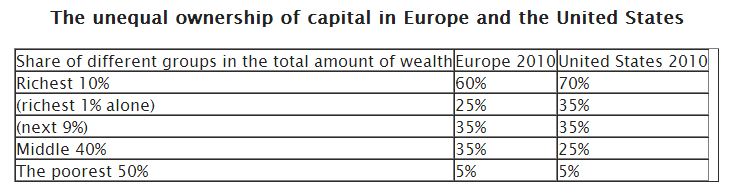
Thomas Piketty has just published a massive new book tackling the explosive growth in income inequality.  Here’s what it looked like in Europe and the United States in 2010 (source):
14
A New York Times review of the book, Capital in the Twenty-First Centurybegins as follows:

What if inequality were to continue growing years or decades into the future? Say the richest 1 percent of the population amassed a quarter of the nation’s income, up from about a fifth today. What about half?

To believe Thomas Piketty of the Paris School of Economics, this future is not just possible. It is likely…

His most startling news is that the belief that inequality will eventually stabilize and subside on its own, a long-held tenet of free market capitalism, is wrong. Rather, the economic forces concentrating more and more wealth into the hands of the fortunate few are almost sure to prevail for a very long time.

Piketty’s pessimistic view is based on his argument that income generated from capital normally grows faster than the economy or income from wages.  This means that the private owners of capital benefit disproportionately from growth, which makes it easier for them to increase their asset holdings and by extension future income.  And, since wealth and income translate into political power, we face a self-reinforcing dynamic leading to ever growing inequality.

This suggests that embracing a system based on maximizing the returns to private owners of capital is a mistake for the great majority of working people. A recent study by the investment bank Credit Suisse provides more evidence for this conclusion.  As Michael Burke explains,

The study… shows that long-term growth rates of GDP in selected industrialized economies are negatively correlated with financial returns to shareholders.

That is, the best returns for shareholders are from countries where GDP growth has been slowest, and vice versa. Where growth has been strongest, shareholder returns are weakest…

The negative correlation [seen in the chart below] does not prove negative causality. But it does support the theory which suggests that the interests of shareholders are contrary to the interests of economic growth and the well-being of the population.

mb

All this information is worth keeping in mind the next time business and political leaders tell us that the key to our well-being is boosting business confidence, the market, or private returns on investment.

Cross-posted at Reports from the Economic Front.

Martin Hart-Landsberg is a professor of economics at Lewis and Clark College. You can follow him at Reports from the Economic Front.

16George Zimmerman was signing autographs at a gun show in Orlando this week. Only 200 showed up for the meet-and-greet, but Zimmerman has many supporters around the country, and, as Jonathan Capeheart says:

This leads to what should bean inevitable question: Who are these people glorifying the killer of an unarmed teenager in one of the most racially polarized incidents in recent history?

I keep wondering how Jonathan Haidt — with his theory of the differing values of liberals and conservatives — would explain this embrace of Zimmerman. The liberal reaction presents no problems. Haidt says that liberal morality rests on two principles:

  • Care/Harm
  • Fairness/Cheating

Killing someone certainly qualifies as Harm, and, almost literally, getting away with murder is not Fair.

The Zimmerman side is that he shot in self-defense. That argument persuaded the jury, or at least created sufficient reasonable doubt. But it doesn’t explain why some people on the right see him as a hero. What moral principle does he represent?

In Haidt’s schema, conservatives take Harm and Fairness into account but balance them with three others:

  • Loyalty/Betrayal
  • Authority/Subversion
  • Sanctity/Degradation

(A sixth foundation – Liberty/oppression – underlies both the liberal and conservative side.)

It’s hard to see how any of these describe the autograph-seekers.  What else might explain that reaction?

The obvious candidate is racism. If the races had been reversed — if a Black man had confronted a White teenager, killed him, and then been acquitted on self-defense grounds — would the left have hailed him as a hero? I doubt it. Would those same autograph hounds in Orlando have sought him out? I doubt it.  And if Black people had then turned out to get his autograph, can you imagine what the reaction on the right would have been?

But it’s not just racism. It’s a more general willingness to do harm, great harm, to those who “deserve” it.  The liberal view (Harm/Care) is that while in some circumstances killing may be necessary or inevitable, it is still unfortunate.  But over on the right, killing, torture, and perhaps other forms of harm are cause for celebration, so long as these can be justified. In 2008, Republicans cheered Sarah Palin when she stood up for torture. In 2011, they cheered Rick Perry for signing death warrants for record numbers of executions. When Wolf Blitzer hypothsized a young man who had decided not to buy medical insurance but now lay in the ICU, and Blitzer asked “Should we let him die?” several people in the Republican audience enthusiastically shouted out, “Yes.”

My guess as to the common thread here is a dimension Haidt doesn’t include as a foundation of morality: boundary rigidity. In those earlier posts, I referred to this, or something similar, as “tribalism.”

Morality is not some abstract universal that applies to all people.  Tribal morality divides the world into Us and Them.  What’s moral is what’s good for Us.  This morality does not extend to Them.

Could it be that as you get farther out on the right, you find more people whose boundaries are more rigid?  They are the hard liners who draw hard lines. Once those lines are drawn, it’s impossible to have sympathy — to extend Care — to someone on the other side. If you imagine that you live in a world where an attack by Them is always imminent, defending those boundaries becomes very important.

That seems to be the world of gun-rights crowd lionizing Zimmerman.  Their cherished scenario is the defense of boundaries against those who are clearly Not Us.  They stand their ground and defend themselves, their families, their houses and property, even their towns and communities.  It is a story they never tire of, repeated time after time in NRA publications.  Zimmerman is a hero because his story, in their view, embodies the narrative of righteous slaughter.

Cross-posted at Montclair SocioBlog.

Jay Livingston is the chair of the Sociology Department at Montclair State University. You can follow him at Montclair SocioBlog or on Twitter.

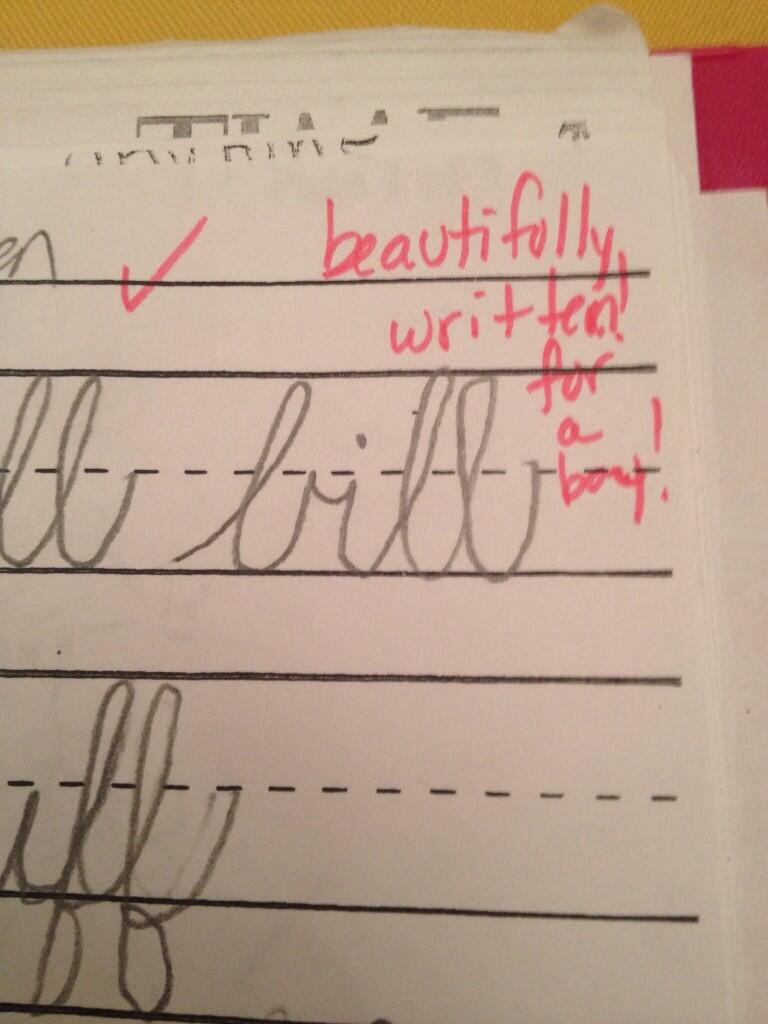
This week Meredith Kleykamp tweeted us a photo of a comment written on her 3rd grade son’s cursive homework.  The teacher wrote: “beautifully written! for a boy!”

1a

So what’s the message here?

Some argue that boys are slower than girls to develop the fine motor coordination that facilitates beautiful handwriting.  I’ve never interrogated that research, but let’s assume, for sake of argument, that that’s true.

If it’s true, then maybe Kleykamp’s son’s handwriting really is beautiful “for a boy.”  But does that make the teacher’s comment innocuous?

Kleykamp observes: “‘Beautifully written’ is sufficient to convey praise.”  Then what additional message does the extra commentary send?  Given a social context in which boys are encouraged to be unlike girls, Christopher Knorr thought the subtext might be: “you will be forced to choose between your penmanship and your masculinity.”

Scholars call these kinds of lessons the “hidden curriculum.”  Here’s another shocking example.

Lisa Wade, PhD is an Associate Professor at Tulane University. She is the author of American Hookup, a book about college sexual culture; a textbook about gender; and a forthcoming introductory text: Terrible Magnificent Sociology. You can follow her on Twitter and Instagram.

Devoted SocImages readers know that I will make any excuse to put up a video involving animals.  I’m going to do it right now.

The video is a dolphin petting a cat. In the first part of the video, you’ll see the dolphin come out of the water and try to put his chin on the top of the cat’s head.  In the second part of the video, you’ll see how the dolphin learned to do that. The cat very clearly wants to rub the top of his head, specifically, on the dolphin and the dolphin is paying attention and learning.

This isn’t just adorable interspecies communication, it’s proto-culture.  It’s the transmission of an idea. I don’t know if all the dolphins in this video pet the cat this way, or if it’s just one dolphin, but I can certainly imagine one dolphin teaching the next, just as the cat taught the first dolphin.

Or, to put it more simply, humans aren’t special because we’re humans, were special because we’re animals.

Lisa Wade, PhD is an Associate Professor at Tulane University. She is the author of American Hookup, a book about college sexual culture; a textbook about gender; and a forthcoming introductory text: Terrible Magnificent Sociology. You can follow her on Twitter and Instagram.

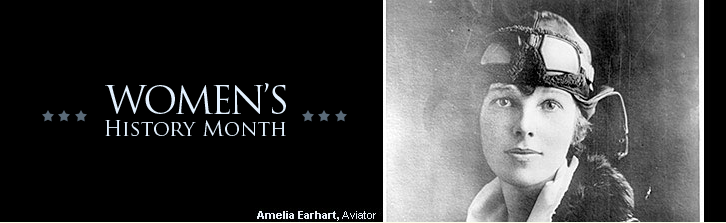
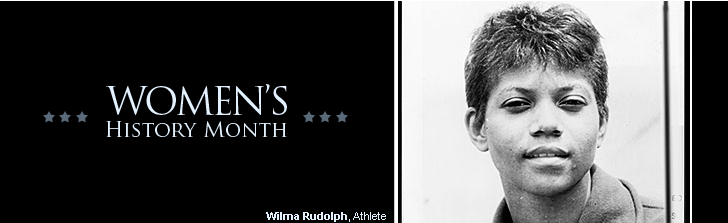
1 (2) - CopyAmelia Earhart, aviator. Wilma Rudolph, athlete. Sally Ride, astronaut. Elizabeth Cady Stanton, activist. Josephine Baker, performer. Virginia Woolf, novelist. Rosie the Riveter, archetype. Alice Paul, suffragist. Frida Kahlo, artist. Hillary Clinton, Secretary of State.

1 (2)

What do these women have in common? They are the 10 iconic women featured this year by womenshistorymonth.gov, the official website of Women’s History Month in the United States. A rotating banner across the top of the page shows a photo of each woman, her name, and a one word description, presumably the reason she is worthy of celebration.

Unfortunately, the women singled out for recognition at the site appear to be considered notable mainly because they excelled at what are generally thought to be “masculine” pursuits. This is androcentric, meaning that it values masculinity over femininity. Traits that have been traditionally conceptualized as masculine (such as being a leader and good at sports and math) are now seen as valuable for girls to develop, while boys are often still discouraged from do things traditionally conceptualized as feminine (such as nurturing, cooking, and cleaning).

I am all for questioning the idea that certain jobs are “men’s jobs,” but we also need to challenge the idea that only women can do “women’s jobs.” If we do not, the belief that women should do “women’s work” and, more importantly, that women’s work is not worth celebrating, is left unquestioned.

1 (3)

Women’s History Month tends to follow this trend. None of the women we typically recognize at this time of year, for example, are noted for being good cooks, care givers, or educators of children, nor are they lauded for their nurturing of others, emotional openness, kindness, or compassion — all traditionally “feminine” traits. Caring for others and teaching youth are wonderful things that everyone should be encouraged to do. Our history books should be filled with people of all genders who were exceptional in these areas. But, these traditionally feminine pursuits are not what earns one accolades during Women’s History Month, or any other time. As a consequence, people are not taught to value such jobs or the people who do them. This one-sided celebration is unlikely to solve the very problem that Women’s History Month is ostensibly designed to combat: gender inequality.

“To all the women who quietly made history” (source):

1 (4)

Laurel Westbrook is an Assistant Professor of Sociology at Grand Valley State University. Her research focuses on gendered violence, social movements, and the inner workings of the sex/gender/sexuality system.