Rachel sent in a link to a post about the recession by Tim Cavanaugh at Reason that led me to an interactive graphic at the Wall Street Journal that lets you track job loss by either sector or by race/ethnicity and sex from December 2007 to August 2010.

Here is the race/ethnicity and sex data for January 2008 (for reasons I cannot understand, Asians are not separated out by sex, and as usual, American Indians aren’t included):
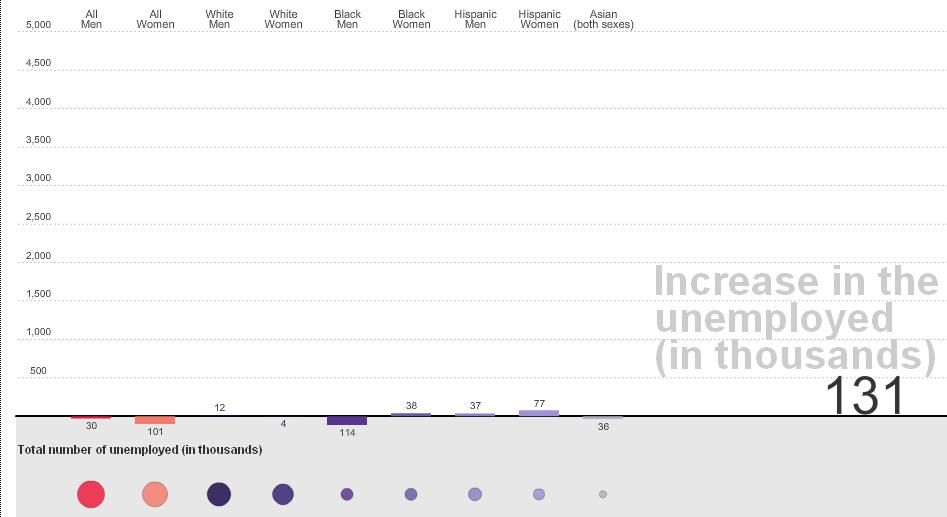
And here’s the breakdown for January 2010:
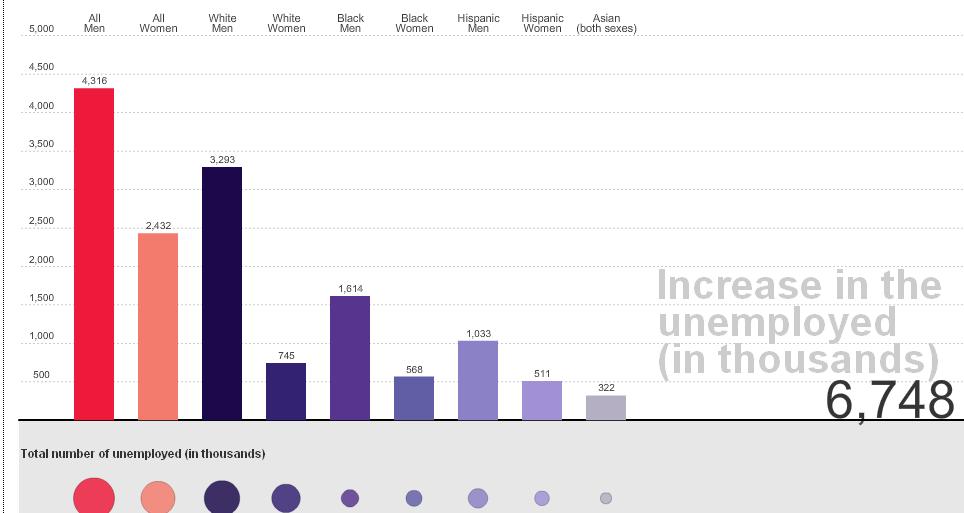
Unfortunately, the numbers aren’t weighted by the number of total workers per category, so we don’t have any way to know how these raw numbers translate into percentages of workers losing their jobs.

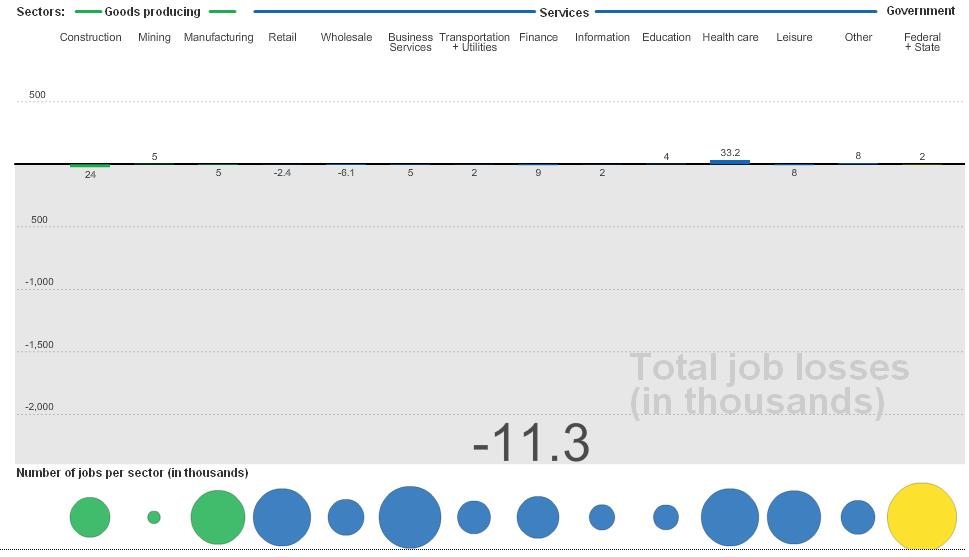
By economic sector, for January ’08:
January ’10:
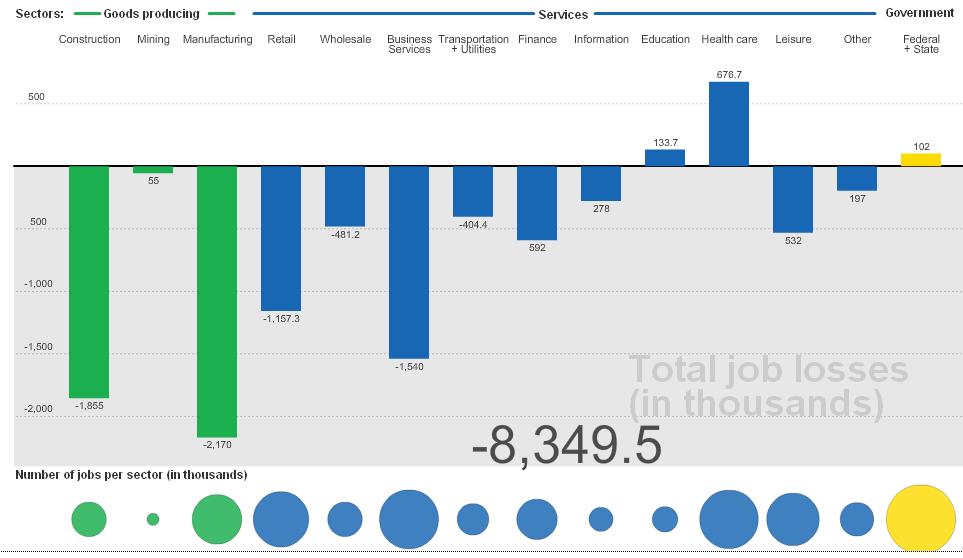
[On a nitpicky note, the sector graphs show job losses in negative numbers, which would work if it showed total change in # of jobs. But I think we’d be thrilled if we had -8… thousand job losses, as the graph is labeled. Just a small sloppy labeling issue.]

As the data show, and as we’ve discussed before, the economic recession has disproportionately affected men. But Cavanaugh cautions that it might be a little soon to declare men an at-risk species or lament the bad luck of being born male. Presumably, if men’s over-representation in construction, for instance, has meant they suffered more than women from the real estate bust, if you felt like it you could turn it around and argue that perhaps they disproportionately benefited from the boom that preceded it. Additionally the employment sectors are pretty broad; “retail” or “finance” will include some specific occupations that are fairly gender balanced, some that are dominated by men, and some dominated by women. And overall loss in retail jobs doesn’t tell us if the losses are spread equally across occupations within the sector.

Should we care about the suffering of men and their families in the recession? Of course. And to the degree that men are disproportionately represented in occupations that are prone to boom/bust cycles, we’re likely to continue to see greater volatility in their employment rates than women’s, sometimes to their advantage, sometimes not. But we might want to be a little careful and look at some more in-depth data before we declare, as some commentators seem to want to do, that women have basically escaped the recession. If nothing else, men and women aren’t islands; lots of us share household expenses, and a woman whose husband loses his job but keeps her own doesn’t exactly avoid any negative consequences of the recession.

Related posts: more comparisons of joblessness, race and recession, unemployment and education level, not everyone suffers during a recession, the gender employment gap,
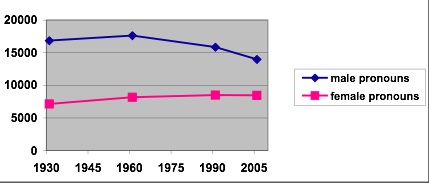
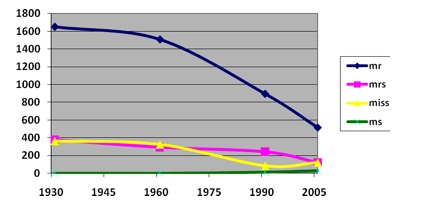
Dr. Paul Baker, a linguist at the University of Lancaster, sent us some graphs from his analysis of use of gendered language over time in the U.K. His data consisted of “four sets of data from written British English from 1931, 1961, 1991 and 2006 (a million words each)” — a full discussion of the methodology will be available in the forthcoming article in Gender and Language.*

First, Dr. Baker looked at use of male and female pronouns (he/his/him vs. she/hers/her) over time:

Clearly male pronouns are still used more than female ones, but the gap is narrowing. Baker found that though part of the reason is that male pronouns are more likely to be used generically to refer to everyone than female pronouns are, the major reason is that men are discussed more than women.

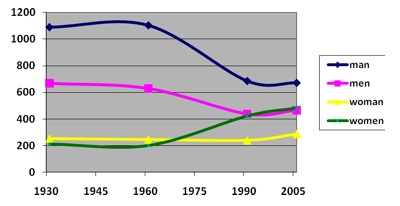
Here are the data specifically for the four words “man,” “men,” “woman,” and “women”:

Notice that the use of the plurals — “men”and “women” — have converged, though we still see higher usage of the male singular than of “woman.”

And finally, Dr. Baker looked at the usage of four gendered titles:

A large decrease, obviously, especially in the use of “Mr.,” but all have tapered off since the 1930s with the exception of “Ms.,” which never did really catch on. Baker argues that while some of the decrease may be due to attempts to use less sexist language, it’s more likely because of more informalization of society in general — titles of address often seem stiff and overly formal today.

Of course, this analysis just tells us the frequency with which these terms are used, not what is actually being said about men and women, a topic he addresses in the full article. But he concludes that the trend is rather encouraging for those who want to see more equal gender representation in terms of language.

* Baker, P. (2010) ‘Will Ms ever be as frequent as Mr? A corpus-based comparison of gendered terms across four diachronic corpora of British English.’ Gender and Language. Forthcoming.


In the TED video below, Lisa Margonelli of the New America Foundation Energy Policy Initiative gives a fascinating 17-minute talk on the political psychology and the political economy of oil… and how the former distracts us from the latter.

Among other revelations, she tells us that:

1.  Oil pumps are purposefully designed to look like ATMs to make us feel better about using them.

2.  Having a car that runs predicts employment more than a GED.

3.  Oil production reform has amounted, largely, to exporting the risk to other countries, and…

4. We pay for our oil dependence not only at the pump, but with our taxes.

Watch:

Via BoingBoing.

Lisa Wade, PhD is an Associate Professor at Tulane University. She is the author of American Hookup, a book about college sexual culture; a textbook about gender; and a forthcoming introductory text: Terrible Magnificent Sociology. You can follow her on Twitter and Instagram.

Dmitriy T.M. sent in an interesting discussion of tax collection in Pakistan by the New York Times.   The narrator argues that rich Pakistanis, among others, do not pay taxes, forcing the government to rely on foreign aid.  Essentially, then, it is argued, “[t]he American taxpayer is subsidizing the Pakistani rich.”   Since the politicians are rich themselves, and happily evading taxes, there is little will to change the system.

One solution? Send in a team of transgender people to embarass homeowners into paying their property taxes, of course!

Lisa Wade, PhD is an Associate Professor at Tulane University. She is the author of American Hookup, a book about college sexual culture; a textbook about gender; and a forthcoming introductory text: Terrible Magnificent Sociology. You can follow her on Twitter and Instagram.

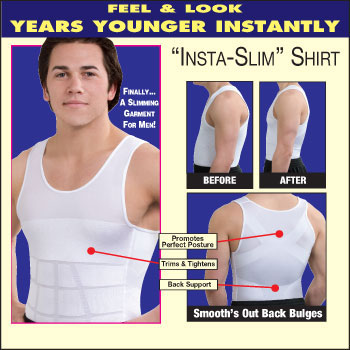
Elizabeth C. sent along two advertisements for body slimming garments from DreamProductsCatalog, one for men and one for women.  Side-by-side, they reveal subtlety different expectations for male and female bodies:

Notice that the women’s garment is aimed solely at making her thinner and more fit appearing.  It “slims,” “eliminates unsightly bulges,” “lifts,” and makes her look “20 pounds thinner.”   Her sexy pose and come hither look emphasizes that her main job is to look good.  In contrast, the man looks confidently and calmly into the camera and, while his garment is also aimed at making him look more “slim” and “trim,” it is also supposed to make him “feel” better and look younger.  It improve his posture and offer back support, too.

The difference here is subtle, and I don’t mean to make too much of it, but it is nonetheless an illustration of the variety of uses to which men’s bodies are believed to be put (aesthetic, yes, but also functional and personal) and the one primary thing that women’s bodies are supposedly for (being looked at).

Lisa Wade, PhD is an Associate Professor at Tulane University. She is the author of American Hookup, a book about college sexual culture; a textbook about gender; and a forthcoming introductory text: Terrible Magnificent Sociology. You can follow her on Twitter and Instagram.

Notions of how to properly raise children change over time and vary across cultures. In early America, children were necessary labor for struggling farmers trying to survive off the land. They were put to work as soon as they were able, apprenticing their parents and older siblings. After the Industrial Revolution, children went to work in factories; this seemed perfectly normal, considering that they had worked on farms for decades to contribute to the economic well-being of their families.

Today, we think that children should not work, but instead should have a “childhood” full of innocence, play, and imagination. This creates new burdens on parents who can no longer simply have their children work alongside them, but must actively cultivate the ability for their children to do what we believe children are supposed to be doing. This has led to what some sociologists have called “intensive mothering” (as it is usually mothers who do it): constant emotional availability and monitoring of their children’s psychological states, endless activity provision, and high investment in their children’s intellectual development.

Indeed, today some argue that failing to nurture children on every dimension of human capacity or, even, to just let them be, borders on neglect. While others argue that this is a new era of “helicopter parenting” in which parents monitor and control everything in their child’s life because they simply can’t look away or let go.

University of Notre Dame Sociology Professor Jessica Collett drew our attention to a set of cartoons illustrating this new contest over proper parenting at Free Range Kids.  The first, by Bill Bramhall, suggests that letting children roam free puts them at risk of homelessness. In it, two homeless-looking men sit on a park bench watching children play by themselves. One says, “My mother took me to the park and left me there, too.”

The second, by artist Richard Estell, is in direct response to the first, arguing that parents are acting out of fear and that over-supervised children are more likely to experience mental and physical health problems. The men read newspapers with headlines that read “Parents see only danger” and “Helicopter parents’ kids depressed.”

What we have here, then, is a new social contest.  Changes in ideas about who children are (kids vs. small adults), why people have them (as a personal indulgence or an additional laborer), and what good parenting looks like (intensive or functional) has created a new type of parenting.

As this new type has become the dominant idea of what good parenting looks like, a backlash has evolved that critiques it.  And thus we have an excellent example of historical change and the social construction of social problems.

Lisa Wade, PhD is an Associate Professor at Tulane University. She is the author of American Hookup, a book about college sexual culture; a textbook about gender; and a forthcoming introductory text: Terrible Magnificent Sociology. You can follow her on Twitter and Instagram.

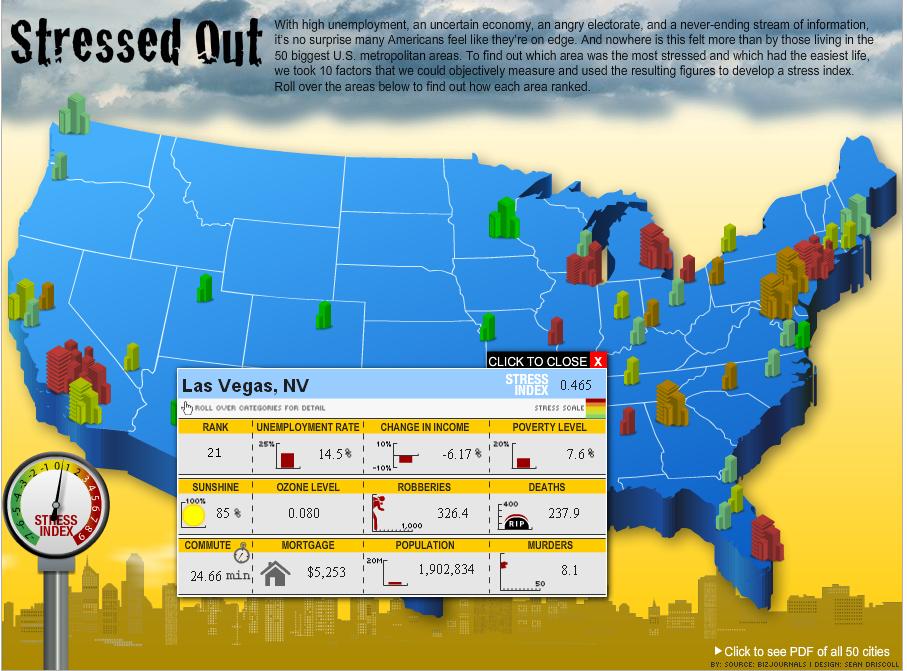
My friend Captain Crab (happy late birthday!) pointed out a graphic at Portfolio that displays the results of their metropolitan “stress test,” in which they use ten measures such as poverty level, unemployment rate, commute, mortgage affordability, etc., to quantify how stressful different metro areas are to live in currently. Obviously it’s a rough measure — they usually use the rates of central cities rather than the larger metro area, people may interpret the same seemingly objective levels of negative or positive factors very differently in terms of how stressed they feel, only the 50 largest metro areas are included, and I don’t know if there’s clear evidence linking less-sunny places to less stress (anyone know?) — but it does provide a snapshot of how different cities compare.

You can hover over a city to get info on its ranking; since I live in Vegas, I checked it out, which has the highest unemployment rate of the 50 metro areas studied, but hey, we get lots of sun!

Just to clarify, the mortgage indicator isn’t the average mortgage, it’s the “affordability” of the mortgage “expressed as median house value per $1,000 of median household income”. The most unaffordable city? New York, followed by L.A.

The overall most stressful city is Detroit; the least is Salt Lake City. If you want to waste more time comparing the rankings on each of the ten measures, they have tables listing the results.

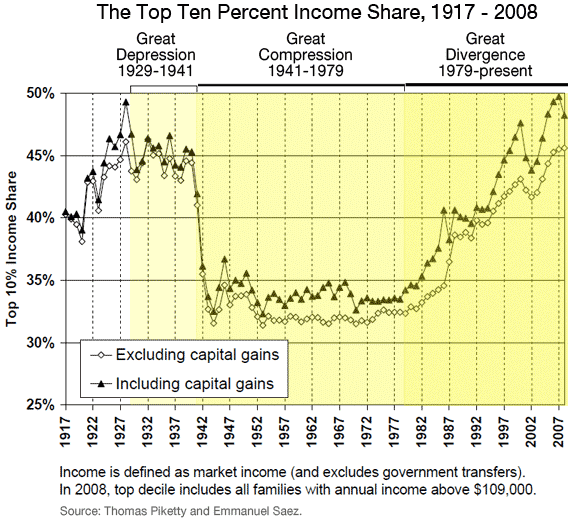
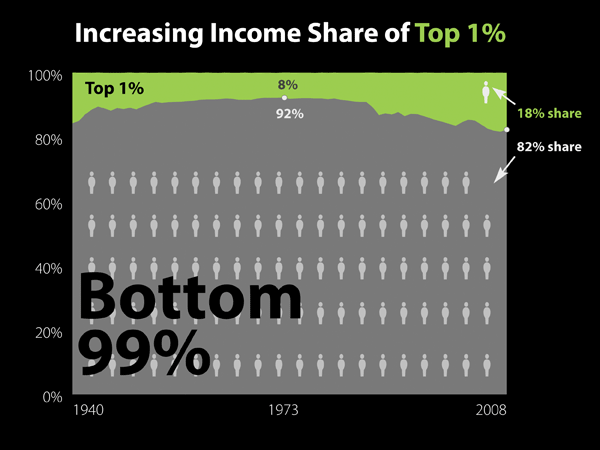
I’m back! I was in the middle of moving and just overwhelmed with everything. Anyway. Talking Points Memo posted a link to an article at Slate about income inequality in the U.S., and particularly the increasing proportion of total U.S. income earned by the very rich. Timothy Noah refers to the “great compression” as a time period when income concentration among top earners dropped significantly, and argues that in the past three decades we’ve seen a “great divergence,” with increasing income inequality hitting levels not seen since the Great Depression:

A slideshow accompanies the article, providing more info on the changes Noah discusses. A few examples (the slideshow provides the data source used to create each image):

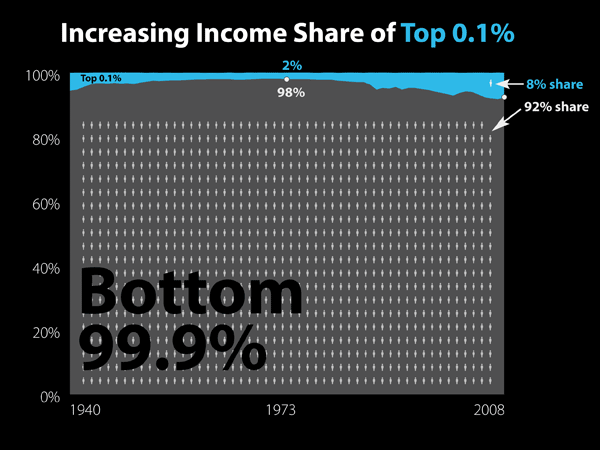
Even among the very rich, we see increasing divergence, with the super-ultra rich, the top 0.1% of earners, now making 8% of all U.S. income:

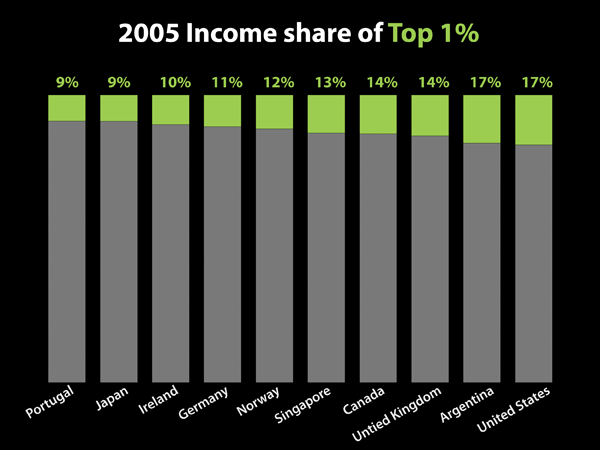
A comparison to some other countries (I don’t know why these specific nations were chosen for the comparison):

Keep in mind, this data includes only income. Wealth — the worth of all assets, including retirement and savings accounts, stocks, homes, cars, and anything else of value — is much more unequally distributed.

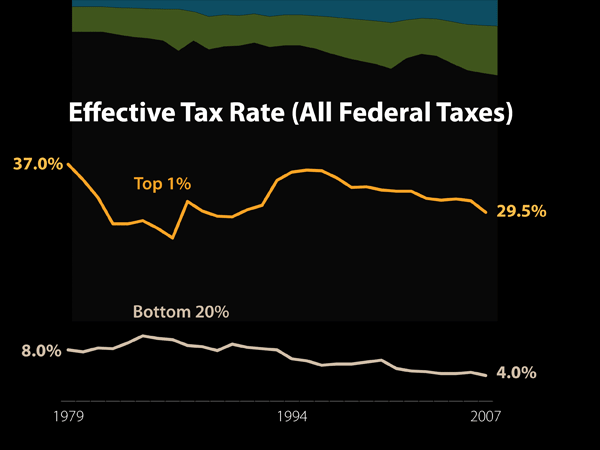
Congress is about to be embroiled in a major debate about whether to extend the tax cuts on high incomes; as both sides weigh in, here’s some context to keep in mind:

The effective tax rate is what people actually pay, as opposed to what their tax rate theoretically is. While we’ve certainly seen a large drop since the late ’70s, Noah argues that, compared to other economic changes, the effective tax rate hasn’t affected the rise in income inequality much. It plays a role, yes, but changing the tax rate on the very rich doesn’t affect the overall distribution of income a huge amount, in part because the effective rate, what people end up actually paying, generally ends up being smaller than what they theoretically owe based on the stated tax rate, once you take into account deductions, write-offs, loopholes, and so on.

So…happy post-Labor Day!