
Video games have often been a target of moral panic in the United States. The 1990s were fraught with worry that consuming violent content in video games would lead to violent behavior in the real world. The 2010s had its own controversies with the immense popularity of franchises like Call of Duty and Grand Theft Auto. Video games have had a litany of bad press for things they might cause, but we don’t give them nearly enough credit for what they actually have – a remarkable ability to foster social joy and whimsy.
Take Kerbal Space Program, a spaceflight simulator that is delightfully cartoony, with its little green player characters and charming music, and brutally punishing with its orbital physics. I have my own fond memories with early versions of the game. As a middle schooler with an interest in outer space, the game motivated me to get into model rocketry and scratched the itch to explore the solar system on my own terms.
As an adult who has abandoned a career in aerospace engineering for one in the social sciences, I still find myself picking up the game every once in a while. I’m not alone. Per SteamDB, the game has roughly quintupled its player base this past spring. This is far from the norm for games this far into their lifespan. While games occasionally see spikes in popularity due to sales, it’s incredibly rare to see sustained popularity on this scale.
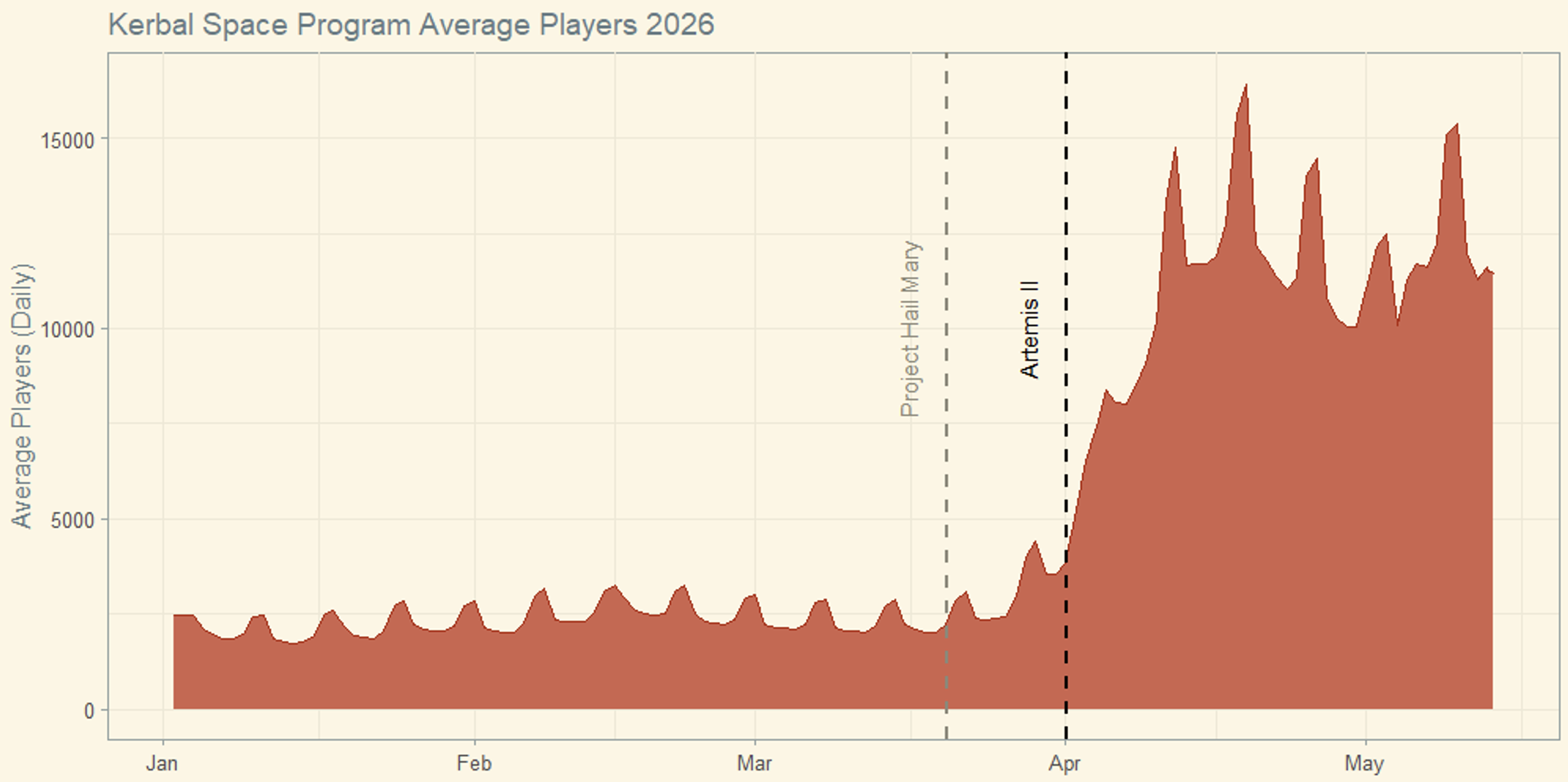
I think the reasons for this spike are quite clear. March and April of 2026 were big months for public interest in space exploration. The breakaway box office success of Project Hail Mary, a film adaptation of Andy Weir’s 2021 sci-fi novel, brought a hopeful and optimistic portrayal of space travel and cooperation into the public consciousness. It was then quickly followed by the successful launch and completion of the Artemis II mission, sending four astronauts on a lunar flyby further away from Earth than ever before.
Sociologists and social theorists have long written about the role of play as a tool to make sense of the world. Georg Simmel and Erving Goffman wrote about play as a form of human interaction, wherein there are distinct rules and routines to play that players know how to abide by to perform a successful interaction. In this setting, play is just something that humans do, not fundamentally different from other forms like work or competition.
In contrast, historian Johan Huizinga argued that play is a primary force in the construction of human culture. In Homo Ludens, Huizinga asserts that play always exists as a representation of something else, that it serves as a layer underneath the “serious” that allows for people to alter the character of otherness. Put more simply, play serves as a space and time set aside to learn, to test, and to grow without consequence. In this way, play as a practice predates culture, predates civilization, and humans have “added no essential feature to the general idea of play.”
Following Huizinga, Thomas S. Hendricks writes about play as a fundamental pathway of behavior and experience, on the same level as work, ritual, and communal engagement. In Selves, Societies, and Emotions, Hendricks argues that play serves as a space to focus on processes rather than an end goal. Play therefore becomes a “test ground”, where glory can be sought in the unpredictable. Through play we can cultivate awareness of our own capabilities. This testing ground is precisely what players – especially new ones – will experience in KSP.
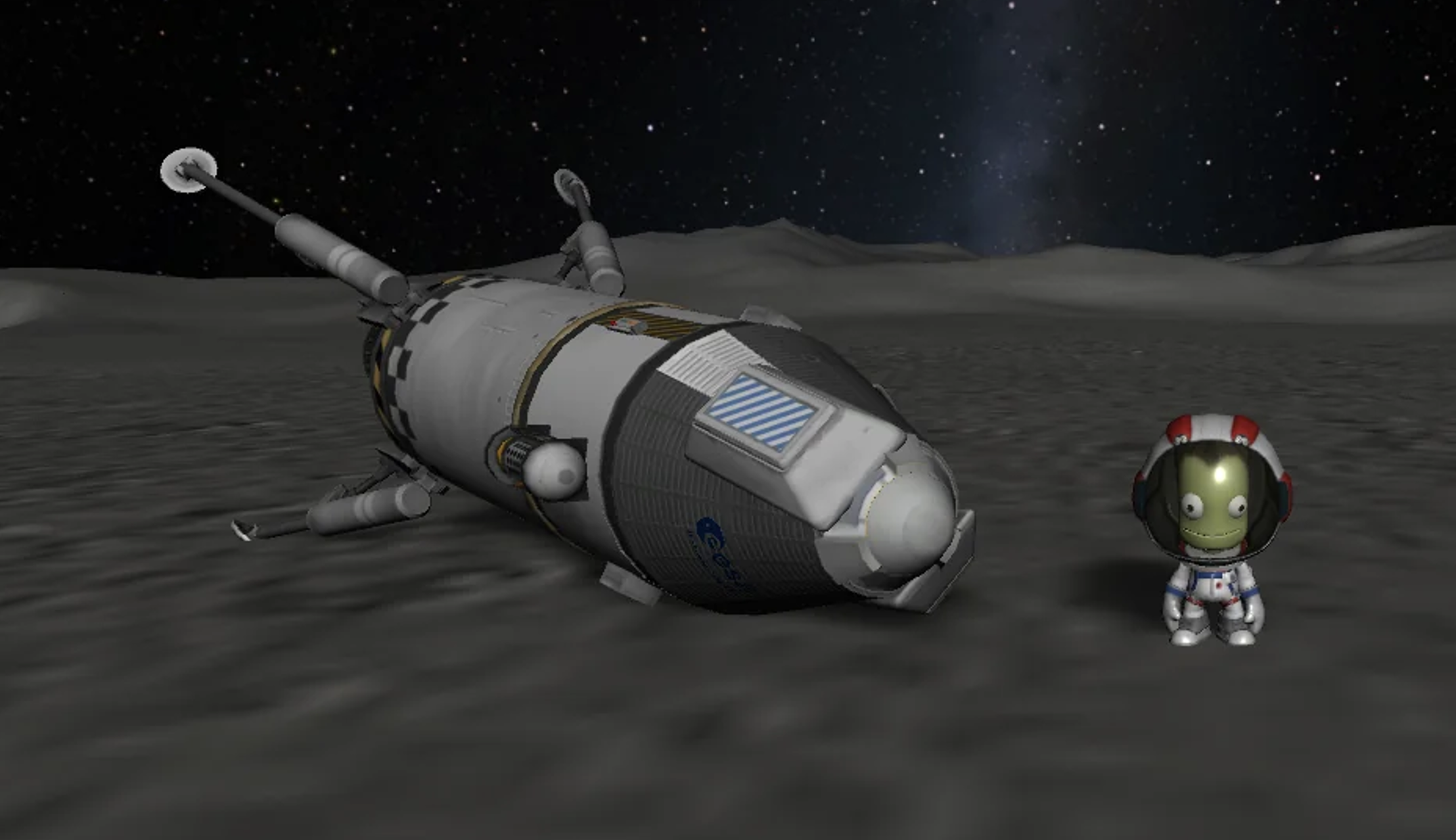
KSP‘s sustained boost in popularity is an example of how we can use play as a measure of public interest. As Huizinga argues, play never happens without it representing something meaningful. And whether this boost in popularity continues to hold stable or eventually declines back to baseline, I can’t help but be optimistic about the fact that more people than ever before are getting involved in the time-tested tradition of launching Jebediah Kerman to the stars, and what that means for the optimism that people have for a future in space.
The Artemis II mission cost billions of dollars, and the Artemis program itself has cost an order of magnitude more. At time of writing, Kerbal Space Program currently costs about $40 through Steam, and less if it is on sale. Even if only a fraction of those players end up turning their play into work, it’s worth it just for the fun of the ride. We often criticize video games for being time wasted at best and harmful power fantasies at worst. But it’s important to recognize how sociologists can use them to study social joy and public interest.
Jack Leatherman is a PhD Candidate at the University of Massachusetts Boston focusing on intersections of culture and technology. You can follow him on BlueSky.
Comments 47
Emily Berry — August 19, 2026
This is a fascinating look at how seemingly simple activities like video games can have profound sociological implications. The author's personal connection to Kerbal Space Program, and how it fostered a passion for space exploration, really highlights the potential for these platforms to inspire and educate beyond mere entertainment. It makes me wonder about other "play" activities and their capacity to shape our understanding of the world and ourselves. MedCertPrep
Henry Browne — August 19, 2026
I really enjoyed this perspective and geometry dash which is interesting. The idea of looking at something as ordinary as games and play through a sociological lens is fascinating. It’s a thoughtful reminder that the things we do for fun can also reflect our relationships, communities, and wider culture.
AchieversIT — August 19, 2026
your content is good and well explained for more content explore bellow links.
data science course institute in bangalore,
data science training institute in bangalore with placement,
ben — August 20, 2026
well explain thank you so much such a good informative content. sassa status check.
willsmith — August 20, 2026
games as more than just entertainment—they can shape how we think and interact. It even makes a simple puzzle game like Meowdoku feel a little more meaningful.
cookie clicker 2 — August 20, 2026
It's fascinating to see how societal concerns shift over time, and how video games have been at the center of these debates. The article provides a thoughtful perspective on the sociology of play and its implications. cookie clicker 2
Alex Wilson — August 21, 2026
I enjoy using dennysmenu to explore restaurant choices before making plans. Browsing the options ahead of time lets me compare different meals and choose something appealing. It is particularly useful when planning a meal with family or friends who may have different tastes.
Ronaldo — August 23, 2026
really enjoyed this perspective on how play and video games can inspire curiosity, creativity, and even a deeper interest in space exploration. It’s a great reminder that everyday experiences can shape how we see the world. Lazblinds. No Drill, No Cords, No Compromise. We design cordless cellular shades, blackout roller shades, and bamboo roman shades that install in minutes—no tools, no screws, and no damage to your window frames. Visit now https://lazblindsstore.com/ to explore more.
Margaret Price — August 26, 2026
Play has always been a crucial outlet for me, sparking creativity while offering an escape. Connecting this to sociology, it’s fascinating how our interactions shape societal narratives. By the way, have you checked out run 3 for some fun ways to play? It ties in perfectly!
Opolyo AI — August 27, 2026
Kerbal Space Program's player base has roughly quintupled this spring, which the post ties to Artemis II and Project Hail Mary. What it doesn't cover is the modding ecosystem that extends the game's life. I use 3D printed models from opolyo 3d model to test my rocket designs before launching. It adds a tactile dimension to the orbital mechanics. That hands-on approach was missing from the sociological angle.
lena — August 27, 2026
I like the argument that games deserve more credit for creating curiosity, social connection, and genuine joy rather than being viewed primarily through the lens of moral panic. The Kerbal Space Program example is especially compelling because a playful simulation can spark real-world interests and learning beyond the game itself. That same curiosity around game systems can lead players to explore practical resources such as Blox Fruits value data when comparing items and trades.
Naoh King — August 28, 2026
Hi,
Family game nights are a great way to get everyone away from screens and actually interacting. I think games with puzzles, simple challenges, and familiar characters can make these evenings even more enjoyable, especially for kids. We recently came acrosshttps://doraemonxgame.com.co/, which has some fun mini-games and adventure-style challenges worth exploring.
Ashwin Khurrana — August 29, 2026
Yes games can be definitely used to educate the masses as used by sociologists. The game which I have been playing from last 2 years is car parking multiplayer a game with realistic physics, just like real world driving.
chynnahe — August 30, 2026
Interesting to see how societal concerns about video games have evolved over time. It's fascinating to think about how these games can be both a source of moral panic and a lens through which we can examine societal issues. FunBoxie offers a variety of free printable PDFs for kids that can provide a more wholesome and educational alternative to video games.
Annabele — August 30, 2026
I really enjoyed the idea of play as a space where people can experiment, learn, and explore without serious consequences. It applies far beyond video games too. Even activities like crossword puzzles encourage curiosity, problem-solving, and persistence. Different forms of play can shape how we think and engage with the world.
ANDRII POZNIAK — August 31, 2026
Exploring the sociology of play and how human games, sports, and recreational culture connect to broader social structures is such a fascinating topic! Analyzing play through an academic lens reveals so much about community values, interaction, and culture. While taking a break from reading sociological essays and cultural analysis, I also like to check out roulettino app for some casual mobile gaming.
Bart — August 31, 2026
RPGs offer deep immersion, but quick games have their place too. https://stakes.org.in/ provides that contrast. The fast rounds are perfect for short breaks. I like the variety of options. The platform is easy to use. It's a nice complement to longer gaming sessions. I can enjoy quick entertainment without committing hours. The games are satisfying in their own way. They offer a different kind of engagement. It's not about deep storylines but immediate fun. That balance is valuable. For busy gamers, this platform fills an important niche.
Mike455 — September 1, 2026
Good im recommended top games https://pokie.inc/en-au/casino-category/real-money-casino/
Maria Santos — September 2, 2026
The discussion about Kerbal Space Program is a great example of how play can inspire curiosity, learning, and social interaction. I especially liked the connection between gaming and broader cultural interests like space exploration it shows that play can have a much deeper impact than simply entertainment. Even everyday digital services, such as arranging an online NBI appointment, are becoming more convenient as technology continues to shape our daily lives.
Jacktaylor — September 3, 2026
The discussion about moving beyond restrictive gender labels in children’s toys highlights the value of playthings that can simply be enjoyed by everyone. Tabasquishy offers Soft squishy toys designed to stay enjoyable and engaging.
YourLadyAngel — September 3, 2026
I really enjoyed this perspective on the sociology of play. The connection between Kerbal Space Program, curiosity, and growing interest in space exploration is especially interesting—it shows how something that looks like simple entertainment can inspire genuine learning and ambition. I also like the idea of play as a “test ground,” where people can experiment, make mistakes, and discover their capabilities without the pressures of real-world consequences. It’s a refreshing counterpoint to the usual discussions about the negative effects of video games. Do you think other simulation games could have a similar influence on people’s real-world interests and careers? #BanerFemalePersonals
elham 21 — September 4, 2026
FFKipas is a website created for people who follow Free Fire.
It brings together topics and information related to the game.FF Kipas Apk
Players can visit the site to explore different gaming resources.
The content is suitable for those interested in the Free Fire community.
Murat — September 4, 2026
FFSensitivity focuses on settings used by Free Fire players.FF Sensitivity
rooz — September 4, 2026
I really enjoyed this perspective on play because it shows that games are much more than simple entertainment. The way people play, the communities they create and the meanings they attach to games can reveal a lot about culture, identity and social relationships.
It is also interesting how new forms of entertainment often become the subject of public concern when they first appear. Looking back at the history of video games, we can see many similarities with previous debates around books, movies and other forms of popular culture.
Sociological perspectives like this help us understand why people engage with games and how play reflects broader changes in society. I also enjoy exploring topics about culture, technology and human behavior through Roozaneh.
trio tax — September 4, 2026
best information forever
richter — September 5, 2026
Om te bepalen of een casino betrouwbaar is, kijk ik naar meerdere factoren tegelijk. Een controleerbare vergunning, duidelijke voorwaarden, veilige betaalmethoden en goede klantenservice vormen voor mij de basis. Daarnaast let ik op de reputatie van de onderneming, de privacyverklaring en de manier waarop het casino met klachten omgaat. Bij https://carlospincasino.com/nl/ zou ik al deze punten vergelijken voordat ik een account aanmaak. Een mooie website of een groot bonusbedrag zegt weinig wanneer de financiële procedures onduidelijk zijn. Betrouwbaarheid blijkt vooral uit consistente informatie en uit hoe het platform zich gedraagt wanneer een speler hulp nodig heeft.
Grace — September 6, 2026
Video games can offer more than entertainment by encouraging creativity, exploration, and social interaction. The example of space-themed games shows how interactive experiences can even inspire players to develop new interests and hobbies.Updating the 3 patti blue online apk regularly keeps performance smooth and access to the newest game additions available. Skipping updates for long periods sometimes causes compatibility issues with newer servers. https://3pattiblue.net/
Online Games — September 6, 2026
I really liked the idea of play as a kind of “test ground” where people can experiment, fail, learn, and try again without the same consequences they would face in real life. Kerbal Space Program is a great example because the game can turn curiosity about space into a deeper interest in physics, engineering, and exploration.
I think this applies to many types of games as well. Even simpler browser games can encourage problem-solving, timing, persistence, and experimentation in their own way. That is one reason I enjoy exploring different kinds of games on BunaGames, where each genre offers a different style of challenge and play.
It’s refreshing to see video games discussed not only in terms of potential negative effects, but also as a meaningful part of culture, learning, curiosity, and social life.
Choicer Voicer Studio — September 7, 2026
This is such a Choicer Voicer Studio fascinating lens through which to examine play! Looking at games — whether digital, social, or childhood — through a sociological framework reveals so much about culture, identity, and human connection. 🧠✨ I love how play isn't just entertainment; it's a mirror of society itself. 🪞🕹️ For more thought-provoking content on culture and society, check out Choicer Voicer Studio! 🎙️📖 Thanks for sharing this perspective! 👏
anomalouscoffeemachine3 — September 7, 2026
What a anomalouscoffeemachine3 fascinating connection between gazing at the stars and the sociology of play! It makes me think about how both activities—observing the cosmos and engaging in play—are fundamental human ways of making sense of the world. Play is a form of social exploration, just as astronomy is a form of cosmic exploration. 🪐 It's like anomalouscoffeemachine3: you input curiosity and observation, and it "brews" a deeper understanding of our social and physical universe. Great post!
favorites lol — September 7, 2026
This is such a favorites lol fascinating intersection of topics! The sociology of play is an often overlooked but incredibly important lens for understanding human behavior. It's amazing how something as simple as play can reflect and shape social structures and relationships. This is a favorites lol for anyone interested in the deeper meaing of everyday activities. Thanks for sharing this insightful perspective!
Marry Jack — September 7, 2026
Video games can be valuable social and educational experiences, not just sources of entertainment. Games like Kerbal Space Program show how play can encourage curiosity, creativity, and collaboration while helping players explore complex ideas. 999 gameplay across different earning apps tends to include a similar mix of Teen Patti, lottery draws, and slot titles. Comparing withdrawal speed and bonus terms usually matters more than the specific game list.
anomalouscoffeemachine3 — September 7, 2026
✦ The way it connects the background, the main idea, and the practical implications makes the subject easy to follow without making it feel simplistic. It encourages a useful conversation, and ◆★ anomalouscoffeemachine3
Fleet Wiz — September 7, 2026
Nice blog! Looking for a reliable fuel monitoring system Qatar? FleetWiz offers smart fuel monitoring solutions to help businesses track fuel usage and improve fleet efficiency.
Visit: https://fleetwiz.app/fuel-monitoring/
One Player — September 9, 2026
Analyzing the sociology of play reveals fascinating insights into how recreational activities shape culture, social connections, and human behavior! Understanding leisure dynamics enriches modern sociopolitical perspectives. Whether studying play theories or unwinding during quiet personal downtime by playing engaging 1 Player Games at home, thoughtful reflection elevates our daily mindset. Insightful article!
textbox — September 11, 2026
The connection between observing the stars and the sociology of play is an intriguing one. It makes me wonder how shared activities, even something as simple as looking at the night sky, can shape social interactions and group dynamics. Speaking of interactive elements, I found this text box generator deltarune tool that might be interesting for creative play or exploring visual text formats.
freesh brook — September 13, 2026
This is such an interesting perspective on video games, social interaction, and the role of play in culture. I especially enjoyed how the article connects play with learning, exploration, and social joy. It also made me think about how thoughtful aesthetic home office spaces can become environments for focused work, creativity, and even playful exploration in our everyday lives.
mason alex — September 13, 2026
I really enjoyed the discussion of play as a “test ground” for learning, experimentation, and understanding our capabilities. The Kerbal Space Program example makes that idea especially clear—players can explore complex systems in a low-stakes environment while developing curiosity and problem-solving skills. It’s interesting to think about how even everyday hands-on activities, from hobbies to practical work like power washing
, can involve that same process of learning through experimentation.
Yacine TV Live — September 17, 2026
Yacine TV Live is an online streaming service focused on live television and sports content. It is especially popular for following football matches, sports events, and selected TV channels in real time. The platform aims to provide a simple and convenient viewing experience across supported devices.Yacine TV Live
james john — September 23, 2026
The show is interesting not just for its viral drama, but for how the cast negotiate identity, faith, gender expectations, and changing social norms. The analysis of competing values and choices also connects with strategic decision-making, where a Block Blast strategy tool applies planning and evaluating possible moves to a very different kind of problem-solving challenge.
ivarr — September 27, 2026
The sociology of play is such an underrated angle, we treat games like they're just kid stuff but they're actually how adults negotiate status, luck and belonging too. You see it everywhere from fantasy football leagues to, honestly, One Red Casino lobbies, where total strangers build little rituals and rivalries around pure chance. That "eye to the stars" framing is nice though, feels like the author is saying we look up for meaning even when we're just rolling dice. Anyone else read this and immediately start overthinking their own gaming habits? Cause I did.
Lewis Nicholson — September 28, 2026
Viewing video games through a sociological lens is fascinating! While casual Easy Games offer quick relaxation, complex simulations provide a testing ground to explore human culture, curiosity, and learning without consequences. Play truly shapes how we understand our world. Thank you for this insightful piece on the deeper power of gaming!
gradepoint — September 29, 2026
I was intrigued by the mention of the sociology of play, especially considering how it might connect to academic pursuits. It makes me wonder about the tools students use to manage their academic load. For instance, something like a grade point average calculator could be a significant factor in how students approach their studies and plan their play time.
SuikaGo — October 3, 2026
The contrast between Kerbal Space Program’s demanding orbital physics and its playful presentation nicely shows how games can turn failure into curiosity rather than mere frustration. For readers who want a quicker, more casual form of experimentation without installation or registration, SuikaGo is a simple fruit-combining option on PC or mobile.
Reader_cnr_8dc023b — October 4, 2026
Thank you for sharing this comprehensive and well-written article.
Playkaro — October 8, 2026
I really enjoyed the argument that games deserve to be studied for the social joy and creativity they can produce, rather than being viewed only through the lens of moral panic. The example of Kerbal Space Program shows how play can combine challenge, learning, imagination, and shared experiences. It is interesting to think about gaming as a meaningful social activity rather than simply entertainment. This perspective makes the discussion around playkaro particularly relevant.
Stefanie — October 8, 2026
This is a fantastic point! It's so true how video games can be unfairly demonized, when they often spark such incredible creativity and passion. Your experience with Kerbal Space Program perfectly illustrates that wholesome side. It reminds me a bit of the simple, yet engaging physics challenges in Eggy Car. So much joy can come from these digital worlds!