
Homefront war support is a critical part of war; care packages, letters, emails, and phone calls greatly increase troop morale. Typically homefront war support is gendered. In the U.S., women are usually the ones at home providing support to the men serving. During various wars the military has encouraged women to support male troops. It’s patriotic, as this WWII poster notes:
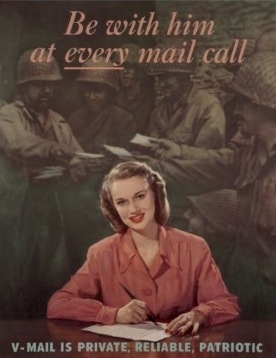
The wars in Iraq and Afghanistan have altered our images of the gendered make up of the homefront and warfront. Today 16% of the military is female, and even though women are not officially allowed in combat positions, they are often in combat situations in the current wars, where the lines of combat are blurred. As a result, over 115 women have been killed in combat. We’re still used to seeing these kinds of images:
But images such as this are becoming more common:
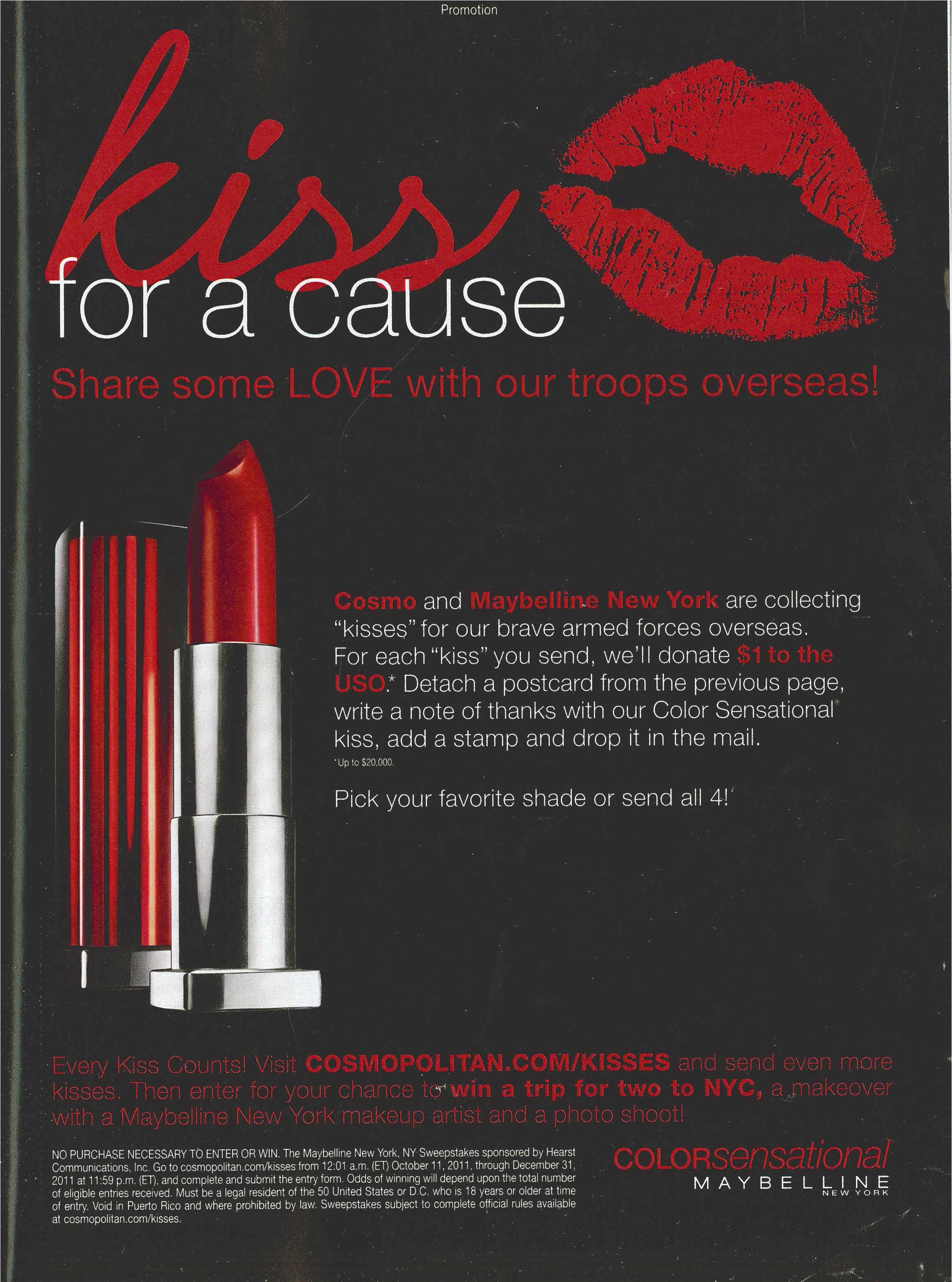
But a student of mine brought me the following ad from the most recent issue of Cosmopolitan:
Main text:
Cosmo and Maybelline New York are collecting ‘kisses’ for our brave armed forces overseas. For each ‘kiss’ you send, we’ll donate $1 to the USO.* Detach a postcard from the previous page, write a note of thanks with our Color Sensational kiss, add a stamp and drop it in the mail. *Up to $20,000
So Maybelline has teamed up with the USO (United Service Organization- a private, non-profit organization) to send support, in the form of “kisses,” and up to $20,000, to the troops overseas.
The assumption here is that armed service members are male and need the support of “kisses” from the homefront—a homefront that is comprised of women. The campaign is also an example of heteronormativity (the often unnoticed ways that heterosexuality is normalized and privileged) because it assumes that (men) serving overseas are heterosexual and will want to receive lipstick kisses from (presumably heterosexual) women. While women service members have been more visible during the wars in Iraq and Afghanistan, this campaign reminds me that war is still largely gendered in a heteronormative fashion. The warfront is still thought of as men’s domain, the homefront women’s domain, and war support relies on heterosexual relationships.
Comments 43
Sarah — November 4, 2011
Also interesting is the inextricable way this is linked with consumerism: "Pick your favorite shade, or send all 4!" It's cause marketing - heteronormative, gendered, cause marketing, in the same vein as "buy pink crap! for breast cancer!". If we really wanted to support the USO, we'd just write a check instead of first buying a lipstick, then kissing, then mailing a card.
renee — November 4, 2011
I don't see men mentioned anywhere in the ad. Don't Ask, Don't Tell was repealed, you know--you're the one making the assumption of heterosexuality. But yeah, this is ridiculous, whoever the recipient is. Send the troops something they can use.
cee — November 4, 2011
I can't read the fine print, but are they actually sending the postcards overseas? I get the impression it's more of a 'mail your yogurt lids in and we'll donate to charity' but using the ad as your proof of purchase for the magazine, in which case it doesn't seem any worse than other charity tag-along advertising (dumb in general, but no more gendered than the product is to begin with)
The funniest part of this to me is the 'private' on the poster about V-mail. Exactly what part of troops' mail was private?
Anonymous — November 4, 2011
Also, all those ladies are pretty white, while there is a significant portion of our service people (and civilian population for that matter) who are from minority backgrounds.
Anonymous — November 4, 2011
Also an example of emotional labor. Sure, they're donating moeny, but the donation is sold as a sign of affection that women are expected to show to complete strangers. And of course they don't get anything in return.
Dreiasdroid — November 4, 2011
Notice also that the male soldier is shown with his wife and kid. The female soldier is only shown with the kids, she either does not have her husband's support or does not have a husband.
Krissy — November 4, 2011
I'm prior active duty Navy. 10 years w/ 2 deployments and a straight female. If I was given one of these postcards while I was still in or one of my fellow sailors got one, I would think it was cute and happy that money was being raised for the USO. I really can't think of anyone I served with being offended by this campaign, male, female, bi, gay or straight.
Missdisco — November 4, 2011
Why would anyone want kisses from a photoshopped stranger? You want them from the one you love, don't you?
Aeon Blue — November 4, 2011
Whuh...huh? Women can't fight in armed combat? I didn't know that! =( That makes me angry.
Umlud — November 5, 2011
I don't get it... are you supposed to send these to someone in the armed services? Could you send them to your friends and have that count toward the $20,000? Do you have to send the card to Maybelline? The instructions in the ad seem rather obscure.
Umlud — November 5, 2011
There was an interesting study that was carried out by the military to look at support services utilized and needed for the husbands of female service personnel:
http://www.military.com/news/article/study-reveals-female-soldiers-marital-issues.html
It seems like the needs of civilian husbands of military wives are still not being appropriately served by the military system, either. It's a new system that is evolving, and it will take some time for things to get sorted out. Still, it's a good thing that the military is becoming more cognizant of being a fighting force comprised of both men and women, with many who are married and with children. (Instead of a conscription force of predominantly very young men, who might still be interested in "some girl back home" instead of their spouse and children.)
Elisa — November 5, 2011
As far as the kisses though--
I am kind of liking the idea of straight lipsticked ladies imagining sending their lips to strong service men overseas, when actually some of them are giving their "kisses" to other women.
The thing is ridiculous, heterosexist, sexist etc etc in general, but that reading makes it the teensiest bit subversive for me.