
Sonita M. sent in a report from the Movement Advancement Project about the state of lesbian, gay, bisexual, and transgender (LGBT) families.
LGBT families are more likely to be poor than non-LGBT families. Nine percent of married cis-gender different-sex couples live in poverty, compared to 21% of gay male couples and 20% of lesbian couples:
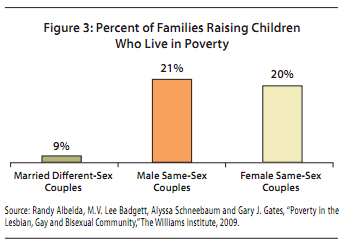
LGBT couples may be more likely to be in poverty in part because of wage differentials between gays, lesbians, and their heterosexual counterparts. Research shows that gay and bisexual men earn significantly less money than heterosexual men, whereas lesbians make somewhat more money than straight women. Gay men would be more likely than heterosexual men to be in poverty, then. But what about women? Women in same-sex couples face the same wage disadvantage that all women face, but also are not married to the heterosexual men that are making so much money (making it so that heterosexual women can make less money than gay women, but still be less likely to live in poverty). Make sense? I hope so.
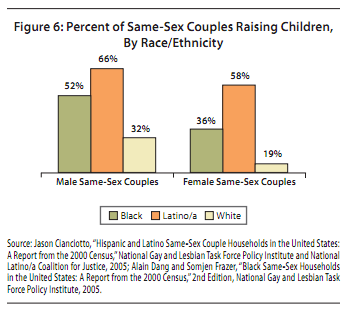
The second reason that LGBT couples with children are more likely than cis-gendered different-sex couples with children to live in poverty is that Black and Latino LGBT people are more likely than White LGBT people to be parents, and Blacks and Latinos are disproportionately poor to begin with:
Among same-sex couples, being a parent is also correlated with immigration status, which also correlates with class. Non-citizens are more likely to be parents than citizens:
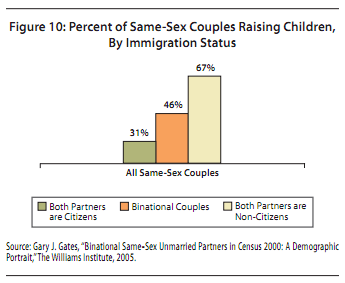
The two million children in America being raised by LGBT parents, then, are more likely to suffer from class disadvantage. The authors of the report go on to discuss the ways in which formal policy and informal discrimination contribute to this state of affairs.
Via Andrew Sullivan.
Lisa Wade, PhD is an Associate Professor at Tulane University. She is the author of American Hookup, a book about college sexual culture; a textbook about gender; and a forthcoming introductory text: Terrible Magnificent Sociology. You can follow her on Twitter and Instagram.
Comments 37
Holly Matthies — December 7, 2011
"LGBT families are more likely to be poor than non-LGBT families. Nine
percent of married different-sex couples live in poverty, compared to
21% of gay male couples and 20% of lesbian couples:"
These two sentences don't go together. Different-gender couples can involve bi or trans people.
And it's not just a one-off mistake. "LGBT couples with children are more likely than different-sex couples with children..." is another example that indicates to me that "LGBT" is here being used as a synonym for "homosexual," with insufficient thought given to what the acronym is actually meant to include.
Rachel Kantstopdaphunk — December 7, 2011
Awesome graphs, thanks for posting. When you start making correlations between race,class,gender and sexual orientation it gets clearer which groups are targeted for discrimination and in what degree and kind.
Rachel Kantstopdaphunk — December 7, 2011
Ah, good point. It's likely that an erasure of trans identities goes all the way through the data, skewing the whole dang thing. Damn and blast!
maciek — December 7, 2011
There are serious errors in charts. 9% bar is way too small - it should be almost half of the 20% bar. In second chart 32% is about 1/3 of 66% bar.
scheckymix — December 7, 2011
if you don't mention anything about T's in your article, please feel free to just say LGB next time. we are all not the same for purposes of these graphs and do not fit into the same gender/sexuality binaries.
Anonymous — December 7, 2011
This is very interesting. Even in these cases, where having kids is very much depending on privilege, having more privileges gives the result of having less kids!
I suppose it says something about queer unity (or rather gay hegemony) that LGBT becomes shorthand for gay. I've almost fallen into that trap myself a few times
Dénes Türei — December 7, 2011
it would be nice to put the intercept on y axis to zero. and on the last graph, the three categories are mutually excluding, and covering all possibilities, isn't it? how is it, that the sum of percentages is more than 100?
Bagelsan — December 7, 2011
Wouldn't marriage complicate this? I assume that many LGB couples aren't married -- do things like income and poverty get assessed the same way in that case as with a married couple, or would some of these couples' kids get counted as being in a single-parent household, etc?
unequivocal — December 7, 2011
"This is outrageous! They've cropped their bar charts at an unspecified value!" is my first thought when reading this post. What does that say about me? :(
Chris — December 8, 2011
This is just FULL of falsity. As a "T", Lisa writes: hey, Chris, other trans-folks are being represented, yo! Then I read the graph's fine print, which says: oh, hey, JUST KIDDING! GOTCHA!
But yeah, the graphs are bad too. Always get suspicious when you can't find a labeled Y axis.
Chris — December 8, 2011
The source: http://williamsinstitute.law.ucla.edu/wp-content/uploads/Census2010Snapshot-US-v2.pdf
The number of male/male couples is very nearly equal to the number of female/female couples in the states. (How might this speak to the 'all gay men are promiscuous' myth?) <-- That is how you write an accurate, respectful summary.
See page 3 pie charts! "Not raising 'own' children" should read "Not raising children". So... ALL gay and lesbian couples are raising kids - either their 'own' or not 'own', right? hahaha
Elisabeth Maddix — December 8, 2011
Since this is kind of on topic, in Michigan there is a possible bill to cut insurance to same sex couples who work within the Michigan government funding. Here is a quote from Dave Agema (government person) in an Ann Arbor News article:
("It is not the responsibility of taxpayers to support the roommates and unmarried partners of public employees," Agema said in a statement.)
I just cannot get over the irony that the only reason they are unmarried is because 'they' will not let them marry. Due to pressure from the universities and colleges, higher education is now excluded from the bill.
This will only add to the poverty of same sex couples, and instead of laughing at the irony of society my blood boils.
Terre — December 8, 2011
I really like the research done here, but the graphs are really misleading. 9% isn't that low next to a 20%. It may not be intended, but it makes the article seem dishonest, even when it isn't. I dare say that this is one of the muddier articles I have read on this site. Combing down through the comments, I can see that I am not the only reader who is extremely confused by some of the details here. I expect more clarity and honesty from you folks.