
Time for another collection of gendered kids’ stuff!
First, the blog-o-sphere is all over this one already and apparently JC Penney has already pulled the t-shirt, reading “I’m to pretty to do homework so my brother has to do it for me.” Really? I like how Jezebel framed the issue with a big “NO”:
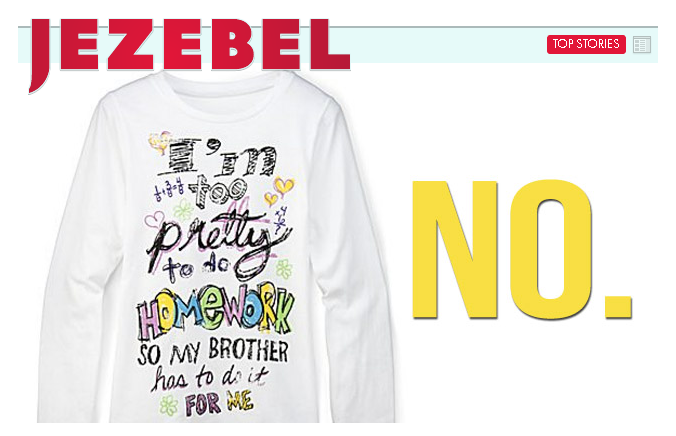
Thanks for Caroline Heldman, Tom Megginson, Mana T., Carmel L., Heidi S., Melissa B., Alli, and Ed A.-N. (on our Facebook page) for sending in that doozy.
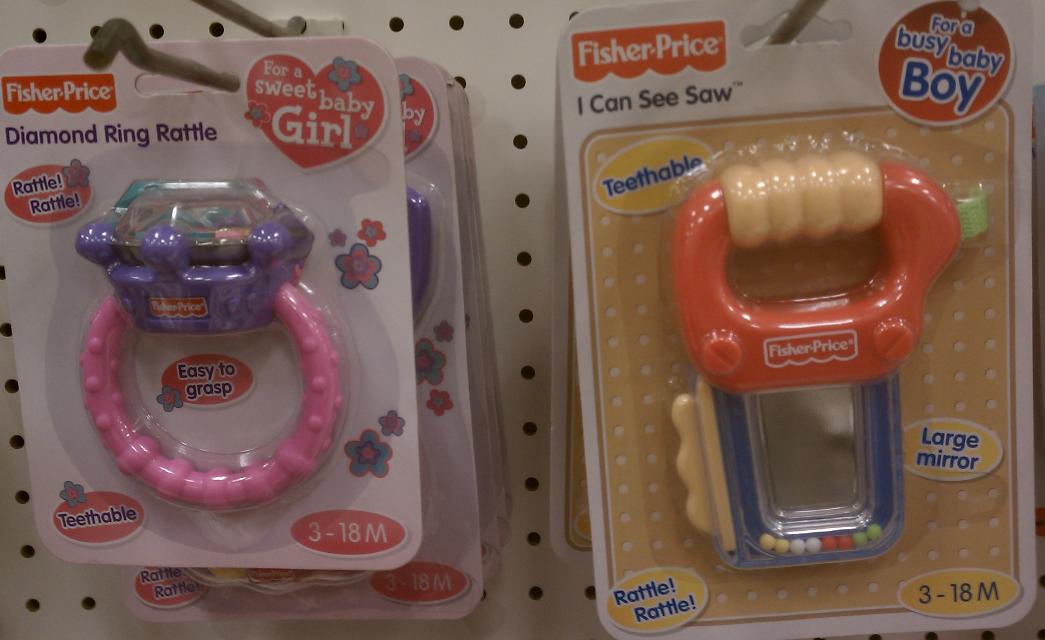
Next, Jessica M. and Amanda G. each sent in a photo of gendered baby rattles, both in terms of the design (girls get a purse and diamond ring, boys get a hammer and saw) but also in the description — girls are “sweet,” boys are “busy”:

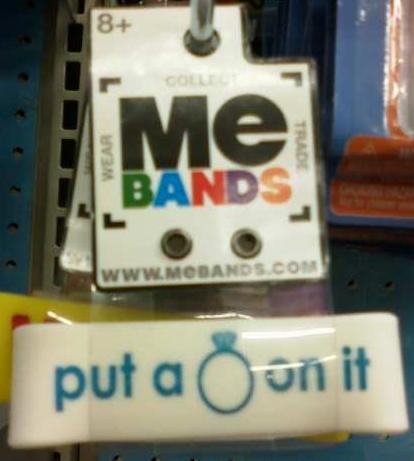
Don’t worry; once your daughter outgrows the diamond ring rattle, there are other products available to remind her that the most important thing in the world is to get a diamond ring, specifically in the form of an engagement ring. Liz saw this for sale in the toy section at Wal-Mart, which was a relief, because as she said, girls these days just “don’t have enough pressure to get hitched at age 8+”:
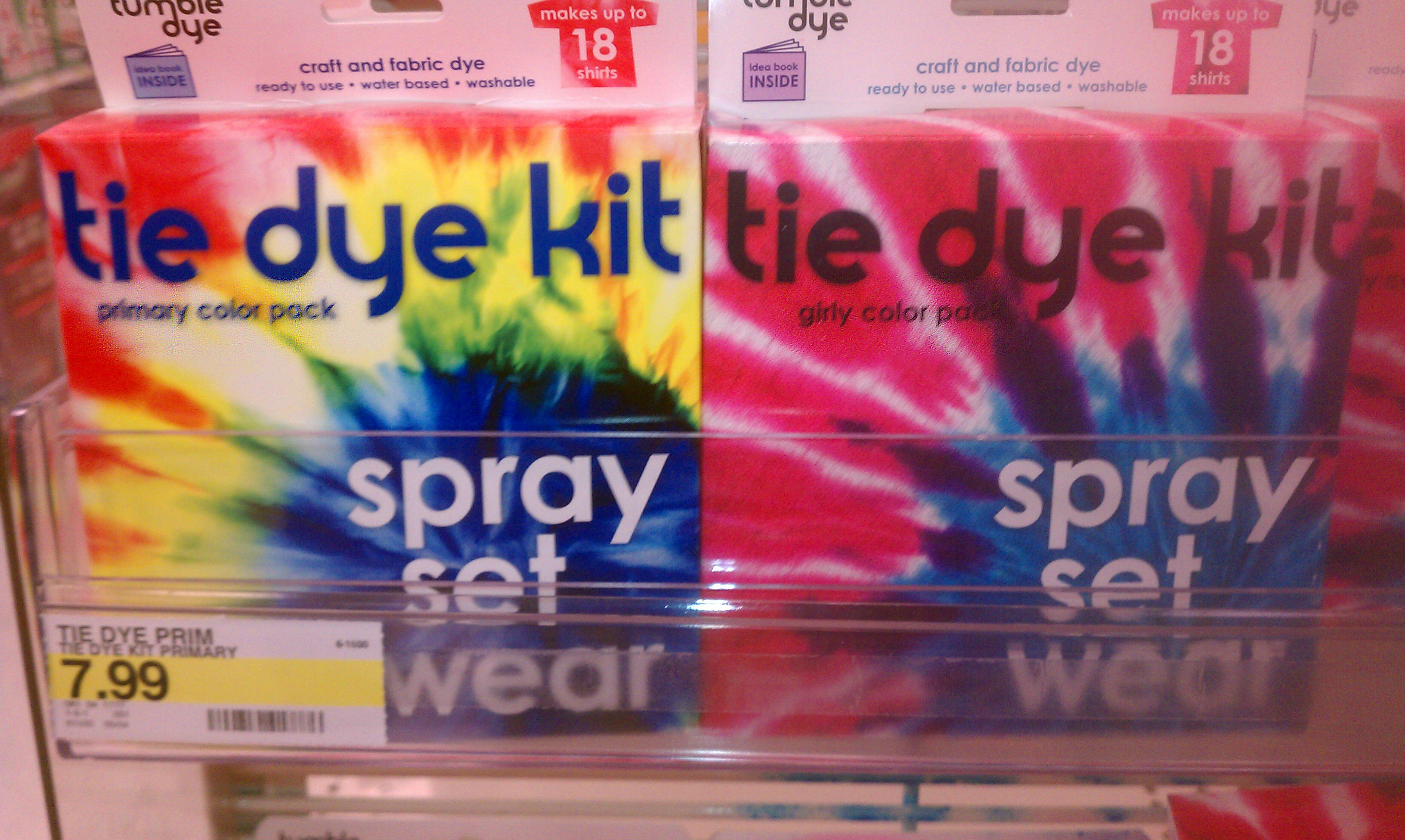
Hishaam S. noticed that Target had four tie-dye kits — camo, neon, primary, and girly:
Laura M. sent us an image Jenga Girl Talk Edition, originally posted by Elena Barbarich. The game (which comes in two versions, pastel blue and purple and “exclusive pink”) includes blocks with girl-specific questions to stimulate conversation, such as who you have a crush on and the truly brilliant “What is your favorite website?”
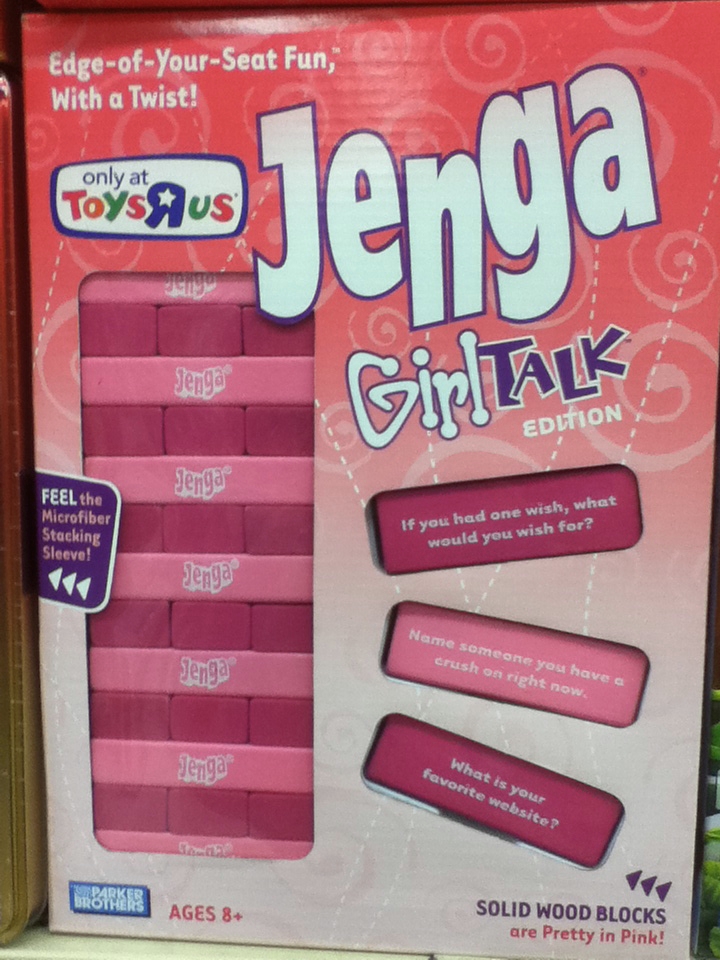
There are many versions of Jenga — Donkey Kong, the Nightmare before Christmas, Transformers, and so on — but there doesn’t appear to be a version specifically labeled for boys. [NOTE: Reader JF says there’s a board game called Girl Talk, so this is being cross-branded with it.]
Esther M.-E. noticed a recent Seventh Avenue catalog contains an example of the “masculinized things are for everyone, but feminized things are only for girls” cultural pattern. The catalog had two facing pages of bed sets, the one on the left called Air Guitar (featuring guitars on the sheets, in a blue room with a basketball on the floor) and the one on the right called Jungle Queen (in a pink room with a cat):
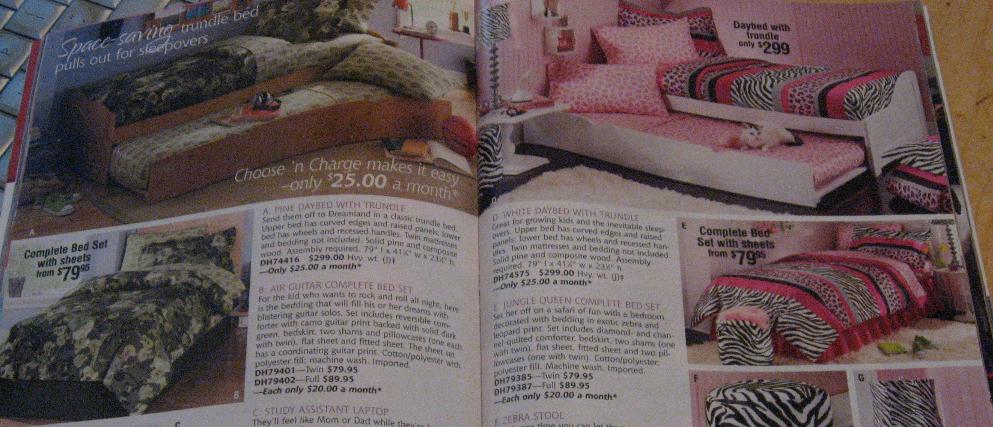
The description of the Air Guitar set, however, describes it as appropriation for boys or girls, while the Jungle Queen set doesn’t include the same language (and its very name specifically genders it):


Seventh Avenue, of course, is marketing in this manner — actively including girls in the product that might otherwise be defined as masculine while not doing the same for boys with the feminized product — because our cultural norms surrounding gender value the masculine over the feminine. Girls who like “boy” things are often seen as cool, sassy, even smart. Boys who like “girly” stuff, though, are not cool. Even if a boy asked for a pink animal-print bedroom set, his parents are less likely to support the choice than if a daughter chose a masculine-gendered item. Seventh Avenue is simply writing copy based on this larger cultural pattern, and in so doing, reinforcing it.
And now, something that just goes in the “wtf?” category, which I include here for no reason other than the pure surreality of its existence. J.O. was looking at the girls’ toys section at All Modern Baby, and among the Fashion and Beauty Fun there were several sets of rubber bands in various shapes, including…the Kama Sutra package, with four positions:
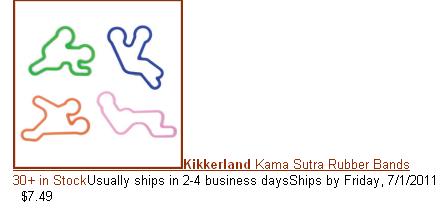
You won’t be surprised to learn they have been removed from the site, and I found a few other kid-related websites that had them listed as no longer available as well, though if you’re dying for a set, several non-child-oriented sites carry them. The perils of modern inventory management: you order a bunch of perfectly ordinary sets of silly bands, and among the space ship and animal shapes, no one catches that you’ve also posted a sex-themed version.
Comments 74
JF — August 31, 2011
I don't see a problem with most of these. The first one, YES....there is cleary a problem with that sweat shirt. Oh, and FYI "Girl Talk" is a board game, so the Jenga is co-branded with that.
Anonymous — August 31, 2011
I suppose you could say that the Karma Sutra bands aren't blatantly genderes, so... yay?
As for the rest, a sweet reminder of the days were you were supposed to be in love all the time - and of course the instilling of a demand to focus on men at an age where girls barely has a perception of what the ring symbolizes. It gets more and more absurd the more you think of it
Yrro Simyarin — August 31, 2011
I'm pretty sure even the "non-girly" tie dye kit is still girly enough to get you picked on as a boy.
I've heard this a few times on this site, and I assume it's a standard viewpoint in sociology... I have a question about the idea, though. Is it that "society does not value girls, therefore girl things are seen as inferior", or that "society does not value girls, therefore they are given inferior things to do"? Obviously there's something of a feedback loop, but which is being claimed as the root cause?
The distinction seems like it might matter, when considering the why of boys and girls being allowed to do traditionally boy things, but only girls being allowed to do traditionally girl things. In the first case, the only reason girly things are considered inferior is that girls do them, and therefore gender equality should gradually raise the status of those actions to where boys or girls can do them. If it is the second, then you would expect girls to have the option of being manly or girly for a while, and the value of the girly things to eventually slip away.
I appreciate any links arguing/proving one or the other, and why the former seems to be the one normally assumed on this blog - I'm sure it's been discussed to death by sociologists.
Casey — August 31, 2011
I got a problem with the writers here (a non-ideological one, too), cause shit like "[NOTE: Reader JF says there's a board game called Girl Talk, so this is being cross-branded with it.]" Happens all the time.
If you're going to comment on a culture, wouldn't it be prudent to be aware of the contexts that you're commenting on? Why do you consistently need to be made aware of the references to the things you're posting? I'm sure you can claim that you're very busy people and don't have the time to research every post, but it comes across as both aloof and out-of-touch when you make simple mistakes like the spelling of one of the artists of last week's post on gendered superheroes (while linking to their page with the correct name on it. That you didn't mention much of the context that produced that image (maybe mentioning why the artist drew it on her tumblr [an actual sociological argument on gender presentation in the industry and how, despite steps toward equality, DC editors still didn't understand the problem people had with their presentation] and that the discussion had grown to the point that another artist tacked on a few more characters) was further demonstration that rather than being aware of and interested in the context of the images being posted, you were simply generating content.
Again, this is probably a lot to ask of very busy professorial types doing a side-job for little or no pay, but it comes across as a total disinterest in the full appreciation of what you post and instead a sort of cherry-picked venture in dogma.
Samantha C. — August 31, 2011
the Girl Talk one just made me remember how miserable it was to be a middle-school girl who DIDN'T have crushes. I remember a student taking my textbook and refusing to give it back until I told her who I had a crush on, and refusing to accept "nobody" as a valid answer (I had to involve the teacher). Girls who had nothing to do with me otherwise put the pressure on me to divulge who I was keeping as a secret crush. It apparently just wasn't possible not to be in love at the moment - or not to want to pursue relationships based only on "he's cute". I was a Disney romantic since childhood, and it baffled me when I hit the age that suddenly I was expected to be all over every boy there was, when I'd grown to love the One True Love mold.
Finnegan — August 31, 2011
I'm not sure that the fact that "Girl Talk" is another product actually detracts from Gwen's point unless we can find some explicitly masculine equivalent. If anything, it just re-enforces it by providing another instance of uneven gendering.
Alan Thomas — September 1, 2011
Interesting (and sadly unsurprising, except the KS bands) collection of images. I just wanted to add that while I think there's a lot of truth to "masculinized things are for everyone, but feminized things are only for girls" (which makes me think of the comedian who observed that beautiful actresses always say they were "tomboys" as kids, while handsome actors never say they were "sissies" growing up), I think it falls apart as you get into the very young age group (infants and toddlers especially).
My wife and I have a daughter who is eighteen months old and we have always tried to avoid dressing her in pink, frilly dresses, etc. (though we are bombarded with such clothing as gifts), and often dress her in what *should* be gender-neutral clothing: denim overalls, blue or green shirts and pants or shorts, etc. This is seen as absolute proof to everyone that she is a boy. Period. Even after we casually mention the words "she" or "her", people usually persist, apparently assuming they must have misheard since their eyes don't lie. And just empirically, to a certain extent they cannot be blamed, for I have yet to see any other baby or toddler dressed in "neutral" type clothing who turned out to be a girl. Just not a single one, anywhere, even when the parents are liberal professor types.
Oh, and probably our greatest rebellion of all against gender norms for babies and toddlers is that we've never put bows or ribbons in her hair. This. Just. Will. Not. Do. At the hospital, hours after she was born, a clearly stunned nurse responded to our refusal to have a bow GLUED to her head like we had calmly stated we weren't planning on giving her a name: first, sure we hadn't heard or understood her correctly, then horrified as it dawned on her that we were the first parents in history (as far as she knew, anyway) to knowingly pass up the opportunity to unambigously attach a "GIRL" badge to their baby's little bald head.
Mawg Land — September 1, 2011
"because our cultural norms surrounding gender value the masculine over the feminine."
I'm not sure I agree with this supposition. I think if you took a group of kids and presented them with toys that were either, "for boys and girls" or "for girls only," the kids would see the girls as favored in this situation. "Why are girls so special that they get their own set of toys?" is the question I could see them asking; or "Where is 'Boy Talk' Jenga?" which is something I actually heard my nephew ask.
Or to put this in another context, if you saw two sets of toys; one which said "appropriate for both black and white children," and another which said, "appropriate only for white children." Who would you think were the favored group in this scenario?
Anonymous — September 1, 2011
I have to say, I don't get why the wrist bands are included here. They belong in a completely different discussion (whether we're selling sex to kids), which is not necessarily valid in and of itself. I don't know if they'd be shopping on that particular site, but I've seen many teenagers and young adults wearing the shaped wrist bands. Oddly, despite the trend being very much aimed at kids in middle school and younger, it seems to have faded out in that demographic, but still maintained a subtle presence in the 14-24 demographic (it's more subtle because teens and adults don't stack them on their arms 50 at a time).
And that shirt bugs me, because it's a combination of "bad message" and "age inappropriate." Shirts like that have been poplar among older girls and young women for a while, but most teens and women in their 20s get that it's a joke to some extent. At the very least, even if they don't take it as a joke, they still made the conscious decision to purchase it and wear it themselves. They as adults value prettiness over smartness, whether that value is unfortunate or not. This shirt (in addition to being not nearly as snappy and well designed as those other shirts) is aimed at girls too young to interpret it as an ironic joke and too young to purchase their own clothes. Which means that the adults in their lives have to buy it for them, imposing (whether or not they're aware of it) the ideal that women not only don't need to be smart, but that smart and attractive are mutually exclusive. A seven year old doesn't get irony.
Cheryl — September 2, 2011
Well Crossmark will promite if they can.
http://www.kountzeonline.com/biography.html