
In light of Romney’s comments regarding those who depend on the government, we thought we’d re-post this great data showing that many people who are using government social programs don’t know they are doing so.
————————
Dolores R. sent in a fascinating image posted at boingboing. It comes from a paper by Suzanne Mettler, a professor in the Department of Government at Cornell. Mettler first asked survey participants whether they had ever used a federal U.S. government program. Then later in the survey she specifically asked respondents whether they had ever benefited from or participated in specific federal programs. As it turns out, large number of people who have benefited from various federal programs or policies do not recognize themselves as having done so. This table shows what percent of people who said they had participated in or used these 19 federal programs had earlier in the surveys said they had never used any social program:
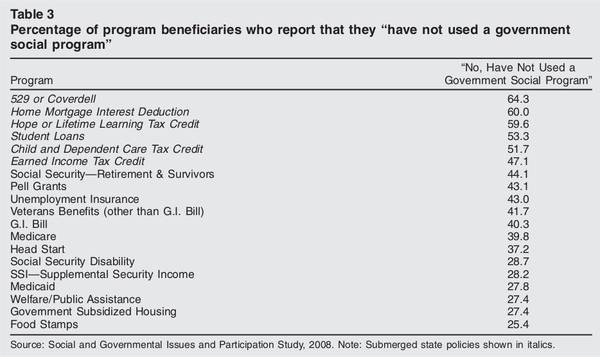
Mettler argues that recipients are less likely to recognize themselves as benefiting from programs that are part of what she calls the “submerged state” — programs and policies that provide incentives and motivations for particular behaviors in the private sector, rather than overtly directing behavior. If you receive food stamps, you interact directly with a government agency, are required to periodically meet with a government worker and reapply to re-establish eligibility, and can point to a specific thing that links you to the program (these days usually a debit-type card rather than the old style coupons/stamps).
On the other hand, if you participate in the government’s mortgage interest deduction program, which encourages home ownership by allowing people to deduct the cost of mortgage interest from their taxable income (which you can’t do with rent costs, for instance), it’s less noticeable that you are benefiting from a federal policy. You get a form from your mortgage company that provides the relevant number, and you transfer it over to the correct line when you’re filling out taxes.
Notably, the programs recipients seem least likely to recognize as a government program are among those the middle (and higher) classes are most likely to use, while those more common among the poor are more clearly recognizable to those using them as government programs. Yet allowing you to write off mortgage interest (but not rent), or charitable donations, or the money you put aside for a child’s education, are all forms of government programs, ones that benefit some more than others. But the “submerged” nature of these policies hides the degree to which the middle and upper classes use and benefit from federal programs.
Comments 83
Yrro Simyarin — July 11, 2011
Sort of an interesting framing problem. Should a tax credit/cut be considered a "Federal Program"? In some ways, you might as well call having tax rates set where they are a government program, because they *could* be charging you 10% more across the board. But on the other hand, cash is cash, whether it's given to you or whether you avoid paying it. There is some moral distinction that most of the respondents seem to be making, though, and I'd like to see someone articulate it better than I have been able to.
Thomas Gokey — July 11, 2011
I'd love to be able to look deeper into these numbers. Do people who are white have a higher tendency to think of themselves as never relying on a government program? I think there is a big tendency for white middle class Americans to think of government programs as being something for "other people, not people like us." So when they collect social security they think "I've earned this" not "I'm using a government program." Government programs have become code words for things poorer, less white people use. If it's primary beneficiaries are wealthy and white then, almost by definition it seems, they aren't government programs (Voila!). "People like us," this self-satisfying story goes, "know how to pull ourselves up by our bootstraps."
But it would be nice to compare my hunches with actual data. Maybe I'm wrong about all this.
EMB — July 11, 2011
I don't think Veterans Benefits and the G.I. Bill should really count for this--they're (very reasonably) seen today as part of the bargain in taking a job in the armed forces, i.e. they're government-as-employer programs rather than government-as-sovereign programs.
Basio — July 11, 2011
Of course, now my question is, do the middle/upper class use these because they are less obvious, or are they less obvious because they target the middle/upper classes? Is the obviousness of food stamps due to something inherent in the nature of the program, or is it simply an example of classism in our government?
S141414 — July 11, 2011
This post is confusing. Why are "government program", "social program", and "federal government program" being conflated? Aren't the results compromised if the terms haven't been properly thought through and defined? Does driving on I-90 count as participating in a federal (social?) program? What about the toll portions of that road? What about a state route? If you participate in SCHIP, I guess that doesn't count as a "federal social program," right? But it is a "government social program", yes? Sorry, I'm confused and wonder if the survey participants were too.
Anonymous — July 12, 2011
I'm thinking one reason recipients of federal funds/deductions make this distinction is because *legislators* do.
Look at the current budget mess and all the arguing over "reducing expenses" (cutting services) vs. "increasing income" (raising taxes).
The various tax credits and deductions fall into the latter category, while Social Security, Medicare, etc. fall into the former.
Anonymous — July 12, 2011
The question here is, do the respondents actually not know they're using a government program? Because honestly, today "government aid" is turning into a four-letter buzzword in some circles, used to differentiate between "us hardworking, upstanding people who only get what we deserve" and "those lazy no-good layabouts asking for handouts." When faced with a chart like this, I'm sure they'd still differentiate....they DESERVE their social security because they worked for it, while someone on food stamps clearly doesn't because they assume (incorrectly) that only voluntarily unemployed people use them, and furthermore that people choose to be unemployed because they can get food stamps ("eat for free"). This leads to the idea that anything they do is either a) not a government program, or b) the exception to the rule ("If I am laid off and need to go on food stamps, that's okay because it's not my fault, but EVERYONE ELSE is lazy and milking the system").
Eric Watkins — July 12, 2011
Can't say it better than Marginal Revolution did:
"People who use 529 programs and who think that they have not used a government social program are not willfully ignorant, they are demonstrating a healthy if fading appreciation of the distinction between civil society and government. What Rampell et al. implicitly imagine is that the natural state is slavery and any departure from that state a government benefit. Thus, if the government taxes your saving for a college education less than your other savings, you should be grateful for how government has benefited you and your children.
And if the government doesn’t jail you today, you should be grateful for how government has granted you the benefit of liberty.This is the attitude of a serf not an American."
Matilda — July 12, 2011
I wish someone would run this study on a group of libertarians.
amberite — July 14, 2011
Hmm. Despite being very keen on increasing public awareness of how we depend on the government, I find the question phrasing - "used a government social program" - disingenuous. It's a very vague wording, and some aspects of the words and their usual meanings directly contradict the categories they're trying to imply.
I certainly haven't thought of my student loans as a government social program. The forgiveness program which will theoretically allow me to get them written off after I finish another degree, indenture myself for several years, and write a sonnet backwards at a crossroads at midnight - yes, that's definitely a government social program. The loans themselves? Errr... All the proper wealthy countries send people to college for free. THAT'S a social program. "We'll lend you money and charge you less interest than a private lender" gets a golf clap for effort.
The word "program" implies... a series of events over time, like a class or something. The word "used" implies an active participation in something, and in combination with "social" implies active participation in something community-oriented.
All of which will direct people's attention away from things like "I checked a box on my taxes" because frankly, we all checked fourteen zillion boxes on our taxes, and some of them took money away and some of them gave money back. It all gets blurred into the same thing. Filing taxes, whether you come out ahead or behind, is non-optional, and so the active choice implied by the phrase "I used..." immediately puts taxes out of the mind.
Perhaps a question worded as "Have you received a benefit or subsidy from any government policy or agency" or "Have you depended on any services, loans or benefits supplied by a federal agency" would give a more accurate idea of who is aware and who is delusional.
I understand the study was meant to illustrate the disconnect people have with this stuff - and I think it still would have if they hadn't stacked the odds. I understand the wording itself was meant to demonstrate something about people's understanding of what constitutes a "social program" but I think it left its respondents with too many ways to misinterpret the question.
TL;DR: This kind of research needs to be done - with better research design, please.
MelissaJane — December 28, 2011
From what is reported here, this survey constructed in a really biased way, designed to get a particular "gotcha" result that is almost inevitable. The real mistake the respondents made, it seems, is not asking the surveyor to define terms.
Just from the comments that I've skimmed here, there's no clear consensus as to what "should" have been implied by the question "Have you ever used a federal program?" One could argue that if you've ever driven on a highway, or been given a vaccine, or in any way benefited from federally funded scientific research, you've benefited from a federal program. And as someone pointed out, we pay taxes for a reason: one would HOPE that a nation's citizens benefit from the programs they pay for. Isn't that the point?
I get the subtext here, that people tend to look down their noses at those "on welfare," or somehow being subsidized by the government, without recognizing the ways in which they themselves benefit, and I even agree with it. But I'm unimpressed with the way the research seems to have been conducted and I'm really unimpressed with allowing such a clear bias to color the work.
Allison Lukens — September 19, 2012
Participation in mandatory institutions, such as social security or income taxes , hardly constitutes "using" these programs. Americans have no choice in the matter of paying social security taxes. Recipients see their benefits as the rightful return of their own money, not using a government social program. The program is using them!
pduggie — September 19, 2012
A tax credit hardly seems like a 'program'. Otherwise, you could say that every time a rate changes, its a new government program.
Is deducting charitable contributions a government social program?I'd think a program would have to be administered by somebody, at the least.
MPS — September 20, 2012
These things miss the point. EVERYONE benefits from government programs, the richer people benefit more. After all, patent protection and copyright are government programs: they are government interventions into the free market which create temporary monopoly protections allowing insiders to extract above-market rates. They enrich not only all the people who work at companies that benefit from intellectual property -- essentially all the major corporations -- but also the people who invest in them, because they improve returns. And they benefit others, by increasing demand for intelligence, which is of limited supply.
I really think this is the primary source of wage disparity between manual labor and highly skilled labor.
Also, it deserves mention that limited-liability corporations are government constructs -- free markets mean full liability, not limited liability. And a consequence of this construct is, for example, the inability of a corporate bank to cover its losses during a fiscal crisis, requiring government intervention, implicitly enriching all those who benefited from exploiting this socialized risk in the past.
And government regulations often benefit rich people. The FCC creates a very profitable TV broadcasting markets. The FAA makes fliers feel safe supporting a large airline industry. The FDA makes people confident in drugs supporting a huge pharmaceutical industry. And public research spending subsidizes industries who benefit from the science (this is particularly sharp with the NIH).
And it goes on and on.
But the easiest way to see that rich people benefit more from government is to simply recognize that without government -- which means without civilization -- they wouldn't be rich. No primitive peoples in the jungle amass huge wealth. To amass huge wealth you need ways to mobilize large numbers of people under your control and extract from the gains of their coordinated mobilization, and this generally requires trust and cooperation and other cultural standards that are ultimately sealed by government.